

An expedited (urgent) insurance appeal must be decided within 72 hours instead of the standard 30 days — but only if you qualify under the CMS "serious jeopardy" standard. To prevent downgrade to standard review, your physician's attestation must use the verbatim CMS phrase: the standard timeframe would "seriously jeopardize the life or health of the enrollee or the enrollee's ability to regain maximum function." Paraphrased equivalents ("urgent," "patient needs treatment soon") are routinely reclassified. The 72-hour clock applies to Medicare Advantage, Medicaid MCO, and ACA marketplace plans under CMS-0057-F; commercial fully insured plans and ERISA self-funded plans carry the same right but enforcement differs.
What Makes an Insurance Appeal "Expedited"
An expedited insurance appeal is available when the standard review timeline would put the patient's health at serious risk. The 72-hour decision requirement — not 14 days, not 30 — applies to any plan type subject to CMS oversight, which since January 1, 2026 includes Medicare Advantage organizations, Medicaid managed care plans, and ACA marketplace QHPs under CMS Interoperability and Prior Authorization Final Rule (CMS-0057-F).
The distinction matters in two directions. First, providers who miss the expedited option are waiting 30 days for a decision that could arrive in three. Second, providers who request expedited review without meeting the standard — or without the right language — receive a downgrade notice that resets the clock to standard timelines, burning time you could have used to start standard appeal documentation.
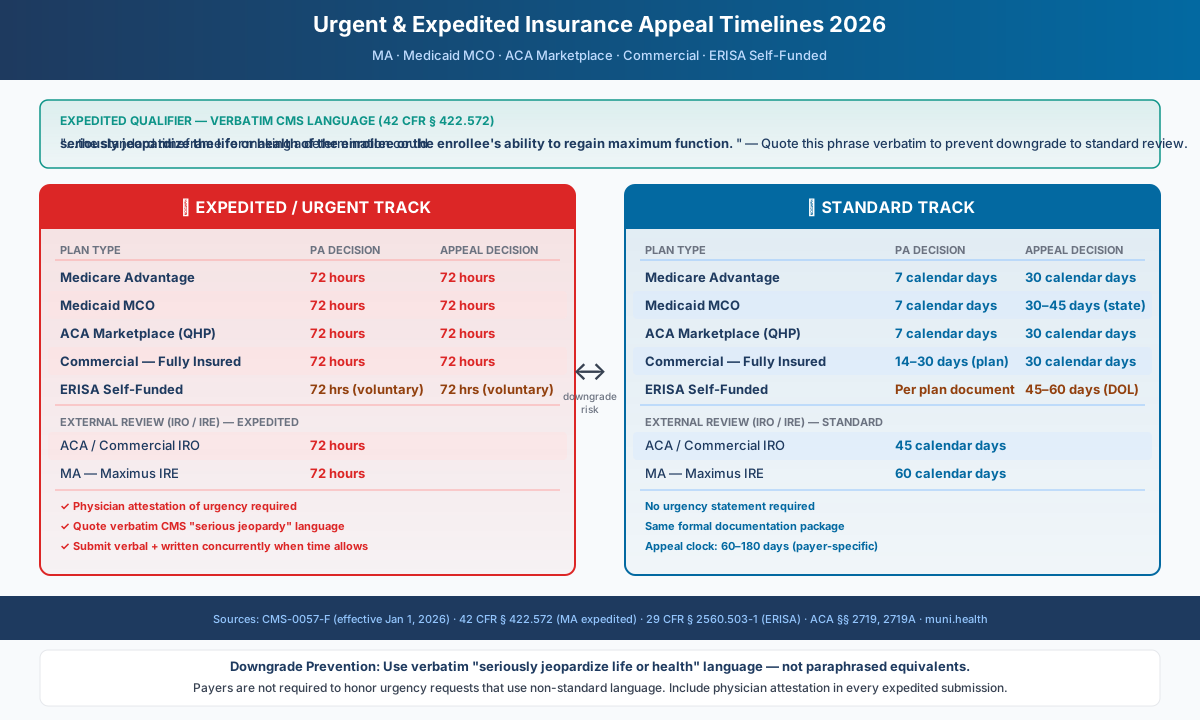
The Verbatim CMS Language That Prevents Downgrade
The single most preventable failure in expedited appeal submissions is the use of paraphrased urgency language. CMS regulations at 42 CFR § 422.572(b) define the expedited standard precisely, and payer intake teams are trained to classify requests that don't meet the regulatory definition as standard.
Turn this denial into a review-ready draft.
Muni prepares a payer-specific appeal, policy citations, and an evidence checklist. Your team reviews and submits it.
The qualifying standard, verbatim (42 CFR § 422.572(b)):
The standard timeframe for making a determination could seriously jeopardize the life or health of the enrollee or the enrollee's ability to regain maximum function.
This phrase — or its equivalent in the applicable regulation for your plan type — must appear in the physician's written attestation. The three components payers look for are:
- Life or health — not just "discomfort," "inconvenience," or "ongoing need"
- Ability to regain maximum function — this extends the standard beyond immediate emergencies to include post-surgical rehabilitation, functional recovery, and chronic disease progression scenarios where delay causes irreversible loss
- Standard timeframe would cause the jeopardy — the jeopardy must flow specifically from the review delay, not from the underlying condition alone
Paraphrased Language Triggers Standard Review
Payer intake systems are trained to flag non-qualifying language. Phrases like "this is urgent," "patient needs treatment soon," "delay is harmful," or "time-sensitive request" do not meet the regulatory standard and are routinely reclassified. Include the verbatim CMS phrase in the physician attestation, then add the clinical specifics that support it.
For commercial fully insured plans regulated under the ACA, the expedited standard appears at 29 CFR § 2590.715-2719 and PPACA § 2719. The language mirrors the CMS MA standard closely: delay would "seriously jeopardize the life or health of the claimant, or would jeopardize the claimant's ability to regain maximum function." Use the same verbatim approach.
Expedited vs. Standard Timelines by Plan Type
The 72-hour clock is not universal — its enforceability depends on the plan type. The table below shows decision timelines for both initial PA determinations and internal appeal decisions.
| Plan Type | PA Decision — Expedited | PA Decision — Standard | Appeal Decision — Expedited | Appeal Decision — Standard | Governing Regulation |
|---|---|---|---|---|---|
| Medicare Advantage | 72 hours | 7 calendar days | 72 hours | 30 calendar days | 42 CFR § 422.572; CMS-0057-F |
| Medicaid MCO | 72 hours | 7 calendar days | 72 hours | 30–45 days (state-specific) | 42 CFR § 438.210(d); CMS-0057-F |
| ACA Marketplace (QHP) | 72 hours | 7 calendar days | 72 hours | 30 calendar days | PPACA § 2719; CMS-0057-F |
| Commercial — Fully Insured | 72 hours | 14–30 days (plan) | 72 hours | 30 calendar days | PPACA § 2719; state law |
| ERISA Self-Funded | 72 hours (voluntary) | Per plan document | 72 hours (voluntary) | 45–60 days (DOL rules) | 29 CFR § 2560.503-1 |
| IRO External Review — ACA | 72 hours | — | — | 45 calendar days | PPACA § 2719A |
| IRO External Review — MA (C2C IRE, as of May 1, 2026) | 72 hours | — | — | 60 calendar days | 42 CFR § 422.592 |
Note on the 7-day standard PA window: CMS-0057-F changed the standard initial PA decision timeline for MA, Medicaid, and ACA marketplace plans from 14 days to 7 calendar days effective January 1, 2026. This applies to the pre-service PA determination — not the internal appeal. The appeal timelines remain 30 days standard / 72-hour expedited.
Note on ERISA: ERISA self-funded plans are governed by the Department of Labor, not CMS. The DOL's claims procedure regulations at 29 CFR § 2560.503-1 require plans to provide expedited procedures for urgent care claims under ERISA § 503, but the enforcement mechanism is a civil action under ERISA § 502(a)(1)(B), not state insurance department action. Most major ERISA plans voluntarily implement 72-hour expedited review to align with commercial market practice, but the mandatory ACA protections do not apply to self-funded plans.
How to Request an Expedited Appeal: Payer-Specific Paths
Expedited appeals require two simultaneous actions: a verbal notification (phone call to the plan's provider or member services line) and a written submission following the denial letter's instructions. Both steps must happen together — verbal alone does not start the 72-hour clock, and written alone without verbal concurrent notice delays triage at most plans.
| Payer | Verbal Request Path | Written Submission Path | What to Include | Key Notes |
|---|---|---|---|---|
| UnitedHealthcare (commercial) | Call provider services line on denial letter; state 'I am requesting expedited review under PPACA urgent care provisions' | Availity portal → Appeal submission → select Expedited, or fax per denial letter | Physician attestation with verbatim CMS language; denial reference number; CPT/ICD codes; supporting clinical records | Commercial expedited available; do not use MA portal for commercial claims |
| UnitedHealthcare MA | Call the MA member services number on the ID card; confirm request is logged as expedited | UHC MA appeals fax per Evidence of Coverage; or uhcprovider.com → Medicare member appeals | Physician statement with 42 CFR § 422.572 language; expedited request form | 72-hour CMS clock starts on receipt of written request, not verbal |
| Aetna (commercial) | Call 1-800-872-3862 (provider services); request expedited appeal; get reference number | Fax to expedited appeals fax per denial letter (separate from standard fax line); or submit via Availity | Physician attestation; expedited designation clearly on cover sheet; denial reference | Aetna uses a separate fax line for expedited submissions — verify in denial letter |
| Aetna Medicare Advantage | Call Aetna Medicare provider services; state expedited request under § 422.572 | Fax or mail per MA denial letter — Aetna MA uses a separate address from commercial | Verbatim CMS serious jeopardy language in physician attestation; plan member ID | Aetna MA delegates some PA to EviCore and NIA — verify the denial issuer before submitting |
| Cigna (commercial) | Call CignaForHCP.com provider services or 1-800-88CIGNA | CignaForHCP.com → Appeals tab → select Urgent; or fax per denial letter | Physician attestation; expedited request noted on cover sheet; denial information | Cigna EviCore-managed services (imaging, MSK) use a separate EviCore expedited path |
| BCBS / Anthem | Call affiliate-specific provider services; request expedited appeal; confirm it is logged | Availity → Appeals → Urgent; or affiliate fax per denial letter | Physician attestation with urgency language; all denial reference numbers | BCBS affiliates vary: Anthem, HCSC (IL/TX/OK/NM/MT), Highmark, BCBS FL use different portals — use denial letter instructions |
| Humana (commercial) | Call HumanaOne provider portal or 1-800-457-4708; state expedited request | Availity or HumanaOne portal → Appeals → Expedited | Physician attestation; clinical records supporting serious jeopardy; expedited designation on cover | Humana EviCore-managed services use separate EviCore expedited path; verify delegation in denial letter |
| Humana Medicare Advantage | Call Humana MA provider services; confirm expedited logging under § 422.572 | Humana MA appeals fax per Evidence of Coverage or mail per denial letter | CMS serious jeopardy verbatim language; physician attestation; denial reference | CMS 72-hour clock; C2C Innovative Solutions handles Humana MA IRE level (as of May 1, 2026; previously Maximus) if plan denies expedited appeal |
Always Verify the Submission Address in the Denial Letter
Payers frequently update their expedited appeal fax numbers and portal workflows. The contact information printed on the denial letter is the authoritative source — not the provider relations directory or older policy documents. Submitting to the wrong fax line or standard appeal address is the most common reason expedited clock disputes arise.
Commercial Plan Expedited Rights Under the ACA and State Law
For commercial fully insured plans, federal expedited appeal rights under the ACA (PPACA § 2719 and § 2719A) apply to all non-grandfathered plans. These rights are at minimum as protective as the CMS MA standard:
- Expedited internal appeal: 72-hour decision when delay would seriously jeopardize life, health, or ability to regain maximum function
- Expedited external independent review (IRO): 72-hour decision after internal appeal is exhausted or payer fails to follow procedures
- Concurrent notice: The plan must notify the member's treating physician of any expedited decision simultaneously with notifying the member
Several states extend expedited rights beyond the federal floor:
| State | Expedited Internal | Expedited External IRO | Notable Extension Over Federal |
|---|---|---|---|
| California | 72 hours | 72 hours | State DMHC complaints run concurrently with internal appeals; DMHC immediate enforcement for life-threatening denials |
| New York | 72 hours | 72 hours | NY DFS requires concurrent IRO access for urgent denials without full internal appeal exhaustion |
| Texas | 72 hours | 72 hours | TDI allows expedited external review without prior exhaustion of internal appeal for urgent cases |
| Illinois | 72 hours | 72 hours | IDOI expedited external review available even if plan disputes urgency classification |
| Florida | 72 hours | 72 hours | FDOI: payer must notify provider of downgrade decision within 1 business day; downgrade is separately appealable |
| All other states | 72 hours (federal floor) | 72 hours (federal floor) | Federal ACA rules apply; state law may add procedural rights — check state insurance commissioner resources |
ERISA self-funded exception: State insurance laws — including state expedited review extensions — do not apply to ERISA self-funded plans. For these plans, the 72-hour expedited right is derived from DOL regulations and the plan document, not state insurance codes. The practical consequence: if a self-funded plan downgrades your expedited request, your recourse is DOL complaint or ERISA § 502(a)(1)(B) civil action, not the state insurance commissioner.
For a complete state-by-state breakdown of insurance appeal rights and external review processes, see the state-by-state insurance appeal laws guide 2026.
What Happens If the Payer Downgrades Your Expedited Request
A downgrade occurs when the payer reclassifies your expedited request as standard, typically on the grounds that the urgency documentation does not meet the "serious jeopardy" threshold. Downgrades can be challenged — and in many cases, reversed — but the process requires moving fast.
How payers issue downgrades:
- A written notice must be sent to the requesting provider and the member within 2 business days of receiving the expedited request
- The notice must explain the specific reason the expedited standard was not met
- The notice must advise the provider and member of their right to resubmit
How to challenge a downgrade — three-step response:
-
Immediate verbal escalation: Call the payer's appeals department on the same day you receive the downgrade notice. Request to speak with a medical director or senior appeals specialist. Provide the physician's clinical rationale verbally. Some payers will reverse downgrades by phone when the clinical picture is clearly explained by the treating physician directly.
-
Resubmit with strengthened written attestation: Your original submission likely lacked the verbatim CMS language. Resubmit immediately with a new cover sheet that explicitly cites the regulatory standard (42 CFR § 422.572 for MA, PPACA § 2719 for commercial), restates the serious jeopardy finding verbatim, and adds a one-paragraph clinical narrative explaining specifically why the standard 30-day timeline — not the underlying condition — causes the jeopardy.
-
File a concurrent state insurance complaint or CMS complaint (depending on plan type):
- MA plans: Submit a complaint to CMS at 1-800-MEDICARE or via the CMS QIC process. CMS can intervene in downgrade disputes under 42 CFR § 422.572 when the plan fails to comply with expedited processing requirements.
- Commercial fully insured: File with the state insurance commissioner. Several states, including California (DMHC) and New York (DFS), have regulatory hotlines for urgent coverage disputes.
- Medicaid MCO: File with the state Medicaid agency. Federal Medicaid regulations require state oversight of expedited determinations under 42 CFR § 438.210(d).
The Downgrade Clock Does Not Reset to Zero
When a payer downgrades an expedited request, they must notify you within 2 business days — but the standard review clock starts from the date of your original expedited request, not from the date of the downgrade notice. You do not lose the time already elapsed. However, if the downgrade notice arrives on day 3, you may have as little as 27 days remaining in the standard review window. Resubmit immediately.
Concurrent Expedited and Standard Documentation: Running Both Tracks
In cases where urgency is high but the expedited outcome is uncertain — either because the clinical picture is borderline or because the payer has a history of downgrading — run both tracks simultaneously:
- Submit the expedited request with full verbatim language and physician attestation
- Begin compiling the Level 1 standard appeal documentation package in parallel
- If the expedited request is granted, use the expedited window to get the decision and withdraw the standard track if resolved favorably
- If the expedited request is downgraded, your standard documentation is already 2–3 days underway rather than starting fresh
This parallel approach is particularly valuable for UHC commercial plans, where the 65-day formal appeal window is shorter than the 180-day window at other major payers, and for Medicare Advantage cases with a 60-day Level 1 deadline.
For the full formal appeal process — including Level 1 documentation, peer-to-peer review windows, and the escalation ladder through IRO and ALJ hearing — see the what happens if prior authorization is denied guide 2026.
How Muni Appeals Handles Expedited Requests
Expedited appeals operate on hours, not weeks. Missing the verbatim language, submitting to the wrong fax line, or failing to make the verbal concurrent call means the 72-hour clock never starts — and the case defaults to 30-day standard review regardless of clinical urgency.
Turn this denial into a review-ready draft.
Muni prepares a payer-specific appeal, policy citations, and an evidence checklist. Your team reviews and submits it.
Muni Appeals surfaces potential expedited-review context from the uploaded denial and prepares draft attestation and appeal language for physician review. Staff determines whether the case qualifies, verifies the payer's current requirements, and manages the verbal and written submissions directly.
Start 3 Free Prior Authorization Appeals
Frequently Asked Questions
What qualifies as an expedited insurance appeal?
An expedited insurance appeal qualifies when the standard 30-day review timeline would "seriously jeopardize the life or health of the enrollee or the enrollee's ability to regain maximum function" (42 CFR § 422.572 for Medicare Advantage; PPACA § 2719 for commercial ACA plans). Clinical scenarios that typically meet the standard include: cancer treatment where delay allows disease progression, post-surgical care where delay risks wound complications or functional loss, intravenous infusion therapies where a gap causes withdrawal or rebound, and high-acuity behavioral health situations. Routine chronic care and elective procedures generally do not meet the standard.
How do I prevent my expedited appeal from being downgraded?
Use the verbatim regulatory language in the physician's written attestation — not paraphrased equivalents like "urgent" or "time-sensitive." The attestation must specifically state that the standard timeline would "seriously jeopardize the life or health of the enrollee or the enrollee's ability to regain maximum function." Add a clinical paragraph that ties the jeopardy specifically to the review delay, not just the underlying diagnosis. Submit verbally and in writing simultaneously, and call the plan to confirm the request is logged as expedited before ending the call.
Does the 72-hour expedited right apply to ERISA self-funded plans?
Yes — but with weaker enforcement than ACA-regulated plans. DOL regulations at 29 CFR § 2560.503-1 require ERISA plans to have expedited procedures for urgent care claims. Most large employer self-funded plans implement 72-hour expedited review voluntarily. However, state insurance laws — including state-mandated expedited IRO access and state insurance department complaints — do not apply to ERISA self-funded plans. If a self-funded plan denies your expedited request improperly, the remedy is a DOL complaint or ERISA § 502(a)(1)(B) civil action.
What is the expedited appeal timeline for Medicare Advantage?
Under CMS-0057-F (effective January 1, 2026), Medicare Advantage plans must decide expedited PA requests within 72 hours and standard PA requests within 7 calendar days. For internal appeals of prior authorization denials, the expedited decision timeline is 72 hours and the standard appeal decision timeline is 30 calendar days. If the plan denies the expedited internal appeal, the case automatically forwards to C2C Innovative Solutions (the CMS Independent Review Entity, as of May 1, 2026; previously Maximus Federal Services) for expedited IRE review within 72 hours. For the full MA appeal ladder including ALJ hearing rights, see the Medicare Advantage denial appeal guide 2026.
Can I request an expedited external review (IRO)?
Yes. External independent review can be expedited on the same standard — when delay would seriously jeopardize life, health, or ability to regain maximum function. For ACA marketplace plans, expedited IRO decisions are issued within 72 hours (standard IRO = 45 days). For Medicare Advantage, the IRE — C2C Innovative Solutions as of May 1, 2026 (previously Maximus) — issues expedited decisions within 72 hours (standard = 60 days). To access expedited external review, the internal appeal must be denied or the payer must fail to follow the required procedures within the applicable timeline. Instructions for requesting IRO review are required to be included in every internal appeal denial letter.
What if I don't know whether the plan is ERISA self-funded or fully insured?
Check the plan documents. If the plan sponsor listed in the Summary Plan Description is an employer rather than an insurance company, the plan is almost certainly ERISA self-funded. HR departments at the employing company can confirm. For billing teams that see a high volume of employer-sponsored patients, this distinction matters: state insurance department complaints and state-mandated IRO access do not apply to self-funded plans. See the state-by-state insurance appeal laws guide 2026 for how this affects your options by state.
Is the expedited appeal separate from the peer-to-peer review?
Yes — these are distinct processes that can run concurrently. Peer-to-peer review is an informal clinical conversation between the treating physician and the insurer's medical director, typically used before or alongside formal appeal filing. Expedited appeal is a formal regulatory right that sets a 72-hour decision clock once filed. You can — and should — pursue both simultaneously when urgency is high: request P2P scheduling while also filing the expedited formal appeal, so the 72-hour clock is running while P2P is being scheduled. For payer-specific P2P windows and how they interact with the formal appeal clock, see the peer-to-peer review insurance denials guide 2026.
What happens if the payer misses the 72-hour expedited deadline?
If a Medicare Advantage plan fails to issue an expedited decision within 72 hours, CMS regulations require the plan to automatically forward the case to the IRE — C2C Innovative Solutions as of May 1, 2026, previously Maximus Federal Services — for independent review — the case is not simply left pending. For commercial ACA plans, a failure to comply with the 72-hour expedited requirement constitutes a procedural denial that entitles the claimant to request external IRO review without first exhausting internal appeal. You can also file a complaint with the relevant regulatory body: CMS for MA, the state insurance department for commercial fully insured, or the DOL Employee Benefits Security Administration (EBSA) for ERISA plans.
Ready to File an Expedited Appeal Correctly?
The 72-hour clock only runs if the request is submitted with the right language, to the right fax line, with the verbal concurrent notice completed. Most expedited appeals that fail do so before the payer's medical director ever reviews the case — they fail at the intake classification step.
Muni Appeals handles:
- Expedited-qualifying case identification at denial intake
- Physician attestation language meeting the verbatim CMS standard for each plan type
- Concurrent verbal and written submission workflow per payer
- Parallel standard documentation so downgrade does not restart the process from zero
- All major payers: Aetna, BCBS, UHC, Cigna, Humana, Medicare Advantage, Medicaid MCO
Start 3 Free Prior Authorization Appeals
This guide reflects 2026 expedited appeal requirements under CMS Interoperability and Prior Authorization Final Rule (CMS-0057-F, effective January 1, 2026), 42 CFR Part 422 (Medicare Advantage), 42 CFR Part 438 (Medicaid managed care), 29 CFR § 2560.503-1 (ERISA), and PPACA §§ 2719–2719A (commercial ACA plans). ERISA self-funded plans are not subject to state insurance laws or CMS jurisdiction. Expedited timelines and plan-specific procedures may vary. This information is for administrative guidance and is not medical or legal advice.