

CO-16 means the claim lacks information needed for adjudication — the code alone names nothing. The paired RARC (an N-code or MA-code, like N290 or MA27) identifies the exact missing field. Fix that field and resubmit as a corrected claim, not a formal appeal — an appeal burns your corrected-claim window without fixing anything.
Understanding CO-16: Why the Code Alone Doesn't Tell You Anything
CO-16 is a placeholder, not a diagnosis. It tells you the claim has a data or documentation problem, but by itself it says nothing about which field is wrong — that detail lives entirely in the accompanying Remittance Advice Remark Code (RARC).
The official X12 definition of CO-16 is "Claim/service lacks information or has submission/billing error(s)." The CO group code means the adjustment is a contractual obligation — you cannot bill the patient for it, and the only paths forward are fixing the claim or writing it off. CO-16 sits under the broader CARC/RARC system that governs every remittance; if you need the full group-code framework (CO, PR, OA, PI) and how CO-16 compares to other common codes, see the EOB denial code guide.
Key Statistic
Missing or inaccurate claim data is the top-cited driver of rising denials, according to Experian Health's 2025 State of Claims Report (n=250 healthcare revenue-cycle decision-makers) — 26% of respondents say at least 10% of their denials trace back to inaccurate or incomplete data collected at patient intake. CO-16 is where that data gap shows up on the remittance.
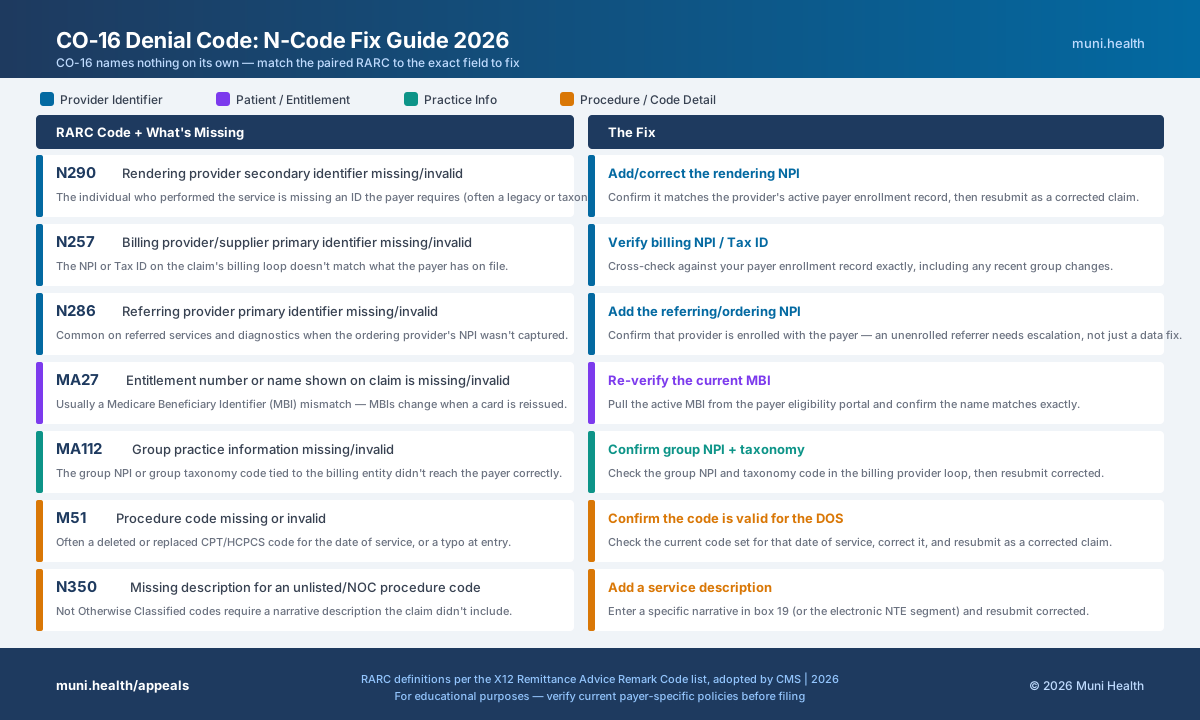
Billing teams that resubmit a CO-16 denial without reading the RARC are guessing — and a wrong guess costs an entire clearinghouse cycle. The table below covers the N-codes and MA-codes that ride with CO-16 most often.
The CO-16 RARC Lookup Table: What Each Code Means and How to Fix It
Every RARC paired with CO-16 points to one specific field. Match the code on your remittance to the row below before you touch the claim.
| RARC / N-Code | What It Means | The Fix |
|---|---|---|
| N290 | Rendering provider primary identifier missing/incomplete/invalid | Add or correct the rendering provider's NPI; confirm it matches their active payer enrollment record |
| N257 | Billing provider/supplier primary identifier missing/invalid | Verify the billing NPI and Tax ID against your payer enrollment file, including recent group changes |
| N286 | Referring provider primary identifier missing/invalid | Add the referring/ordering provider's NPI; confirm that provider is actually enrolled with the payer |
| MA27 | Entitlement number or name on the claim missing/invalid | Re-verify the patient's current Medicare Beneficiary Identifier (MBI) via the payer eligibility portal |
| MA112 | Group practice information missing/invalid | Confirm the group NPI and group taxonomy code in the billing provider loop |
| M51 | Procedure code missing or invalid | Confirm the CPT/HCPCS code is valid for the date of service; check for a deleted or replaced code |
| N350 | Missing description for a Not Otherwise Classified (NOC) or unlisted procedure code | Add a specific narrative description of the service (box 19 or the electronic NTE segment) |
Read the RARC Before You Touch Anything Else
The most common CO-16 mistake is correcting the wrong field because the RARC was skipped entirely. N290 and N286 look similar at a glance — one is the rendering provider, the other is the referring provider. Fixing the wrong one produces a second CO-16 denial on the resubmission and burns another cycle against your corrected-claim deadline.
Step-by-Step: Turning a CO-16 Denial Into a Clean Resubmission
Fixing CO-16 correctly the first time is mostly a matter of sequence — read before you edit, and resubmit the right way.
Step 1: Identify the RARC, Not Just the CARC
Pull the full remittance line, not just the denial summary. CO-16 alone is not actionable; the RARC sitting next to it is the entire instruction.
Step 2: Pull the Source Record for That Field
Depending on the RARC, that means your payer enrollment file (for provider identifiers), the patient's eligibility verification (for MA27), or your CPT/HCPCS code set for the date of service (for M51). Don't guess from memory — enrollment records and code sets both change without notice.
Step 3: Correct the Field, Not the Whole Claim
Change only what the RARC identified. CO-16 resubmissions that also re-edit unrelated fields invite a second review pass and slow adjudication.
Step 4: Resubmit as a Corrected Claim, Not an Appeal
Submit with frequency code 7 (replacement claim), referencing the original claim number. A formal appeal is the wrong tool here — there's no coverage decision to appeal, just a data error to fix.
Step 5: Log the Resubmission Against Your Timely Filing Clock
Corrected-claim windows are typically shorter than appeal windows and run independently of them. Track the resubmission date at the clearinghouse level so a second CO-16 doesn't push you past the deadline. See corrected claim timely filing limits by payer for the specific windows.
Corrected Claim, Not Appeal — Why the Distinction Costs Real Money
CO-16 is a data problem, not a coverage decision, and that distinction determines which clock is running. Filing a formal appeal on a CO-16 denial doesn't pause your corrected-claim deadline — if that window closes while the appeal is still processing, you permanently lose the ability to resubmit, even if the appeal itself is later denied for the wrong reason.
The two tracks solve different problems and run on different clocks. For the full breakdown of when each applies and how the deadlines interact, see corrected claim vs. insurance appeal and reconsideration vs. appeal.
Template: CO-16 Corrected Claim Cover Note
Most payers don't require a cover letter with an electronic corrected claim, but a short cover note reduces manual-review delays and gives you a paper trail if the resubmission is questioned later. Customize the bracketed fields for the specific RARC you're resolving.
[Your Practice Letterhead]
[Date]

[Payer Name] Claims Department
[Payer Claims Address]

RE: Corrected Claim Resubmission — CO-16 Denial
  Patient: [Patient Name], DOB: [Date of Birth]
  Member ID: [Member ID]
  Original Claim Number: [Claim #]
  Date of Service: [DOS]
  Original Remittance Date: [Remit Date]
  Denial Code: CO-16
  Remark Code: [RARC/N-Code, e.g., N290]

To Whom It May Concern:

This is a corrected claim resubmission (Frequency Code 7) for the claim referenced above, originally denied CO-16 with remark code [RARC/N-Code]. Per the remittance advice, the claim lacked the following required information:

[Describe the specific missing element per the RARC — e.g., "the rendering provider's National Provider Identifier (NPI)"]

The following correction has been made and is reflected on the enclosed corrected claim:

[State the correction — e.g., "The rendering provider NPI has been added and verified against our current payer enrollment record: [NPI]."]

No other information on this claim has changed. Please process this corrected claim under the original date of service listed above.

If any additional documentation is needed to complete adjudication, please contact our office directly.

Sincerely,

[Your Name]
[Title]
[Practice Name]
[Phone Number]
[Billing NPI / Tax ID]
Skip the blank template. Start with a review-ready draft.
Use the template as guidance, or let Muni prepare a payer-specific draft for your team to verify, sign, and submit.
First 3 appeals free, then $20 per appeal. Start with your denial letter or EOB and available records. No meeting or clearinghouse connection required.
When CO-16 Isn't a Quick Data-Entry Fix
Most CO-16 denials resolve with a field correction, but a few RARC patterns signal a deeper problem that a corrected claim alone won't solve.
N290 or N286 on an unenrolled provider. If the rendering or referring provider genuinely isn't enrolled with that payer, re-typing their NPI changes nothing — the claim will deny CO-16 again. This needs a credentialing or provider-enrollment fix before any resubmission will succeed.
The same RARC recurring across many claims. A single CO-16 is a data-entry error. The same code repeating across a batch usually means your practice management system or clearinghouse export is dropping a field before the claim ever reaches the payer — worth a configuration check rather than fixing claims one at a time.
CO-16 following a COB scenario. Occasionally a payer issues CO-16 when the real issue is an unresolved coordination-of-benefits order. If the RARC references entitlement or other-payer information, verify COB before assuming it's a simple missing-field fix.
CO-16 vs. Other Common Denial Codes
CO-16 gets confused with codes that look similar on a remittance but require a completely different response.
Prepare this appeal packet with your team.
Draft the appeal, coordinate missing documents, and approve the reviewed packet. Keep your clearinghouse; your practice checks deadlines and submits through the payer’s accepted channel.
First 3 appeals free, then $20 per appeal. Start with your denial letter or EOB and available records. No meeting or clearinghouse connection required.
| Code | Type of Problem | Correct Response |
|---|---|---|
| CO-16 | Missing or incorrect claim data (varies by RARC) | Corrected claim, fixing only the field the RARC identifies |
| CO-4 | Missing or incorrect modifier | Corrected claim (frequency code 7) |
| CO-29 | Timely filing deadline expired | Proof of timely submission only — not fixable by data correction |
| CO-50 | Coverage decision — not medically necessary | Clinical appeal with policy-mapped documentation |
The dividing line: if the claim itself has an error, it's a corrected claim. If the payer made a coverage decision, it's a formal appeal. CO-16 is always the first category — see the EOB denial code guide for how CO-4, CO-29, CO-50, and CO-97 fit into that same framework, or the CO-50 denial code appeal guide if the code on your remittance is the medical-necessity one instead of a data error.
How Muni Appeals Handles CO-16 Denial Routing
When staff upload a CO-16 remittance, Muni Appeals surfaces the paired RARC and suggests a likely corrected-claim path instead of a clinical appeal. Staff confirms the specific field, verifies the response path, and calendars the corrected-claim and appeal deadlines in the practice's approved workflow.
For practices weighing whether denial-routing automation is worth adding to an existing billing workflow, see appeal automation cost vs. manual processing for a breakdown of where the time actually goes.
Frequently Asked Questions
What does CO-16 mean on an EOB or remittance advice?
CO-16 means the claim lacks information or has a submission/billing error needed for adjudication. It's a Contractual Obligation code, so the practice — not the patient — absorbs the adjustment until the claim is corrected. The code itself doesn't identify the specific problem; the paired RARC does.
What's the difference between CO-16 and CO-4?
CO-4 is specifically a missing or incorrect modifier. CO-16 is broader — it covers any missing or invalid data element the RARC identifies, from provider identifiers to procedure codes to entitlement numbers. Both are corrected-claim situations, not appeals.
Can I file a formal appeal on a CO-16 denial?
You can, but it won't work and it wastes time. CO-16 isn't a coverage decision, so there's nothing for an appeal to overturn. Worse, filing an appeal doesn't pause your corrected-claim deadline, so the window to actually fix the claim can close while the appeal sits in queue.
What if my CO-16 denial has no RARC or N-code attached?
Contact the payer's provider services line and request the specific remark code — some clearinghouse reports truncate or drop the RARC in their default claim-status view even though the payer sent one. Resubmitting without knowing the RARC is a guess, and a wrong guess produces a second CO-16.
How long do I have to resubmit a CO-16 corrected claim?
Corrected-claim windows vary by payer and are often shorter than formal appeal windows — some run 90 days from the original remittance, others tie to the original timely filing deadline. Check the specific payer's corrected-claim policy rather than assuming your appeal deadline applies; see corrected claim timely filing limits by payer.
What does RARC N290 mean specifically?
N290 means the rendering provider's primary identifier is missing, incomplete, or invalid — typically the NPI of the clinician who actually performed the service, as opposed to the billing entity. (Its sibling N291 covers the rendering provider's secondary identifier, such as a payer-assigned ID or taxonomy the payer requires.) It often appears with CO-16 on claims where a locum, resident, or covering provider performed the visit.
Why does the same CO-16/RARC pair keep recurring on my claims?
A recurring pattern usually means the field is being dropped somewhere upstream of the payer — a practice management system template, a clearinghouse mapping rule, or an EHR export setting — rather than a one-off data-entry mistake. Check the export configuration before continuing to fix claims individually.
Does a CO-16 corrected claim need a new claim number?
No. A corrected claim uses the original claim number with a frequency code of 7 (replacement) so the payer links it to the original submission. Submitting it as a brand-new claim without referencing the original can trigger a duplicate-claim denial instead of processing the correction.
Ready to Stop Guessing at CO-16 Denials?
CO-16 shows up constantly precisely because it covers so many different underlying errors — and the fastest way to lose time on it is treating every instance the same way. Read the RARC, fix the specific field, and resubmit as a corrected claim.
Get started:
- Automated CARC/RARC routing to the correct response — corrected claim, clinical appeal, or write-off
- Enrollment and eligibility data pulled directly into the resubmission workflow
- Corrected-claim and appeal deadline fields kept distinct for staff verification and calendaring
This guide reflects 2026 CARC/RARC code definitions and payer resubmission standards. Specific payer systems, corrected-claim windows, and provider enrollment requirements vary by plan and clearinghouse. Verify current payer-specific policies before filing. This guide does not constitute legal or billing compliance advice.