

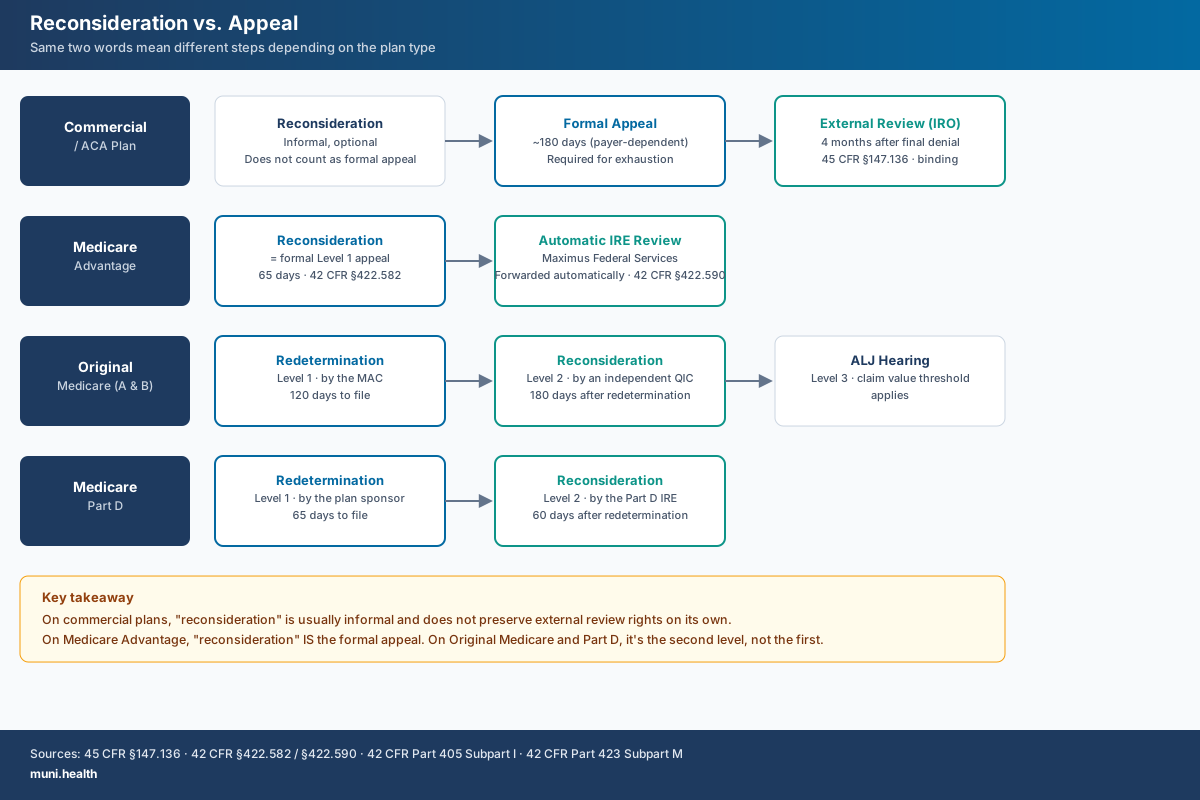
Reconsideration and appeal are not the same step, and the meaning flips by plan type. On commercial plans, reconsideration is usually informal and does not preserve external review rights on its own — file the formal appeal separately. On Medicare Advantage, reconsideration is the formal Level 1 appeal (42 CFR § 422.582, 65-day deadline). On Original Medicare and Part D, reconsideration is the second level, after a first-level "redetermination."
Why "Reconsideration" and "Appeal" Aren't Interchangeable
The same two words mean four different things depending on which plan denied the claim. That's the entire problem.
On a commercial plan, a billing team calls the payer, gets a "reconsideration" opened, and assumes the appeal clock is now running. On a Medicare Advantage plan, that same word — reconsideration — is the formal appeal, with a federally regulated 65-day deadline and an automatic forward to an independent reviewer if the plan upholds the denial. On Original Medicare, reconsideration doesn't even come first — it's the second step, decided by a contractor with no relationship to the plan that denied the claim.
Mixing these up doesn't just slow a claim down. On commercial plans, treating an informal reconsideration as if it satisfied the formal internal appeal requirement can mean a practice never actually exhausts internal appeals — which is a precondition for external review under 45 CFR § 147.136. The claim can end up permanently closed without the practice ever having filed what the payer's process actually required.
The Costly Assumption
Calling something a "reconsideration" and treating it as your formal appeal is the single most common way practices lose external review eligibility on commercial plans. Reconsideration and formal appeal usually run on separate tracks with separate deadlines — filing one does not automatically file the other.
Commercial Plans: Reconsideration Is Usually a Warm-Up, Not the Appeal
On most commercial plans, reconsideration is an informal, lower-friction first look at a denial — often resolved by phone or a quick portal submission, without the procedural protections (written notice, specific denial rationale, appeal rights language) that a formal ERISA/ACA-compliant appeal requires.
Prepare this appeal packet with your team.
Draft the appeal, coordinate missing documents, and approve the reviewed packet. Keep your clearinghouse; your practice checks deadlines and submits through the payer’s accepted channel.
First 3 appeals free, then $20 per appeal. Start with your denial letter or EOB and available records. No meeting or clearinghouse connection required.
UnitedHealthcare treats claim reconsideration as a distinct, non-appeal step. According to UHCprovider.com's appeals and reconsiderations guidance, UHC's commercial post-service process is a mandatory two-step sequence: one reconsideration, then a formal appeal if the reconsideration doesn't resolve the issue. Both steps must be completed within a combined 12-month window from the original claim determination — not 12 months each. Skipping straight to a formal appeal without first requesting reconsideration is flagged as a common and costly mistake in UHC's own provider guidance.
Cigna structures it similarly. Per Cigna's Appeals and Disputes page, an informal reconsideration (a clinical review request) does not consume formal appeal rights — if the reconsideration doesn't resolve the denial, the practice still has the full formal appeal window measured from the original denial date, not from the reconsideration outcome.
Aetna blurs the line further: per Aetna's Disputes and Appeals Overview, a reconsideration is a formal review of a previous claim decision, filed within 180 days of that decision, and a formal appeal — including an appeal of the reconsideration itself — must be filed within 60 days of the reconsideration decision. That makes Aetna's reconsideration function closer to a genuine first appeal step than UHC's or Cigna's. Filing formats and deadlines for BCBS and Humana vary by affiliate and plan; verify the specific process in the payer's current provider manual before assuming reconsideration and appeal share a deadline.
| Payer | What "Reconsideration" Means | Counts as the Formal Appeal? | Formal Appeal Deadline |
|---|---|---|---|
| UnitedHealthcare (commercial) | Informal first step; required before formal appeal | No — separate step | Combined 12-month window covers both reconsideration and formal appeal |
| Cigna (commercial) | Informal, often phone-resolved clinical review | No — doesn't consume appeal rights | 180 days from the original denial date, unaffected by reconsideration |
| Aetna (commercial) | Functions as the first formal review step | Effectively yes — starts the second-level clock | 60 days from the reconsideration decision (not the original denial) |
| BCBS (by affiliate) | Terminology and process vary by the 36 independent affiliates | Varies — verify with the affiliate's provider manual | Varies by affiliate; see the BCBS FEP guide linked below for one documented example |
| Humana (commercial) | Reconsideration/claim review via Availity | Varies by plan type | Verify in the current Humana provider manual before assuming it matches the appeal deadline |
For exact commercial appeal deadlines by payer, see Insurance Appeal Deadlines 2026. For BCBS's federal employee plan specifics, see the BCBS FEP claim denial appeal guide.
Medicare Advantage Flips the Meaning: Reconsideration Is the Formal Appeal
Medicare Advantage terminology inverts the commercial pattern entirely. There is no separate "informal reconsideration" step — the reconsideration is Level 1 of the federally regulated appeal process, governed by 42 CFR § 422.582.
The filing deadline is 65 calendar days from the date printed on the denial notice, counted from the notice date, not the date the practice opened the mail. The MA plan must decide within 30 calendar days for standard requests or 72 hours for expedited requests. If the plan upholds the denial in whole or in part, 42 CFR § 422.590 requires it to automatically forward the case to the federal Independent Review Entity — C2C Innovative Solutions as of May 1, 2026 (previously Maximus Federal Services) — without the practice having to separately request it.
That automatic forward is the practical payoff of understanding this distinction: on a Medicare Advantage plan, a properly filed reconsideration already sets up the next level of review. There's no separate "formal appeal" step to remember to file on top of it. For the full plan-by-plan MA appeal process, see How to Appeal Medicare Advantage Denials 2026.
The MA Deadline Overrides the Commercial Default
Even when the same insurer sells both commercial and Medicare Advantage plans, the MA deadline (65 days) is a federal floor that governs regardless of what the insurer's general commercial appeals policy states. Confirm plan type before applying a payer's standard deadline.
Original Medicare and Part D Add a Third Meaning: Reconsideration Is Level 2
Traditional fee-for-service Medicare (Parts A and B) uses reconsideration differently again — this time as the second level of appeal, not the first.
Per CMS's First Level of Appeal guidance, Level 1 is called a redetermination, filed within 120 days of the initial determination and decided by the Medicare Administrative Contractor (MAC) — typically the same contractor that processed the original claim — within 60 days.
If the redetermination is denied, Level 2 is the reconsideration, filed within 180 days of the redetermination decision. Per CMS's Second Level of Appeal guidance, this reconsideration is decided by a Qualified Independent Contractor (QIC) — an entity independent of the MAC that made the first decision — within 60 days. For the full 5-level Original Medicare ladder beyond reconsideration — ALJ hearing, Medicare Appeals Council, federal district court, and the dollar thresholds that gate the last two — see our Medicare redetermination and appeal guide.
Medicare Part D prescription drug plans follow the same two-name, two-level pattern with different clocks: a redetermination by the plan sponsor, filed within 65 days of the coverage determination notice and decided within 7 days (72 hours if expedited), followed by a reconsideration with the Part D Independent Review Entity, filed within 60 days of the redetermination and decided within 7 days (72 hours if expedited). See CMS's Part D Redetermination and Part D Reconsideration pages for the underlying rules.
| Plan Type | Level 1 Name | Level 1 Deadline to File | Level 2 Name | Level 2 Deadline to File | Who Decides Level 1 |
|---|---|---|---|---|---|
| Commercial / ACA plan | Appeal (reconsideration optional, informal) | Typically 180 days — verify by payer | Second-level appeal | Typically 60 days from Level 1 denial — verify by payer | The insurer |
| Medicare Advantage | Reconsideration | 65 days from denial notice | Automatic IRE review (C2C Innovative Solutions, as of May 1, 2026) | Automatic — no separate filing required | The MA plan |
| Original Medicare (Parts A & B) | Redetermination | 120 days from initial determination | Reconsideration | 180 days from redetermination decision | Medicare Administrative Contractor (MAC) |
| Medicare Part D | Redetermination | 65 days from coverage determination notice | Reconsideration | 60 days from redetermination decision | The Part D plan sponsor |
Which Step Actually Preserves External Review Rights
For ACA-regulated commercial plans, external review through an accredited Independent Review Organization (IRO) requires that internal appeals be exhausted first — a formal procedural requirement under 45 CFR § 147.136, not a courtesy. An informal reconsideration that never followed the plan's formal appeal notice and decision requirements generally does not satisfy that exhaustion requirement on its own.
There's one safety valve: the "deemed exhaustion" rule. If the plan fails to strictly follow the internal appeals procedures required of it — missing a decision deadline, failing to provide required notice content — the claimant is deemed to have exhausted internal appeals and can proceed directly to external review, even without a completed formal appeal. That protects practices from insurer stalling, but it isn't something to rely on by default; it depends on the insurer's own procedural failure, not the practice's filing choice.
The practical rule: on commercial plans, always confirm that a formal, written appeal — not just a reconsideration — has been filed and decided before assuming external review is available. For the full external review process once internal appeals are exhausted, see the Independent Review Organization (IRO) Appeal Guide 2026.
Don't Let a Reconsideration Eat Your Appeal Clock
Even on payers where reconsideration doesn't formally consume appeal rights (like Cigna), waiting on a reconsideration response before starting the formal appeal paperwork can leave a practice scrambling near the deadline. Start drafting the formal appeal in parallel with any reconsideration request — don't wait for the reconsideration outcome to begin.
How Muni Appeals Helps With the Right-Track Decision
Getting reconsideration and appeal confused costs practices time they don't have. Muni Appeals uses the uploaded notice to surface the likely track and deadline risk, but staff must verify and calendar every reconsideration and formal-appeal window so one process does not silently exhaust another.
Frequently Asked Questions
Is a reconsideration the same as an appeal?
Not usually, and the answer depends entirely on plan type. On most commercial plans (UnitedHealthcare, Cigna), reconsideration is an informal step that does not substitute for the formal, regulated appeal. On Medicare Advantage plans, reconsideration is the formal Level 1 appeal under 42 CFR § 422.582. On Original Medicare and Part D, reconsideration is actually the second level of appeal, not the first. For VA Community Care Network claims, contracted providers start with the administrator's reconsideration process and consult their contract or VCA for further remedies. The exclusion of federal VA review options does not establish that reconsideration exhausts all contractual dispute rights.
Does filing a reconsideration extend or reset my appeal deadline?
It depends on the payer. Cigna's informal reconsideration does not affect the formal appeal deadline, which still runs from the original denial date. Aetna's structure works differently — the formal second-level appeal deadline (60 days) runs from the reconsideration decision, not the original denial. Confirm the specific payer's rule before assuming either pattern applies by default.
Can I skip reconsideration and go straight to a formal appeal?
On UnitedHealthcare commercial plans, no — UHC requires the reconsideration step before a formal appeal will be accepted, and skipping it is explicitly called out as a common filing error in UHC's own provider guidance. On other payers, check the specific provider manual; some allow filing a formal appeal directly.
What happens if I only file a reconsideration on a commercial plan and never file a formal appeal?
The claim likely never reaches the formal, procedurally compliant internal appeal that ACA rules require before external review becomes available. Absent a "deemed exhaustion" failure on the insurer's part, this can leave a practice without a path to Independent Review Organization review, since internal appeals were never formally exhausted.
Why does Medicare Advantage call its first appeal level "reconsideration" instead of "appeal"?
That's simply the terminology CMS uses in 42 CFR Part 422, Subpart M. It functions exactly like a first-level formal appeal — written request, specific deadline, plan decision, automatic escalation if denied — but the regulation and the plan's own denial notices will refer to it as a reconsideration, not an appeal.
What is the deadline difference between Medicare Advantage reconsideration and Original Medicare reconsideration?
They're on different clocks entirely. Medicare Advantage reconsideration must be filed within 65 days of the denial notice, and it's the first level of appeal. Original Medicare (Parts A & B) reconsideration must be filed within 180 days of a redetermination decision, and it's the second level — the first level there is called a redetermination, with its own 120-day filing window.
Who decides a reconsideration versus who decides a formal appeal?
On commercial plans, the same insurer typically reviews both the reconsideration and the formal appeal, sometimes with a different internal reviewer for the second look. On Medicare Advantage, the plan decides the reconsideration, but if upheld, an independent federal contractor (C2C Innovative Solutions as of May 1, 2026, previously Maximus, as the IRE) decides the next level automatically. On Original Medicare, the redetermination is decided by the Medicare Administrative Contractor, while the reconsideration is decided by a Qualified Independent Contractor with no relationship to the MAC.
Ready to Stop Losing Deadlines to Terminology Confusion?
The words "reconsideration" and "appeal" carry real procedural weight, and that weight changes by plan type. Confirming which track a denial is on — commercial, Medicare Advantage, Original Medicare, or Part D — before filing anything is the fastest way to avoid losing a deadline to the wrong assumption.
Where to start:
- Confirm the plan type before assuming which step comes first
- On commercial plans, file the formal written appeal even if a reconsideration is also in progress
- On Medicare Advantage, treat reconsideration as the real appeal — there's no separate step to remember
- Track deadlines separately for reconsideration and appeal; they rarely share a clock
For related deadline detail, see Insurance Appeal Deadlines 2026 and When to Appeal an Insurance Denial 2026. Reconsideration and appeal aren't the only payer terms that get conflated — see Predetermination vs. Prior Authorization vs. Precertification for the pre-service version of the same confusion.
This guide reflects 2026 insurance appeal procedures under 45 CFR § 147.136, 42 CFR Part 422 Subpart M, 42 CFR Part 423 Subpart M, and 42 CFR Part 405 Subpart I, along with current payer provider manuals for UnitedHealthcare, Cigna, and Aetna. Plan-specific deadlines and reconsideration processes vary by payer, affiliate, and plan type. Always verify current procedures against the denial letter received and the applicable provider manual.