

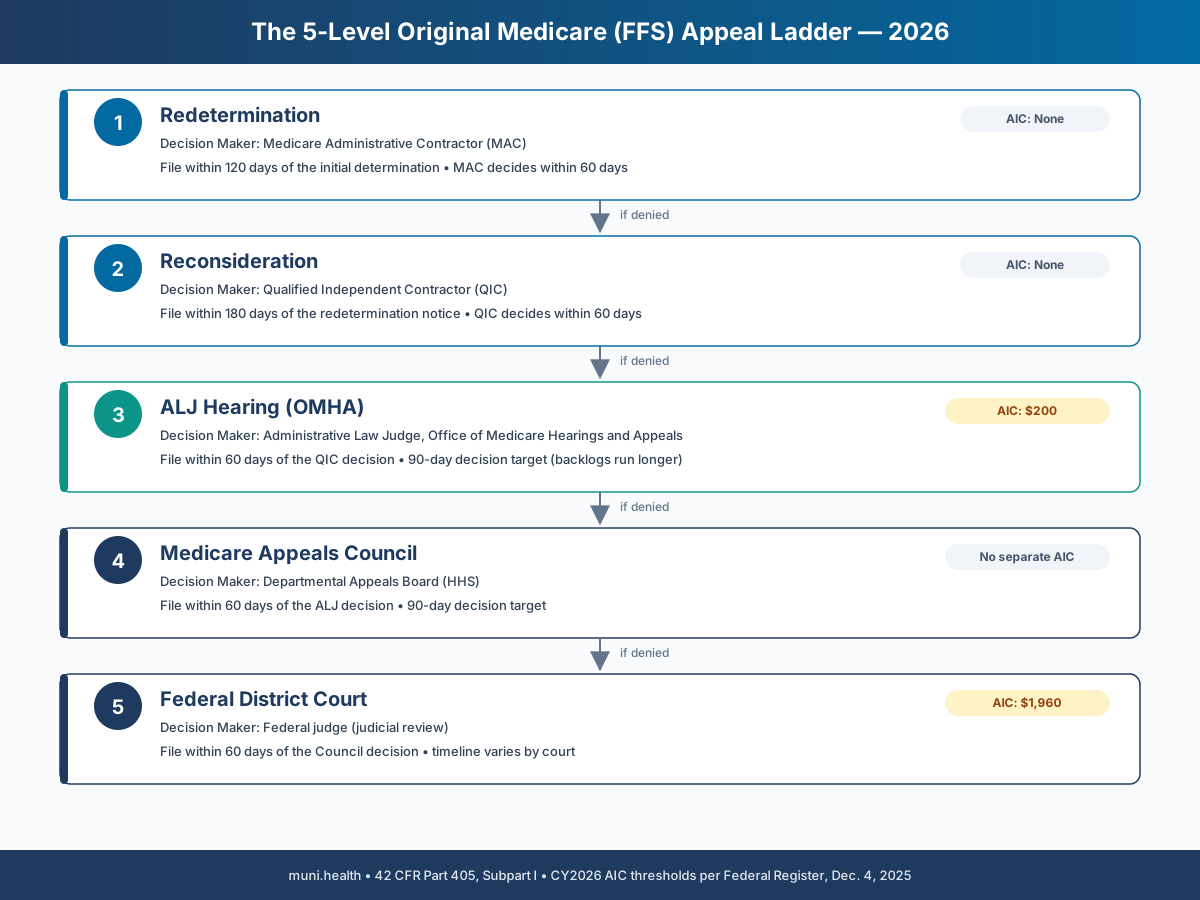
To appeal a denied Original Medicare (Part A or Part B fee-for-service) claim, file a Medicare Redetermination Request — Form CMS-20027 or an equivalent written request — with your Medicare Administrative Contractor (MAC) within 120 days of receiving the initial determination. The MAC has 60 days to decide. If it's still denied, you have 180 days to request reconsideration by a Qualified Independent Contractor (QIC), then 60 days to request an Administrative Law Judge hearing once the claim is worth at least $200 (2026 threshold), then 60 days to the Medicare Appeals Council, then 60 days to federal district court if at least $1,960 remains in dispute.
Original Medicare Appeals Are Not Medicare Advantage Appeals
If your practice treats both Medicare Advantage and Original Medicare patients, do not reuse your MA appeal playbook here. The two run on entirely different tracks, with different decision-makers, different deadlines, and a different form at the first step.
A Medicare Advantage denial goes to the health plan itself for Level 1 reconsideration, then automatically to a federal Independent Review Entity. An Original Medicare (fee-for-service) denial never touches an insurance company — it goes to your Medicare Administrative Contractor (MAC), the regional claims-processing contractor CMS hires to pay and review Part A and Part B claims. That first step is called a redetermination, not a reconsideration, and it uses its own form: CMS-20027.
Sending a redetermination request to the wrong address, or filing it as if it were an MA appeal, does not stop the 120-day clock. For the Medicare Advantage process specifically, see our Medicare Advantage appeal guide and MA appeal letter templates instead of this one.
Redetermination vs. Reconsideration — the terms flip depending on the plan
On Original Medicare, "redetermination" is the first appeal level and "reconsideration" is the second. On Medicare Advantage, "reconsideration" is the first level — there is no redetermination step at all. See our reconsideration vs. appeal comparison for how the terminology maps across commercial, MA, and Original Medicare tracks.
The 5-Level Original Medicare Appeal Ladder
Every Original Medicare Part A/B claim denial follows the same federal structure, set out in 42 CFR Part 405, Subpart I. Two numbers most guides skip — the Amount in Controversy (AIC) thresholds — decide whether you can even reach Levels 3 and 5, and both were adjusted for 2026.
| Level | Decision Maker | Your Filing Deadline | Decision Timeframe | AIC Threshold (2026) |
|---|---|---|---|---|
| 1 — Redetermination | Medicare Administrative Contractor (MAC) | 120 days from receipt of initial determination | 60 days | None |
| 2 — Reconsideration | Qualified Independent Contractor (QIC) | 180 days from redetermination notice | 60 days | None |
| 3 — ALJ Hearing | Administrative Law Judge (OMHA) | 60 days from QIC decision | 90 days (target) | $200 |
| 4 — Medicare Appeals Council | Departmental Appeals Board | 60 days from ALJ decision | 90 days (target) | No separate threshold |
| 5 — Federal District Court | Federal judge | 60 days from Council decision | Varies | $1,960 |
Receipt is presumed, not measured from the date on the notice
Every deadline above runs from the date you received the notice, and CMS presumes receipt 5 calendar days after the date printed on the notice, unless you can show otherwise (CMS, First Level of Appeal). In practice that means your real filing window is closer to 115 days than 120 if you count from the notice date instead of the presumed receipt date. Don't cut it close on the assumption you have the full nominal number of days.
The AIC thresholds are adjusted every year based on the medical-care component of the CPI, then rounded to the nearest $10. For claims filed on or after January 1, 2026, the ALJ threshold rose to $200 and the federal court threshold rose to $1,960 (Federal Register, Dec. 4, 2025 — CY2026 AIC adjustment). If the disputed amount doesn't clear $200 after a QIC denial, your appeal is effectively over at Level 2 — the QIC's decision is final and binding, with no ALJ hearing available unless you can aggregate related claims to meet the threshold.
Level 1: Redetermination — Your First Appeal
A redetermination is a fresh review of your claim by MAC staff who were not involved in the original denial. You (or the beneficiary, or an authorized representative) have 120 days from the date you received the initial determination to request it (CMS, First Level of Appeal).
You can use Form CMS-20027 (the "Medicare Redetermination Request Form — 1st Level of Appeal"), available directly from CMS's forms library (CMS Forms, CMS-20027), or submit any written request that includes the same required elements under 42 CFR § 405.944: the beneficiary's name and Medicare number, the specific service and date(s) at issue, the name of the party or representative, and the reason you disagree with the determination. The form is a convenience, not a legal requirement — but it guarantees you don't omit a required field and trigger a request for more information that eats into your clock.
Once filed, the MAC has 60 days to issue its decision. There's no minimum dollar amount required to request a redetermination — every denied claim, no matter how small, can be appealed at this level.
Where to Send Your Redetermination Request
Original Medicare claims are processed regionally. Your redetermination request goes to the MAC that processed the original claim — found on your Medicare Summary Notice (MSN) or Remittance Advice — not to CMS directly and not to a national Medicare phone line.
| MAC Jurisdiction | Contractor | States / Territories |
|---|---|---|
| JE | Noridian Healthcare Solutions | CA, HI, NV, Guam, American Samoa, Northern Mariana Islands |
| JF | Noridian Healthcare Solutions | AK, AZ, ID, MT, ND, OR, SD, UT, WA, WY |
| JH | Novitas Solutions | AR, CO, LA, MS, NM, OK, TX |
| JL | Novitas Solutions | DE, DC, MD, NJ, PA |
| JJ | Palmetto GBA | AL, GA, TN |
| JM | Palmetto GBA | NC, SC, VA, WV |
| J5 | WPS Government Health Administrators | IA, KS, MO, NE |
| J8 | WPS Government Health Administrators | IN, MI |
| J6 | National Government Services (NGS) | IL, MN, WI |
| JK | National Government Services (NGS) | CT, ME, MA, NH, NY, RI, VT |
| J15 | CGS Administrators | KY, OH |
| JN | First Coast Service Options | FL, PR, US Virgin Islands |
MAC contracts are periodically re-competed
CMS re-bids MAC contracts on a rolling schedule, and jurisdiction assignments and mailing addresses can change between award cycles. Treat the table above as a starting point, and confirm your current MAC and its exact appeals address using CMS's own directory before you mail anything (CMS, MAC Websites & Contact List) — a request sent to a MAC that no longer holds your jurisdiction does not stop your 120-day clock.
Redetermination Request Cover Letter
Whether you use Form CMS-20027 or write your own request, attach a cover letter that states your case up front instead of leaving the reviewer to piece it together from enclosures. Fill in the bracketed fields and adapt the reason section to your specific denial.
MEDICARE REDETERMINATION REQUEST — COVER LETTER
(Use with Form CMS-20027, or as a standalone written request under 42 CFR § 405.944)
Date: [Date]
[Medicare Administrative Contractor Name]
Medicare Part [A/B] Appeals Department
[Address from your Medicare Summary Notice or Remittance Advice]
RE: Request for Redetermination — 1st Level Medicare Appeal
Beneficiary Name: [Full Name]
Medicare Beneficiary Identifier (MBI): [11-character MBI]
Claim / Document Control Number: [From MSN or Remittance Advice]
Date(s) of Service: [Date or range]
Item/Service Denied: [Brief description]
HCPCS/CPT Code(s): [Codes]
Provider/Supplier Name: [Practice or facility name]
Provider NPI: [NPI]
Date of Initial Determination Notice: [Date]
This request is filed within 120 days of the above notice date.
REASON FOR THIS REQUEST
[MAC name] denied the above claim, stating: "[quote the exact denial
reason and remark code(s) from the MSN or Remittance Advice — e.g.,
CO-50, or CO-16 with its accompanying N-code]."
I am requesting redetermination because:
[State specifically why the denial reason does not apply. Cite the
applicable NCD or LCD number and how the documentation on file meets
its criteria, or identify the specific documentation that was omitted
from the original submission and is now enclosed.]
SUPPORTING EVIDENCE ENCLOSED
- Original claim / Medicare Summary Notice or Remittance Advice
- Treating physician's letter of medical necessity, addressing the
denial reason directly
- Relevant clinical notes, dated [range]
- Diagnostic results supporting the billed service
- Applicable coverage determination citation: [NCD number or LCD
L-number for this MAC's jurisdiction]
- Corrected claim data, if the denial was for coding or documentation
I am the [beneficiary / assignee / authorized representative] and am
requesting redetermination of the above claim under 42 CFR § 405.940
et seq. If this request is denied, please include instructions for
requesting reconsideration by a Qualified Independent Contractor (QIC).
Signature: ___________________________
Printed Name: [Name]
Relationship to Beneficiary: [Self / Authorized Representative /
Provider, by assignment]
Phone: [Number]
Enclosures: [List each attached document]
Skip the blank template. Start with a review-ready draft.
Use the template as guidance, or let Muni prepare a payer-specific draft for your team to verify, sign, and submit.
First 3 appeals free, then $20 per appeal. Start with your denial letter or EOB and available records. No meeting or clearinghouse connection required.
Level 2: Reconsideration by a Qualified Independent Contractor
If the MAC upholds its own denial, you have 180 days from the date you receive the redetermination notice to request reconsideration (CMS, Second Level of Appeal). This step is handled by a Qualified Independent Contractor (QIC) — a panel that includes physicians and has no relationship to the MAC that just denied your redetermination, which is the point: it's the first genuinely independent look at the claim.
The QIC reviews the complete record, including everything submitted at redetermination, and issues its decision within 60 days. There is still no minimum dollar amount required at this level. This is also your last practical chance to submit new evidence without restriction — CMS applies limits on introducing new documentation at the ALJ level that wasn't part of the QIC record, so front-load your strongest clinical evidence here rather than holding it back for a hearing.
Level 3: ALJ Hearing — Where the Dollar Threshold Starts to Matter
If the QIC upholds the denial, you have 60 days from receipt of the QIC's decision to request a hearing before an Administrative Law Judge at the Office of Medicare Hearings and Appeals (OMHA). This is the first level where the claim must clear an Amount in Controversy requirement — $200 for claims filed in 2026 — calculated on the amount still in dispute after the QIC decision, not the original billed charge.
OMHA targets a decision within 90 days of receiving your hearing request (CMS, Third Level of Appeal), but OMHA has carried a significant backlog for years and actual wait times routinely run well past that target — build your case assuming months, not weeks. You can request either an in-person, video, or telephone hearing, or ask the ALJ to decide "on the record" without a hearing if your documentation is thorough and you don't need to present live testimony.
If your claim doesn't reach $200, Level 2 is your last stop
A QIC decision on a claim worth less than $200 is final. There is no aggregation shortcut unless the claims genuinely involve the same issue and the same beneficiary or a defined class — check with OMHA before assuming you can bundle unrelated small-dollar denials to clear the threshold.
Levels 4 and 5: Medicare Appeals Council and Federal District Court
If the ALJ upholds the denial, you have 60 days from receipt of the ALJ's decision to request review by the Medicare Appeals Council, part of HHS's Departmental Appeals Board (42 CFR Part 405, Subpart I, eCFR). The Council conducts a full review of the entire record — not just the ALJ's reasoning — and targets a decision within 90 days. There is no separate AIC requirement at this level beyond what was already required to reach the ALJ.
Prepare this appeal packet with your team.
Draft the appeal, coordinate missing documents, and approve the reviewed packet. Keep your clearinghouse; your practice checks deadlines and submits through the payer’s accepted channel.
First 3 appeals free, then $20 per appeal. Start with your denial letter or EOB and available records. No meeting or clearinghouse connection required.
If the Council also upholds the denial, the final step is judicial review in federal district court, filed within 60 days of receiving the Council's decision (CMS, Fifth Level of Appeal). This level requires the amount remaining in controversy to meet the 2026 threshold of $1,960. Very few provider appeals reach this stage — the time and legal cost involved generally only make sense for claims well above the minimum or for cases turning on a coverage policy question with broader implications for the practice.
Common Mistakes When Appealing Original Medicare Denials
Treating it like a Medicare Advantage appeal. There is no health plan to call, no "prior authorization appeals department." Everything before Level 3 goes to a MAC or a QIC — administrative contractors, not insurers.
Missing the 120-day window because you counted from the wrong date. Receipt is presumed 5 days after the notice date, not the notice date itself — but that presumption cuts against you if you wait until day 120 assuming you have that full window from receipt. File with margin.
Appealing a clerical error. A wrong modifier, transposed code, or data-entry mistake on an adjudicated claim isn't a redetermination issue. MACs must handle clerical errors as reopenings, and a reopening request doesn't pause your 120-day clock. See the Medicare Part B reopening guide for the routing rules and a tracking worksheet.
Skipping the NCD/LCD citation. Original Medicare coverage decisions are governed by National Coverage Determinations and Local Coverage Determinations specific to your MAC's jurisdiction. A redetermination request that argues "medical necessity" in the abstract, without citing the specific NCD or LCD number and showing how the documentation meets its criteria, is easier for a reviewer to uphold.
Holding back evidence for the ALJ hearing. New evidence introduced for the first time at the ALJ level faces restrictions under OMHA rules. Submit your complete clinical case — physician letter, diagnostic results, guideline citations — at redetermination and reconsideration, not later.
Not checking the AIC before requesting an ALJ hearing. Confirm the amount still in dispute clears $200 before filing a Level 3 request; OMHA will dismiss a hearing request that doesn't meet the threshold, which costs you the time you spent preparing it.
How Muni Appeals Helps With Medicare Redeterminations
Original Medicare denials add a fifth appeal track for practices that already juggle Medicare Advantage, commercial, and Medicaid deadlines — each with its own clock, its own decision-maker, and its own form. Muni Appeals organizes that workflow instead of leaving it to memory:
- Surfaces deadline risk from each uploaded notice; staff verifies and calendars the controlling redetermination, reconsideration, or escalation window
- Compiles the applicable NCD/LCD citation for the procedure code and MAC jurisdiction
- Provides likely MAC routing guidance for staff to verify against the current regional instructions before filing
- Provides fields for staff to record what they submitted at each level, reducing the risk that evidence is withheld until an ALJ hearing where new documentation faces restrictions
For a broader look at the cost of handling this manually versus systematizing it, see our break-even math for appeal automation.
Frequently Asked Questions
What is a Medicare redetermination?
A redetermination is the first-level appeal of a denied Original Medicare (Part A or Part B) claim, conducted by the Medicare Administrative Contractor (MAC) that processed the original claim, using staff who were not involved in the initial decision. It's requested using Form CMS-20027 or an equivalent written request, within 120 days of the initial determination.
How is this different from a Medicare Advantage appeal?
Original Medicare appeals go to a MAC, a claims-processing contractor — never to an insurance company. Medicare Advantage appeals go to the health plan itself for Level 1, then automatically to a federal Independent Review Entity. The deadlines, forms, and decision-makers are entirely separate. See our Medicare Advantage appeal guide if that's the track you're on.
Do I have to use Form CMS-20027, or can I just write a letter?
Either works. CMS-20027 is a convenience form that guarantees you include every required element under 42 CFR § 405.944. A written letter is equally valid as long as it includes the beneficiary's name and Medicare number, the specific claim and service dates, the requestor's name, and the specific reason for disagreeing with the determination.
What happens if I miss the 120-day redetermination deadline?
Your MAC can accept a late request only if you show good cause for the delay, which is a discretionary exception, not a guarantee. The safest approach is to file well before the deadline, especially since receipt is presumed 5 days after the notice date rather than measured from your actual receipt.
What is the Amount in Controversy threshold, and why does it matter?
It's the minimum dollar amount still in dispute required to advance to Levels 3 and 5. For 2026, that's $200 to request an ALJ hearing and $1,960 to pursue federal district court review. A QIC (Level 2) decision on a claim below $200 is final — there's no further appeal available for that claim alone.
How do I find my Medicare Administrative Contractor?
Check the Medicare Summary Notice (MSN) or Remittance Advice for the claim — it identifies the contractor that processed it. Because MAC jurisdictions are periodically re-competed, confirm the current contractor and mailing address using CMS's own MAC directory before submitting a request.
How long does the full 5-level process take if a claim goes all the way to federal court?
There's no fixed total, but the built-in decision targets alone add up to roughly a year even before accounting for OMHA's well-documented ALJ backlog, which frequently extends Level 3 well past its 90-day target. Most disputes that get appealed at all resolve at Level 1 or Level 2, long before reaching that timeline.
Can a patient's authorized representative file the redetermination instead of the provider?
Yes. A beneficiary, their authorized representative, or a provider that accepted assignment on the claim can each file a redetermination request. If a provider files on the beneficiary's behalf without an assignment of benefits, additional authorization documentation may be required — check the specific MAC's instructions before submitting.
Ready to Stop Tracking This Manually?
A denied Original Medicare claim runs on a five-step clock that has nothing in common with your Medicare Advantage or commercial appeal deadlines — different forms, different reviewers, different addresses. Missing any single deadline in that chain ends the appeal at whatever level you're on, regardless of clinical merit.
Muni Appeals keeps each level's deadline, the applicable NCD/LCD citation, and the correct MAC routing in one place instead of spread across notices and sticky notes.
Get started:
- Submit your first 3 appeals free, including Original Medicare redeterminations
- Verify and calendar redetermination, reconsideration, and ALJ deadlines from each notice
- Reference the applicable NCD/LCD by MAC jurisdiction for the procedure code
- Record each submission across all five appeal levels using the provided fields
This guide reflects 2026 Original Medicare (fee-for-service) appeal procedures under 42 CFR Part 405, Subpart I. Amount in Controversy thresholds reflect the December 4, 2025 Federal Register adjustment effective January 1, 2026. MAC jurisdiction assignments can change between contract award cycles — confirm your current contractor before filing. This information is for administrative and billing purposes and is not medical advice.