

Ophthalmology claim denials require claim-specific rules. Anti-VEGF preferred-drug sequences differ across Aetna, Devoted, UnitedHealthcare, and individual plan designs. Medicare's current practitioner table lists CPT 67028 with MUE 1 and MAI 3, a clinical date-of-service edit rather than a per-eye limit. Cataract criteria also vary by Medicare Administrative Contractor (MAC), so verify the member's plan and jurisdiction before appealing.
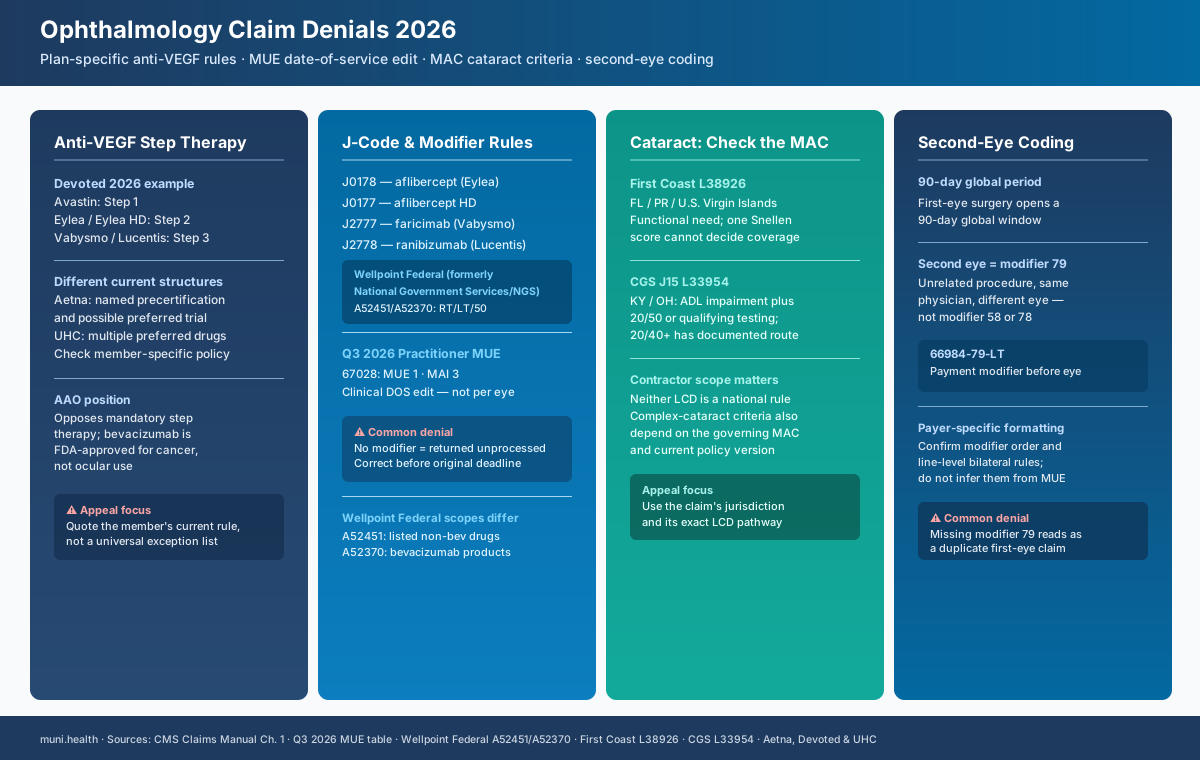
Why Ophthalmology Denials Split Into Two Distinct Patterns
Ophthalmology billing combines two distinct denial patterns: high-cost anti-VEGF intravitreal drugs routed through step-therapy and precertification policy, and cataract surgery governed by medical-necessity documentation and global-period coding rules. A step-therapy denial and a modifier-79 denial come from opposite root causes, so the response should address the cited policy or coding issue rather than rely on a generic resubmission.
According to the 2025 AMA Prior Authorization Physician Survey (n=1,000 physicians, fielded December 2025), practices complete an average of 40 prior authorizations per physician per week, and 32% of physicians report PA requests are often or always denied. Anti-VEGF policies add ophthalmology-specific work because the preferred product, sequence, precertification requirement, and continuation criteria can change by payer, line of business, and plan.
Four Ophthalmology Denial Patterns This Guide Covers
Each denial type below traces to a different root cause — a step-therapy policy, a coding modifier, a medical-necessity standard, or a global-period rule — and needs different evidence in the appeal.
| Denial Type | Key Codes | Primary Trigger | Appeal Focus |
|---|---|---|---|
| Anti-VEGF preferred-drug or precertification denial | J0178 (Eylea), J0177 (Eylea HD), J2777 (Vabysmo), J2778 (Lucentis) | The member-specific plan requires a different product, sequence, or authorization record | Quote the current plan criterion and document only the trial, response, or exception that criterion actually requests |
| Injection-administration / modifier denial | 67028 | Missing or incorrect site modifier, payer-specific bilateral reporting, or an MUE date-of-service edit | Confirm the applicable contractor/payer rule; CMS lists MUE 1 with MAI 3, not a universal one-unit-per-eye rule |
| Cataract surgery medical-necessity denial | 66984, 66982 | The record does not satisfy the applicable MAC's visual-function, acuity/testing, or exception pathway | Use the claim's jurisdiction-specific LCD; do not substitute another MAC's criteria |
| Second-eye global-period denial | 66984-79-LT/RT | Missing modifier 79 on the second eye's claim, filed within the first eye's 90-day global period | Resubmit with modifier 79 plus the correct eye modifier and documentation that the fellow eye is a separate, medically necessary procedure |
Anti-VEGF Step-Therapy Denials: Eylea, Vabysmo & Lucentis
Anti-VEGF denials can reflect a preferred-product hierarchy or missing precertification record, but there is no safe universal rule that every payer requires bevacizumab first or recognizes the same exceptions.
Use named, current payer criteria. Three current policies show why the claim's exact plan matters:
- Aetna Clinical Policy Bulletin 0701 covers commercial medical plans. It requires precertification for named aflibercept, faricimab, and ranibizumab products in applicable plan designs and says a lower-cost drug trial may be required. The bulletin does not establish one bevacizumab-first rule for every Aetna member.
- Devoted Health's 2026 Medicare Part B step-therapy list places Avastin at Step 1, Eylea and Eylea HD at Step 2, and Vabysmo, Lucentis, and several other products at Step 3. Devoted separately tells clinicians what information can support access to a later-step drug; use that current plan language rather than importing an exception from another payer.
- UnitedHealthcare's commercial ophthalmologic VEGF policy, policy 2026D0042AQ effective July 1, 2026, lists Avastin, Cimerli, Eylea, Eylea HD, Lucentis, Pavblu, and Vabysmo as preferred products for its Medical Necessity Plans while applying separate criteria to non-preferred products. That hierarchy is materially different from Devoted's three-step sequence.
Start with the denial notice, the member's benefit plan, and the current policy version. Record the required product sequence, look-back period, prior response, and any exception language exactly as written. Do not present intolerance, contraindication, adverse event, or inadequate response as available unless the member's policy actually lists that route.
What the American Academy of Ophthalmology Says About This
The AAO's clinical statement on biosimilars states plainly: "The Academy does not support step-therapy; the choice of treatment should be that of a patient and their ophthalmologist." The Academy also notes that bevacizumab (Avastin) itself is FDA-approved only for systemic cancer treatment, not ocular use — its ophthalmic use is off-label, compounded, and repackaged into intravitreal doses. The AAO separately cautions against substituting an untested bevacizumab biosimilar for the reference product in eye disease "in the absence of sufficient clinical studies for eye disease," since small variations in inactive ingredients can affect intraocular safety. None of this changes a payer's step-therapy requirement, but it does mean the underlying "cheaper alternative" is itself an off-label product — worth knowing when a step-therapy denial reads as if bevacizumab were the FDA-approved standard of care for AMD.
What a preferred-drug exception request needs. A criterion-matched request quotes the member's current policy and documents that criterion without assuming another payer's exception language applies.
[Practice Letterhead]
[Date]

[Payer] Pharmacy/Medical Prior Authorization Appeals
[Address from denial letter]

RE: Step-Therapy Exception Request
Patient: [Name] | DOB: [Date] | Member ID: [ID]
Diagnosis: [e.g., Neovascular AMD, right eye — ICD-10 code]
Requested Drug: [Eylea / Eylea HD / Vabysmo / Lucentis]
HCPCS Code: [J0178 / J0177 / J2777 / J2778]
Denial Reason: [Step therapy not met / bevacizumab not tried]

Dear [Payer] Review Team,

This request documents the patient's bevacizumab trial history and the
basis for a step-therapy exception under the plan's own published
criteria.

BEVACIZUMAB TRIAL HISTORY:
Product administered: [Repackaged bevacizumab (Avastin) / biosimilar]
Number of doses: [count] | Dates of administration: [dates]
Clinical response: [Describe BCVA and/or OCT findings before and
  after the trial]

--- OR, if bevacizumab was not trialed ---

Plan-recognized reason bevacizumab was not administered:
  [Copy the exact exception category from this member's current policy,
  then describe the supporting facts and dates]

EXCEPTION CRITERION CITED:
[Quote the specific exception language from the denial notice or
 the member's current plan policy; do not substitute criteria from
 another payer or line of business]

SUPPORTING DOCUMENTATION ENCLOSED:
- Office visit notes documenting each bevacizumab administration
- OCT and/or best-corrected visual acuity measurements before and
  after the trial
- [If applicable] Documentation of the intolerance, contraindication,
  or adverse event and its date

CLINICAL RATIONALE:
[Brief statement connecting the documented trial outcome or
 exception to the requested product]

I am available to discuss this case or provide additional
documentation.

Respectfully,

[Provider Name, Credentials]
NPI: [Number]
Skip the blank template. Start with a review-ready draft.
Use the template as guidance, or let Muni prepare a payer-specific draft for your team to verify, sign, and submit.
First 3 appeals free, then $20 per appeal. Start with your denial letter or EOB and available records. No meeting or clearinghouse connection required.
J-Code, Injection-Administration & Frequency Denials
A second, entirely separate category of anti-VEGF denial has nothing to do with step therapy — it's a coding-administration error on a drug the payer has already approved.
First identify the contractor and drug product. Wellpoint Federal (formerly National Government Services/NGS) publishes two current, contractor-scoped articles for its J6 and JK jurisdictions. A52451 applies to its listed ranibizumab and aflibercept products and biosimilars, aflibercept HD, brolucizumab, and faricimab. A52370 applies to bevacizumab and its biosimilars. Within those product and jurisdiction scopes, Wellpoint Federal requires RT, LT, or 50 on CPT 67028 and returns a claim without the modifier unprocessed. These are not national rules for every Medicare claim or payer, so verify the claim's MAC, drug product, and current article before correcting it.
An unprocessable claim does not restart timely filing. The CMS Medicare Claims Processing Manual, Chapter 1, says an incomplete or invalid submission is not considered filed for timely-filing purposes. A returned unprocessable submission is not a denial and carries no appeal rights. Correct and resubmit it promptly within the claim's applicable original timely-filing deadline; the return does not create a new filing date or reset the deadline.
The MUE is a clinical date-of-service edit, not a per-eye allowance. CMS's Q3 2026 Practitioner Services MUE table lists CPT 67028 with an MUE value of 1 and MAI 3. CMS defines MAI 3 as a clinical date-of-service edit, and the MUE sums units billed by the same provider for the same beneficiary on the same date of service. It does not mean one unit per eye. MAI 3 edits can be reviewed on appeal with supporting documentation, while bilateral reporting format remains payer- and contractor-specific. Do not infer modifier 50 versus separate RT/LT lines from the MUE value itself.
Under the Applicable Wellpoint Federal Article, a Drug Denial Takes the Injection Code With It
Current Wellpoint Federal articles A52451 and A52370 state, within their respective product and contractor scopes, that if the drug is denied as not reasonable and necessary, the associated 67028 injection-administration code is denied with it. For an affected Wellpoint Federal claim, resolve the underlying drug issue before treating the administration line as an independent coding error. Other MACs and payers may publish different instructions.
Use the product-specific dose rule. Wellpoint Federal A52451 addresses its listed non-bevacizumab products, while A52370 addresses bevacizumab and its listed biosimilars. For a dose or frequency denial, use the current article or policy that applies to that drug and claim rather than importing a limit from the other article or another payer.
Cataract Surgery Medical Necessity & Second-Eye Coding Denials
Cataract surgery denials come from a different root cause entirely: a preoperative record that documents the wrong thing, or a second-eye claim missing the one modifier that tells the payer it isn't a duplicate.
Prepare this appeal packet with your team.
Draft the appeal, coordinate missing documents, and approve the reviewed packet. Keep your clearinghouse; your practice checks deadlines and submits through the payer’s accepted channel.
First 3 appeals free, then $20 per appeal. Start with your denial letter or EOB and available records. No meeting or clearinghouse connection required.
Cataract criteria are jurisdiction-dependent. First Coast's LCD L38926, for Florida, Puerto Rico, and the U.S. Virgin Islands, uses a functional standard and says a single Snellen acuity alone cannot rule surgery in or out. In contrast, CGS J15 LCD L33954, for Kentucky and Ohio, generally requires documented activity-of-daily-living impairment plus visual acuity of 20/50 or worse or a qualifying two-line reduction with glare or consensual-light testing. CGS also allows consideration at 20/40 or better when the other criteria are met and substantial medical-necessity documentation supports surgery. Neither LCD is a national Medicare rule. Use the claim's current MAC and jurisdiction, then connect the record to that LCD's exact route. The medical necessity justification letter guide covers the general documentation pattern.
Complex cataract rules also depend on the MAC. First Coast L38926 separately lists circumstances supporting CPT 66982, including specified pupil-expansion devices, zonular-support techniques, pediatric posterior capsulotomy, and dye used to visualize the capsulorrhexis for a mature cataract. Those are First Coast criteria, not a portable national checklist. Confirm the applicable MAC's current standard and document the exact qualifying circumstance rather than only stating that the case was difficult.
Address the denial's exact criterion. First Coast L38926 also lists non-covered scenarios, including adequate tolerable correction, no lifestyle compromise, or no expected functional improvement. If that LCD governs the claim, respond to the cited scenario directly. Do not assume another jurisdiction uses the same list.
Second-eye surgery within the global period needs modifier 79, not 58 or 78. Cataract surgery carries a 90-day global period, and the American Academy of Ophthalmology's own coding guidance is direct about which modifier applies when the second eye is operated on inside that window: modifier 79, "unrelated procedure or service by the same physician during the postoperative period," because operating on the other eye is a genuinely independent surgical episode on different anatomy — not a planned extension of the first surgery (modifier 58) and not a return to the OR for a related complication (modifier 78). Confirm the payer's line-level modifier order and ensure each eye's record independently supports medical necessity under the applicable policy.
How Muni Appeals Helps Ophthalmology Billing Teams
The denial patterns covered in this guide turn on a specific, identifiable issue: an unmet step-therapy exception, a missing site or global-period modifier, or a preoperative note that documents an acuity score without the functional-impairment language the LCD actually requires. Identify which one applies before resubmitting.
Muni Appeals organizes uploaded ophthalmology denial materials, matches documentation to the cited step-therapy exception, coding rule, or LCD criterion, and highlights which specific element the record is missing. Staff confirms the correct modifier, exception language, and submission channel before filing. Practices comparing workflows should see the appeal automation cost comparison.
Frequently Asked Questions
Why does my insurance require bevacizumab before covering Eylea or Vabysmo?
Some plans do, but it is not universal. Devoted's current 2026 Part B sequence places Avastin at Step 1 and Eylea and Eylea HD at Step 2. Current Aetna commercial and UnitedHealthcare Medical Necessity Plan policies use different preferred-product and precertification structures. Read the member's denial and current plan policy before assuming a bevacizumab trial or a particular exception applies.
Can I bill CPT 67028 without a site modifier?
For claims within current Wellpoint Federal (formerly National Government Services/NGS) articles A52451 or A52370, no: Wellpoint Federal requires RT, LT, or 50 and returns a claim without one of those modifiers unprocessed. Other MACs and payers may use different bilateral-reporting instructions, so confirm the rule governing the claim.
Why was my second cataract surgery on the other eye denied?
Cataract surgery carries a 90-day global period. A second-eye surgery performed within that window needs modifier 79 (unrelated procedure, same physician) appended to the CPT code, along with the correct eye modifier (for example, 66984-79-LT). Without modifier 79, the claim can be denied as a duplicate of the already-paid first-eye surgery.
What visual acuity does Medicare require for cataract surgery to be covered?
There is no single national Medicare threshold. First Coast L38926 uses a functional standard and says a single Snellen score alone cannot determine coverage. CGS J15 L33954 generally uses documented functional impairment plus 20/50 acuity or qualifying glare/consensual-light testing, with a documented route for some patients at 20/40 or better. Use the LCD for the claim's jurisdiction.
Why were both my drug claim and my injection administration claim denied together?
Within their respective Wellpoint Federal (formerly National Government Services/NGS) product and contractor scopes, current articles A52451 and A52370 state that a drug denial for lack of reasonable and necessary use also denies the associated CPT 67028 administration. Confirm that one of those articles governs the claim before applying that cascade.
What's the difference between standard and complex cataract surgery coding?
Standard cataract extraction with IOL insertion is CPT 66984. Complex cataract surgery is CPT 66982, but the coverage criteria are contractor-specific. For example, First Coast L38926 lists specified pupil-expansion, zonular-support, pediatric capsulotomy, and mature-cataract dye circumstances. Use the current LCD governing the claim rather than treating that list as national.
Ready to Stop Losing Time to Ophthalmology Step-Therapy and Coding Denials?
Match the ophthalmology response to the actual issue — a step-therapy exception the plan already allows, a missing site or global-period modifier, or preoperative documentation that speaks to functional impairment instead of an acuity number alone. A resubmission that does not address the cited issue leaves that issue unresolved.
Muni Appeals helps ophthalmology billing teams:
- Organize appeals by denial type instead of treating every denial the same way
- Match documentation requirements to the specific step-therapy exception, coding modifier, or LCD criterion cited
- Flag missing site, bilateral, or global-period modifiers before a claim is submitted or resubmitted
This guide reflects 2026 ophthalmology billing and appeal procedures. HCPCS/CPT codes, payer step-therapy and precertification policies, NCCI/MUE edits, and Medicare LCD criteria are updated regularly and vary by Medicare Administrative Contractor and commercial payer. State requirements and plan-level rules also vary. This information is for administrative and billing purposes and is not medical advice.