

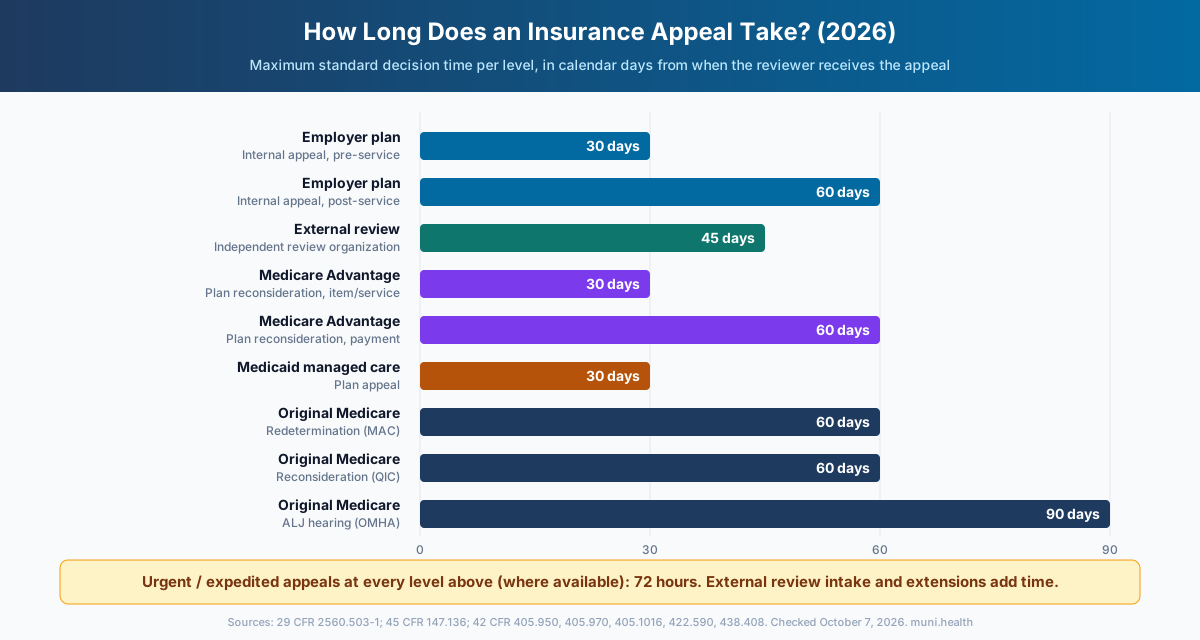
Most insurance appeals must be decided within 30 days for a pre-service request and 60 days for a post-service (already rendered) claim, or within 72 hours when the request is urgent. These limits come from federal rules for employer plans, 29 CFR 2560.503-1(i), and Medicare Advantage plans use the same 30/60/72-hour structure. Medicaid managed care plans have up to 30 days. If the internal appeal fails, external review takes up to 45 days (72 hours if expedited). Original Medicare has 60 days at each of the first two levels and 90 days at an ALJ hearing. Each clock starts when the plan receives the appeal, not on the date you mailed it.
Whose appeal is this?
The federal clocks on this page govern claimant appeals: appeals by the patient, or by the practice acting as the patient's authorized representative, or by a non-contracted provider where the rules allow it. When an in-network practice disputes payment under its own provider agreement, the contract and state prompt-pay law usually set the timeline. Check the dispute section of your agreement. For how long you have to file, see insurance appeal deadlines by payer.
How Long Each Appeal Level Takes
Each appeal level has a legal maximum decision time. That maximum depends on the coverage type, on whether the service has already happened, and on whether the request is urgent. The table below lists the federal maximum for each level. States and contracts can set shorter windows, but not longer ones.
| Coverage and level | Standard decision | Expedited decision | Clock starts | Rule |
|---|---|---|---|---|
| Employer / commercial plan: internal appeal, pre-service | 30 days (15 days per level if the plan has two levels) | 72 hours | Plan receives the appeal | 29 CFR 2560.503-1(i)(2) |
| Employer / commercial plan: internal appeal, post-service | 60 days (30 days per level if two levels) | N/A (service already rendered) | Plan receives the appeal | 29 CFR 2560.503-1(i)(2) |
| External review (federal or state IRO) | 45 days | 72 hours | IRO receives the request | 45 CFR 147.136 |
| Medicare Advantage: plan reconsideration, item or service | 30 days (+ up to 14) | 72 hours (+ up to 14) | Plan receives the request | 42 CFR 422.590 |
| Medicare Advantage: plan reconsideration, payment | 60 days (no extension) | N/A | Plan receives the request | 42 CFR 422.590(b) |
| Medicare Advantage: plan reconsideration, Part B drug | 7 days (no extension) | 72 hours | Plan receives the request | 42 CFR 422.590(c) |
| Medicare Advantage: Part C IRE review | 30 days pre-service / 60 days payment | 72 hours | IRE receives the case file | CMS IRE guidance |
| Medicaid managed care: plan appeal | 30 days (+ up to 14) | 72 hours (+ up to 14) | Plan receives the appeal | 42 CFR 438.408 |
| Medicaid: state fair hearing after a plan appeal | 90 days | 3 working days | Date the plan appeal was filed | 42 CFR 431.244(f) |
| Original Medicare: redetermination (MAC) | 60 days | N/A at this level for most claims | MAC receives the request | 42 CFR 405.950 |
| Original Medicare: reconsideration (QIC) | 60 days | N/A for most claims | QIC receives the request | 42 CFR 405.970 |
| Original Medicare: ALJ hearing (OMHA) | 90 days | N/A | OMHA receives the hearing request | 42 CFR 405.1016 |
| Original Medicare: Medicare Appeals Council | 90 days | N/A | Council receives the request | 42 CFR 405.1100 |
All day counts are calendar days unless the rule says otherwise. The table shows the latest lawful decision date. The rules also require the plan to decide as quickly as the patient's condition requires.
When the Appeal Clock Starts
For almost every federal appeal level, the decision clock starts when the reviewer receives the appeal, not when you sent it. The postmark date does not start the clock, and neither does the date the plan logs the appeal as complete.
Prepare this appeal packet with your team.
Draft the appeal, coordinate missing documents, and approve the reviewed packet. Keep your clearinghouse; your practice checks deadlines and submits through the payer’s accepted channel.
First 3 appeals free, then $20 per appeal. Start with your denial letter or EOB and available records. No meeting or clearinghouse connection required.
The employer-plan rule makes the second point explicit. The review period begins when the appeal "is filed in accordance with the reasonable procedures of a plan, without regard to whether all the information necessary" to decide it is attached (29 CFR 2560.503-1(i)(4)). A plan cannot hold your appeal until the file feels complete.
Two different clocks are easy to confuse:
| Clock | Starts on | Example rule |
|---|---|---|
| Your filing deadline | Your receipt of the denial notice, often presumed to be 5 days after the notice date | MA reconsideration: 60 days after receipt, with receipt presumed 5 days after the notice date (42 CFR 422.582(b)) |
| The payer's decision deadline | The payer's receipt of your appeal | MA standard reconsideration: 30 or 60 days from the date the plan receives the request (42 CFR 422.590) |
Proof of the receipt date matters, because that date sets both clocks. Use a portal submission confirmation, a fax transmission report, or certified mail with a return receipt, and file the proof with the appeal copy.
What can pause or extend the payer's clock:
- New evidence (Original Medicare). Each time you submit additional evidence after filing, the MAC or QIC gets up to 14 more calendar days (42 CFR 405.950(b)(3), 405.970(b)(3)). Sending everything with the first request avoids this.
- A 14-day extension (Medicare Advantage service requests and Medicaid). These plans may extend once by up to 14 calendar days, with written notice of the reason (42 CFR 422.590(f), 438.408(c)). MA payment and Part B drug reconsiderations cannot be extended.
Commercial and Employer Plans: 30 or 60 Days per Internal Appeal
An employer or commercial plan must decide a pre-service appeal within 30 days and a post-service appeal within 60 days of receiving it. Urgent care appeals must be decided within 72 hours (29 CFR 2560.503-1(i)(2)).
Some plans have two internal appeal levels. The plan then gets half the time at each level: 15 days per level for pre-service appeals and 30 days per level for post-service appeals. The total is the same 30 or 60 days, split across two reviews. Your denial letter should say how many levels the plan has.
Two details change the real timeline:
- Multiemployer (union) plans whose board of trustees meets at least quarterly may decide post-service appeals at the board's next meeting, or the one after if the appeal arrives within 30 days of a meeting. In the worst case, that can take several months.
- ACA rules apply strict compliance. For non-grandfathered plans, a plan that fails to follow the claims rules can cause the claimant to be deemed to have exhausted the internal process. The claimant can then go straight to external review. Minor violations that cause no harm and occur during a good-faith exchange of information do not trigger this (45 CFR 147.136(b)(2)(ii)(F)).
Self-funded plans run by a TPA follow the same federal clocks, but the plan document controls the procedure. See the ERISA self-funded plan appeal guide for how to read it.
External Review: Up to 45 Days, or 72 Hours Expedited
After a final internal denial, an independent review organization (IRO) must issue a standard external review decision within 45 days of receiving the request. An expedited external review must be decided within 72 hours (45 CFR 147.136).
The 45 days start only when the IRO has the case, so add the intake steps before it:
- Filing window: the claimant has four months after receiving the final internal denial to request external review.
- Preliminary review: under the federal process, the plan has five business days to check eligibility and one business day after that to notify the claimant.
- IRO decision: up to 45 days after the IRO receives the request.
An IRO decision in the patient's favor is binding on the plan, which must then provide coverage or payment immediately. For how to prepare the file, see the independent review organization appeal guide. For Blue plans, see BCBS external review.
Medicare Advantage: 30 Days Pre-Service, 60 Days for Payment
A Medicare Advantage plan must decide a standard reconsideration within 30 calendar days for an item or service, 60 calendar days for a payment request, and 7 calendar days for a Part B drug. Expedited reconsiderations must be decided within 72 hours (42 CFR 422.590).
The Medicare Advantage process has a step that commercial plans do not. If the plan upholds its denial, even partly, it must automatically forward the case to the Part C Independent Review Entity (IRE). If the plan misses its deadline, the miss counts as an affirmation and the file must go to the IRE as well. You do not file a second appeal to get there.
The IRE then has the same structure: 72 hours expedited, 30 days pre-service, 7 days for Part B drugs, and 60 days for payment requests. It can extend by up to 14 days in limited cases (CMS Part C IRE page). The IRE contractor has changed. Maximus processed reconsiderations received through April 30, 2026, and C2C Innovative Solutions became the Part C IRE on May 1, 2026.
Who can use this track matters for practices:
- Non-contracted providers can request a payment reconsideration, generally with a signed Waiver of Liability, within the same 60-day filing window.
- Contracted providers usually dispute payment through the plan's provider dispute process in the agreement, not through enrollee reconsideration. Those timelines come from the contract.
For the full Medicare Advantage workflow, see how to appeal Medicare Advantage denials. For copyable language, use the Medicare Advantage appeal letter template.
Original Medicare: Up to Five Levels, 60 to 90 Days Each
Original Medicare (Parts A and B) has five appeal levels. The first two levels each have a 60-day decision limit, and the next two each have 90 days.
| Level | Who decides | Your filing window | Decision limit | If they miss it |
|---|---|---|---|---|
| 1. Redetermination | Medicare Administrative Contractor (MAC) | 120 days from receipt of the initial determination | 60 days | Wait for the decision; there is no escalation at this level |
| 2. Reconsideration | Qualified Independent Contractor (QIC) | 180 days from receipt of the redetermination | 60 days | You may escalate to OMHA in writing |
| 3. ALJ hearing | Office of Medicare Hearings and Appeals (OMHA) | 60 days from receipt of the reconsideration | 90 days (180 if escalated from the QIC) | You may escalate to the Council |
| 4. Council review | Medicare Appeals Council | 60 days from receipt of the ALJ decision | 90 days (180 if escalated from OMHA) | You may escalate to federal court |
| 5. Judicial review | Federal district court | 60 days from receipt of the Council decision | No regulatory limit | N/A |
Filing windows come from 42 CFR 405.942, 405.962, 405.1014, and 405.1102. Decision limits come from 405.950, 405.970, 405.1016, and 405.1100. Receipt of a notice is generally presumed to be 5 days after its date.
The ALJ backlog is mostly gone. OMHA reports an average processing time of 69 days in fiscal year 2026 (through the third quarter), below the 90-day limit. The peak was 1,430 days in FY2020 (OMHA average processing time by fiscal year, reviewed August 11, 2026). Older guidance that warns of multi-year ALJ waits describes the backlog years, not 2026.
To reach an ALJ, the amount in controversy must be at least $200 for requests filed in 2026. Federal court requires $1,960 (First Coast, CY2026 AIC). For requests filed on or after January 1, 2027, the thresholds are $200 and $2,000 (CMS-4213-N).
For the first-level filing workflow, see the Medicare redetermination appeal guide.
Medicaid Managed Care: 30 Days, Then a State Fair Hearing
A Medicaid managed care plan must resolve a standard appeal within 30 calendar days of receiving it and an expedited appeal within 72 hours. Either can be extended by up to 14 days (42 CFR 438.408). States may set shorter limits, and many do.
The enrollee has 60 days from the date on the denial notice to file the plan appeal (42 CFR 438.402). If the plan upholds the denial, or misses its deadline, the enrollee is deemed to have exhausted the plan appeal and can request a state fair hearing. The state must take final action within 90 days of the date the plan appeal was filed, not counting the days the enrollee took to request the hearing. Expedited fair hearings are decided within 3 working days after the state receives the case file (42 CFR 431.244(f)).
The Medicaid fair hearing appeal guide covers state-by-state routing.
How Long the Whole Appeal Process Can Take
Adding the decision limits gives the longest a payer can lawfully take at each stage, if you file every step the same day you receive each decision. Real timelines are longer because of filing time, mail, and evidence extensions.
Prepare this appeal packet with your team.
Draft the appeal, coordinate missing documents, and approve the reviewed packet. Keep your clearinghouse; your practice checks deadlines and submits through the payer’s accepted channel.
First 3 appeals free, then $20 per appeal. Start with your denial letter or EOB and available records. No meeting or clearinghouse connection required.
| Path | Decision-time maximum (standard) | How it adds up |
|---|---|---|
| Employer plan, post-service claim, through external review | 105 days | 60-day internal appeal + 45-day IRO review, plus external review intake |
| Employer plan, pre-service request, through external review | 75 days | 30-day internal appeal + 45-day IRO review, plus intake |
| Any urgent request, internal + expedited external | About 6 days | 72 hours + 72 hours |
| Medicare Advantage payment dispute, plan + IRE | 120 days | 60-day plan reconsideration + 60-day IRE review |
| Medicare Advantage pre-service, plan + IRE | 60 to 88 days | 30 + 30 days, plus up to 14-day extensions at each level |
| Medicaid managed care, plan + fair hearing | Up to 90 days from the plan appeal filing | The 90-day fair-hearing limit counts from the plan appeal date, minus the time you take to request the hearing |
| Original Medicare, levels 1 to 4 | 300 days | 60 + 60 + 90 + 90, before filing time and 14-day evidence extensions |
For a practice's cash flow, the first level matters most. Every later level adds another 30 to 90 days of decision time, so a complete first submission is the biggest time saver you control.
What to Do When the Payer Misses Its Deadline
A missed decision deadline almost never means automatic approval. It usually means you can move to the next level without waiting. What that looks like depends on the coverage type:
- Employer and ACA plans: a plan that fails to follow the claims rules can trigger deemed exhaustion, which opens external review or court (45 CFR 147.136(b)(2)(ii)(F)).
- Medicare Advantage: a missed reconsideration deadline counts as an affirmation, and the plan must send the file to the IRE. If the case does not reach the IRE, raise it with the plan and keep proof of the date you filed.
- Medicaid managed care: a missed deadline is deemed exhaustion, and the enrollee can request a state fair hearing.
- Original Medicare: after the QIC or ALJ deadline passes, the appellant can escalate in writing to the next level.
Before escalating, call the payer to confirm it received the appeal and to get a reference number. Ask for the decision due date in its system. The appeal status call script lists the questions to ask and what to document. If the patient's condition makes the standard timeline dangerous, request expedited review. The urgent and expedited appeal guide has the qualifying language.
Payer decision time is not your lawsuit deadline
The decision clocks above limit the payer. Your own deadlines to file the next level, or to sue after a final denial, are separate and often shorter than you expect. See the insurance appeal statute of limitations guide.
Frequently Asked Questions
How long does an insurance company have to respond to an appeal?
For employer and commercial plans, the plan has up to 30 days for a pre-service appeal and 60 days for a post-service appeal, or 72 hours if urgent. Medicare Advantage plans have 30 days for items or services and 60 days for payment. Medicaid managed care plans have up to 30 days. Each limit counts from when the plan receives the appeal.
How long does an external review take?
Up to 45 days after the independent review organization receives the request, or 72 hours for an expedited external review. Allow extra time for intake: under the federal process, the plan has five business days for preliminary review and one more business day to send notice.
How long does a Medicare appeal take?
In Original Medicare, the MAC has 60 days to decide a redetermination and the QIC has 60 days to decide a reconsideration. An ALJ has 90 days. OMHA reported an average of 69 days in fiscal year 2026. Each evidence submission after filing can add up to 14 days at the first two levels.
Does the appeal clock start when I mail the appeal?
No. For most federal appeal levels, the payer's decision clock starts when the payer or reviewer receives the appeal. Keep a fax confirmation, portal receipt, or certified-mail return receipt to prove the date.
Can an insurance company extend the appeal decision deadline?
Sometimes. Medicare Advantage plans (for item or service requests) and Medicaid managed care plans can extend once by up to 14 days with written notice. Group-health appeal deadlines follow 29 CFR 2560.503-1(i)(2); the cited missing-information extension provisions for other claim types do not establish a general extension for group-health appeals. Medicare Advantage payment and Part B drug reconsiderations cannot be extended.
What happens if the insurer doesn't decide my appeal on time?
It is usually not an automatic approval. Depending on the coverage, a missed deadline lets you move to the next level: external review for employer plans, automatic IRE review for Medicare Advantage, a state fair hearing for Medicaid, or written escalation in Original Medicare.
Get the First Appeal Right So the Clock Works for You
The fastest appeal is the one decided at the first level. That means sending a complete file on the first submission, with proof of the date the payer received it. Muni Appeals reads the denial you upload, drafts the appeal with the evidence the denial calls for, and flags the deadlines your team needs to confirm and calendar.
This guide summarizes federal regulations (29 CFR 2560.503-1, 45 CFR 147.136, 42 CFR parts 405, 422, 431, and 438) and CMS and OMHA guidance as checked on October 7, 2026. State law, plan documents, and provider agreements can set shorter timelines, and your denial notice controls the route for each claim. This is administrative information, not legal advice.