

If a patient's health plan is self-funded, ERISA — not state insurance law — governs the appeal. Self-funded plans must give claimants at least 180 days to file an internal appeal (29 CFR 2560.503-1(h)(3)(i)) and must provide a free copy of the entire claim file, including the internal criteria relied on to deny it (29 CFR 2560.503-1(h)(2)(iii)). State external review — California's IMR, New York's DFS — doesn't apply; only the federal review track does.
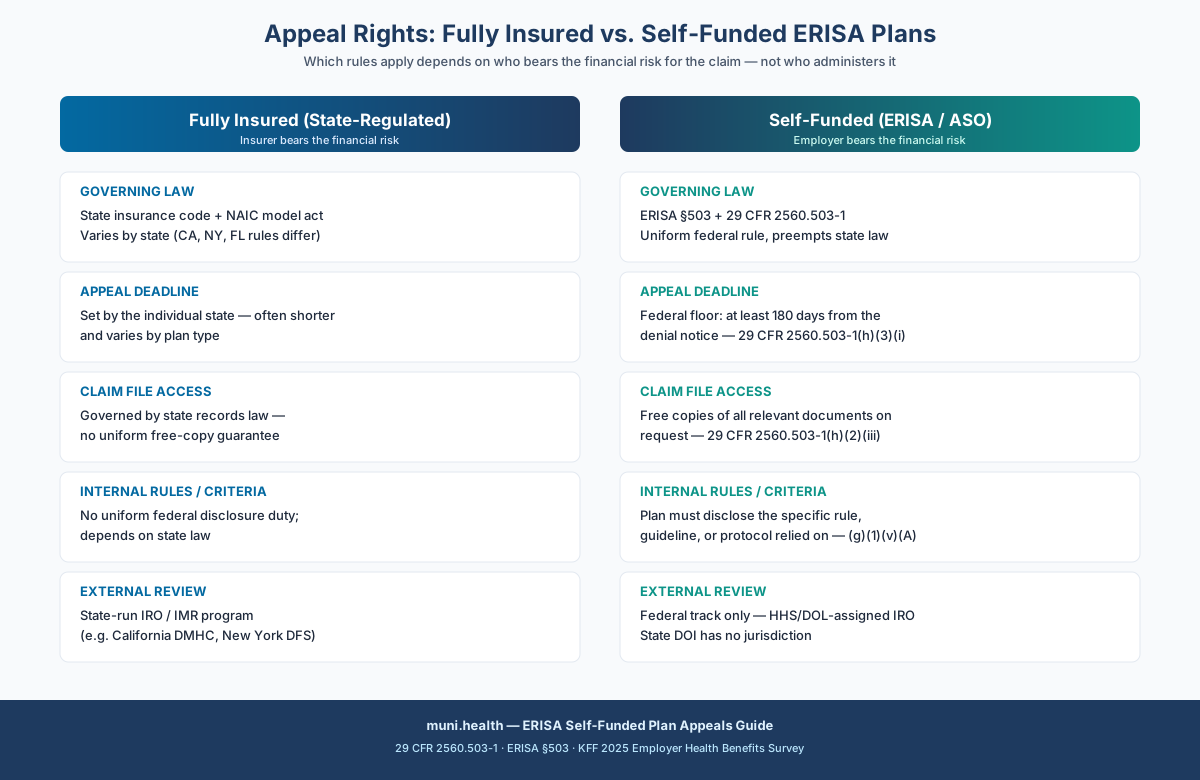
Why "Who Administers the Plan" Isn't the Same Question as "Who Pays"
Most denial letters look identical whether the plan is self-funded or fully insured — same insurer logo, same customer service number, same appeal instructions. But the letterhead only tells you who administers the plan. It doesn't tell you who pays the claim, and that second fact is what determines which set of appeal rules actually applies.
A fully insured plan is one an employer buys from a carrier that assumes the financial risk — Aetna, Cigna, UHC, or a BCBS licensee pays the claim out of premiums it collected, and state insurance law governs how it has to handle your appeal. A self-funded plan is the opposite: the employer pays claims out of its own funds, and hires an insurer or third-party administrator (TPA) purely for administrative services only (ASO) — processing claims, running the network, sending the same-looking denial letter. The insurer's name on the card doesn't mean the insurer is on the hook for the money.
That distinction matters here because self-funded plans are governed by the Employee Retirement Income Security Act of 1974 (ERISA), which preempts state insurance law for claims administration. Our state-by-state insurance appeal laws guide covers how to identify a self-funded plan in more depth — the short version is to check the Summary Plan Description for "self-funded" or "ASO" language, or look for a third-party administrator named separately from the insurance carrier on the EOB. This guide picks up from there: once you know the plan is self-funded, here's exactly how your appeal rights change, and how to use the ones most billers never invoke.
Key statistic
About 67% of covered workers are enrolled in a self-funded plan — 27% at firms with 10 to 199 employees and 80% at larger firms (KFF 2025 Employer Health Benefits Survey). If a practice sees mostly commercial patients through employer coverage, a majority of those claims are likely running on the federal ERISA track rather than a state one.
The 180-Day Appeal Window
State appeal deadlines vary — our insurance appeal deadlines guide covers the range across payers and plan types, and some run considerably shorter than what ERISA requires. For a self-funded group health plan, federal law sets a floor: the plan must give the claimant at least 180 days following receipt of the adverse benefit determination notice to file an internal appeal (29 CFR 2560.503-1(h)(3)(i)).
That's a minimum, not a suggestion. A self-funded plan's own claims procedure document can offer more than 180 days, but it cannot legally offer less. If a self-funded plan's denial letter states a shorter appeal window — 60 or 90 days is common boilerplate copied from a fully insured template — the letter itself is non-compliant, and that non-compliance is leverage you can use (see the "deemed exhausted" section below).
This 180-day floor is specific to group health plan claims under the 2016 update to the claims procedure regulation. It does not automatically extend to every benefit type ERISA covers — disability and pension claims carry their own timing rules — so confirm the claim in front of you is a group health claim before relying on the 180-day figure.
Your Right to the Complete Claim File — Free
This is the right most billing teams never use, and it's the one with the most practical leverage. Under 29 CFR 2560.503-1(h)(2)(iii), a self-funded ERISA plan must provide, upon request and free of charge, reasonable access to and copies of all documents, records, and other information relevant to the claim — before you've even filed the appeal.
"Relevant" has a specific regulatory definition under 29 CFR 2560.503-1(m)(8). A document is relevant if it:
- was relied upon in making the benefit determination
- was submitted, considered, or generated in the course of making the determination, regardless of whether it was actually relied upon
- demonstrates compliance with the plan's own administrative processes and safeguards
- constitutes a statement of policy or guidance concerning the denied treatment or benefit, even if it wasn't relied upon for this specific claim
That third and fourth category are what most practices never request. They mean you're entitled to the plan's internal medical necessity criteria, utilization review guidelines, or the specific policy the reviewer applied — not just the file the plan chooses to hand over voluntarily. Separately, 29 CFR 2560.503-1(g)(1)(v)(A) already requires the initial denial notice to either state the specific rule, guideline, or protocol relied on, or disclose that one was relied on and offer a free copy on request — so if the denial letter is vague about what internal criteria drove the decision, that's a second, independent basis to demand it.
Request the file before you write the appeal, not after
The claim-file request works best filed as its own letter, separate from and before the appeal itself. Reviewing the actual internal guideline the plan applied — rather than guessing at it from the denial letter's boilerplate language — tells you exactly what the appeal needs to rebut. Requesting it after the appeal is already submitted wastes the leverage.
ERISA Claim File Request Letter
Adapt this letter to the specific plan and denial. Send it to the claims administrator address on the denial notice, and keep a copy of the request with your appeal file — the date you sent it starts the clock on the plan's obligation to respond.
REQUEST FOR CLAIM FILE AND RELEVANT DOCUMENTS
(Filed under 29 CFR 2560.503-1(h)(2)(iii) and (m)(8))

Date: [Date]

[Plan Name / Claims Administrator]
[Address from the denial notice]

RE: Request for Complete Claim File — ERISA Section 503 / 29 CFR 2560.503-1

Patient / Claimant Name: [Full Name]
Plan/Policy Number: [Number]
Claim Number: [Number]
Date(s) of Service: [Date or range]
Date of Adverse Benefit Determination: [Date]

I am the [patient / authorized representative / treating provider,
by assignment] for the above claimant. This is a request, under 29
CFR 2560.503-1(h)(2)(iii), for reasonable access to and copies of
all documents, records, and other information relevant to this
claim, as defined at 29 CFR 2560.503-1(m)(8). This request is made
free of charge, as the regulation requires.

Please provide:

1. The complete claim file, including all documentation reviewed
 in making the initial benefit determination
2. Any internal rule, guideline, protocol, or similar criterion
 relied upon in denying this claim, including utilization
 review or medical necessity criteria (per 29 CFR
 2560.503-1(g)(1)(v)(A))
3. Any statement of policy or guidance concerning this treatment
 or benefit for this diagnosis, whether or not it was relied
 upon for this specific determination
4. The identity, qualifications, and any expert consulted in
 reviewing this claim, if applicable
5. A copy of the plan's claims procedure document and Summary
 Plan Description provisions governing this type of claim

Please confirm receipt of this request and provide the requested
documents within a reasonable time so that I can prepare a timely
appeal within the applicable appeal window.

Signature: ___________________________
Printed Name: [Name]
Relationship to Claimant: [Self / Authorized Representative /
Provider, by assignment]
Phone: [Number]
Skip the blank template. Start with a review-ready draft.
Use the template as guidance, or let Muni prepare a payer-specific draft for your team to verify, sign, and submit.
First 3 appeals free, then $20 per appeal. Start with your denial letter or EOB and available records. No meeting or clearinghouse connection required.
If the Plan Doesn't Follow Its Own Rules: "Deemed Exhausted"
ERISA gives self-funded plans real procedural flexibility to design their own claims process — but only within the boundaries the regulation sets. If a plan fails to establish or follow claims procedures that comply with 29 CFR 2560.503-1, the claimant is deemed to have exhausted the plan's administrative remedies and can proceed directly to federal court under ERISA Section 502(a), without having to complete the internal appeal first (U.S. Department of Labor, EBSA — Group Health and Disability Plans Benefit Claims Procedure Regulation).
In practice, that provision — 29 CFR 2560.503-1(l) — is a compliance check on the plan, not just a legal option for a lawsuit. A denial letter that gives you 60 days instead of the required 180, or that fails to disclose the internal criteria it relied on, is itself a procedural violation. Documenting that gap in the appeal record matters even for a practice that has no intention of pursuing litigation, because it establishes that any missed internal deadline downstream was the plan's failure, not yours. For the plan's own decision deadlines (30 days pre-service, 60 days post-service, 72 hours urgent), see how long an insurance appeal takes.
This is a group-health-plan rule with a disability-benefits exception
The strict-compliance rule applies straightforwardly to group health plan claims. Disability benefit claims carry a narrower exception — a plan can avoid the deemed-exhausted consequence for minor, non-prejudicial violations that aren't part of a pattern of violations. If the claim in question is a disability benefit rather than a medical claim, don't assume the same standard applies without checking.
No State External Review — the Federal Track Only
If the internal appeal is denied, fully insured plans in most states offer an external review through a state-run Independent Review Organization program — California's DMHC Independent Medical Review, New York's DFS process, and similar programs elsewhere. ERISA preemption generally blocks those state programs from applying to self-funded plans. Instead, self-funded plans use the federal external review process administered through the Department of Labor and HHS, with review conducted by an HHS-designated IRO rather than a state one.
Prepare this appeal packet with your team.
Draft the appeal, coordinate missing documents, and approve the reviewed packet. Keep your clearinghouse; your practice checks deadlines and submits through the payer’s accepted channel.
First 3 appeals free, then $20 per appeal. Start with your denial letter or EOB and available records. No meeting or clearinghouse connection required.
Our Independent Review Organization appeal guide covers the federal external review timeline and filing mechanics in detail, and the state-by-state insurance appeal laws guide covers the full state-vs-federal decision tree, including the common and costly mistake of filing a self-funded plan's external review request with a state agency that has no jurisdiction over it. If litigation after external review is on the table, the insurance appeal statute of limitations guide covers the filing windows that follow.
| Right | Self-Funded ERISA Plan | Regulatory Citation |
|---|---|---|
| Minimum internal appeal window | 180 days from denial notice | 29 CFR 2560.503-1(h)(3)(i) |
| Free copy of the claim file | Yes, on request | 29 CFR 2560.503-1(h)(2)(iii) |
| Disclosure of internal criteria relied on | Required in the denial notice, or on request | 29 CFR 2560.503-1(g)(1)(v)(A) |
| Definition of what counts as "relevant" | Relied on, considered, compliance docs, or applicable policy statements | 29 CFR 2560.503-1(m)(8) |
| Consequence of the plan's non-compliance | Deemed exhausted — can proceed to federal court | 29 CFR 2560.503-1(l) |
| External review venue | Federal track (DOL/HHS-assigned IRO), not state DOI | ERISA preemption |
How Muni Appeals Helps With ERISA Deadlines
Self-funded plans add a wrinkle to appeal tracking that a lot of billing workflows don't account for: the same insurer name on two different patients' cards can mean two entirely different rule sets, depending on which employer is actually paying the claim. Muni Appeals organizes that distinction into the workflow instead of leaving it to memory:
- Surfaces ERISA versus state deadline context from the uploaded notice; staff verifies and calendars the controlling window
- Provides fields for staff to record the claim-file request and response with the appeal
- Compiles the applicable citation — ERISA or state code — into the appeal documentation
- Surfaces a possible conflict when uploaded deadline language appears shorter than the federal floor; staff verifies the plan and rule
For the broader case on whether to systematize this instead of tracking it manually, see our break-even math for appeal automation. For a ready-to-use appeal letter that applies these ERISA-specific rights to a UMR-administered plan — including the plan-document request and full-and-fair-review language — see UMR Appeal Letter Template 2026.
Frequently Asked Questions
How do I know if a patient's plan is self-funded?
Check the Summary Plan Description for language like "self-funded" or "this plan is not an insurance policy," or look at the EOB for a third-party administrator listed separately from the insurance carrier. Our state-by-state insurance appeal laws guide covers the identification process in more detail, including what to do when it's ambiguous.
Does the 180-day appeal window apply to every ERISA plan?
It applies to group health plan claims under 29 CFR 2560.503-1(h)(3)(i). Disability and pension benefit claims under ERISA have their own separate timing rules, so confirm the claim type before relying on the 180-day figure.
Can a self-funded plan give me less than 180 days to appeal?
No. The regulation sets 180 days as a floor, not a target. A plan can offer more time in its own claims procedure, but a denial notice stating a shorter deadline is non-compliant with federal law — which is itself grounds to document in the appeal record.
Is the claim-file request the same thing as filing the appeal?
No — file it separately and before the appeal. It's a document request under 29 CFR 2560.503-1(h)(2)(iii), not the appeal itself. Reviewing what the plan actually relied on before you write the appeal lets you rebut the specific criteria used, rather than guessing from the denial letter's summary language.
What happens if the plan ignores my claim-file request?
Failing to provide relevant documents on request is itself a procedural violation of the plan's claims obligations. Document the request date and the plan's response (or non-response) — it strengthens a "deemed exhausted" argument if the plan's overall handling of the claim falls out of compliance with 29 CFR 2560.503-1.
Can I still file a state insurance department complaint against a self-funded plan?
Generally no. ERISA preemption blocks most state insurance law, including state complaint and external review processes, from applying to self-funded plans. Filing with the wrong agency doesn't stop your federal deadlines from running, and it wastes time you may need for the correct process.
Does this guide apply to Medicare Advantage or Medicaid managed care plans?
No. Medicare Advantage and Medicaid managed care run on their own federal and state appeal tracks, not ERISA's commercial group health rules. See our Medicare Advantage appeal guide or Medicaid managed care appeal guide for those processes instead.
If a self-funded plan violates the claims procedure regulation, does that automatically win the appeal?
No — "deemed exhausted" means you can proceed to federal court without completing the internal appeal first; it does not decide the underlying medical necessity or coverage question. It's a procedural remedy for a procedural failure, not a substitute for the substance of the appeal.
Ready to Stop Tracking Appeal Rules by Payer Instead of by Plan Type?
The insurer's name on the card doesn't tell you which rulebook applies — the plan's funding type does. Confirming that before you write the appeal changes the deadline you're working against, what you're entitled to request for free, and where the case goes if the internal appeal fails.
Muni Appeals surfaces likely ERISA context, candidate citations, and deadline risk from the uploaded notice. Staff verifies the funding arrangement and controlling deadline, then records and calendars them in the practice's approved workflow.
Get started:
- Submit your first 3 appeals free
- Verify and calendar the correct ERISA or state appeal deadline by plan type
- Record the claim-file request and response with the appeal materials
- Review candidate regulatory citations before including them in the final packet
This guide reflects 2026 ERISA claims procedure regulations under 29 CFR 2560.503-1. ERISA preemption analysis is fact-specific, and plan documents can vary — when in doubt about whether a specific plan is self-funded or how a specific provision applies, consult the plan's Summary Plan Description or a benefits attorney. This information is for administrative and billing purposes and is not legal advice.