

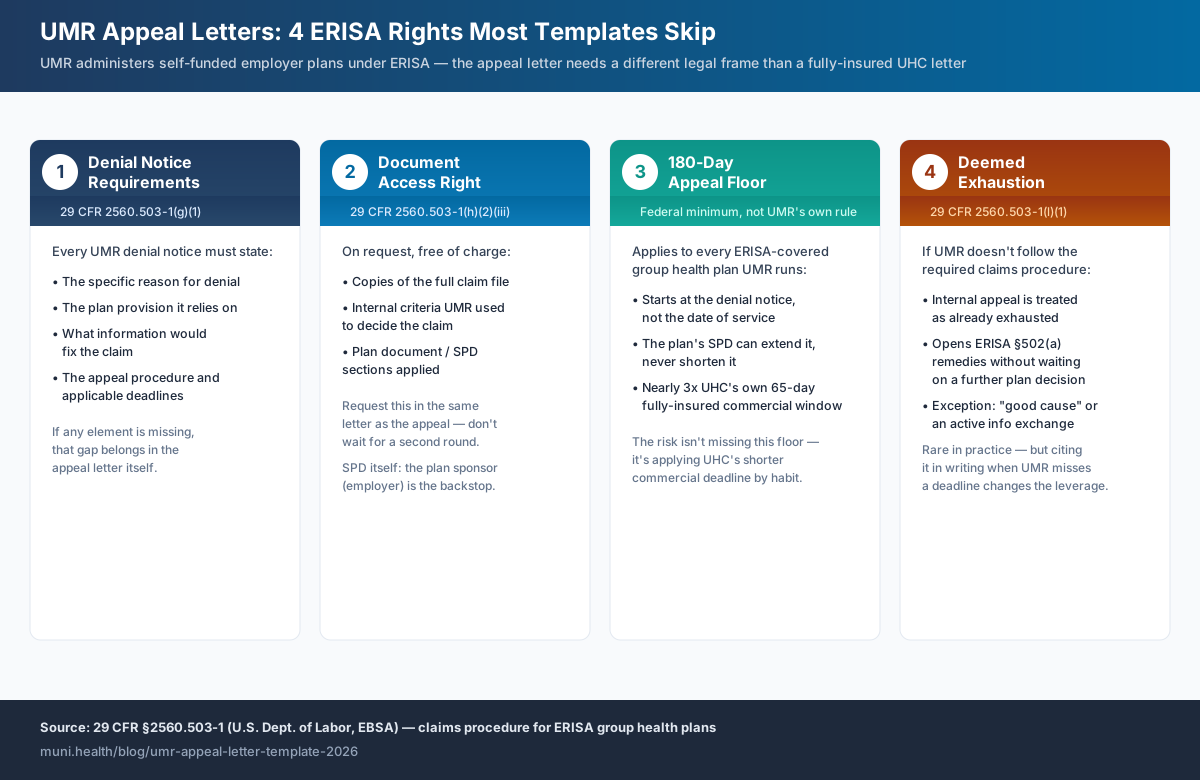
A UMR appeal letter needs the same basics as any payer letter — member ID, claim number, denial reason, clinical support — but the piece most templates skip is that UMR administers self-funded ERISA group health plans, not its own insurance policies. That changes the legal frame: the letter should cite the federal 180-day internal appeal floor (29 CFR §2560.503-1), request the claim file and relevant plan documents free of charge under the same regulation, and route to UMR's Claim Appeals address (PO Box 30546, Salt Lake City, UT 84130-0546) or the umr.com provider portal — never UHCProvider.com. If UMR fails to follow the required claims procedure, federal law lets you treat internal appeals as already exhausted.
Why a UMR Appeal Letter Isn't a UHC Appeal Letter With a New Logo
UMR is UnitedHealthcare's third-party administrator (TPA) for self-funded employer health plans — it processes claims on behalf of the employer, it doesn't underwrite the coverage. That distinction matters for the appeal letter itself, not just the deadline. Self-funded plans are governed by the Employee Retirement Income Security Act of 1974 (ERISA), and ERISA hands claimants specific procedural rights that a fully-insured UHC commercial plan doesn't carry the same way — most billing teams never invoke them because they're writing a UMR appeal as if it were a standard UHC one.
Self-funded plans aren't a niche corner of the market. 67% of covered workers nationally — and 80% at firms with 200 or more employees — are enrolled in a self-funded health plan, according to the KFF 2025 Employer Health Benefits Survey. At a mid-size or larger employer, the UMR-administered plan a patient carries is more likely to be the norm than the exception.
For the deadline mechanics specifically — why UMR doesn't have one fixed timely filing number and how to find the plan-specific window — see UMR Timely Filing Limit 2026. For the form itself — UMR's portal path and its Post-Service Appeal Request Form, field by field — see the UMR Appeal Form Guide. This post covers the letter itself: what to put in it, and the three ERISA rights worth invoking that a fully-insured template never mentions. For the fully-insured sibling — UHC's own commercial and Medicare Advantage appeal letters, built around Coverage Determination Guideline citations instead of ERISA claims-procedure rights — see Free UHC Appeal Letter Template 2026. Don't use that template for a UMR denial; the legal basis for each is different even when the treatment being appealed is identical.
Confirm the Plan Is Actually Self-Funded First
Not every UMR-branded ID card belongs to a self-funded ERISA plan — a small number of UMR-administered arrangements involve stop-loss or fully-insured components with different rules. If the plan document or SPD isn't available at intake, the safest default is to treat it as ERISA self-funded (the far more common case) and confirm during document collection.
The Three ERISA Rights a Fully-Insured Appeal Letter Never Needs
A UHC commercial appeal letter cites Coverage Determination Guidelines. A UMR appeal letter should cite the federal claims-procedure regulation that governs every ERISA group health plan — 29 CFR §2560.503-1. Three provisions in it are worth building directly into the letter.
1. What the Denial Notice Was Required to Contain
Under 29 CFR §2560.503-1(g)(1), every adverse benefit determination notice must include four specific things: the exact reason for the denial, the plan provision it relies on, a description of any additional information that would change the outcome, and a description of the plan's appeal procedure and deadlines. If the UMR denial notice is missing any of these — a common gap, since notices are often generated from a short remark code — that gap belongs in the opening paragraph of the appeal letter as a stated deficiency, not just something to work around silently.
2. The Right to the Claim File and Plan Criteria, Free of Charge
Under 29 CFR §2560.503-1(h)(2)(iii), a claimant (or their authorized representative — the appealing provider, if designated) is entitled to reasonable access to, and copies of, all documents, records, and information relevant to the claim, on request and at no cost. That includes the internal criteria UMR applied to decide the claim and the specific plan-document sections it relied on. Request this in the same letter as the appeal itself, not as a separate follow-up — it costs one sentence and can surface the exact language needed to rebut the denial before the appeal deadline runs out.
Two Different 'Plan Documents'
The claim-specific records UMR holds (the criteria it applied, the internal review notes) are what §2560.503-1(h)(2)(iii) requires UMR to produce. The full Summary Plan Description is a separate document that ERISA §104(b)(4) makes the plan administrator's responsibility — usually the employer, not UMR. If UMR can't produce the SPD directly, the request should go to the employer's benefits or HR contact in parallel.
3. Deemed Exhaustion: What Happens If UMR Skips a Step
29 CFR §2560.503-1(l)(1) provides that if a plan fails to establish or follow claims procedures consistent with the regulation, the claimant is deemed to have exhausted the plan's internal appeal process — meaning the claimant can pursue remedies under ERISA §502(a) without waiting for a further plan-level decision. Courts have carved out exceptions for violations made in good faith or during an active back-and-forth exchange of information, and there's an active circuit split over how strictly "consistent with the requirements" is enforced (U.S. Department of Labor, EBSA, Compliance Assistance — Group Health and Disability Plans Benefit Claims Procedure Regulation). It's not a routine tool, and it isn't a substitute for filing on time — but citing it in writing the moment UMR misses a required response deadline changes the leverage in the conversation immediately, well before anyone considers litigation.
| ERISA Provision | What It Gives the Provider | When to Use It |
|---|---|---|
| §2560.503-1(g)(1) | Denial notice must state reason, plan provision, missing info, and appeal steps | Opening paragraph, if the notice is incomplete |
| §2560.503-1(h)(2)(iii) | Free copies of claim file, criteria, and relevant plan-document sections | Same letter as the appeal, not a follow-up |
| §2560.503-1(l)(1) | Deemed exhaustion if UMR doesn't follow required procedure | Only after a documented missed deadline or procedural failure |
UMR Appeal Letter Template (ERISA Self-Funded Plan)
This template builds the ERISA framing into the letter itself rather than treating it as an afterthought — the document-access request and the 180-day floor statement are load-bearing paragraphs, not boilerplate.
[Your Practice Letterhead]

[Date]

UMR - Claim Appeals
PO Box 30546
Salt Lake City, UT 84130-0546
Fax: 877-291-3248
[Or submit via the UMR provider appeals portal at umr.com using a One Healthcare ID]

RE: Provider Appeal — Adverse Benefit Determination
Patient/Member Name: [Full Name]
UMR Member ID: [ID Number]
Group Number: [Group Number, if known]
Date of Birth: [MM/DD/YYYY]
Claim Number: [From EOB / denial notice]
Date(s) of Service: [Service date or range]
Provider Name / NPI / TIN: [Practice name / NPI / Tax ID]
Date of Denial Notice: [Date]
Denial Reason (verbatim from notice): "[Quote the exact denial language]"

Dear UMR Appeals Review Team:

I am writing on behalf of [Patient Name] to appeal the above adverse
benefit determination. This appeal is submitted within the applicable
appeal filing window. Because this plan is self-funded and governed by
ERISA, federal regulation 29 CFR §2560.503-1 requires the plan to allow
at least 180 days from the date of this denial notice to file an internal
appeal; this letter is submitted within that period. [If the plan's own
Summary Plan Description sets a longer window, state: "and within the
plan's own [XX]-day window per its Summary Plan Description."]

DENIAL NOTICE COMPLETENESS

Under 29 CFR §2560.503-1(g)(1), the adverse benefit determination notice
was required to state the specific reason for denial, the plan provision
relied on, a description of any information that would change the
outcome, and a description of the applicable appeal procedure. [If any
of these was missing from the notice, state which one(s) and note: "I am
requesting that this information be provided as part of the appeal
review."]

REQUEST FOR CLAIM FILE AND PLAN CRITERIA

Pursuant to 29 CFR §2560.503-1(h)(2)(iii), I am requesting reasonable
access to, and copies of, all documents, records, and information
relevant to this claim, free of charge, including the specific internal
criteria and plan-document provisions UMR applied in making this
determination. Please provide these materials promptly so they can be
reviewed as part of this appeal.

DENIAL REASON — SPECIFIC RESPONSE

UMR denied this claim citing: "[quote the exact reason from the denial
notice]." I respectfully disagree with this determination for the
following reasons:

[Respond directly to the stated denial reason — medical necessity, prior
authorization, timely filing, or coding. Address the specific criterion
UMR cited; a generic argument that doesn't respond to the stated reason
is easier for a reviewer to uphold.]

PATIENT CLINICAL PRESENTATION (for medical necessity denials)

[Patient Name] is a [age]-year-old patient diagnosed with [condition —
ICD-10 code]. Relevant clinical history:

- [Diagnosis, onset date, and relevant comorbidities]
- [Objective findings: labs, imaging, exam findings with dates]
- [Prior treatments attempted and documented outcomes]

MEDICAL NECESSITY / COVERAGE JUSTIFICATION

1. Plan Coverage Criteria
This service is medically necessary and consistent with the plan's own
coverage criteria for [condition/service] as reflected in the Summary
Plan Description and/or the plan-document excerpts requested above.

2. Clinical Guideline Support
[Service] is standard of care for [condition] per [medical society]
guidelines ([year]). [Patient Name]'s presentation meets the guideline's
indication because [specific clinical connection].

3. Failed Conservative Treatment (if applicable)
The following less intensive treatments were attempted before this
request without adequate clinical response:
- [Treatment 1]: [dates, dosage/duration, documented outcome]
- [Treatment 2]: [dates, dosage/duration, documented outcome]

FOR TIMELY FILING DENIALS — REPLACE THE SECTION ABOVE WITH:

This claim was originally submitted within the applicable timely filing
window under the plan document. Enclosed is proof of timely submission:
[277CA clearinghouse acknowledgment / umr.com portal confirmation / fax
transmission report] dated [date].

SUPPORTING DOCUMENTATION ENCLOSED

- Copy of the original denial notice
- [Clinical notes, diagnostic results, or prior treatment records]
- [Proof of timely filing, if applicable]
- [Prior authorization number and correspondence, if PA was granted]

REQUESTED RELIEF

I respectfully request that UMR overturn this denial and process payment
for [service, CPT/HCPCS code(s)] provided to [Patient Name] on [date of
service]. I am available for peer-to-peer or telephonic review at
[phone] or [email]. If this appeal is not decided within the plan's
required timeframe, or if the plan's claims procedure requirements under
29 CFR §2560.503-1 are not followed, I reserve all rights available under
ERISA, including treating internal remedies as exhausted under
§2560.503-1(l)(1).

Sincerely,

[Provider Name], [Credentials]
NPI: [Number]
[Practice Name, Address, Phone, Fax]

Enclosures: [List all attached documents]
Skip the blank template. Start with a review-ready draft.
Use the template as guidance, or let Muni prepare a payer-specific draft for your team to verify, sign, and submit.
First 3 appeals free, then $20 per appeal. Start with your denial letter or EOB and available records. No meeting or clearinghouse connection required.
ERISA Self-Funded, Not UHC Commercial
Skip the CDG citation language from UHC's own commercial template here — UMR-administered ERISA plans aren't reviewed against UnitedHealthcare's Coverage Determination Guidelines the way fully-insured commercial claims are. The plan document and SPD are the controlling coverage criteria, which is exactly why the document-access request above is load-bearing rather than optional.
Follow-Up Letter: When UMR Misses a Required Deadline or Step
This is the letter most appeal-template collections don't have, because it only applies to ERISA-governed plans. Use it if UMR fails to issue a decision within the required timeframe, or fails to provide the notice content or documents required above — not as a routine second letter.
[Your Practice Letterhead]

[Date]

UMR - Claim Appeals
PO Box 30546
Salt Lake City, UT 84130-0546
Fax: 877-291-3248

RE: Notice of Claims-Procedure Deficiency — [Patient Name], Claim #[Number]

Dear UMR Appeals Review Team:

On [date], I submitted an appeal on behalf of [Patient Name] regarding
claim #[number]. As of the date of this letter, [describe the specific
deficiency: "no decision has been issued within the plan's required
timeframe" / "the requested claim-file documentation under 29 CFR
§2560.503-1(h)(2)(iii) has not been provided" / "the denial notice dated
[date] did not include [missing element] as required under 29 CFR
§2560.503-1(g)(1)"].

Under 29 CFR §2560.503-1(l)(1), a plan's failure to establish or follow
claims procedures consistent with this regulation entitles the claimant
to be deemed to have exhausted the plan's administrative remedies. I am
documenting this deficiency in writing and requesting that it be
corrected promptly. Absent a response addressing the deficiency described
above by [date, typically 10-14 business days out], I will treat internal
appeal remedies as exhausted for the purposes of this claim.

Please contact me at [phone] or [email] to resolve this directly.

Sincerely,

[Provider Name], [Credentials]
NPI: [Number]
[Practice Name, Address, Phone, Fax]
UMR Appeal Letter vs. UHC Commercial Appeal Letter: What Actually Changes
| UMR (self-funded ERISA) | Fully-insured UHC commercial | |
|---|---|---|
| Governing framework | 29 CFR §2560.503-1 + employer's SPD | UHC's standard participation agreement + state law |
| Coverage criteria cited | Plan document / SPD provisions | UHC Coverage Determination Guidelines (CDGs) |
| Appeal filing floor | At least 180 days (federal minimum) | Varies by Participation Agreement; verify the denial notice and contract |
| Document access right | Free claim file + criteria under (h)(2)(iii) | Not a distinct federal right in the same form |
| If plan mishandles the appeal | Deemed exhaustion under (l)(1) may apply | State external review process applies instead |
| Submission route | umr.com / UMR Claim Appeals, PO Box 30546 | UHCProvider.com |
Prepare this appeal packet with your team.
Draft the appeal, coordinate missing documents, and approve the reviewed packet. Keep your clearinghouse; your practice checks deadlines and submits through the payer’s accepted channel.
First 3 appeals free, then $20 per appeal. Start with your denial letter or EOB and available records. No meeting or clearinghouse connection required.
If UMR upholds the appeal (or the process is deemed exhausted), the next step for most non-grandfathered self-funded plans is the federal external review process — either an accredited independent review organization or the HHS-administered process — rather than a state insurance department's external review, which applies to fully-insured plans instead. See the independent review organization appeal guide for how that process works and when it applies.
The Federal Floor Is the Practical Difference
UMR's ERISA framework supplies a federal 180-day minimum for the first internal appeal. UHC's commercial appeals guidance says timelines vary by Participation Agreement and the denial notice, so billing teams should not copy a commercial day count onto a UMR claim or assume every United-branded denial follows the same clock.
What to Attach to Every UMR Appeal
- The complete denial notice, including any stated criteria
- Office notes, diagnostic reports, and lab results tied directly to the denied service
- A physician letter of medical necessity that responds to UMR's specific stated reason
- The relevant clinical guideline citation (medical society guideline, CMS NCD/LCD where applicable)
- For a granted-then-denied prior authorization: the authorization number and related correspondence
- For timely filing appeals: the 277CA clearinghouse acknowledgment, portal confirmation, or fax transmission report
Common Mistakes That Slow Down a UMR Appeal
Submitting through UHCProvider.com. UMR routes through umr.com and the address above — a fully-insured UHC submission channel doesn't reach UMR's appeals queue, and the misroute can cost real time on a deadline that's already plan-specific.
Skipping the document-access request. The free claim-file and criteria request under §2560.503-1(h)(2)(iii) costs one paragraph and can surface the exact plan language needed to build a stronger rebuttal — most UMR appeal letters never ask for it.
Applying a fixed UHC commercial deadline out of habit. UHC's own provider guidance says commercial timelines vary by Participation Agreement. A UMR-administered plan instead has an ERISA first-level appeal floor of 180 days, so copy neither workflow's deadline onto the other without checking the governing denial notice and plan terms.
Treating the SPD as UMR's document to produce. UMR can typically produce claim-specific criteria; the full Summary Plan Description is the plan administrator's — usually the employer's — responsibility under ERISA §104(b)(4). If UMR can't produce it, go to the employer's benefits contact in parallel rather than waiting.
How Muni Appeals Supports UMR Appeal Letters
Writing a UMR appeal correctly means tracking which plan is self-funded, pulling the right ERISA citations, and requesting plan documents before the appeal clock runs — a workflow most billing teams handle inconsistently because it depends on remembering that "UMR" and "UHC" aren't the same appeal.
Muni Appeals organizes uploaded UMR denial materials and plan documents for staff review:
- Separates ERISA self-funded appeal guidance from UHC's fully-insured commercial defaults
- Compiles a review-ready packet including the document-access request language
- Surfaces the federal floor and any longer plan-specific window found in an uploaded SPD; staff verifies and calendars the controlling deadline
- Provides fields for staff to record submission confirmations and correspondence for deemed-exhaustion documentation if needed
For a worked comparison of manual appeal-writing time against automated preparation, see Muni Appeals Pricing Explained.
Frequently Asked Questions
What is UMR's appeal letter deadline?
There's no single UMR-wide number — the deadline comes from the employer's Summary Plan Description. The federal floor under 29 CFR §2560.503-1 requires at least 180 days from the denial notice for the first-level internal appeal; the SPD can extend that but cannot shorten it.
Is UMR the same as UnitedHealthcare?
No. UMR is a UnitedHealthcare affiliate that administers claims for self-funded employer plans — it processes claims on the employer's behalf rather than underwriting the coverage. That means UMR appeals follow the employer's plan document and federal ERISA claims-procedure rules, not UHC's fully-insured commercial policy, and route through umr.com rather than UHCProvider.com.
Where do I submit a UMR appeal letter?
Mail or fax to UMR - Claim Appeals, PO Box 30546, Salt Lake City, UT 84130-0546 (fax 877-291-3248), or submit through the UMR provider portal using a One Healthcare ID. Confirm the exact route on the specific denial notice, since some plans specify a dedicated address or portal path.
Can I request UMR's claim file and plan document for free?
Yes. Under 29 CFR §2560.503-1(h)(2)(iii), a claimant or authorized representative is entitled to reasonable access to, and free copies of, all documents, records, and information relevant to the claim — including the criteria UMR applied. The full Summary Plan Description is technically the plan administrator's (usually the employer's) responsibility under ERISA §104(b)(4), so request it from both if UMR can't produce it directly.
What is deemed exhaustion, and when does it apply to a UMR appeal?
Under 29 CFR §2560.503-1(l)(1), if UMR fails to establish or follow the claims procedures the regulation requires, the claimant is treated as having exhausted the plan's internal appeals — opening remedies under ERISA §502(a) without waiting for a further plan decision. Courts recognize exceptions for good-faith or in-process exchanges, so it's a documentation-and-leverage tool for a genuine procedural failure, not a routine substitute for the normal appeal process.
Does a UHC commercial appeal deadline apply to UMR claims?
No. UHC commercial appeal timelines vary by Participation Agreement and the denial notice, while UMR-administered plans are self-funded ERISA plans governed by 29 CFR §2560.503-1, which sets a minimum 180-day first-level internal appeal floor. Verify the specific plan terms instead of importing a commercial deadline into the UMR workflow.
What happens if UMR denies the appeal?
For most non-grandfathered self-funded plans, the next step is the federal external review process — either an accredited independent review organization or the HHS-administered process — rather than a state insurance department review. See the independent review organization appeal guide for how that process works.
Do I need the employer's Summary Plan Description to write a UMR appeal letter?
It strengthens the letter significantly but isn't strictly required to file — the template above works with the denial notice alone and includes a document-access request for the SPD and claim criteria as part of the same submission. Once the SPD language is in hand, cite the specific coverage provision directly rather than relying on the general ERISA floor alone.
Ready to Stop Treating Every United-Branded Denial the Same Way?
A UMR denial and a UHC commercial denial can look identical on the surface — same logo, similar EOB format — but they run on different legal frameworks with different deadlines, different document rights, and a different escalation path if the plan mishandles the appeal.
Get Started:
- UMR appeal letters built on the correct ERISA claims-procedure framing, not a relabeled UHC template
- Document-access requests included automatically alongside the appeal
- 180-day floor tracked separately from plan-specific commercial deadlines
- Submission and correspondence records kept for deemed-exhaustion documentation if it's ever needed
This guide reflects 2026 UMR appeal procedures under the federal ERISA claims-procedure regulation, 29 CFR §2560.503-1. Because UMR administers self-funded employer plans, exact appeal deadlines, coverage criteria, and external review eligibility vary by the specific plan's Summary Plan Description — always verify current plan terms before filing. This information is for administrative and billing purposes and is not legal or medical advice.