

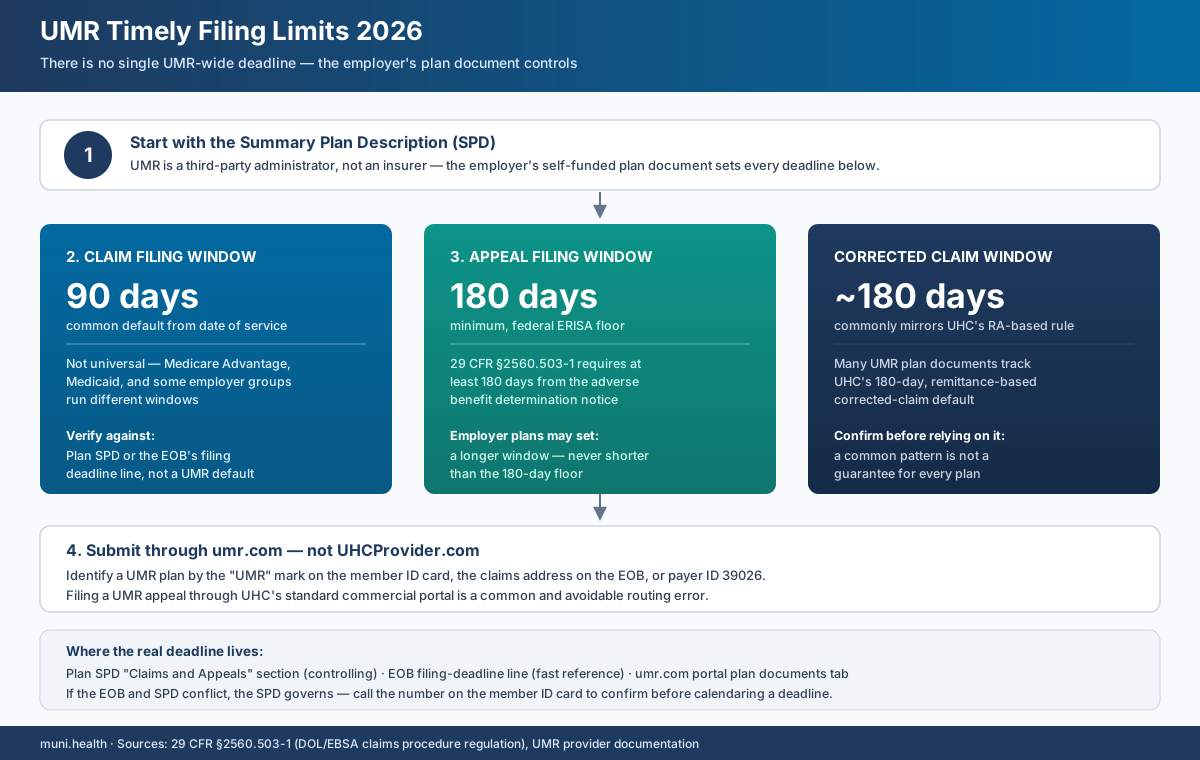
UMR does not have one company-wide timely filing limit — it's UnitedHealthcare's third-party administrator (TPA) for self-funded employer plans, and each employer's plan document sets the actual deadlines. In practice, claim submission commonly defaults to 90 days from the date of service, but the federal claims-procedure regulation (29 CFR §2560.503-1) requires every ERISA-covered group health plan — UMR-administered plans included — to give claimants at least 180 days to file an internal appeal after an adverse benefit determination. Corrected claims commonly mirror UHC's 180-day remittance-based window but must be confirmed. Submit through umr.com, not UHCProvider.com.
UMR Is Not an Insurer — It's a Third-Party Administrator
UMR is UnitedHealthcare's third-party administrator (TPA) for self-funded employer health plans, and it doesn't set its own uniform timely filing schedule — the employer's plan document does. UMR is the largest TPA in the country by member volume, but a TPA's job is to process claims and administer benefits on behalf of a self-funded employer, not to underwrite the plan. That distinction is the reason a generic "UMR timely filing = X days" answer is usually wrong for a specific claim.
Because UMR-administered plans are self-funded, employer-sponsored group health plans, they're governed by ERISA rather than a standard state-regulated insurance policy. The deadlines that matter — claim submission, corrected claim, and appeal — are written into that employer's Summary Plan Description (SPD), not into a single national UMR policy.
Two UMR Deadlines Are Different Things
Practices routinely conflate the claim filing deadline (how long you have to submit the original claim after the date of service) with the appeal filing deadline (how long you have to contest a denial). Both are plan-specific for UMR, but they run on separate clocks and have separate minimums under federal law.
Where to Find the Real UMR Timely Filing Limit for a Specific Plan
The SPD's "Claims and Appeals" section is the controlling document — if the EOB and the SPD ever conflict, the SPD wins. In practice, most billing teams don't have quick access to every patient's SPD, so there are two faster reference points that usually match it:
Prepare this appeal packet with your team.
Draft the appeal, coordinate missing documents, and approve the reviewed packet. Keep your clearinghouse; your practice checks deadlines and submits through the payer’s accepted channel.
First 3 appeals free, then $20 per appeal. Start with your denial letter or EOB and available records. No meeting or clearinghouse connection required.
- The EOB / remittance advice. UMR explanation of benefits documents typically print the applicable filing deadline directly, often labeled something like "claims must be submitted within [X] days of the date of service" or a parallel line for appeal rights.
- The umr.com provider portal. After registering with a Tax ID Number, the portal's claim status and plan documents sections show plan-specific filing windows tied to the member's group number.
If neither is available and the deadline is time-sensitive, calling the number on the back of the member's UMR ID card is faster than guessing. Confirming the actual plan-specific number before calendaring a deadline avoids two opposite failure modes: closing out a claim too early because a generic 90-day rule was applied to a plan with a longer window, or missing a shorter deadline because a different plan's SPD was assumed to apply.
How to Identify a UMR-Administered Plan
Look for the "UMR" mark on the member's ID card, a claims mailing or portal address referencing umr.com, or payer ID 39026 on the claim submission (UMR Insurance Billing Guide, QuickIntell, 2026) — this last one is a third-party billing reference, not an official UMR publication, so treat it as a quick identifier rather than a substitute for the plan's own documentation.
UMR Claim Submission Timely Filing: 90 Days Is Common, Not Guaranteed
UMR's most frequently seen claim submission window is 90 days from the date of service, but Medicare Advantage, Medicaid, employer-group, and secondary-payer claims commonly run on different windows (UMR Insurance Billing Guide, QuickIntell, 2026). Because this figure comes from a billing-guide aggregator rather than UMR's own published policy, treat it as a starting assumption to verify against the specific plan's SPD or EOB — not as a fixed rule to apply across every UMR claim.
| Deadline Type | Common Default | Governing Source | Verify Against |
|---|---|---|---|
| Initial claim submission | 90 days from date of service | Employer plan document (SPD) | SPD or EOB filing-deadline line |
| Corrected claim | ~180 days, RA-based (commonly mirrors UHC's default) | Employer plan document (SPD) | SPD; confirm before relying on the UHC-standard pattern |
| Internal appeal | At least 180 days from the adverse determination notice | 29 CFR §2560.503-1 (federal ERISA floor) + SPD | SPD — may be more generous than the 180-day floor, never less |
| External review | Varies by plan; commonly 120 days after internal appeal | Employer plan document (SPD) | SPD's external review section |
UMR accepts electronic claims via standard clearinghouses using ANSI X12 837P/837I formats, with real-time eligibility checks (270/271) and X12 278 prior authorization submissions supported for participating providers (UMR Insurance Billing Guide, QuickIntell, 2026). For most network providers, electronic submission through a clearinghouse or the umr.com portal is faster and more traceable than mail.
UMR Appeal Timely Filing: The 180-Day ERISA Floor
Federal law sets a hard floor, not a UMR-specific number: every ERISA-covered group health plan must give claimants at least 180 days following receipt of an adverse benefit determination to file an internal appeal. This comes directly from the Department of Labor's group health and disability claims procedure regulation, 29 CFR §2560.503-1, which governs self-funded plans like the ones UMR administers.
That 180-day minimum applies to the first level of appeal. For plans with a two-level internal review process, the regulation doesn't set a fixed number of days for the second level — it requires only that the plan give claimants a "reasonable opportunity" to pursue the full second-level review (U.S. Department of Labor, EBSA, Compliance Assistance — Group Health and Disability Plans Benefit Claims Procedure Regulation).
180 Days Is a Floor, Not a Ceiling
An employer plan can set an appeal window longer than 180 days — many do — but it cannot set one shorter. If a UMR denial letter or EOB cites an appeal deadline under 180 days, that's a red flag worth escalating with the plan sponsor or filing anyway with the correct federal minimum on record.
| Appeal Stage | Timeline | Basis |
|---|---|---|
| Internal appeal (first level) | At least 180 days from the denial notice | 29 CFR §2560.503-1 federal floor; SPD may extend it |
| Internal appeal (second level, if applicable) | Plan-specific — must be a "reasonable opportunity" | 29 CFR §2560.503-1; no fixed federal minimum for the second level |
| External review (independent third party) | Plan-specific — commonly measured from the internal-appeal denial | Employer plan document; ERISA external review process |
Because UMR sits underneath dozens of different employer plan designs, the practical move is to treat 180 days as the safe floor for the first appeal, then confirm the specific plan's SPD for the exact number and for second-level or external review timing — those aren't standardized the way the first-level floor is.
UMR Corrected Claim Timely Filing
UMR corrected claims commonly follow a pattern close to UHC's standard commercial corrected-claim rule — roughly 180 days from the original remittance date — but this is a common pattern observed across UMR-administered plans, not a guaranteed UMR-wide policy. Because UMR plan documents can and do diverge from UHC's fully-insured defaults, confirm the corrected-claim window in the specific plan's SPD before relying on the 180-day assumption, especially for high-dollar corrections where a missed window is costly.
Submit UMR corrected claims the same way as any other UMR claim — through the umr.com portal or a clearinghouse — using frequency/resubmission code 7 for a replacement claim and including the original claim number. For the full breakdown of how UHC's own corrected-claim rules work by plan type, including the frequency-code mechanics that also apply to most UMR-administered submissions, see the UHC corrected claim timely filing guide.
UMR vs. Fully-Insured UHC: What Actually Changes
The practical difference between a UMR claim and a standard fully-insured UHC commercial claim isn't the deadlines themselves — both commonly land near 90 days for claims — it's who controls those deadlines and where you submit.
| UMR (self-funded TPA) | Fully-insured UHC commercial | |
|---|---|---|
| Governing document | Employer's Summary Plan Description (SPD) | UHC's standard participation agreement |
| Claim TFL | Commonly 90 days — plan-specific | 90 days (most contracts) |
| Appeal TFL | ≥180 days (ERISA floor, 29 CFR §2560.503-1) | 65 calendar days |
| Submission portal | umr.com | UHCProvider.com |
| Payer ID (common) | 39026 | Varies by UHC product |
| Regulatory framework | ERISA self-funded plan rules | UHC's fully-insured commercial contract terms |
That appeal-window gap is the detail with the most financial consequence. UHC's own fully-insured commercial appeal deadline is a comparatively tight 65 calendar days, covered in full in the UHC appeal timely filing deadlines guide — while a UMR-administered plan is legally required to allow at least 180 days. A billing team that applies UHC's 65-day commercial deadline to a UMR denial by habit forfeits real appeal time it's entitled to under federal law.
The ERISA Floor Works in the Practice's Favor
Unlike UHC's tight commercial appeal window, the 180-day ERISA floor gives billing teams considerably more runway on UMR appeals. The risk isn't usually missing the deadline outright — it's assuming the shorter 65-day UHC commercial window applies and closing out a UMR denial before the real deadline arrives.
How to Submit a UMR Claim or Appeal
File electronically through the umr.com provider portal whenever possible — it produces an immediate confirmation and tracking record that becomes your proof of timely filing if a deadline is later disputed.
- Register or sign in at the UMR provider portal using a One Healthcare ID, with the practice's Tax ID Number on file
- For claim status or appeal initiation, use the portal's claim lookup to pull the original claim before starting a correction or appeal
- Submit corrected claims and appeals through the portal's tracking tools, which log both the submission and any status updates
- For electronic claim submission, route through a standard clearinghouse using payer ID 39026 with ANSI X12 837P/837I formats
- For member-initiated appeals, UMR maintains a dedicated Post-Service Appeal Request form; provider-initiated appeals typically route through the same portal appeal-initiation workflow — see the UMR Appeal Form Guide for the field-by-field walkthrough and the Provider Inquiry vs. Member Appeal distinction
Providers can also reach UMR directly for claim status, eligibility, and authorization questions at 1-800-826-9781 (UMR Insurance Billing Guide, QuickIntell, 2026).
umr.com, Not UHCProvider.com
UMR claims, corrections, and appeals route through umr.com — a separate system from UHCProvider.com. Submitting a UMR appeal through the standard UHC commercial portal, or filing it against UHC's 65-day commercial deadline instead of the 180-day ERISA floor, is the most common UMR-specific filing error billing teams make.
What Happens If You Miss a UMR Deadline
A late claim submission typically results in a denial that's difficult to overturn without a documented exception reason; a late appeal is governed by the specific plan's SPD language on exceptions, since UMR itself doesn't set a uniform late-filing policy. As with most payers and TPAs, "the deadline wasn't tracked" is not treated as a valid exception — the practical defense against missed UMR deadlines is knowing which plan document actually governs a given claim before the window closes, not after.
Because UMR sits under so many different plan designs, a claim that looks routine can carry an unusually generous or unusually tight deadline depending entirely on the employer's SPD. Confirming the actual window at intake — rather than defaulting to a generic assumption — is the highest-leverage step for any practice with meaningful UMR volume.
Writing the Actual UMR Appeal Letter
Knowing the deadline is only half the job — the letter itself should also invoke the ERISA claims-procedure rights that come with a self-funded plan, including a free request for the claim file and plan criteria and the "deemed exhaustion" remedy if UMR skips a required step. See UMR Appeal Letter Template 2026 for the full letter template, an escalation letter for missed deadlines, and a side-by-side comparison against UHC's own fully-insured appeal letter.
How Muni Appeals Supports UMR Deadline Review
Tracking UMR deadlines by hand means pulling the correct SPD or EOB language for each individual employer plan, rather than applying one fixed rule across a UMR panel — a workflow that doesn't scale past a handful of patients without a system behind it.
Prepare this appeal packet with your team.
Draft the appeal, coordinate missing documents, and approve the reviewed packet. Keep your clearinghouse; your practice checks deadlines and submits through the payer’s accepted channel.
First 3 appeals free, then $20 per appeal. Start with your denial letter or EOB and available records. No meeting or clearinghouse connection required.
Muni Appeals organizes uploaded UMR denial materials and plan documents for staff review:
- Surfaces the ERISA appeal floor and any uploaded SPD language that may set a different window
- Separates claim, corrected-claim, and appeal deadline guidance from UHC commercial defaults
- Compiles a review-ready packet with UMR submission guidance
- Organizes uploaded SPD excerpts and EOB deadline language with the appeal materials for staff review
Frequently Asked Questions
What is UMR's timely filing limit?
There isn't a single UMR-wide timely filing limit. UMR is UnitedHealthcare's third-party administrator for self-funded employer plans, and each employer's Summary Plan Description sets the actual deadline. The most commonly seen claim submission default is 90 days from the date of service, but this varies by plan and should be confirmed against the SPD or EOB rather than assumed.
Is UMR the same as UnitedHealthcare?
No. UMR is a UnitedHealthcare affiliate that operates as a third-party administrator for self-funded, ERISA-covered employer health plans — it processes claims on behalf of the employer rather than underwriting the coverage itself. Because of that structure, UMR's timely filing rules come from the employer's plan document, not from UHC's standard fully-insured commercial policy, and UMR claims route through umr.com rather than UHCProvider.com.
What is the UMR appeal deadline?
Federal law under 29 CFR §2560.503-1 requires every ERISA-covered group health plan, including UMR-administered plans, to allow claimants at least 180 days from the adverse benefit determination notice to file an internal appeal. An employer's plan document can extend this window but cannot shorten it below 180 days. This is materially longer than UHC's own 65-day fully-insured commercial appeal deadline.
Where do I find the actual timely filing limit for a specific UMR plan?
Start with the EOB or remittance advice, which typically prints the applicable filing deadline directly. For the controlling answer, check the plan's Summary Plan Description under its "Claims and Appeals" section — if the EOB and SPD ever disagree, the SPD governs. The umr.com provider portal's plan documents section is another fast reference point once registered with the practice's Tax ID Number.
What is UMR's corrected claim timely filing limit?
Many UMR-administered plans mirror UHC's standard commercial corrected-claim window of roughly 180 days from the original remittance date, but this is a common pattern rather than a guaranteed UMR-wide rule. Confirm the specific plan's SPD before relying on it. Corrected claims submit the same way as other UMR claims — through umr.com or a clearinghouse — using resubmission code 7 with the original claim number included.
How do I submit a claim or appeal to UMR?
Submit electronically through the umr.com provider portal after registering with a One Healthcare ID and the practice's Tax ID Number, or route electronic claims through a standard clearinghouse using payer ID 39026. The portal supports claim status lookup, corrected claim submission, and appeal initiation with tracking. Providers can also call 1-800-826-9781 for claim status and authorization questions.
Does UHC's 65-day appeal deadline apply to UMR claims?
No, and applying it is one of the most common UMR filing mistakes. UHC's 65-day appeal window applies to UHC's own fully-insured commercial plans. UMR-administered plans are self-funded ERISA plans governed by 29 CFR §2560.503-1, which sets a minimum 180-day internal appeal window — nearly three times longer than UHC's commercial deadline. Treating a UMR denial as if it were a standard UHC commercial denial can lead a billing team to abandon a claim well before the real deadline.
What happens if I miss a UMR filing deadline?
There's no single UMR-wide late-filing exception policy — outcomes depend on the specific plan's SPD language. As with most payers, an untracked deadline caused by administrative oversight is unlikely to be accepted as a valid exception. The stronger position is confirming the correct plan-specific deadline at intake, since a UMR plan's window can be materially different from the generic defaults billing teams apply out of habit.
Ready to Stop Guessing at UMR Deadlines?
UMR's biggest filing risk isn't a short deadline — the 180-day ERISA appeal floor is one of the more generous windows in the industry. It's applying the wrong assumption: UHC's 65-day commercial window, a different payer's rule, or a guessed claim TFL instead of the number the plan's own SPD actually sets.
Get Started:
- Plan-specific UMR deadline guidance instead of a one-size-fits-all default
- ERISA appeal-floor context separated from UHC commercial guidance
- Documentation storage at the claim level for SPD and EOB references
- Review-ready appeal packages with umr.com submission guidance
This guide reflects 2026 UMR claims and appeals procedures based on the federal ERISA claims procedure regulation (29 CFR §2560.503-1), UMR's published provider resources, and industry billing references. Because UMR administers self-funded employer plans, exact timely filing and appeal deadlines vary by plan and are governed by each employer's Summary Plan Description — always verify the specific plan's terms before calendaring a deadline. For UHC's own fully-insured commercial and Medicare Advantage timely filing rules, see the UHC Appeal Timely Filing Deadlines 2026 and UHC Corrected Claim Timely Filing Limit 2026 guides.