

Kaiser Permanente splits appeals into two letters with two destinations. A provider payment dispute letter — for your own claim's payment, coding, bundling, or timely filing — goes to the regional Claims Administration or Provider Dispute Resolution unit. A member grievance and appeal letter — for a coverage, medical necessity, or care decision — generally goes to the regional Member Relations department in the patient's name or through an authorized representative. Do not treat signed authorization as universal: Kaiser's Mid-Atlantic provider manual says that, in some Medicare cases, a health care professional may file a pre-service initial determination request or appeal without additional authorization. Follow the current denial notice and Evidence of Coverage (EOC), or confirm the rule with the plan representative, before filing or mailing either letter.
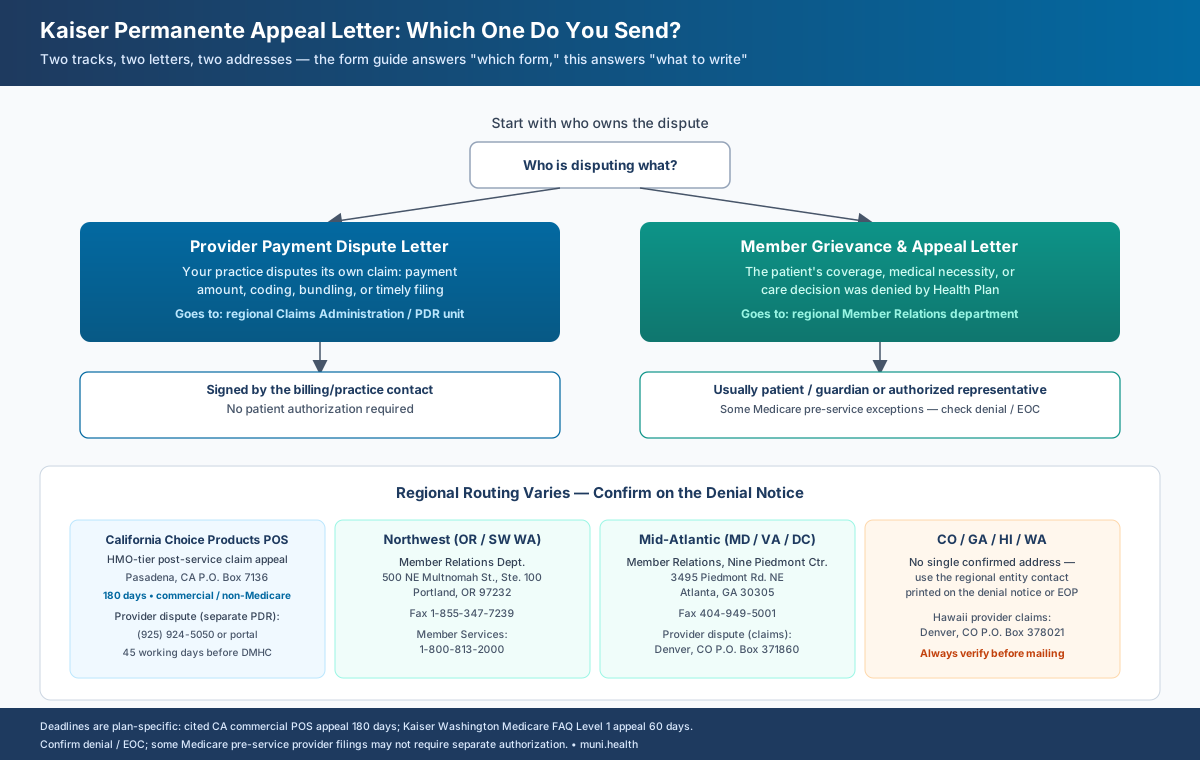
Two Letters, Not One
Kaiser Permanente does not publish a single "Kaiser appeal letter." Which letter you send depends on who owns the dispute, not how strong the clinical argument is:
- Provider payment dispute — your practice is disputing the amount Kaiser paid on a claim it processed: coding, bundling, contractual allowed amount, or timely filing. Your practice signs and files it, no patient authorization needed.
- Member grievance and appeal — Kaiser denied coverage, a prior authorization, or a specific medical necessity determination for the patient. The patient or authorized representative is ordinarily the filer, even when a billing staffer drafts the letter. A documented exception exists for some provider-filed Medicare pre-service initial determinations or appeals; use the denial notice, EOC, and plan representative to confirm whether it applies.
For the regional forms that carry each letter — Kaiser's Provider Dispute Resolution Request, its Member Relations Grievance and Appeal Form, and the region-by-region variations — see the Kaiser Permanente appeal form guide 2026. This guide covers what to write once you know which form applies; that one covers which form to use. For the deadlines behind each track, see the Kaiser Permanente timely filing limits guide 2026.
Not a 'Health Plan vs. Medical Group' Split
Kaiser's own provider manuals and member forms describe this as a payment dispute vs. grievance/appeal split, not a separate "health plan" track and "medical group" track. The decision that gets appealed — a coverage denial, a medical necessity determination, or a claim payment — is issued by Kaiser Foundation Health Plan in every region reviewed for this guide. The practical fork that determines which letter and address you use is who is filing and what is being disputed, covered above.
Provider Payment Dispute Letter Template
Use this version only when your practice is disputing its own claim payment — not a coverage decision. Attach it to the regional Provider Dispute Resolution form (or submit it in place of that form where Kaiser accepts a complete written dispute, as California does). Quote the denial reason from the Explanation of Payment (EOP) exactly; a generic restatement of the clinical story does not answer a coding or bundling denial.
If the disputed action is a timely filing denial, pull your transmission confirmation or 277 acknowledgment before drafting — the Kaiser Permanente timely filing limits guide 2026 covers what Kaiser accepts as proof of timely submission.
[Practice Letterhead]

[Date]

Kaiser Permanente — [Regional Entity Name]
[Claims Administration / Provider Dispute Resolution address from
the denial notice or EOP — see the regional table below]

RE: Provider Payment Dispute

Provider Name / Tax ID: [Practice name / Tax ID]
Provider Type: [ ] Contracted (PAR)  [ ] Non-Contracted
Member Name: [Full Name]
Kaiser Member/Medical Record Number: [ID]
Claim Number(s): [From EOP]
Date(s) of Service: [Date or Range]
Total Billed Amount in Dispute: [Amount]
Denial Reason (verbatim from EOP): "[Quote the exact denial reason]"

Our practice is disputing the payment amount, coding determination, or
timely filing status on the claim above. This is a provider payment
dispute concerning what Kaiser owes the practice under its payment
policy or provider agreement — it is not a member coverage appeal.

OUR POSITION

[State specifically why the denial reason does not apply. Cite the
applicable Kaiser payment policy, provider agreement provision, coding
guideline (NCCI edit, modifier support), or proof of timely submission.
Reference each enclosed document by name.]

ENCLOSED

- Copy of the original claim and EOP showing the denial
- [Coding documentation, operative note, or itemized bill supporting
the disputed amount]
- [277 acknowledgment, clearinghouse confirmation, or certified mail
receipt if timely filing is disputed]
- [Provider agreement provision or payment policy, if applicable]

Please issue a corrected EOP and direct your written determination to
the contact below.

Sincerely,

[Name], [Title]
[Practice Name, Address, Phone, Fax, Tax ID / NPI]

Enclosures: [List each attached document]
Skip the blank template. Start with a review-ready draft.
Use the template as guidance, or let Muni prepare a payer-specific draft for your team to verify, sign, and submit.
First 3 appeals free, then $20 per appeal. Start with your denial letter or EOB and available records. No meeting or clearinghouse connection required.
Member Grievance and Appeal Letter Template
Use this version for a coverage denial, prior authorization denial, or medical necessity determination — never for your practice's own payment dispute. Ordinarily, the patient signs it or signs an authorization naming the practice as representative. Kaiser's current Mid-Atlantic provider manual documents a narrower exception: in some Medicare cases, a health care professional may file a pre-service initial determination request or appeal without additional authorization. That is not a general exception for Medicare, post-service claims, or payment disputes. Follow the denial notice and EOC, and ask the plan representative to confirm the filing and authorization rules for the specific plan before relying on it.
Pull the specific coverage criteria Kaiser cited before drafting the narrative, and confirm the plan, service, and region. The Kaiser Permanente medical necessity letter template uses Washington guidance to explain Kaiser Clinical Review Criteria, MCG/ASAM for some services, and Aetna medical clinical policies for care through the Aetna Signature Administrators network. Do not infer the criteria from a PPO or point-of-service label alone. The medical necessity justification letter guide 2026 covers the general cross-insurer approach.
[Patient Name, or "on behalf of [Patient Name]" if a representative files]

[Date]

Kaiser Permanente — [Regional Entity Name]
Member Relations Department
[Address from the denial notice or the regional table below]

RE: Member Grievance and Appeal
Patient Name: [Full Name]
Kaiser Health Record / Member Number: [ID]
Denial or Authorization Reference: [Number, from the denial notice]
Service or Treatment Denied: [Description]
Date of Denial Notice: [Date]

[If a practice files on the patient's behalf: The attached signed
authorization designates this practice as the patient's representative
for this appeal. If the denial notice, EOC, or plan representative has
confirmed a Medicare pre-service exception, identify that plan-specific
rule here instead; do not assume the exception applies.]

I am appealing Kaiser's decision to deny coverage for the service or
treatment above.

DENIAL REASON AND RESPONSE

Kaiser's notice states: "[Quote the exact denial reason.]"

The determination should be reversed because: [Respond directly to
the coverage criteria or medical necessity standard Kaiser cited.
Reference the plan's Evidence of Coverage provision and the specific
clinical evidence — test results, treatment history, published
guideline support — that meets it. Do not restate the diagnosis
without tying it to the cited criteria.]

ENCLOSED

- Complete denial notice
- Signed authorization if the plan requires it, or documentation of a confirmed Medicare pre-service filing exception
- Clinical notes, imaging or test results, and treatment history
- Medical necessity letter and any supporting clinical guideline
- [Prudent layperson documentation, if this is an emergency-billing
dispute rather than a medical necessity denial]

REQUESTED RESOLUTION

Please reverse the adverse determination and approve coverage for
[service or treatment]. Send the written decision and appeal-rights
notice to the patient and, if applicable, to the authorized
representative named above.

Sincerely,

[Patient or Authorized Representative Name; or treating professional
only when a Medicare pre-service filing exception is confirmed]
[Contact Information]

Enclosures: [List each attached document]
Emergency Claim Disputes Use the Member Track
When Kaiser contests whether an out-of-network emergency visit qualifies as a genuine emergency, that is a member coverage question, not a payment coding question — file it as a member grievance and appeal (or the applicable provider dispute if the plan routes it that way on the denial notice), and lead with presenting symptoms and the prudent layperson standard rather than the final diagnosis. The Kaiser Permanente appeal guide 2026 covers the prudent layperson documentation in detail.
Regional Mailing Addresses and Deadlines
Kaiser operates as separate regional entities, and both the address and the appeal deadline vary by region, product, and stage of review. The Pasadena address and 180-day deadline below come only from Kaiser's current California Choice Products POS member-claims page for a post-service claim decision under the HMO tier (Kaiser Permanente California POS member claims); they are not a general California or Medicare rule. Kaiser's current Washington Medicare FAQ separately lists 60 calendar days from the written notice for the Level 1 appeal it describes (Kaiser Permanente Medicare appeal FAQ). The other sources are the Northwest region's current Member Relations Grievance and Appeal Form (Kaiser Foundation Health Plan of the Northwest form) and the Kaiser Permanente Mid-Atlantic States provider manual, Chapter 5 (December 2025 edition). For any other plan or appeal stage, use the denial notice and current EOC or confirm with the plan representative before mailing.
Prepare this appeal packet with your team.
Draft the appeal, coordinate missing documents, and approve the reviewed packet. Keep your clearinghouse; your practice checks deadlines and submits through the payer’s accepted channel.
First 3 appeals free, then $20 per appeal. Start with your denial letter or EOB and available records. No meeting or clearinghouse connection required.
| Region / Plan | Letter Type | Confirmed Address | Deadline |
|---|---|---|---|
| California — Choice Products POS, HMO-tier post-service claim decision | Member grievance & appeal | Kaiser Foundation Health Plan, Inc., Attn: Health Plan Clinical Review Special Services, P.O. Box 7136, Pasadena, CA 91109-7136 (fax 626-405-3039) | 180 days from the adverse benefit determination notice for this commercial/non-Medicare POS context |
| California — provider payment dispute | Provider payment dispute | Regional PDR unit: (925) 924-5050, or Kaiser's Online Affiliate portal | 45 working days of PDR review before DMHC will accept a complaint |
| Northwest (OR, SW WA) | Member grievance & appeal | Kaiser Foundation Health Plan of the Northwest, Member Relations Dept., 500 NE Multnomah St., Ste. 100, Portland, OR 97232 (fax 1-855-347-7239) | Check the denial notice; expedited review available for urgent cases |
| Mid-Atlantic (MD, VA, DC) | Member grievance & appeal | Kaiser Permanente, Attn: Member Relations, Nine Piedmont Center, 3495 Piedmont Rd. NE, Atlanta, GA 30305 (fax 404-949-5001) | Grievances handled within 30 calendar days; appeal deadline per the plan's Evidence of Coverage |
| Mid-Atlantic / Hawaii — provider payment dispute | Provider payment dispute | Claims Administration, P.O. Box 371860 (Mid-Atlantic) or P.O. Box 378021 (Hawaii), Denver, CO 80237-9998 | Varies by plan type — see the form for the member's specific plan |
| Washington — Medicare health plan Level 1 | Member coverage or payment appeal | Use the Member Services routing in the current denial notice and EOC | 60 calendar days from the written coverage or payment decision notice on Kaiser's current Washington Medicare FAQ; confirm the current plan documents |
| Colorado, Georgia, Washington state — other plan contexts | Either | No single confirmed address for this guide — use the regional Provider Services line or Member Relations contact printed on the denial notice or EOP | Check the denial notice and EOC |
Confirm Before You Mail
Kaiser's own California member-claims page lists a third address — Kaiser Permanente Insurance Company, Member Relations Appeals, P.O. Box 1809, Pleasanton, CA 94566 — for participating and non-participating provider appeals tied to specific POS and indemnity products. Addresses vary by plan type even within one region. Use the address on the specific denial notice or EOP, not a bookmarked address from a prior claim.
What to Attach to Either Letter
- The complete denial notice or EOP, unaltered
- The letter that matches the dispute type — do not send both templates for one denial
- Signed patient authorization when the plan requires it for a practice-filed member appeal; document any confirmed Medicare pre-service exception instead
- The specific policy, provider-agreement provision, or Evidence of Coverage language the denial cites
- Clinical records or coding documentation tied directly to the cited denial reason
- Proof of timely submission, when timely filing is the disputed issue
- A copy of the complete packet and its submission confirmation, kept with the case
Common Mistakes With Kaiser Appeal Letters
Sending the payment dispute letter for a coverage denial. A provider payment dispute letter answers a coding or payment question. It will not move a medical necessity denial, which belongs on the member grievance and appeal track and ordinarily needs the patient or an authorized representative to file; confirm any Medicare pre-service exception from the plan documents.
Assuming one authorization rule covers every member appeal. Signed authorization is ordinarily required when a practice files for a member. Kaiser's Mid-Atlantic manual documents that some health care professionals caring for Medicare patients may file a pre-service initial determination request or appeal without additional authorization. Treat that as a plan- and stage-specific exception: follow the denial notice and EOC, or confirm with the plan representative, before filing.
Reusing a mailing address from a prior claim. Kaiser's own forms show different addresses for HMO, POS, and provider-dispute products within the same region. Confirm the address on the current denial notice each time.
Restating the diagnosis instead of answering the cited criteria. Kaiser's denial notice names a specific coverage provision or clinical criterion. A letter that responds to that exact criterion is stronger than one that generally argues the treatment was appropriate.
Applying one deadline across Kaiser plans. The cited 180-day clock applies to the commercial/non-Medicare California Choice Products POS HMO-tier post-service claim decision described on Kaiser's member-claims page. It does not establish a Medicare deadline. For example, Kaiser's current Washington Medicare FAQ gives 60 calendar days from the written notice for the Level 1 appeal it describes. Use the current denial notice and EOC for the actual plan.
How Muni Appeals Helps With Kaiser's Two-Track Process
Kaiser's split between provider payment disputes and member grievances — layered on top of regional addresses that shift by plan type — means billing teams need to get the letter, the signature, and the address right before the clinical argument even gets read.
Muni Appeals helps billing teams organize the denial materials, draft the letter that matches the correct track, and keep the recorded submission method with the case. Staff remains responsible for confirming the current Kaiser regional address, the plan-specific deadline, and the applicable authorization or documented Medicare pre-service exception before filing.
For the underlying cost comparison between handling this manually and systematizing it, see our appeal automation cost vs. manual guide.
Frequently Asked Questions
Does Kaiser Permanente have one appeal letter for every denial?
No. Kaiser splits appeals into a provider payment dispute letter, filed by the practice over its own claim payment, and a member grievance and appeal letter, filed in the patient's name over a coverage or medical necessity decision. The two use different forms, different addresses, and different signers.
Who signs the Kaiser member grievance and appeal letter?
Ordinarily, the patient, parent/legal guardian, or a representative named in a signed authorization. Kaiser's Mid-Atlantic provider manual says that in some Medicare cases a health care professional may file a pre-service initial determination request or appeal without additional authorization. Do not extend that exception to other Medicare appeals, post-service claims, or products; follow the denial notice and EOC or confirm with the plan representative.
Where do I send a Kaiser provider payment dispute letter?
To the regional Claims Administration or Provider Dispute Resolution unit for the Kaiser entity that processed the claim — for example, California's PDR unit at (925) 924-5050, or the Mid-Atlantic/Hawaii Claims Administration P.O. boxes in Denver, CO. Confirm the current address on the EOP, since it can vary by plan type within a region.
What is Kaiser's appeal deadline for a California Choice Products POS claim denial?
For the commercial/non-Medicare California Choice Products POS HMO-tier post-service claim decision described on Kaiser's published member-claims page, the plan must receive the appeal within 180 days of the adverse benefit determination notice. That deadline does not cover every California plan or Medicare appeal. Kaiser's current Washington Medicare FAQ, for example, gives 60 calendar days from the written notice for the Level 1 appeal it describes. Always use the current denial notice and EOC for the member's plan. The 45-working-day Provider Dispute Resolution rule is a separate provider-payment process before a complaint can go to the California Department of Managed Health Care.
Can I use the provider payment dispute letter for a prior authorization denial?
No. A prior authorization or medical necessity denial is a coverage decision, which goes through the member grievance and appeal track even when the practice drafts the letter and gathers the clinical documentation. A provider still may be permitted to file certain Medicare pre-service appeals without additional authorization when the plan's rules say so; confirm that exception from the denial notice, EOC, or plan representative. The provider payment dispute letter is for claim payment, coding, and billing issues only.
Does the Mid-Atlantic region use the same address for provider disputes and member grievances?
No. Kaiser's Mid-Atlantic member grievance and appeal letters go to the Member Relations address in Atlanta, GA, while Mid-Atlantic provider payment disputes route through Claims Administration in Denver, CO. Sending either letter to the other address delays routing.
What if I don't know which Kaiser region processed the claim?
Check the denial notice, EOP, or the member's ID card — each identifies the Kaiser regional entity. If it isn't listed, Kaiser's regional Provider Services or Member Services line (see the Kaiser Permanente provider phone numbers guide 2026 for the number by region) can confirm routing before you mail either letter.
Is a written letter required, or can I call instead?
Kaiser accepts standard, non-urgent appeals and grievances in writing. Expedited appeals, for situations where waiting could seriously jeopardize the patient's health, can generally be initiated by phone through the regional Member Services line — but a written record still strengthens the case and should follow even an expedited verbal request.
Send the Letter That Matches the Dispute
The letter itself is not the hard part. Getting the track, the signature, and the regional address right before Kaiser reads a word of the clinical argument is what determines whether it gets processed the first time.
Get Started:
- Confirm whether this is a provider payment dispute or a member grievance and appeal
- Use the matching template above — not a generic combined letter
- Get the patient's signature or authorization before filing a member appeal, unless the plan confirms a documented Medicare pre-service exception
- Confirm the current regional address on the denial notice or EOP
This guide reflects Kaiser Permanente provider payment dispute and member grievance and appeal materials available as of August 18, 2026, including Kaiser Foundation Health Plan of the Northwest's Member Relations Grievance and Appeal Form, the Kaiser Permanente Mid-Atlantic States provider manual (December 2025), Kaiser's California Choice Products POS member-claims page, and Kaiser's Washington Medicare appeal FAQ. Kaiser operates as separate regional entities with forms, authorization rules, addresses, and deadlines that vary by region, product, and appeal stage and change over time — always verify current requirements from the denial notice, EOC, or Kaiser's regional Member Relations or Provider Relations representative before filing. This information is for administrative and billing purposes and is not medical or legal advice. Muni Health is not affiliated with Kaiser Permanente.