

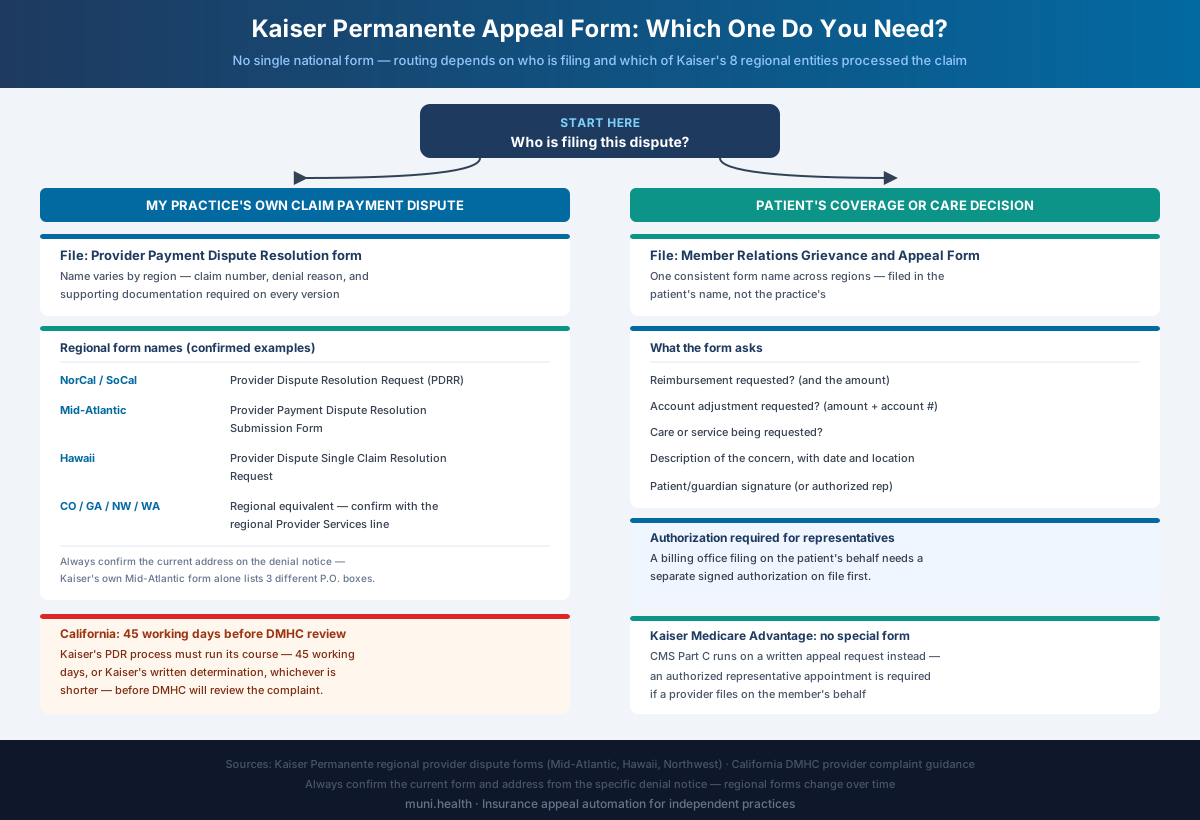
Kaiser Permanente publishes different appeal paths by region and dispute type. Practices challenging their own claim payment generally use the regional provider dispute process; patients or authorized representatives challenging coverage or care use the Member Relations grievance and appeal process. Confirm the form and address on the denial notice. In California, complete Kaiser's process or wait 45 working days before asking DMHC to review.
Why There's No Single "Kaiser Appeal Form"
Kaiser Permanente publishes regional claims and dispute materials for Northern California, Southern California, Colorado, Georgia, Mid-Atlantic (Maryland, Virginia, D.C.), Northwest (Oregon and Southwest Washington), Washington state, and Hawaii. Its published forms and submission instructions vary by region and dispute type, so there is no single form that covers every Kaiser appeal.
On top of the regional split, Kaiser separates disputes by who is filing: a practice disputing its own claim payment uses a different form and address than a patient (or a practice filing on the patient's behalf) disputing a coverage or medical necessity decision. Using the wrong one routes the paperwork to the wrong department and burns time you may not have on a filing deadline.
For the full appeal process — including peer-to-peer review, external review, and the CMS Medicare Advantage process — see the Kaiser Permanente appeal guide 2026. This guide focuses specifically on identifying and completing the right form. For the phone number to call in each of these eight regions before or after filing, see the Kaiser Permanente provider phone numbers guide.
Which Form Do You Need? Provider Dispute vs. Member Grievance
Start here. The two tracks use different forms, go to different departments, and cannot substitute for one another.
| Question | Provider Payment Dispute | Member Grievance & Appeal |
|---|---|---|
| Who files it? | The billing practice, on its own claim | The patient, parent/guardian, or an authorized representative |
| What it covers | Claim payment, coding, timely filing, bundling, or administrative denials on a claim you submitted | Coverage decisions, medical necessity denials, requests for care or service, or reimbursement to the member |
| Form name (varies by region) | "Provider Dispute Resolution Request" (CA), "Provider Payment Dispute Resolution Submission Form" (Mid-Atlantic), "Provider Dispute Single Claim Resolution Request" (Hawaii), or regional equivalent | "Member Relations Grievance and Appeal Form" |
| Where it goes | The regional Kaiser Claims Administration or Provider Dispute Resolution unit for the entity that processed the claim | The regional Kaiser Member Relations Department |
| Signature required | Provider or practice billing contact | Patient/guardian signature, or a separate authorization form if someone else represents them |
If a claim was denied and you, the practice, want the payment reconsidered — use the provider dispute form. If a patient's prior authorization or medical necessity determination was denied and you're helping them fight it, that's the member grievance and appeal track, and you'll typically need the patient's signed authorization to act as their representative.
Provider Payment Dispute Resolution Forms by Region
Kaiser publishes region-specific provider dispute materials. Three confirmed examples show the pattern — and the variation:
Official examples include Kaiser's California Provider Dispute Resolution Request, Mid-Atlantic Provider Payment Dispute Resolution Submission Form, and Hawaii Provider Dispute Single Claim Resolution Request.
| Region | Form | Key Fields | Submit To |
|---|---|---|---|
| Northern & Southern California | Provider Dispute Resolution Request (PDRR) | Provider info, claim number, denial reason, dispute description; may also submit a complete written dispute without the PDRR | Regional PDR unit — NorCal Provider Dispute Resolution Unit: (925) 924-5050, or Online Affiliate portal |
| Mid-Atlantic (MD, VA, DC) | Provider Payment Dispute Resolution Submission Form | Provider Tax ID, denial reason code (e.g., timely filing, unbundled procedure, not separately payable), member name, claim number(s), billed amount | Mid-Atlantic Claims Administration, P.O. Box 371860, Denver, CO 80237-9998 (address varies by plan type — see form) |
| Hawaii | Provider Dispute Single Claim Resolution Request | Provider name/Tax ID, contracted or non-contracted status, patient name, Kaiser claim ID, billed/paid amounts, detailed dispute description | KP Hawaii – Provider Appeals, Claims Admin Dept, PO Box 378021, Denver, CO 80237-9998 |
| Colorado, Georgia, Northwest, Washington | Regional provider dispute form (name and layout vary) | Generally similar: provider identification, claim number, denial reason, supporting documentation | Contact the regional Kaiser Provider Services line listed on the denial notice or EOP for the current form |
Use the Address on Your Denial Notice
Kaiser's own forms show submission addresses that vary by plan type even within one region — the Mid-Atlantic form alone lists three different P.O. boxes depending on whether the plan is Signature/Select, Flexible Choice, or self-funded. Always confirm the current address and fax on the specific denial notice or Explanation of Payment (EOP) rather than reusing an address from a prior claim.
California: The 45-Working-Day Rule Before DMHC Review
California is the one region where the provider dispute process is directly regulated. Under the Knox-Keene Health Care Service Plan Act, Kaiser (like every DMHC-licensed plan) must maintain a fast, fair Provider Dispute Resolution mechanism. Kaiser's Northern California provider manual describes its regional process. Before the California Department of Managed Health Care will review a provider's complaint against Kaiser, the provider must first submit the dispute through Kaiser's own PDR mechanism and let it run for a minimum of 45 working days, or until Kaiser issues its written determination — whichever comes first.
That means a California provider dispute is a two-step process by design: file the PDRR with Kaiser's regional PDR unit first, and only escalate to DMHC if Kaiser hasn't resolved it (or resolved it unfavorably) after that window closes.
Member Grievance and Appeal Form: What's Actually on It
Kaiser's Member Relations Grievance and Appeal Form is shorter than most payers' medical necessity appeal forms, but it asks a few things worth preparing before you fill it out. The Kaiser Foundation Health Plan of the Northwest form, for example, asks the filer to specify:
- Whether the request involves reimbursement (and the amount)
- Whether it involves an account adjustment (and the amount, plus account number)
- Whether the filer is requesting care or service (and which one)
- A description of the concern, including the date and location of the incident
If someone other than the patient — a billing staff member, an office manager, a family member — is filing on the patient's behalf, Kaiser requires a separate signed authorization naming that representative before it will discuss the case with them. Don't submit the grievance form alone and expect Kaiser to accept a practice's involvement without that authorization on file.
This Form Is Not for Your Own Claim Payment
The Member Grievance and Appeal Form is filed in the patient's name for the patient's coverage or care issue. If your practice's own claim was denied for a coding, timely filing, or payment reason, that goes through the provider payment dispute process above instead — not this form.
For the deadlines that apply once you know which track you're on, see the Kaiser Permanente timely filing limits guide 2026, which covers the 24-month contracted vs. 60-day non-contracted provider appeal windows in detail.
Kaiser Medicare Advantage: Follow the CMS Part C Appeal Path
For a Kaiser Medicare Advantage coverage denial, follow the plan instructions and the CMS Part C appeal process rather than a regional provider-payment dispute form. The first appeal level is a reconsideration by the Medicare Advantage health plan. CMS says standard requests generally must be written unless the plan accepts verbal requests; expedited requests may be verbal or written. An enrollee, the enrollee's representative, or the enrollee's physician may request reconsideration. Check the denial notice and Evidence of Coverage for the plan's filing and representative requirements.
The five CMS Part C appeal levels are health-plan reconsideration, reconsideration by the Independent Review Entity (IRE), an Administrative Law Judge hearing, Medicare Appeals Council review, and federal district court review. For a letter template, see the Medicare Advantage appeal letter template 2026.
Kaiser Dispute Routing Worksheet and Provider Cover Letter
Use the worksheet to confirm which track and region apply before filing, then attach the cover letter to a provider payment dispute when the regional form isn't available or doesn't fit the situation.
KAISER PERMANENTE DISPUTE ROUTING WORKSHEET — Complete Before You File
STEP 1 — WHO IS THIS DISPUTE FOR?
[ ] My practice's own claim payment, coding, or timely filing issue
-> PROVIDER PAYMENT DISPUTE track (Step 2)
[ ] The patient's coverage, medical necessity, or care decision
-> MEMBER GRIEVANCE AND APPEAL track (Step 3)
[ ] Kaiser Medicare Advantage prior authorization or coverage denial
-> CMS PART C track — health-plan reconsideration request;
check the plan notice for format and representative requirements
STEP 2 — PROVIDER PAYMENT DISPUTE
Kaiser regional entity that processed the claim: __________
(NorCal / SoCal / Colorado / Georgia / Mid-Atlantic / Northwest /
Washington / Hawaii)
Contracted or non-contracted provider: __________
Denial reason from the EOP/remittance (verbatim): __________
Regional PDR/claims dispute address (from denial notice): __________
California only: date PDRR was submitted to Kaiser __________
(DMHC review is available only after 45 working days or Kaiser's
written determination, whichever is first)
STEP 3 — MEMBER GRIEVANCE AND APPEAL
Is a non-patient representative filing? [ ] Yes -> attach signed
authorization form [ ] No
Reimbursement requested? [ ] Yes, amount: ______ [ ] No
Account adjustment requested? [ ] Yes, amount: ______ [ ] No
Care or service requested: __________
Regional Member Relations address/fax (from denial notice): __________
STEP 4 — PROVIDER PAYMENT DISPUTE COVER LETTER
(Use when the regional PDR form is unavailable or the situation
doesn't fit its categories. Attach supporting documentation.)
[Date]
Kaiser Permanente — [Regional Entity Name]
[Claims Administration / Provider Dispute Resolution address from
the denial notice]
RE: Provider Payment Dispute
Provider Name / Tax ID: [Practice name / Tax ID]
Provider Type: [ ] Contracted [ ] Non-Contracted
Member Name: [Full Name]
Kaiser Medical Record / Member ID: [ID]
Claim Number(s): [From EOP]
Date(s) of Service: [Date or range]
Total Billed Amount in Dispute: [Amount]
Denial Reason (verbatim from EOP): "[Quote the exact denial reason]"
I am requesting reconsideration of the above claim. [State specifically
why the denial reason does not apply, citing the applicable Kaiser
policy, contract provision, or coding guideline, and referencing the
documentation enclosed.]
Enclosed:
- Copy of the original claim and remittance/EOP showing the denial
- [Medical records / operative report / itemized bill, as applicable]
- [Account ledger or claim status screen print, if a timely filing
dispute]
Please direct your written determination to the address below.
Sincerely,
[Name], [Title]
[Practice Name, Address, Phone, Fax, Tax ID]
Enclosures: [List each attached document]
Skip the blank template. Start with a review-ready draft.
Use the template as guidance, or let Muni prepare a payer-specific draft for your team to verify, sign, and submit.
Once you know which form applies, the Kaiser Permanente appeal letter template 2026 has the copyable letter to attach to it — a separate provider payment dispute letter and member grievance and appeal letter, each with the current regional mailing address confirmed for this guide.
How Muni Appeals Helps With Kaiser's Regional Dispute Process
Kaiser's split between provider payment disputes and member grievances — layered on top of regional submission processes — means billing teams end up tracking which track applies, which regional address is current, and (in California) whether the 45-working-day PDR clock has run before escalating to DMHC.
Turn this denial into a review-ready draft.
Muni prepares a payer-specific appeal, policy citations, and an evidence checklist. Your team reviews and submits it.
Muni Appeals helps billing teams organize uploaded denial materials, surface deadline risk for staff verification, and produce a grounded appeal draft. Staff remains responsible for confirming the correct Kaiser dispute track, current submission address, and filing requirements before sending.
For the underlying cost comparison between handling this manually and systematizing it, see our appeal automation cost vs. manual guide.
Frequently Asked Questions
Does Kaiser Permanente have one universal appeal form?
No. Kaiser publishes region-specific claims administration and dispute materials. Which form applies also depends on whether you're disputing your own claim payment (Provider Payment Dispute Resolution) or a coverage/care decision on the patient's behalf (Member Grievance and Appeal Form).
What's the difference between a Kaiser provider dispute and a member grievance?
A provider payment dispute is filed by the billing practice over its own claim — payment amount, coding, timely filing, or an administrative denial. A member grievance and appeal is filed in the patient's name over a coverage decision, medical necessity denial, or a request for care, and requires the patient's signature or a signed authorization if someone else is representing them.
Where do I get the Kaiser Provider Dispute Resolution form for my region?
Check the denial notice or Explanation of Payment first — it names the regional entity and usually the correct form or portal. Northern and Southern California providers can also contact the regional Provider Dispute Resolution unit directly (Northern California: (925) 924-5050) or submit online through Kaiser's Affiliate portal. Colorado, Georgia, Northwest, and Washington providers should contact their regional Kaiser Provider Services line for the current form — see our Kaiser Permanente provider phone numbers guide for the full region-by-region directory.
Do I have to use Kaiser's official form, or can I submit a written dispute instead?
For California provider disputes, Kaiser accepts a complete written dispute in place of the Provider Dispute Resolution Request form, as long as it includes the same required information (provider identification, claim number, denial reason, and supporting documentation). Regional forms outside California may be similarly flexible, but confirm on the specific denial notice before assuming a letter will substitute for a required form.
How long does Kaiser have to respond to a provider dispute in California before I can go to DMHC?
Kaiser's Provider Dispute Resolution process must run for a minimum of 45 working days, or until Kaiser issues a written determination — whichever is shorter — before the California Department of Managed Health Care will review a provider complaint against Kaiser.
Can a billing office file a grievance on a patient's behalf without the patient's involvement?
No. Kaiser requires a signed authorization naming the representative before it will discuss or act on a grievance filed by anyone other than the patient, parent, or legal guardian. Submit the authorization along with — or before — the grievance form itself.
Is there a separate form for Kaiser Medicare Advantage appeals?
Kaiser Medicare Advantage follows the CMS Part C process. The first appeal level is health-plan reconsideration, and the denial notice or Evidence of Coverage should identify the accepted filing methods and any representative requirements. CMS generally requires standard reconsideration requests to be written unless the plan accepts verbal requests; expedited requests may be verbal or written.
What happens if I submit the wrong form to the wrong Kaiser region?
Sending a form to the wrong regional claims department can delay routing while the applicable filing window continues to run. Confirm the regional entity and submission channel on the denial notice or Explanation of Payment before filing, and retain proof of timely submission.
Ready to Stop Guessing Which Kaiser Form to File?
Kaiser's regional structure and its provider-vs-member form split are the two things that trip up practices before the actual dispute even gets argued. Get the routing right first, and the rest of the process is no different from any other payer.
Get Started:
- Identify whether this is a provider payment dispute or a member grievance and appeal
- Confirm the Kaiser regional entity from the denial notice or EOP
- For California: track the 45-working-day PDR window before escalating to DMHC
- Attach the required documentation and file with the current regional address
This guide reflects 2026 Kaiser Permanente provider dispute and member grievance procedures based on Kaiser's published regional forms and the California Department of Managed Health Care's provider complaint guidance. Kaiser operates as separate regional entities with forms, addresses, and requirements that vary by region and change over time — always verify current requirements from your denial notice or Kaiser's regional Provider Relations representative before filing. This information is for administrative and billing purposes and is not medical advice. Muni Health is not affiliated with Kaiser Permanente.