

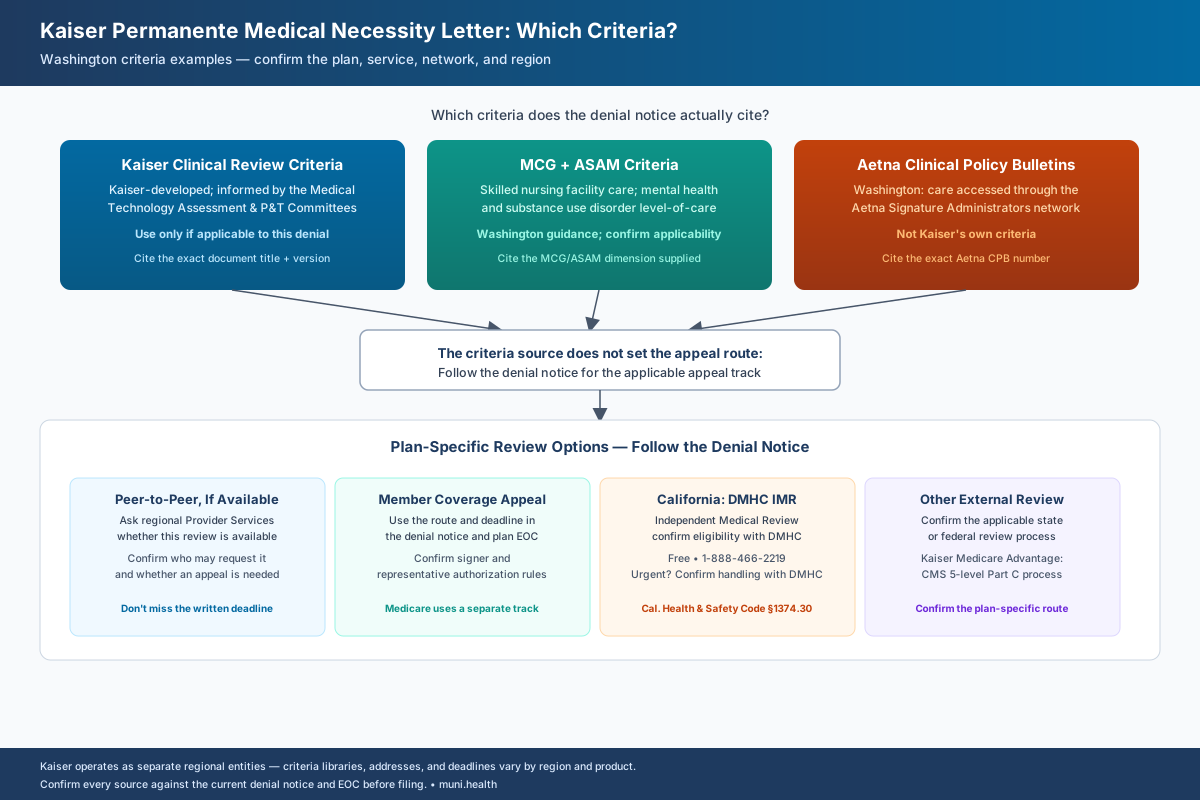
For a Kaiser Permanente medical necessity denial, follow the appeal instructions in the denial notice and confirm the plan, region, and reviewing entity before choosing a letter. This template is for a member coverage appeal; Medicare Advantage uses the separate Part C process described below. Kaiser Permanente Washington publishes its own Clinical Review Criteria, and some service categories reference MCG or ASAM. For Washington members receiving care through the Aetna Signature Administrators network, Kaiser says it uses Aetna medical clinical policies. Those sources are not interchangeable: cite the document actually named in the denial, and confirm which regional rules apply.
For general medical necessity letter guidance that applies across insurers, see the medical necessity justification letter guide. This guide covers what makes Kaiser's review model different and how to route the letter once it's written.
Why a Generic Medical Necessity Letter Misses Kaiser's Review Model
Kaiser Permanente Washington publishes clinical review criteria for coverage determinations. The applicable criteria and appeal route depend on the member's plan, service, and region; identify those inputs from the denial notice before drafting.
Kaiser Permanente Washington publicly documents this as Kaiser Clinical Review Criteria — criteria developed by Kaiser to determine coverage eligibility, informed by the results of Kaiser's own Medical Technology Assessment Committee and Pharmacy & Therapeutics Committee reviews (Kaiser Permanente Washington Clinical Review Criteria). Do not assume that this library, InterQual, or another policy governed a particular denial; request the specific criteria that were applied.
Read the Denial Notice Before You Write Anything
Start with the denial's stated reason and the exact criteria title it names. Kaiser's medical director (or a designee) issues the coverage determination, and the written notice to the member and practitioner is required to state the basis for the denial. Do not assume Kaiser used a generic "medical necessity" standard, InterQual, or MCG without confirming it from the notice itself.
Washington materials identify additional criteria sources for some services and network arrangements. Confirm applicability from the denial before citing them:
- MCG and ASAM categories. Kaiser has elected to use MCG Care Guidelines for some service lines — for example, inpatient skilled nursing facility coverage — and for mental health and substance use disorder level-of-care decisions, Kaiser's own documentation describes meeting MCG criteria, ASAM criteria, and/or Kaiser-specific medical necessity criteria for the treatment program (Kaiser Permanente Washington — Clinically Necessary Mental Health Care).
- Care through the Aetna Signature Administrators network. Kaiser Permanente Washington says it uses Aetna medical clinical policies when care is accessed through that network (Washington additional network options). This is not a blanket rule for every Access PPO or point-of-service claim. Confirm the network and criteria cited in the denial.
This Criteria Structure Is Documented for Washington
Kaiser Permanente Washington publishes a Clinical Review Criteria library; this guide uses it as a regional example. Kaiser operates as distinct regional entities (California, Colorado, Georgia, Hawaii, Mid-Atlantic, Northwest), and each may structure its criteria library, MCG/ASAM usage, and Access PPO or point-of-service equivalents differently. Use the denial notice and your region's own provider materials to confirm the source before citing "Kaiser Clinical Review Criteria" as the applicable standard.
How to Identify the Criteria Kaiser Actually Applied
| Possible Source | When It Applies | What to Cite in the Letter |
|---|---|---|
| Kaiser Clinical Review Criteria (Kaiser-developed) | Washington criteria cited in the denial; confirm the exact document and regional applicability | The specific criteria document title and version cited, and the Medical Technology Assessment Committee or P&T Committee basis if the notice references it |
| MCG Care Guidelines | Categories where Kaiser has elected MCG — documented for skilled nursing facility coverage and as part of the behavioral health level-of-care standard | The MCG guideline title, edition, and the specific indicator or criterion the denial supplied |
| ASAM Criteria + Kaiser-specific criteria | Mental health and substance use disorder level-of-care determinations | The ASAM dimension cited plus the Kaiser-specific criterion, addressed separately |
| Aetna Clinical Policy Bulletins | Washington care through the Aetna Signature Administrators network; confirm the denial cites Aetna policy | The Aetna CPB number and the exact criterion language the denial quotes |
If the denial notice doesn't name a specific document, request it in writing before finalizing the letter — Kaiser can share the specific criteria used for an individual member's utilization management decision on request, and arguing against a criteria set Kaiser didn't apply wastes the appeal.
Kaiser Medical Necessity Letter Template
This is a member coverage appeal template. Use it only when the denial notice identifies that appeal route, and confirm the filing authority and destination. Provider payment disputes and Medicare Advantage appeals can follow different procedures. See the Kaiser Permanente appeal letter template guide and appeal form guide, but follow the current instructions for the specific plan.
[Patient Name, or "on behalf of [Patient Name]" if a representative files]
[Date]

Kaiser Permanente — [Regional Entity Name]
Member Relations Department
[Address from the denial notice — do not reuse an address from a prior claim]

RE: Medical Necessity Appeal — Member Grievance and Appeal
Patient Name: [Full Name], DOB: [Date]
Kaiser Health Record / Member Number: [ID]
Denial or Authorization Reference: [Number, from the denial notice]
Service or Treatment Denied: [Description], CPT/HCPCS: [Code]
Diagnosis: [ICD-10 code and description]
Date of Denial Notice: [Date]
Criteria Cited in Denial: [Exact document title/version, if supplied]

[If a practice files on the patient's behalf: The attached signed
authorization designates this practice as the patient's representative
for this appeal. If the denial notice, EOC, or plan representative has
confirmed a Medicare pre-service filing exception, identify it here
instead; do not assume the exception applies.]

Dear Kaiser Permanente Member Relations Reviewer,

I am appealing Kaiser's decision to deny coverage for the above service on
the basis of medical necessity. This letter responds directly to the
criteria cited in Kaiser's denial notice.

PATIENT CLINICAL PRESENTATION:

[Patient name] is a [age]-year-old [gender] with a diagnosis of [condition]
(ICD-10: [code]). Clinical presentation includes:

- Chief Complaint: [Specific symptoms]
- Duration of Symptoms: [Timeline]
- Severity: [Objective measures — pain scale, functional limitation, lab or imaging values]
- Previous Treatments: [List prior interventions, duration, and outcomes]

RESPONSE TO THE CRITERIA CITED IN THE DENIAL

[Retain only the section supported by the denial notice; delete the others.
Do not supply an exact criterion Kaiser's notice did not name.]

If the denial cites KAISER CLINICAL REVIEW CRITERIA:
Per Kaiser's [criteria document title, version], [service] is covered
when the following criteria are met:
Criterion 1: [exact criterion text] — met because [clinical explanation with evidence]
Criterion 2: [exact criterion text] — met because [clinical explanation with evidence]
[Continue for every criterion the notice lists]

If the denial cites MCG CARE GUIDELINES:
Per MCG [Guideline Title, edition], the requested level of care / service
is supported by: [list each MCG indicator and the specific chart evidence
meeting it].

If the denial cites ASAM CRITERIA (behavioral health / SUD):
Per the ASAM Criteria, [Dimension(s)] support the requested level of
care: [list the specific ASAM dimension findings and supporting
documentation]. This is consistent with Kaiser's mental health and
substance use disorder medical necessity standard for this program.

If the denial cites an AETNA CLINICAL POLICY BULLETIN (Access PPO / POS):
Per Aetna Clinical Policy Bulletin [number], [service] is covered when
the following criteria are met: [list each criterion and the specific
chart evidence meeting it].

CONSERVATIVE TREATMENT HISTORY (where applicable):

- [Treatment 1]: [Duration, outcome]
- [Treatment 2]: [Duration, outcome]

SUPPORTING CLINICAL EVIDENCE:

Per [clinical guideline source — e.g., a specialty society guideline or
peer-reviewed study], [clinical statement supporting the denied service].
This is consistent with the criteria cited above.

CLINICAL CONCLUSION:

[Patient name] meets the criteria cited in Kaiser's denial notice for
[service]. Denial of this medically necessary service would be
inconsistent with the cited criteria and the patient's documented clinical
needs. I am available to discuss this case via peer-to-peer review with
Kaiser's regional medical director at your convenience.

ENCLOSED

- Complete denial notice
- Signed authorization if the plan requires it, or documentation of a confirmed Medicare pre-service filing exception
- Clinical notes, imaging or test results, and treatment history
- Relevant clinical guideline excerpt or peer-reviewed citation
- [ASAM assessment or MCG-referenced documentation, if applicable]

Please reverse the adverse determination and approve coverage for [service
or treatment]. Send the written decision and appeal-rights notice to the
patient and, if applicable, to the authorized representative named above.

Sincerely,

[Patient or Authorized Representative Name; or treating professional only
when a confirmed Medicare pre-service filing exception applies]
[Contact Information]

Enclosures: [List each attached document]
Skip the blank template. Start with a review-ready draft.
Use the template as guidance, or let Muni prepare a payer-specific draft for your team to verify, sign, and submit.
First 3 appeals free, then $20 per appeal. Start with your denial letter or EOB and available records. No meeting or clearinghouse connection required.
Free Template — Copy and Customize
Copy the template above, retain only the criteria section supported by the denial notice, replace all [bracketed] fields with patient-specific information, and confirm the current regional address and authorization rule before submitting. This page does not generate a separate downloadable file. Outcomes vary by plan, facts, and documentation.
Where the Letter Goes and Who Signs It
Kaiser operates as separate regional entities, and both the address and the signature rule vary by region and product. The addresses below are drawn from the same current regional sources verified for the Kaiser Permanente appeal letter template guide — confirm the specific address on the current denial notice before mailing, since Kaiser's own forms list different addresses even within one region depending on plan type.
Prepare this appeal packet with your team.
Draft the appeal, coordinate missing documents, and approve the reviewed packet. Keep your clearinghouse; your practice checks deadlines and submits through the payer’s accepted channel.
First 3 appeals free, then $20 per appeal. Start with your denial letter or EOB and available records. No meeting or clearinghouse connection required.
| Region | Member Relations Address | Deadline |
|---|---|---|
| California — Choice Products POS, HMO-tier post-service decision | Kaiser Foundation Health Plan, Inc., Attn: Health Plan Clinical Review Special Services, P.O. Box 7136, Pasadena, CA 91109-7136 (fax 626-405-3039) | 180 days from the adverse benefit determination notice for this commercial/non-Medicare POS context |
| Northwest (OR, SW WA) | Kaiser Foundation Health Plan of the Northwest, Member Relations Dept., 500 NE Multnomah St., Ste. 100, Portland, OR 97232 (fax 1-855-347-7239) | Check the denial notice; expedited review available for urgent cases |
| Mid-Atlantic (MD, VA, DC) | Kaiser Permanente, Attn: Member Relations, Nine Piedmont Center, 3495 Piedmont Rd. NE, Atlanta, GA 30305 (fax 404-949-5001) | Grievances handled within 30 calendar days; appeal deadline per the plan's Evidence of Coverage |
| Washington | Use the Member Services routing on the current denial notice and EOC; Provider Assistance Unit for criteria questions: 1-888-767-4670 | Per the current denial notice and EOC |
| Colorado, Georgia, Northern/Southern California HMO, Hawaii — other plan contexts | No single confirmed address for this guide — use the regional Member Relations contact printed on the denial notice or EOC | Check the denial notice and EOC |
Ordinarily the patient, parent/legal guardian, or a signed authorized representative signs a Kaiser member grievance and appeal letter — not the billing office alone. Kaiser's Mid-Atlantic provider manual documents a narrower exception: in some Medicare cases, a health care professional may file a pre-service initial determination request or appeal without additional authorization. Do not extend that exception to other Medicare appeals, post-service claims, or non-Medicare products; confirm it from the denial notice, EOC, or plan representative first.
This Is Not the Provider Payment Dispute Track
If your practice is disputing what Kaiser paid on a claim it already processed — coding, bundling, or timely filing — that is a provider payment dispute, not a medical necessity appeal, and it goes to a different department with a different signer. See the Kaiser Permanente appeal letter template guide for that track.
Ask Whether Peer-to-Peer Review Is Available
Ask the regional Provider Services team whether peer-to-peer review is available for this service and stage of review, who may request it, and whether a separate written appeal is still needed. Do not assume it replaces a formal appeal or changes its deadline.
Request a peer-to-peer through Kaiser's regional Provider Services line — see the Kaiser Permanente provider phone numbers guide for the number by region. Do not delay the written appeal deadline while waiting on an informal peer-to-peer unless Kaiser's instructions confirm the deadline is preserved.
California: DMHC Independent Medical Review for Medical Necessity Denials
For Kaiser plans regulated by the California Department of Managed Health Care (DMHC), qualifying medical necessity disputes may be eligible for Independent Medical Review (IMR). DMHC generally directs members to use the plan's grievance process first; its complaint guidance also explains when to contact the Help Center if the plan has not responded within 30 days or the situation is urgent. IMR is free. Contact DMHC at 1-888-466-2219 to confirm jurisdiction, eligibility, and urgent-review handling rather than assuming a fixed completion time.
This route does not apply to every Kaiser product. Medicare Advantage has its own federal appeal process, and other plans may have different external-review arrangements. Follow the denial notice and applicable regulator's instructions.
Kaiser Medicare Advantage Medical Necessity Denials
Kaiser Medicare Advantage coverage denials use the CMS Part C appeal process: reconsideration by the health plan, reconsideration by an Independent Review Entity (IRE), an Office of Medicare Hearings and Appeals decision, Medicare Appeals Council review, and judicial review in federal district court when applicable requirements are met. An unfavorable plan reconsideration is forwarded for independent review. Do not substitute Original Medicare's redetermination/QIC instructions. The CMS prior authorization rule sets standard seven-calendar-day and expedited 72-hour decision limits for affected non-drug prior authorization requests beginning in 2026; these are initial decision limits, not appeal filing deadlines. Follow the plan notice for the appeal deadline and use the Medicare Advantage appeal letter template.
Save Time Preparing Kaiser Medical Necessity Letters
Muni Appeals prepares a Kaiser-specific draft from the denial and supporting records you upload. The review-ready packet can:
- Surface the criteria source indicated by the denial notice for staff verification
- Organize relevant CPT codes, ICD-10 codes, and candidate clinical references by criterion
- Prepare a draft addressing the cited Kaiser, MCG, ASAM, or Aetna criteria
- Provide an evidence checklist and submission guidance for staff verification
Try 3 Free Kaiser Appeals (no credit card): Start Now →
Frequently Asked Questions
Does Kaiser Permanente use InterQual for medical necessity denials?
Do not assume which criteria Kaiser used. Washington publishes Kaiser Clinical Review Criteria, and some service categories reference MCG, ASAM, or other sources. Confirm the exact title and version from the denial notice and request the criteria if they are not identified.
Where do I find Kaiser's Clinical Review Criteria?
Kaiser publishes clinical review criteria through its regional provider sites — for example, Kaiser Permanente Washington's Clinical Review Criteria library. Kaiser operates as separate regional entities, so the specific library, format, and contact vary by region. If a criteria document isn't publicly posted for your region, Kaiser can share the specific criteria used for an individual member's utilization decision on request.
What if my patient has a Kaiser Access PPO or point-of-service plan?
Confirm the network and reviewing entity before drafting. Kaiser Permanente Washington's additional network guidance says Aetna medical clinical policies apply when care is accessed through the Aetna Signature Administrators network. Do not extend this to every PPO/POS claim or another region without confirmation.
Who signs the Kaiser medical necessity appeal letter?
Ordinarily the patient, parent/legal guardian, or a representative named in a signed authorization — this is a member grievance and appeal, not a provider payment dispute. Kaiser's Mid-Atlantic provider manual documents a narrower exception for some Medicare pre-service filings by a health care professional without additional authorization; don't extend that to other Medicare appeals, post-service claims, or non-Medicare products without confirming it first.
Can I request a peer-to-peer review before appealing?
Ask regional Provider Services whether peer-to-peer review is available for the specific denial and review stage. Keep the written appeal deadline unless the plan explicitly confirms a change. This guide does not establish that peer-to-peer review is faster or more successful at Kaiser than at another payer.
What is DMHC Independent Medical Review, and when can I use it?
IMR is a free external review for qualifying disputes involving plans under DMHC jurisdiction. Follow DMHC's filing guidance for plan grievance requirements, urgent situations, and eligibility. It does not replace the Medicare Advantage Part C process.
How is this different from the Kaiser Permanente appeal letter template guide?
The Kaiser Permanente appeal letter template guide covers both Kaiser letter tracks — the provider payment dispute letter and the member grievance and appeal letter — for any dispute type. This guide is scoped specifically to medical necessity denials on the member grievance and appeal track, with the criteria-identification step (Kaiser, MCG, ASAM, or Aetna) that a medical necessity argument needs and a general payment dispute doesn't.
What if my patient has Kaiser Medicare Advantage?
Medical necessity denials for Kaiser MA members follow the CMS 5-level Part C process, not the member grievance and appeal track described above. See the Kaiser Permanente appeal guide for the full timeline and the Medicare Advantage appeal letter template for that letter.
Ready to Appeal a Kaiser Medical Necessity Denial?
The step that determines whether Kaiser's reviewer engages with the letter at all is identifying which criteria source actually produced the denial — Kaiser's own criteria, an MCG or ASAM category, or Aetna's policies for applicable network care. Everything else follows from getting that right.
Before you submit:
- Read the denial notice for the stated reason and the exact criteria document named
- Confirm the plan, region, network, and reviewing entity named in the denial
- Request the specific criteria in writing if the notice doesn't supply it
- Get the patient's signature or authorization before filing, unless a confirmed Medicare pre-service exception applies
- Ask whether peer-to-peer review is available without delaying the appeal
- Confirm the current regional Member Relations address and deadline on the denial notice
- For California: confirm DMHC jurisdiction and IMR eligibility using its filing guidance
This guide reflects Kaiser Permanente medical necessity review materials available as of September 22, 2026, including Kaiser Permanente Washington's published Clinical Review Criteria and mental health/substance use disorder medical necessity documentation, and Kaiser's Mid-Atlantic States provider manual. Kaiser operates as separate regional entities with criteria sources, forms, authorization rules, addresses, and deadlines that vary by region, product, and appeal stage and change over time — always verify current requirements from the denial notice, EOC, or Kaiser's regional Member Relations or Provider Relations representative before filing. This information is for administrative and billing purposes and is not medical or legal advice. Muni Health is not affiliated with Kaiser Permanente or Aetna.