

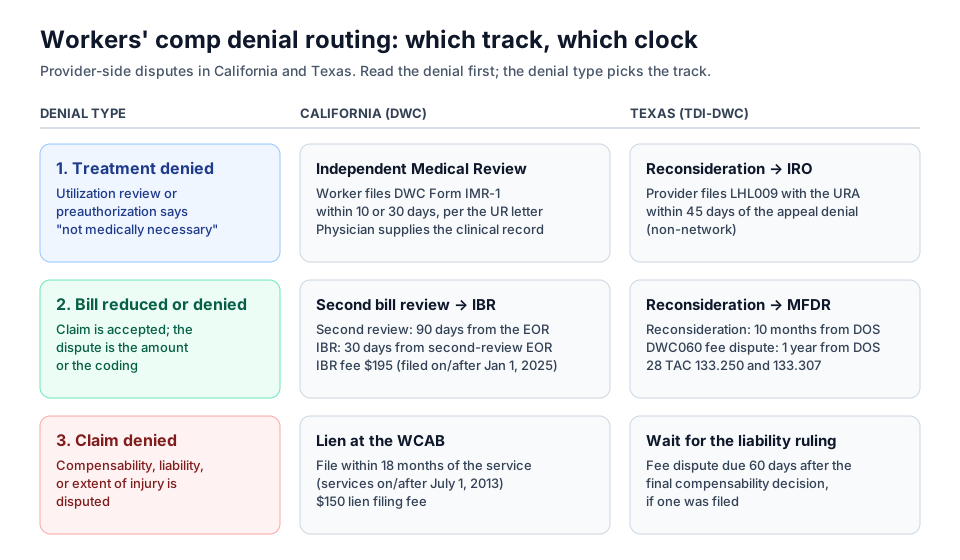
A workers' compensation denial is disputed through the state's workers' comp system, not through a commercial payer appeal. The track depends on what was denied. Treatment denied by utilization review goes to independent review: California's Independent Medical Review, or a reconsideration and then an independent review organization in Texas. A bill amount dispute goes to a second bill review and then Independent Bill Review in California, or to reconsideration and then medical fee dispute resolution in Texas. A denial of the claim itself (compensability) usually has to be resolved between the worker and the carrier before the bill can be paid. In California the provider protects the bill by filing a lien. The clocks are short and state-specific. California's second bill review must be requested within 90 days of the explanation of review. Texas reconsideration is due within 10 months of the date of service.
Why Workers' Comp Denials Need a Different Playbook
Workers' comp is a state-regulated benefit, so the dispute rules come from the state's labor code and the workers' comp agency. There is no single insurer appeal process. The ERISA claims rules and commercial plan appeal steps that govern most denials don't apply, and a commercial-style appeal letter mailed to the adjuster may not start the state's dispute process at all.
Three things differ from commercial billing:
- The state picks the process. Each state sets its own dispute forms, deadlines, and reviewers. Federal employees' work injuries go through the U.S. Department of Labor's FECA program, not a state agency.
- The denial type picks the track. A medical-necessity denial, a fee-schedule reduction, and a compensability denial go to three different reviewers, often with three different clocks.
- The worker sometimes has to file. In California, the injured worker files the IMR application. The treating physician supplies the clinical case but can't file IMR alone.
A strong clinical case can still fail if it goes to the wrong track or misses the clock. Read the denial, classify it, then route it.
Step 1: Classify the Denial Before You Respond
Find the reason language on the utilization review letter or explanation of review. It tells you which of three tracks you are on, and each one has its own reviewer.
| What the denial says | Denial type | Who decides the dispute | What the provider does first |
|---|---|---|---|
| Treatment not medically necessary, not authorized, or modified by utilization review | Utilization review (UR) / preauthorization | An independent medical reviewer (IMR in California, IRO in Texas) | Read the UR letter's appeal instructions and deadline; build the clinical case |
| Paid at a reduced amount, coded differently, bundled, or denied for billing reasons on an accepted claim | Bill payment / fee schedule | An independent bill reviewer or the state's fee dispute unit | Request the state's second review or reconsideration on time |
| Injury not work-related, claim denied, liability disputed, or body part not accepted | Compensability / liability / extent of injury | The state workers' comp judge or hearing system, in a case between the worker and carrier | Protect the bill (lien or tolling rules) and track the case outcome |
Some denials mix types. A bill denied because the treatment was never authorized is a utilization review problem, and an IBR filing will not fix it. In Texas, medical fee dispute resolution can be dismissed or abated while an adverse medical-necessity determination or a compensability dispute is unresolved. Settle the threshold issue first.
California Workers' Comp: IMR, Second Bill Review, IBR, and Liens
California runs three provider-relevant tracks through the Division of Workers' Compensation (DWC). Each has a fixed deadline that runs from a document date.
| California track | Use it when | Deadline | Who files / cost |
|---|---|---|---|
| Independent Medical Review (IMR) | UR denied, delayed, or modified a treating physician's request as not medically necessary | 10 or 30 days of the UR determination letter, as stated in the letter | Injured worker or designated representative, on DWC Form IMR-1; costs paid by the employer |
| Second bill review | Payment amount or billing dispute on a bill the claims administrator reviewed | 90 days from service of the explanation of review (8 CCR § 9792.5.5(b)) | Provider; marked original bill or DWC Form SBR-1 (SBR-1 required for medical-legal bills) |
| Independent Bill Review (IBR) | Amount still disputed after the second review | 30 days after service of the second review decision | Provider; $195 application fee for filings on or after Jan 1, 2025, reimbursed if more money is found owed |
| Lien at the WCAB | Claim or liability disputed, so the bill can't be paid through bill review | 18 months from the date of service, for services on or after July 1, 2013 (Labor Code § 4903.5) | Provider; $150 filing fee (8 CCR § 10207) |
Utilization review denials (IMR). DWC says IMR is available when utilization review denies, delays, or modifies a treating physician's request on medical necessity grounds. The application goes on the DWC IMR-1 form within the 10- or 30-day window stated in the UR letter. Because the worker files, the practice's job is to tell the patient the clock is running and get the clinical record ready. DWC's IMR page gives the record deadlines for the reviewer: 15 calendar days from a mailed notice or 12 from an electronic notice for regular review, and 24 hours for expedited review. Missing the application window is costly. In a 2015 WCAB panel decision, an application mailed on day 30 and received after the deadline was treated as untimely.
Payment disputes (second bill review, then IBR). Under 8 CCR § 9792.5.5, the second review request must list the original dates of service and the same itemized services as the original bill, with no new codes. It must also give the EOR date and claim number, the item and amount in dispute, the additional payment requested and why, and any information the first EOR asked for. The claims administrator has 14 days to issue a final written determination. If the only dispute is the amount and no second review is requested in 90 days, the bill is deemed satisfied, and neither the employer nor the worker owes anything more. If the second review doesn't resolve it, DWC's IBR page gives 30 days from service of that decision to file IBR.
Compensability denials (lien). When the carrier denies the claim, the bill can't move through bill review. The provider protects it by filing a lien with the Workers' Compensation Appeals Board. For services on or after July 1, 2013, Labor Code § 4903.5 bars filing more than 18 months after the service date, and 8 CCR § 10207 requires the $150 filing fee to be paid before or at filing.
California Has Two Different IMRs
Workers' comp IMR is run by the DWC under the Labor Code. Health plan IMR for commercial HMO and insured plans is a separate state program with different forms and rules. If the patient's card says workers' comp, use the DWC process. The state-by-state appeal laws guide covers the health plan side.
Texas Workers' Comp: Reconsideration, IRO, and Medical Fee Dispute Resolution
Texas puts both medical necessity and payment disputes through the Texas Department of Insurance, Division of Workers' Compensation (TDI-DWC). Payment disputes require a reconsideration with the carrier first, and non-network medical-necessity disputes require an appeal to the utilization review agent before IRO review.
| Texas track | Use it when | Deadline | Notes |
|---|---|---|---|
| Reconsideration of a medical bill | Carrier took final action on a bill and you disagree with the payment | No later than 10 months from the date of service (28 TAC § 133.250(b)) | Carrier must take final action within 30 days of receiving the request |
| Medical fee dispute resolution (MFDR) | Still dissatisfied after the carrier's final action on reconsideration | No later than 1 year after the date of service (28 TAC § 133.307(c)(1)) | Filed on DWC060; deadline extends to 60 days after a final decision on a related compensability, liability, or medical-necessity dispute |
| Independent review organization (IRO) | Preauthorization, concurrent review, or retrospective review denied as not medically necessary | 45 calendar days after receiving the URA's denial of an appeal (non-network) or after the date of denial (network) | File form LHL009 with the URA; no cost except non-network retrospective reviews |
| Medical contested case hearing | A party disagrees with the IRO decision | Within 20 days of receiving the IRO decision | Written appeal to DWC's chief clerk of proceedings |
Payment disputes. Under 28 TAC § 133.250, the reconsideration request is due 10 months from the date of service. The carrier must take final action within 30 days of receiving it. You can't file reconsideration until the carrier has taken final action on the bill, or until 50 days have passed without an explanation of benefits. MFDR under 28 TAC § 133.307 is due one year from the date of service, so the two deadlines aren't the same. A practice can still be inside the MFDR year after it has already missed the 10-month reconsideration window. Calendar the 10-month date first.
Medical necessity disputes. TDI's IRO process sheet (revised February 2026) requires the LHL009 request to be filed with the utilization review agent (URA), not with TDI. After receiving the dispute, the IRO must decide within 8 days for life-threatening conditions, 20 days for preauthorization or concurrent review, and 30 days after receiving the fee for retrospective review. TDI's medical necessity dispute page notes that a party who disagrees with the IRO decision can request a hearing on DWC Form-049.
Other States Use Their Own Names and Clocks
New York, Florida, Pennsylvania, and other states have their own UR, bill-review, and fee-dispute processes. Don't carry California or Texas deadlines over to another state. Start with the dispute instructions printed on the denial or EOR, then confirm the current rule on the state workers' comp agency's site. Some carriers also use a medical provider network or a network contract that changes the route, as Texas's network and non-network IRO clocks show.
Workers' Comp Dispute Letters (Copyable)
There are two letters, one for each track a provider controls. The first supports a medical-necessity dispute: a UR reconsideration in Texas, or the physician's statement attached to the worker's IMR in California. The second is a payment dispute: a California second bill review cover letter or a Texas request for reconsideration. Keep the bracketed option that matches your state and delete the rest. Attach the state form where one is required. A letter does not replace a required form.
[Practice Letterhead]
[Date]

[Claims Administrator / Insurance Carrier / Utilization Review Agent name]
[Address or fax from the UR determination letter]

RE: [Request for Reconsideration of Adverse Determination (Texas)]
  [Treating Physician Statement in Support of Independent Medical Review (California)]

Injured worker: [Name]                   DOB: [MM/DD/YYYY]
Claim number: [Number]                   Date of injury: [MM/DD/YYYY]
Employer: [Name]                         Accepted body part(s): [List]
UR / preauthorization reference: [Number]
Date of UR determination: [MM/DD/YYYY]   Date received: [MM/DD/YYYY]
Treatment requested: [CPT/HCPCS code(s), description, frequency, duration]

I am the treating physician for the injured worker named above. I request
reconsideration of the [denial / modification / delay] of the treatment
listed above, issued on [date].

1. The denial basis
The determination states: "[quote the reason and criterion cited]."
The guideline applied was [MTUS / ODG / other guideline named in the
letter, section and version].

2. Why the guideline criteria are met
- Criterion: [exact criterion from the cited guideline]
Documentation: [objective finding, date, and where it appears in the
attached records]
- Criterion: [next criterion]
Documentation: [finding, date, record location]
- Prior conservative care: [treatments tried, dates, duration, response]
- Functional status: [measured limitations and work restrictions, with
dates]

3. Relationship to the accepted injury
The requested treatment is for [accepted body part / condition], which
is the subject of this claim. [If the denial raised causation or extent
of injury, state that this is a separate dispute and is not decided by
utilization review.]

4. [Only if departing from the guideline] Why this case warrants an
exception
[Patient-specific factors and the medical evidence supporting the
deviation, with citations.]

5. Requested action
Please approve [treatment] as requested. If the denial is upheld,
please identify the reviewer's specialty and the specific criterion
not met, and include the instructions for independent review.

[California: I have advised the injured worker of the IMR application
deadline stated in the UR letter. This statement and the enclosed
records are provided for the IMR file.]

Enclosures: UR determination letter; [progress notes dated ___];
[imaging / test reports]; [functional assessments]; [guideline excerpt]

[Physician name, credentials]
[Specialty]   NPI: [Number]   [State license number]
[Phone]   [Fax]   [Email]
Skip the blank template. Start with a review-ready draft.
Use the template as guidance, or let Muni prepare a payer-specific draft for your team to verify, sign, and submit.
First 3 appeals free, then $20 per appeal. Start with your denial letter or EOB and available records. No meeting or clearinghouse connection required.
[Practice Letterhead]
[Date]

[Claims Administrator / Insurance Carrier name]
[Bill review address from the explanation of review]

RE: [Request for Second Bill Review, 8 CCR 9792.5.5 (California)]
  [Request for Reconsideration, 28 TAC 133.250 (Texas)]

Injured worker: [Name]                  Claim number: [Number]
Employer: [Name]                        Date of injury: [MM/DD/YYYY]
Date of the explanation of review / EOB being disputed: [MM/DD/YYYY]
Bill / control number: [Number]
Original date(s) of service: [MM/DD/YYYY - MM/DD/YYYY]

This request concerns the same dates of service and the same itemized
services as the original bill. No new dates of service or codes are
included.

Items in dispute:

Line | DOS | Code + modifier | Billed | Paid | Amount in dispute | Reason
[1]  | [ ] | [ ]             | [$  ]  | [$ ] | [$ ]              | [EOR reason code]
[2]  | [ ] | [ ]             | [$  ]  | [$ ] | [$ ]              | [EOR reason code]

Additional payment requested: [$ total]

Basis for additional payment:
- Line [1]: [fee schedule section and rate that applies; why the
reduction or denial reason does not apply; modifier or documentation
that supports the code as billed]
- Line [2]: [same structure]

[If the EOR asked for more information:] The information requested in
the explanation of review dated [date] is enclosed: [list].

Please reprocess these lines and issue payment of the amount in
dispute. If you uphold any part of the original determination, please
issue a written explanation for each line so the dispute can proceed to
[Independent Bill Review (California) / medical fee dispute resolution
(Texas)].

Enclosures: copy of the original bill; explanation of review dated
[date]; [operative or procedure note]; [authorization approval];
[fee schedule excerpt]; [DWC Form SBR-1, if used (California)]

[Billing contact name and title]
[Practice name]   Tax ID: [Number]   NPI: [Number]
[Phone]   [Fax]   [Email]
Calendar each deadline from the document that starts it: the UR letter, the EOR, or the date of service. Keep proof of the date each request was sent and received. California IMR applications have to be received within the window, not just mailed.
Common Mistakes That Forfeit Workers' Comp Payment
Each of these can forfeit payment regardless of the clinical merits.
Prepare this appeal packet with your team.
Draft the appeal, coordinate missing documents, and approve the reviewed packet. Keep your clearinghouse; your practice checks deadlines and submits through the payer’s accepted channel.
First 3 appeals free, then $20 per appeal. Start with your denial letter or EOB and available records. No meeting or clearinghouse connection required.
- Sending a commercial appeal letter to the adjuster. It may not count as the state's second review, reconsideration, or IRO request, and the real clock keeps running.
- Filing IBR or MFDR on a medical-necessity denial. Payment-dispute reviewers don't decide medical necessity. Win the UR dispute first.
- Letting California's 90-day second review window pass. If the only dispute is the amount, the bill is deemed satisfied.
- Watching only the Texas one-year MFDR date. Reconsideration is due at 10 months.
- Assuming the patient knows about IMR. In California the worker files. If nobody tells them, the 10- or 30-day window closes.
- Adding codes or dates to a second review. California requires the same itemized services as the original bill.
- Ignoring a compensability denial. In California, a lien filed more than 18 months after the service is barred.
Frequently Asked Questions
Can a provider appeal a workers' comp denial directly?
Usually, yes, for payment disputes and, in some states, for medical-necessity disputes. In California the provider requests second bill review and IBR, but the injured worker files IMR for a utilization review denial. In Texas a health care provider can request reconsideration, medical fee dispute resolution, and IRO review. Compensability denials are usually decided in the worker's case against the carrier, and the provider protects the bill through state-specific rules such as California's lien.
How long do I have to appeal a workers' comp bill denial?
It depends on the state. In California, second bill review is due within 90 days of service of the explanation of review, and IBR within 30 days of service of the second review decision. In Texas, reconsideration is due within 10 months of the date of service and medical fee dispute resolution within one year. Check the deadline printed on the EOR, then confirm it in the state's current rule.
What is the difference between IMR and IBR in California workers' comp?
IMR decides whether a treatment is medically necessary after utilization review denies, delays, or modifies it. IBR decides whether a bill was paid the correct amount after a second bill review. They use different applications and deadlines, and IBR has a $195 provider fee (for filings on or after January 1, 2025) that is reimbursed if more money is owed. IMR costs are paid by the employer.
Can I bill the patient or their health insurance when workers' comp denies the claim?
It depends on the state and the denial. Many states restrict billing the injured worker for a compensable injury, and a compensability denial may still be overturned. Check the state's balance-billing rules and the status of the worker's case before billing the patient or their group health plan. Keep your workers' comp dispute rights, such as a California lien, protected on time while you wait.
Does a workers' comp UR denial have an expedited option?
Yes, in both states covered here. California's IMR has an expedited track when the UR was expedited or a physician states the need is urgent. DWC asks for records within 24 hours. Texas IROs must decide within 8 days for life-threatening conditions. For other states, see the expedited instructions on the UR letter.
Get the Letter Drafted, Keep the Clock in Front of Staff
A workers' comp denial is won by routing it to the right track and filing before the state clock runs out. The letter has to answer the guideline or fee-schedule reason the carrier gave. Muni drafts appeal and dispute letters from the denial and the clinical record for staff to review. Your team still confirms the state form, the reviewer, and the deadline before anything goes out. For the commercial and Medicare side of your denials, the 2026 insurance appeal deadlines table gives each payer's clock. For the clinical argument itself, see the medical necessity justification letter guide.
Sources checked October 8, 2026: California DWC Independent Medical Review and Independent Bill Review pages; 8 CCR § 9792.5.5 and § 10207; Labor Code § 4903.5; Texas 28 TAC § 133.250 and § 133.307; TDI-DWC IRO process sheet (revised 02/26) and medical necessity dispute page. Workers' comp dispute rules vary by state, network status, and claim status, and change by regulation. Verify the denial notice, the current state rule, and any network contract before filing. This guide is administrative information, not legal or clinical advice.