

A Medicaid managed care appeal runs through two tracks. Track 1 is the MCO's internal appeal: file within 60 days of the denial, and the MCO must decide within 30 days, or 72 hours if expedited (42 CFR § 438.402, § 438.408). Track 2 opens only once Track 1 is exhausted — states must give 90 to 120 days from the MCO's resolution notice to request a state fair hearing. A provider may request the appeal or hearing as the patient's authorized representative when state law permits and the patient gives written consent, but the enrollee must personally request continuation of benefits on its separate, shorter 10-day clock (42 CFR § 438.402(c)(1)(ii), § 438.420).
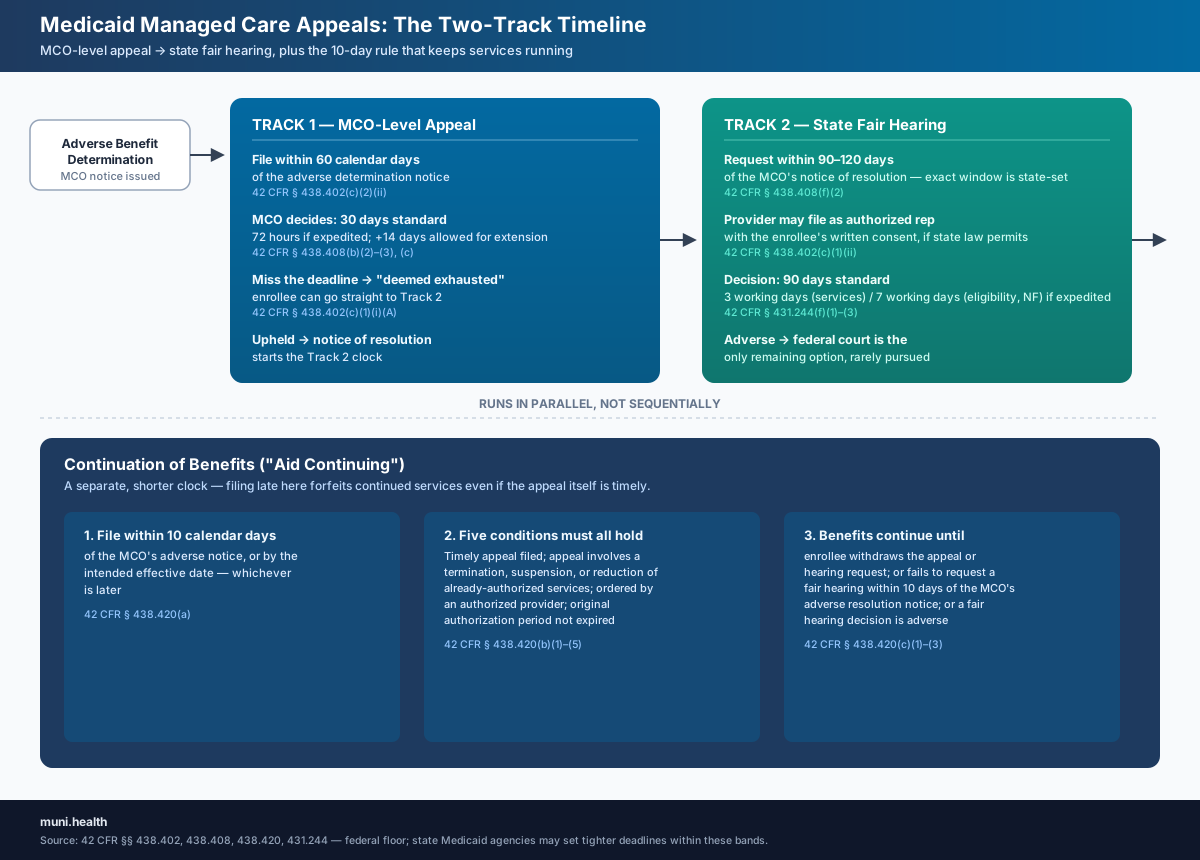
The Two-Track Structure Billers Keep Conflating
A Medicaid managed care denial is not one appeal — it is two, run in sequence, governed by two different federal regulations. Billers who treat it like a single appeal (the way they'd handle a commercial insurance denial) miss deadlines on the second track because they never realized it had its own clock.
Track 1 is the MCO's internal grievance and appeal system, required under 42 CFR Part 438, Subpart F. This is functionally similar to a commercial payer appeal: you file with the plan, the plan's own reviewers decide, and you generally cannot skip it. Track 2 is the state fair hearing — an administrative proceeding run by the state Medicaid agency (not the MCO), governed by 42 CFR Part 431, Subpart E and, for managed care specifically, 42 CFR § 438.408. It only opens up once Track 1 is exhausted.
This structure exists across every Medicaid MCO — UHC Community Plan, Molina, CareSource, Centene/Wellcare, and the rest all operate under the same Part 438 framework, with state-specific portals and mailing addresses layered on top. If you handle a specific plan's appeal regularly, see our guides to UHC Community Plan Medicaid appeals, Molina Healthcare appeals, CareSource appeals, and Centene/Wellcare provider appeals for the plan-level mechanics. This guide covers the part those guides only touch on: what happens after the MCO says no for the last time.
Fee-for-Service Medicaid Is Different
This guide covers Medicaid managed care — the majority of Medicaid enrollees nationally. Traditional fee-for-service Medicaid (no MCO) skips Track 1 for an enrollee's eligibility or benefit dispute; the enrollee uses the state's fair-hearing process under Part 431. A provider's own payment or claim-processing dispute may instead follow a separate state provider-appeal process. Confirm both the coverage model and who owns the dispute before following this timeline.
Track 1: The MCO-Level Appeal
The MCO-level appeal is not optional and it is not the state fair hearing — it is a prerequisite the enrollee (or their authorized representative) must clear first, with one narrow exception.
Filing deadline: 60 calendar days from the date on the MCO's adverse benefit determination notice (42 CFR § 438.402(c)(2)(ii)).
MCO decision timeline: No longer than 30 calendar days for a standard appeal, no longer than 72 hours for an expedited appeal, with a permitted extension of up to 14 calendar days if the enrollee requests it or the MCO shows the delay is in the enrollee's interest (42 CFR § 438.408(b)(2)–(3), (c)).
The exception — deemed exhaustion: If the MCO fails to meet the notice and timing requirements in § 438.408, the enrollee is treated as having exhausted the internal appeal automatically and can go straight to a state fair hearing (42 CFR § 438.402(c)(1)(i)(A)). This matters in practice more than it sounds: an MCO that sits on an appeal past its own 30-day window has just opened the door to Track 2 early, whether it meant to or not. Track the MCO's response deadline as closely as the filing deadline — it is leverage, not just a courtesy.
One Internal Level, Not Two
Some MCOs brand their process as "reconsideration" followed by "formal appeal," which reads like two internal levels. Under federal rule, an MCO can maintain only one level of internal appeal for providers acting on an enrollee's behalf — what looks like a second internal step is often the same appeal continuing, not a separate escalation tier. Read the specific plan's appeal guide before assuming a two-step internal process buys you two separate 60-day windows.
For the Track 1 letter itself, a state-agnostic skeleton with the filing deadline left as a fill-in-your-state field is more durable than a single-state template — see Molina Appeal Letter Template 2026 for that pattern applied to one MCO's Medicaid appeal letter.
Track 2: The State Fair Hearing
Once the MCO issues its notice of resolution upholding the denial — or once deemed exhaustion applies — the enrollee (or their authorized representative) can request a state fair hearing. This is where most billing teams underestimate how much runway they actually have, and then separately miss the much tighter clock on continued benefits (see below).
| Step | Deadline / Timeframe | Governing Rule |
|---|---|---|
| Request the fair hearing | 90–120 calendar days from the MCO's notice of resolution (exact number is state-set within that range) | 42 CFR § 438.408(f)(2) |
| State issues final decision | 90 calendar days standard | 42 CFR § 431.244(f)(1) |
| Expedited — service/benefit denials | As expeditious as the enrollee's condition requires, no later than 3 working days | 42 CFR § 431.244(f)(2) |
| Expedited — eligibility & nursing facility claims | As expeditious as possible, no later than 7 working days | 42 CFR § 431.244(f)(3) |
Two things worth flagging. First, "90–120 days" is a federal band, not a fixed number — the state Medicaid agency sets the exact figure within it, so the deadline printed on the MCO's resolution notice controls, not a number from a guide like this one. Second, the fair hearing decision itself is bound by the same 90-day outer limit regardless of which stage the state agency counts it from, with a documented "unusual circumstances" exception for delays the appellant requests or the agency can't avoid (42 CFR § 431.244(f)(4)).
If the fair hearing decision is adverse, the next review path varies by state and by the final order. It may include agency reconsideration, state judicial review, or another remedy described in the decision notice; federal litigation is not the automatic next step. Follow the final order's instructions and applicable state law, and consult qualified counsel when further review is being considered.
Filing as the Enrollee's Authorized Representative
A provider can request the MCO appeal, file a grievance, or request the state fair hearing on the enrollee's behalf — but only under specific conditions, and this is where a well-intentioned filing gets rejected on a technicality.
Federal rule requires two things to hold at once: state law must permit provider representation, and the provider must have the enrollee's written consent (42 CFR § 438.402(c)(1)(ii)). States implement the consent requirement differently — some accept a signed line within the appeal or hearing request itself, others (Florida is a documented example) require a standalone signed authorization filed with the hearing office before the provider can be recognized as the representative of record. Confirm the state's specific consent format before the hearing request goes out; a hearing office that hasn't received the consent it requires can dismiss the request on standing alone, independent of the appeal's merits.
Build the consent language into your standard intake paperwork rather than chasing a signature after a denial arrives — by the time you're inside the 60-day Track 1 window, you don't want to be waiting on a patient callback to file.
The Enrollee Must Request Continued Benefits
The provider-representative rule has an explicit limit: a provider may request the appeal or fair hearing with the enrollee's written consent, but a provider may not request continuation of benefits for the enrollee. The enrollee must make and sign that request personally. A provider can help prepare and transmit the combined filing, but the continuation section must remain the enrollee's own request.
The Aid-Continuing Rule: Keeping Services Running During the Appeal
This is the mechanism that changes the economics of appealing, and it runs on the shortest clock in this whole process — separate from, and much tighter than, the appeal filing deadlines above.
The 10-day rule: to keep previously authorized services in place while the appeal or fair hearing is pending, the request for continuation of benefits must be filed within 10 calendar days of the MCO sending its adverse notice, or by the notice's intended effective date — whichever is later (42 CFR § 438.420(a)).
All five conditions must hold for continuation to apply (42 CFR § 438.420(b)(1)–(5)):
- the appeal (or fair hearing request) was itself filed timely
- the appeal involves the termination, suspension, or reduction of a previously authorized service — not an initial denial of a new request
- the service was ordered by an authorized provider
- the period covered by the original authorization has not yet expired
- the request for continuation was itself filed on time under the 10-day rule above
Benefits continue until one of three things happens: the enrollee withdraws the appeal or hearing request; the enrollee fails to request a state fair hearing (and continuation) within 10 calendar days of the MCO's adverse resolution notice; or a state fair hearing decision comes back adverse to the enrollee (42 CFR § 438.420(c)(1)–(3)).
This Is Not the Same 10 Days, Twice
The rule fires at two separate points on the timeline — once after the MCO's original adverse notice, and again after the MCO's resolution upholding that denial (to keep benefits running into the fair hearing stage). Missing either 10-day window ends continuation at that point, even if the underlying appeal or hearing request is still fully valid and on time. Track it as its own deadline, not a subtask of the appeal filing.
Why this changes the economics of appealing: a denial that only threatens future services is a different fight than one that would stop a patient's current course of treatment mid-episode — chemotherapy, home health, a therapy series. Aid continuing can keep treatment from stopping while the case is pending, but it is not risk-free: if the final decision is adverse, the MCO may recover the cost of services furnished during the appeal when state policy permits (42 CFR § 438.420(d)). Confirm the state's recovery policy before treating continued services as guaranteed reimbursement.
Template: Fair Hearing Request Combined with Continuation-of-Benefits Request
Use this when Track 1 has been exhausted (or deemed exhausted) and you're filing the state fair hearing request as the patient's authorized representative. It combines the written consent statement and hearing request with a separately signed, first-person continuation request from the enrollee. Send it to the state fair hearing office named in the MCO's notice of resolution, by the method that office specifies (mail, portal, or fax vary by state).
[Date]

[State Medicaid Fair Hearing Office]
[Address from MCO's Notice of Resolution]

RE: Request for State Fair Hearing and Continuation of Benefits
Enrollee: [Patient Full Name]
Medicaid ID: [ID Number]
Date of Birth: [MM/DD/YYYY]
MCO: [Plan Name]
MCO Appeal/Case Number: [Number from MCO's Notice of Resolution]
Notice of Resolution Date: [Date]

AUTHORIZED REPRESENTATIVE CONSENT:
I, [Patient Full Name], authorize [Provider/Practice Name], NPI [Number], to act as my authorized representative for purposes of this appeal, including requesting a State Fair Hearing on my behalf, under 42 CFR § 438.402(c)(1)(ii).

[Patient Signature] [Date]
[Provider Signature] [Date]

REQUEST FOR STATE FAIR HEARING:
This is a timely request for a State Fair Hearing under 42 CFR § 438.408(f), filed within [X] days of the MCO's Notice of Resolution dated [Date]. [Plan Name]'s internal appeal was [exhausted on [Date] / deemed exhausted under 42 CFR § 438.402(c)(1)(i)(A) due to the MCO's failure to meet the resolution timeframe required by 42 CFR § 438.408(b)].

The denial being appealed: [Describe the service, date of service, and the MCO's stated denial reason/code].

Basis for reversal: [Medical necessity justification, policy citation, or documentation basis — attach supporting clinical records.]

ENROLLEE'S REQUEST FOR CONTINUATION OF BENEFITS:
I, [Patient Full Name], personally request continuation of my benefits pending the fair hearing. I am filing this request within 10 calendar days of the MCO's Notice of Resolution, under 42 CFR § 438.420. The service at issue is a termination/suspension/reduction of a previously authorized service — [Service Name], authorized [Original Authorization Number] on [Date], with the authorization period extending through [Date] — ordered by [Ordering Provider Name].

[Patient Signature for Continuation Request] [Date]

Enclosures: MCO denial notice, Notice of Resolution, prior authorization confirming the original service order, clinical documentation supporting medical necessity.

[Provider/Practice Name]
[Contact Phone] | [Contact Email]
Skip the blank template. Start with a review-ready draft.
Use the template as guidance, or let Muni prepare a payer-specific draft for your team to verify, sign, and submit.
Replace Every Bracket Before Filing
This combines three distinct filings that each carry their own eligibility conditions — do not submit it with placeholder text still in place. The enrollee must personally sign the continuation request. If continuation of benefits doesn't apply (a new-service denial, not a reduction of an existing one), remove that section rather than filing a request the five conditions in § 438.420(b) can't support.
How Muni Appeals Helps with Medicaid Managed Care Escalations
Tracking two sequential deadlines with a third, shorter deadline running in parallel is exactly the kind of multi-clock problem that gets missed on a spreadsheet or a sticky note — not because the rule is unclear, but because it requires remembering to check back in ten days on a case that otherwise feels resolved. Muni Appeals keeps the MCO appeal, the fair hearing request, and the continuation-of-benefits filing on one timeline per patient, so the 10-day window doesn't get discovered after it's closed.
Turn this denial into a review-ready draft.
Muni prepares a payer-specific appeal, policy citations, and an evidence checklist. Your team reviews and submits it.
If you're still deciding whether automating Medicaid escalations is worth it for your practice's volume, our cost comparison of appeal automation vs. manual appeals walks through the math.
Frequently Asked Questions
Do I have to go through the MCO's internal appeal before requesting a state fair hearing?
Yes, with one exception. Federal rule requires the MCO's internal appeal to be exhausted first, unless the MCO itself misses the notice or timing requirements in § 438.408 — in which case the enrollee is "deemed" to have exhausted the process and can request the fair hearing directly.
How long do I have to request a Medicaid state fair hearing?
States must give enrollees between 90 and 120 calendar days from the date of the MCO's notice of resolution, with the exact number set by the state. Check the deadline printed on that specific notice rather than assuming a fixed figure.
Can a provider request a state fair hearing on behalf of a patient?
Yes, if the state permits it and the provider has the patient's written consent. The consent format varies by state — some accept a signed line on the hearing request itself, others require a separate authorization document filed with the hearing office.
Will my patient's services keep running while the appeal is pending?
Only if continuation of benefits was requested within 10 calendar days of the relevant adverse notice, the underlying appeal involves reducing or stopping a currently authorized service (not a new request), and the other conditions under § 438.420(b) are met. It is not automatic.
What happens if the MCO misses its own appeal deadline?
The enrollee is deemed to have exhausted the MCO's internal process and can request a state fair hearing immediately, without waiting for a decision that never came.
Does this process apply to fee-for-service Medicaid too?
Not exactly. For an enrollee's eligibility or covered-benefit dispute, fee-for-service Medicaid has no MCO-level appeal to exhaust, so the enrollee uses the state's fair-hearing process under 42 CFR Part 431. A provider's own payment or claim-processing dispute may use a separate state provider-appeal process instead.
What's the difference between this and a commercial insurance appeal?
Commercial appeals are governed by state insurance law and, for employer plans, ERISA — with an external review step at the end. Medicaid managed care appeals are governed by federal Medicaid regulation (42 CFR Parts 431 and 438) and end in a state administrative fair hearing rather than an independent external review organization.
What if the fair hearing decision is also adverse?
Further review depends on the state and the final order. The notice may identify agency reconsideration, state judicial review, or another remedy; federal court is not the automatic next step. Follow the order's review instructions and applicable state law, and consult qualified counsel if the enrollee is considering another appeal.
Ready to Stop Tracking Medicaid Deadlines by Hand?
The two-track structure isn't complicated once it's mapped out — but it is easy to lose a 10-day continuation-of-benefits window inside a 60-day appeal deadline you're already watching closely.
Get Started:
- Centralized tracking across the MCO appeal, fair hearing, and continuation-of-benefits deadlines
- Documentation and consent paperwork organized per patient
- Insurer-specific guidance across Medicaid MCOs
This guide reflects 2026 federal Medicaid managed care appeal regulations. State agencies and individual MCO contracts may set tighter deadlines within the federal bands described here — always confirm the exact figures on the specific denial or resolution notice. This information is for administrative and billing purposes and is not legal or medical advice.