

Interventional pain denials — ESIs, facet/medial branch blocks, and RFA — usually turn on frequency limits and conservative-care documentation, not a fresh medical necessity fight. Medicare caps lumbar ESIs at 3 per 6 months and RFA at 2 sessions per region per rolling 12 months (CMS LCD L35148; L33930). Commercial plans route the same codes through eviCore or Carelon, each publishing its own thresholds — cite the specific payer's rule, not a generic argument.
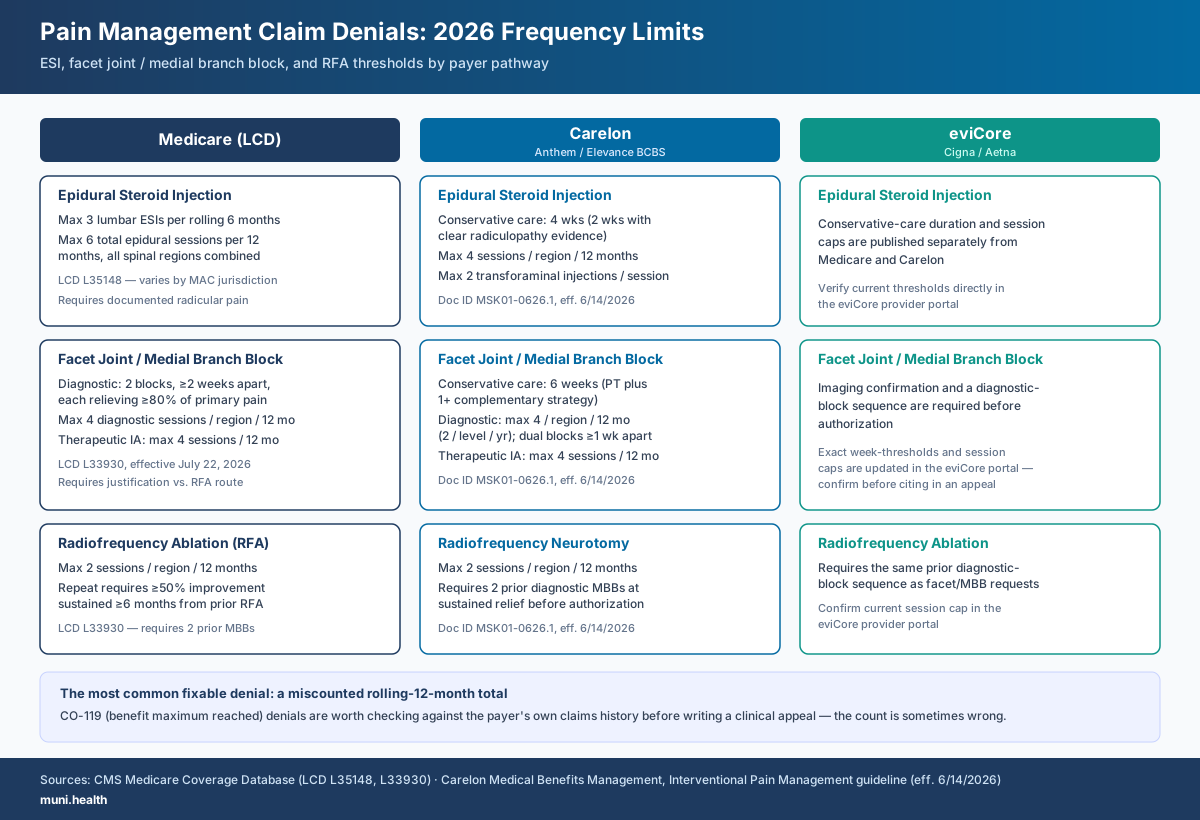
Why Pain Management Denials Cluster on Frequency, Not Medical Necessity
Interventional pain procedures are billed repeatedly for the same patient over the same benefit year — a lumbar ESI series, a diagnostic-then-therapeutic facet block sequence, a repeat RFA once relief wears off. That repetition is exactly what payers build utilization-management rules around: how many sessions per region, per year, and what has to happen (imaging, a documented trial of conservative care, a diagnostic block with a minimum percent relief) before the next one is authorized.
Three separate rule sets govern the same CPT codes depending on who's paying:
- Medicare's Local Coverage Determinations (LCDs) — frequency caps and diagnostic-block requirements set by each Medicare Administrative Contractor (MAC)
- eviCore — the delegated musculoskeletal/interventional-pain reviewer for Cigna and Aetna commercial and Medicare Advantage plans
- Carelon Medical Benefits Management (formerly AIM Specialty Health) — the delegated interventional-pain reviewer for Anthem/Elevance-branded Blue Cross Blue Shield plans
The same two vendors also manage orthopedic joint and spine surgery prior authorization — see the orthopedic surgery claim denials guide for how eviCore's MSK delegation works on the surgical side of the same UM programs.
None of these three publish the same numbers. A denial that looks like a medical-necessity fight is frequently a count mismatch or a documentation gap against one specific published policy — which means the fastest path to overturning it is citing the payer's own rule back at them, not building a new clinical argument from scratch.
Medicare's Frequency Caps: What the LCDs Actually Allow
CMS Local Coverage Determinations set hard session limits for epidural and facet-joint procedures. LCD numbers vary by Medicare Administrative Contractor — the figures below come from a Noridian-jurisdiction LCD for lumbar ESIs (L35148) and a facet-joint LCD effective July 22, 2026 (L33930) — but the same structure (diagnostic-block-then-therapeutic, rolling 12-month caps) appears across MAC jurisdictions.
| Procedure | Medicare Frequency Limit | Diagnostic Requirement |
|---|---|---|
| Lumbar epidural steroid injection (ESI) | No more than 3 per rolling 6-month period | Documented radicular pain and failed conservative care |
| All epidural sessions combined (any region) | No more than 6 therapeutic/diagnostic sessions per rolling 12 months | N/A — combined cap across cervical, thoracic, lumbar |
| Diagnostic medial branch block (MBB) | No more than 4 diagnostic sessions per spinal region, per rolling 12 months | Two blocks required, ≥2 weeks apart, each relieving ≥80% of primary pain |
| Therapeutic facet joint injection (intraarticular) | No more than 4 sessions per spinal region, per rolling 12 months | Two prior diagnostic blocks at ≥80% relief, plus documentation of why RFA isn't suitable |
| Radiofrequency ablation / neurotomy (RFA) | No more than 2 sessions per spinal region, per rolling 12 months | Two diagnostic MBBs at ≥80% sustained relief; repeat RFA needs ≥50% improvement sustained ≥6 months |
Confirm the LCD That Applies to Your MAC Jurisdiction
LCD numbers and exact wording differ by Medicare Administrative Contractor. Before citing a specific LCD in an appeal, pull the version that governs your jurisdiction from the CMS Medicare Coverage Database rather than assuming the numbers above apply verbatim everywhere — the underlying structure is consistent, but the LCD ID and effective date are not.
Commercial UM Vendors Don't Use Medicare's Numbers
Medicare Advantage plans generally follow the LCD framework above, but commercial and self-funded plans route interventional pain procedures through a delegated utilization-management vendor with its own published guideline — and the two vendors that cover most of the market don't agree with each other.
Carelon Medical Benefits Management (Anthem/Elevance BCBS)
Carelon's current Interventional Pain Management guideline (effective June 14, 2026; Doc ID MSK01-0626.1) sets its own conservative-care and frequency thresholds, distinct from Medicare's:
| Requirement | Carelon Threshold (2026) |
|---|---|
| Conservative care before ESI | ≥4 weeks (may proceed at 2 weeks with clear radiculopathy evidence) |
| ESI frequency | Max 4 therapeutic sessions per region per rolling 12 months; max 2 transforaminal injections per session; 1 session max for caudal/interlaminar |
| Conservative care before facet/MBB | ≥6 weeks, including physical therapy plus at least one complementary strategy |
| Diagnostic MBB frequency | Max 4 diagnostic sessions per region per rolling 12 months (max 2 per level per year); dual blocks required ≥1 week apart |
| Therapeutic intraarticular facet injection | Max 4 sessions per rolling 12 months, when indicated over RFA |
| Radiofrequency neurotomy | Max 2 sessions per region per rolling 12 months |
Carelon also requires imaging within 18 months (12 months for a repeat procedure) and a documented pain score of at least 3/10 with functional impairment — details a Medicare-focused appeal will miss entirely.
eviCore (Cigna and Aetna)
Cigna and Aetna delegate musculoskeletal and interventional-pain prior authorization to eviCore, which runs its own separate conservative-care and imaging-confirmation program for ESIs, facet/MBB procedures, and RFA — publicly documented on eviCore's Musculoskeletal utilization-management program page and provider FAQs. eviCore's exact week-thresholds and session caps are published and updated in its provider portal rather than in a single static PDF, so verify the current numbers directly against your eviCore portal login before citing a specific figure in an appeal — don't assume Carelon's or Medicare's numbers transfer.
The Real Skill Is Matching the Rule to the Payer
The same CPT code — say, 64493 for a lumbar facet injection — can be denied for entirely different reasons depending on whether Medicare, Carelon, or eviCore reviewed it. An appeal that cites the wrong vendor's threshold reads as generic and gets rejected on that basis alone, independent of the clinical merits.
The Two-Diagnostic-Block Rule Before Radiofrequency Ablation
The single most common structural denial in this specialty is billing RFA (CPT 64633–64636) without the diagnostic sequence every major payer requires first: two separate medial branch blocks, performed on different days, each independently relieving a defined percentage of the patient's primary pain. Medicare requires ≥80% relief on each block, at least two weeks apart. Carelon requires dual blocks at least one week apart. If either diagnostic block is missing, performed too close together, or the relief percentage isn't documented in the chart note, the RFA claim denies regardless of how well-justified the underlying diagnosis is.
What the diagnostic-block documentation needs to show:
- Date and CPT code of each block
- The specific percentage (or duration) of pain relief reported by the patient after each block, in the patient's own words where possible
- The interval between the two blocks
- A statement connecting the diagnostic response directly to the RFA request ("sustained >80% relief from bilateral L4-L5, L5-S1 MBB confirms facetogenic pain source; RFA requested at the confirmed levels")
Missing any one of these is the most common reason an otherwise-appropriate RFA denies — and the most common reason the appeal succeeds once the missing element is supplied. If the written appeal stalls, most UM vendors offer a peer-to-peer review before the case moves to a formal external review — see the peer-to-peer review guide for how to prepare the treating physician for that call.
Step-Therapy and Conservative-Care Denials
A "conservative care not documented" denial is rarely a claim that conservative care never happened — it's usually a claim that the chart note doesn't say so in the terms the payer's UM criteria require. Carelon's standard, for example, asks for physical therapy and at least one complementary strategy (medication trial, adjunctive treatment, or alternative therapy) for a defined duration before ESI or facet/MBB procedures.
The appeal fix is almost always documentation, not a new clinical argument:
- Pull the specific conservative-care requirement from the denial notice or the payer's published UM guideline
- Build a dated timeline: what was tried, for how long, and the documented outcome (partial relief, no relief, adverse effect)
- If conservative care was genuinely not attempted because of a contraindication or acute presentation, document the specific clinical reason rather than leaving the gap unexplained
- Cite the payer's own guideline language in the appeal letter — this is what turns a generic-sounding rebuttal into one the reviewer has to engage with on its own terms
For the broader documentation structure behind any medical-necessity argument, including how to map clinical evidence to a payer's specific criteria, see the medical necessity justification letter guide.
The Controlled-Substance Angle
Interventional pain practices frequently manage Schedule II opioid therapy alongside procedural care, and payers increasingly require a documented non-opioid or non-pharmacologic trial before authorizing continued opioid therapy — consistent with the CDC Clinical Practice Guideline for Prescribing Opioids, which most payer opioid-management policies reference. Most states also require a prescription drug monitoring program (PDMP) query before a new or continued Schedule II prescription; a missing PDMP check is a distinct, easily-fixed reason a medication claim or prior authorization request can be returned. This is a separate track from the procedural denials above — confirm which requirement (step therapy, PDMP documentation, or quantity limit) the specific denial notice cites before drafting a response.
Denial Codes to Know for Interventional Pain Claims
For denial-code lookups beyond the three below, see the EOB denial code guide.
| Code | Meaning | What It Signals |
|---|---|---|
| CO-50 | Not medically necessary | A coverage decision on clinical merits — see the full CO-50 appeal guide |
| CO-119 | Benefit maximum for this time period or occurrence has been reached | A frequency/quantity limit, often paired with RARC M80 (service frequency limit exceeded) — check the rolling-12-month count first, since payer counters are sometimes wrong |
| CO-197 | Precertification/authorization/notification absent | No prior authorization on file, or the claim doesn't match the scope of the authorization that was granted (wrong CPT, level, or date) |
A CO-119 denial is worth double-checking before writing any appeal narrative — if the payer's own frequency count is wrong (a session from a different spinal region miscounted against the wrong cap, for example), the fix is a correction request with the accurate claims history attached, not a medical-necessity argument.
Appeal Letter: Frequency Limit or Conservative-Care Documentation Denial
Use this template when the denial cites a frequency/session limit (CO-119) or missing conservative-care documentation, and the actual clinical record supports that the payer's own published criteria were met. Adjust the bracketed policy citation to the specific payer — Medicare LCD number, Carelon guideline, or eviCore criteria — named on the denial notice.
[Practice Letterhead]
[Date]

[Payer/UM Vendor] Appeals Department
[Address from denial letter]

RE: Appeal — [Frequency Limit / Conservative Care Documentation] Denial
Patient: [Name] | DOB: [Date] | Member ID: [ID]
Claim #: [Claim Number] | DOS: [Date]
CPT Code(s): [Codes] | Spinal Region: [Cervical/Thoracic/Lumbar]
Denial Reason: [CO-119 benefit maximum reached / conservative care not documented]

Dear Appeals Reviewer:

This claim was denied on the basis of [frequency limit exceeded / insufficient
conservative care documentation]. The attached records demonstrate that this
procedure meets the criteria published in [Payer/UM Vendor]'s current
Interventional Pain Management guideline [guideline name/ID, e.g., Carelon
Doc ID MSK01-0626.1] / Medicare LCD [LCD number].

FREQUENCY COUNT

This is the [first/second/third] [ESI / diagnostic MBB / therapeutic facet
injection / RFA] session for this patient in the [cervical/thoracic/lumbar]
region within the applicable rolling 12-month window, which began
[date of first session in window]. This falls within the [payer]'s published
limit of [X] sessions per rolling 12 months for this region. A complete
claims history for the applicable window is attached.

CONSERVATIVE CARE / DIAGNOSTIC BLOCK DOCUMENTATION

[Patient name] completed the following before this procedure, consistent
with [Payer]'s published requirement of [X weeks conservative care /
diagnostic block protocol]:

1. [Modality — e.g., physical therapy] from [start date] to [end date],
 [X] sessions, documented outcome: [partial relief / no improvement]
2. [Complementary strategy — e.g., NSAID/muscle relaxant trial or
 adjunctive treatment] from [dates], documented outcome: [outcome]
3. [If diagnostic blocks apply] Diagnostic medial branch block performed
 [date 1] and [date 2], [X weeks] apart, with [X]% relief reported at
 each encounter, as documented in the attached procedure notes

REQUEST

Based on the attached claims history and clinical documentation, this
claim meets [Payer]'s own published frequency and conservative-care
criteria. I respectfully request that you overturn this denial and
process payment for the dates of service above.

Sincerely,

[Provider Name], [Credentials]
[Practice Name]
[Phone] | [Fax]
Skip the blank template. Start with a review-ready draft.
Use the template as guidance, or let Muni prepare a payer-specific draft for your team to verify, sign, and submit.
First 3 appeals free, then $20 per appeal. Start with your denial letter or EOB and available records. No meeting or clearinghouse connection required.
How Muni Appeals Handles Pain Management Denials
Interventional pain billing generates a disproportionate share of repeat-procedure denials because the same patient, same region, and often the same CPT code get billed multiple times across a benefit year — which is exactly where frequency-count and conservative-care documentation gaps hide. Muni Appeals helps billing teams:
Prepare this appeal packet with your team.
Draft the appeal, coordinate missing documents, and approve the reviewed packet. Keep your clearinghouse; your practice checks deadlines and submits through the payer’s accepted channel.
First 3 appeals free, then $20 per appeal. Start with your denial letter or EOB and available records. No meeting or clearinghouse connection required.
- Organize the claims history needed to verify or dispute a payer's frequency count against the applicable rolling-12-month window
- Surface which UM vendor (eviCore, Carelon, or the health plan directly) issued the denial, for staff to confirm the correct appeal routing
- Compile conservative-care documentation and diagnostic-block records against the specific criteria the denial notice cites
- Surface the appeal deadlines that apply across Medicare LCD, eviCore, and Carelon review pathways, for staff to calendar and file against
Practices weighing whether to build this documentation workflow manually or automate it should review the appeal automation software comparison for small practices before deciding.
Frequently Asked Questions
Why do pain management denials keep coming back to frequency limits instead of new medical necessity disputes?
Interventional pain procedures are billed repeatedly for the same patient and region across a benefit year, so payers build utilization-management rules around session counts and conservative-care sequencing rather than re-litigating medical necessity every time. Medicare LCDs, eviCore, and Carelon each publish their own frequency caps and documentation requirements for the same CPT codes, and a denial usually means one specific published rule wasn't met or was miscounted — not that the procedure lacks clinical justification.
What is Medicare's frequency limit for lumbar epidural steroid injections?
Per CMS LCD guidance (e.g., L35148), no more than 3 lumbar epidural steroid injections may be performed in a rolling 6-month period, and no more than 6 total epidural sessions across all spinal regions combined in a rolling 12-month period. LCD numbers vary by Medicare Administrative Contractor, so confirm the exact LCD governing your jurisdiction before citing it in an appeal.
How many diagnostic medial branch blocks does Medicare require before radiofrequency ablation?
Two separate diagnostic medial branch blocks, performed at least two weeks apart, each relieving at least 80% of the patient's primary pain, per the applicable facet-joint LCD (e.g., L33930). Repeat RFA at the same level additionally requires documented improvement of at least 50%, sustained for at least 6 months, from the prior RFA session.
Does Cigna or Aetna use eviCore for interventional pain management prior authorization?
Yes. Cigna and Aetna delegate musculoskeletal and interventional-pain-management prior authorization review to eviCore for most commercial and Medicare Advantage plans. eviCore publishes its own conservative-care and imaging-confirmation requirements separate from Medicare's LCDs and Carelon's guideline, and updates them in its provider portal — verify the current thresholds there rather than assuming they match another payer's numbers.
Does Anthem or another BCBS plan use Carelon for pain management prior authorization?
Anthem/Elevance-branded Blue Cross Blue Shield plans delegate interventional pain management, spine surgery, and joint surgery review to Carelon Medical Benefits Management, formerly AIM Specialty Health. Carelon's current Interventional Pain Management guideline (effective June 14, 2026) sets its own conservative-care duration and session-frequency thresholds, which differ from both Medicare's LCDs and eviCore's program.
What's the difference between a CO-50, CO-119, and CO-197 denial on a pain management claim?
CO-50 means the payer decided the service isn't medically necessary on clinical grounds — see the full CO-50 appeal guide. CO-119 means a benefit or frequency maximum was reached for the billing period, often paired with remark code M80 (service frequency limit exceeded) — worth double-checking against the payer's own claims history before assuming the count is correct. CO-197 means no authorization was on file, or the submitted claim didn't match the scope (CPT, level, or date) of an authorization that was actually granted.
How does step-therapy or conservative-care documentation affect a pain management appeal?
Most UM vendors require a documented trial of conservative care — commonly physical therapy plus at least one complementary strategy, for a defined number of weeks — before authorizing an ESI or facet/MBB procedure. A denial citing insufficient conservative-care documentation is usually a documentation gap, not evidence that conservative care wasn't attempted: the fix is a dated timeline of what was tried, for how long, and the documented outcome, tied directly to the payer's published requirement.
Can Muni Appeals help with interventional pain management denials?
Yes. Muni Appeals organizes the claims history and clinical documentation needed to verify a payer's frequency count, confirm which UM vendor reviewed the denial, and match conservative-care or diagnostic-block records to the specific criteria cited on the denial notice. Staff verify the clinical facts and submission path before anything is sent. The first 3 appeals are free, then pricing is $20 per appeal.
This guide reflects 2026 Medicare LCD frequency limits and Carelon Medical Benefits Management's interventional pain management guideline. eviCore, plan-specific, and state-level requirements vary and change frequently — verify current criteria directly with the applicable payer or UM vendor before filing. This information is for administrative and billing purposes and is not legal or medical advice.