

A No Surprises Act (NSA) payment dispute is not an appeal. It's a negotiation over the out-of-network rate, followed by baseball-style arbitration if that fails. Under 45 CFR 149.510, either party has 30 business days from the initial payment or notice of denial of payment to send an open negotiation notice. The open negotiation period then runs for 30 business days, and the Federal IDR process must be initiated within the 4 business days after it ends. The 2026 IDR Operations final rule cut the administrative fee to $15 per party per dispute for disputes initiated on or after June 11, 2026. If the plan denied the claim as not covered or not medically necessary, that is an adverse benefit determination. It goes through the plan's internal appeal, not IDR.
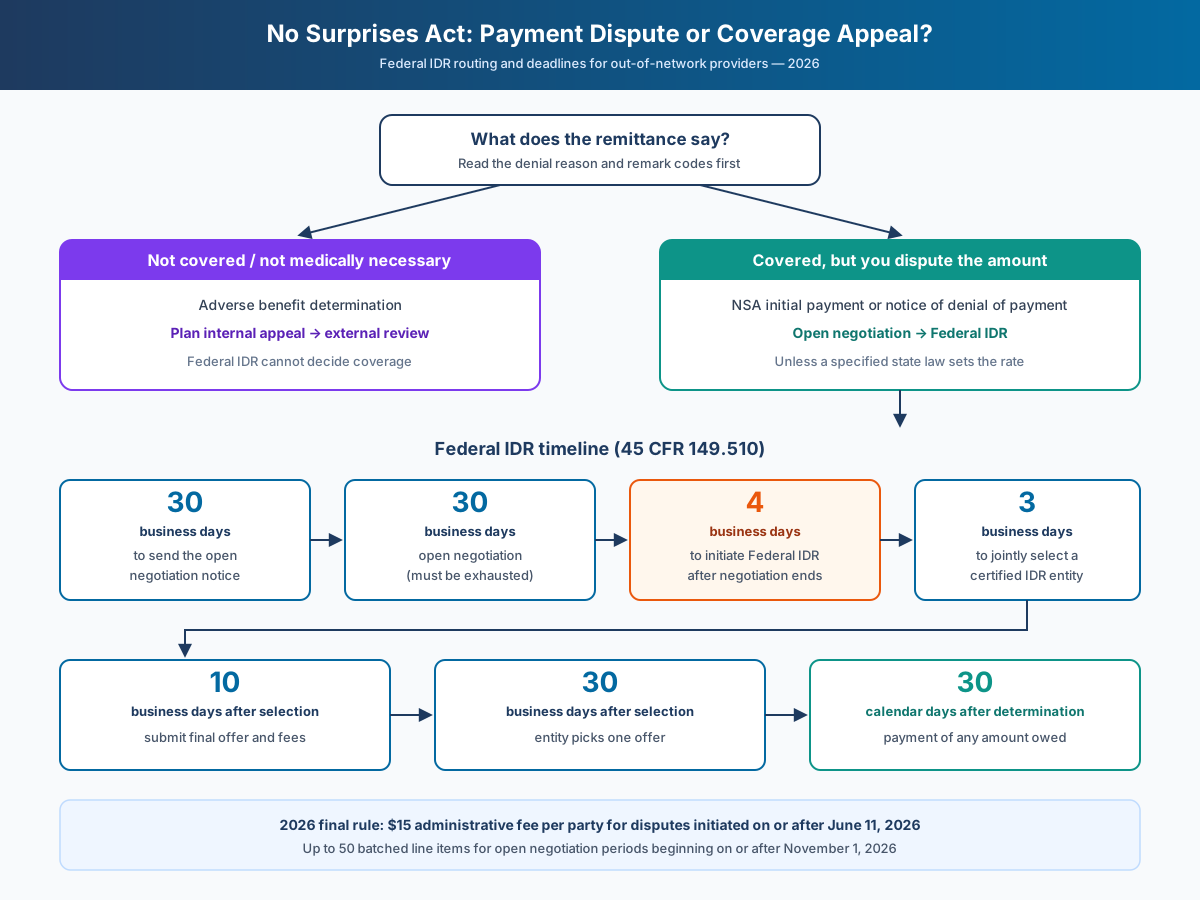
Is This an NSA Payment Dispute or a Coverage Appeal?
Check the remittance before anything else. If the plan says the service is covered and just paid less than you wanted (or paid $0 after patient cost sharing), you have an NSA rate dispute. If the plan says the service isn't covered or isn't medically necessary, you have a coverage denial, and IDR can't resolve it.
The regulation draws this line itself. The 45 CFR 149.30 definition of a "notice of denial of payment" applies to items or services the plan covers under the surprise-billing protections. The Departments' July 17, 2026 remark-code guidance states that a notice of denial of payment "is not considered a notice of benefit denial due to an adverse benefit determination."
| What the remittance says | What it is | Correct route |
|---|---|---|
| Covered; paid at the plan's out-of-network rate (often tied to the QPA) | NSA initial payment | Open negotiation, then Federal IDR if no agreement |
| Covered, but $0 paid because patient cost sharing absorbed the amount | NSA notice of denial of payment | Open negotiation, then Federal IDR if no agreement |
| Not covered, not medically necessary, experimental, or missing prior authorization | Adverse benefit determination | Plan internal appeal, then external review |
| Payment amount set under a specified state law or All-Payer Model Agreement | State-process claim | The state's dispute process, not Federal IDR |
Mix these up and you lose time on both tracks. An IDR entity can't overturn a medical-necessity denial, and a clinical appeal letter won't get the plan to reprice a covered claim. For the coverage track, start with the medical necessity justification letter guide and, after internal appeals, the independent review organization (external review) guide.
Self-funded plans and state laws
Some states have their own balance-billing laws that set out-of-network payment amounts for the plans they regulate. CMS notes that whether the federal or a state process applies depends on state law. Self-funded ERISA plans are generally outside state insurance regulation, so the federal process is the usual route for them unless state law lets the plan opt into the state process and it has. Confirm the plan type before choosing a forum. The ERISA self-funded plan appeal guide covers how to identify one.
Which Services Qualify for Federal IDR?
The Federal IDR process covers payment disputes over the specific services the NSA protects patients from balance billing for. It applies only when the out-of-network rate isn't set by a specified state law or All-Payer Model Agreement. Per section 3.1.1 of the Departments' guidance for disputing parties, the eligible services are:
- Emergency services from an out-of-network provider or facility
- Non-emergency services from an out-of-network provider at an in-network facility, such as an out-of-network anesthesiologist, radiologist, or pathologist at an in-network hospital, when the patient didn't receive the required notice or didn't give valid consent to waive balance-billing protections
- Air ambulance services from an out-of-network provider
Ground ambulance isn't on that list. A service where the patient validly waived NSA protections through notice and consent isn't eligible either.
The Federal IDR Timeline, Step by Step
The table below describes the process as of September 24, 2026. Deadlines use business days except payment and the current 90-day cooling-off period, which use calendar days. For batched disputes whose open negotiation begins on or after November 1, 2026, the cooling-off period changes to 30 business days, as explained below. Business days mean Monday through Friday, excluding federal holidays, per the Departments' guidance for disputing parties. Counting calendar days instead can make you think a window is still open after it has closed.
| Step | Deadline | Who acts |
|---|---|---|
| 1. Send the open negotiation notice | Within 30 business days of receiving the initial payment or notice of denial of payment | Either party |
| 2. Open negotiation | Runs 30 business days from the day the notice is first sent | Both parties |
| 3. Initiate Federal IDR | Within the 4 business days after open negotiation ends | Either party, via the Federal IDR portal |
| 4. Select a certified IDR entity | Jointly within 3 business days of initiation; otherwise the Departments select one by the 6th business day | Both parties, then the Departments |
| 5. Submit offers and fees | Within 10 business days of certified IDR entity selection | Both parties |
| 6. Payment determination | Within 30 business days of certified IDR entity selection | Certified IDR entity |
| 7. Payment of any amount owed | Within 30 calendar days of the determination | Plan or provider, as applicable |
| 8. Cooling-off period | Currently 90 calendar days after the determination; 30 business days for batched disputes whose open negotiation begins on or after November 1, 2026 | The initiating party can't re-initiate against the same party for the same or similar item or service |
Sources: 45 CFR 149.510 and the Departments' guidance for disputing parties.
The open negotiation period must be exhausted before IDR can start, even if the plan never replies. According to the guidance, parties can keep negotiating after day 30. That doesn't move the IDR deadline: initiation still has to happen within the 4 business days starting on the 31st business day.
Prove the notice was received
The Departments warn that if the open negotiation notice isn't properly delivered, they may decide the 30-business-day period never began. Any later IDR determination could then be unenforceable. Confirm the plan's contact information, and keep proof of receipt such as read receipts or certified-mail records. That matters most when the plan doesn't respond.
What the IDR Entity Weighs When It Picks an Offer
The certified IDR entity picks one of the two final offers. It doesn't split the difference, so your offer should be one you can defend with evidence. Under 45 CFR 149.510, the entity must consider the qualifying payment amount (QPA) for the same or similar service, along with credible additional information such as:
- The provider's training, experience, and quality and outcomes measurements
- The market share of the provider or the plan in the geographic region
- Patient acuity and the complexity of the service
- The facility's teaching status, case mix, and scope of services
- Good-faith efforts, or lack of them, by either party to enter into a network agreement
The same section prohibits the entity from considering usual and customary charges, the provider's billed charges, and public payer rates (Medicare, Medicaid, CHIP, TRICARE, and VA). An offer built on "our chargemaster rate" or "150% of Medicare" argues from factors the entity can't use. Build your offer on acuity, complexity, experience, and contract history instead.
What the 2026 IDR Operations Final Rule Changes
The Departments published the Federal IDR Operations final rule on June 4, 2026, effective August 3, 2026. Most changes don't apply yet. Many are tied to features in the new IDR Gateway that CMS hasn't launched. Here's what applies when, per CMS's August 7, 2026 implementation timeline:
| Change | Applies to |
|---|---|
| Administrative fee cut from $115 to $15 per party per dispute | Disputes initiated on or after June 11, 2026 |
| Bundled-payment definition; new QPA disclosure requirements with payments and denials | August 3, 2026 (the rule's effective date) |
| New batching rules, up to 50 line items per dispute, and a 30-business-day cooling-off period for batched disputes | Disputes whose open negotiation period begins on or after November 1, 2026 |
| Required NSA remark codes (RARCs) on remittances to out-of-network providers | Items and services furnished on or after January 1, 2027 |
| Open negotiation and initiation notices filed through the IDR Gateway; entity selection; extensions; withdrawals | 90 calendar days after CMS announces each Gateway function (CMS expects to roll these out starting in spring 2027) |
| Plan and issuer registration in the IDR Registry | Within 90 business days after CMS announces the registry function |
The final rule shortens the cooling-off period for batched disputes from 90 calendar days to 30 business days. The CMS implementation timeline applies this batching provision to disputes whose open negotiation period begins on or after November 1, 2026. Do not apply that shorter period to earlier disputes or to non-batched disputes.
According to the CMS fact sheet, the new batching rules allow up to 50 line items in one dispute in three situations:
- Items for the same patient on the same or consecutive dates, billed on one claim form
- Items with the same service code across different patients
- Anesthesiology, radiology, pathology, or laboratory items grouped under their Category I CPT code sections
Once the Gateway open negotiation function goes live, the fact sheet says the receiving party must answer an open negotiation notice by the 15th business day. Certified IDR entities will also have to decide eligibility within 5 business days of their selection. Until CMS announces each function, the current process stays in place.
Read the new remark codes on your remittances
For items furnished on or after January 1, 2027, the July 17, 2026 guidance requires plans to flag each out-of-network item with an NSA remittance advice remark code:
| RARC | Meaning | Federal IDR eligible? |
|---|---|---|
| N877 | Initial payment made under the NSA; you may open negotiation | Yes, after open negotiation |
| N876 | Covered, but no plan payment (notice of denial of payment); you may open negotiation | Yes, after open negotiation |
| N871 | Initial payment calculated under a specified state law | No — state process |
| N944 | Covered, no plan payment; cost sharing based on a specified state law or All-Payer Model Agreement | No — state process |
The guidance also states that certified IDR entities, not plans, make the final eligibility call. A provider who disagrees with a plan's code can still initiate IDR after open negotiation ends. For how remark codes combine with CARCs on a denial, see the EOB denial code guide.
Open Negotiation Notice Cover Letter and Worksheet
The Departments require parties to use their standard Notice of Open Negotiation (Appendix B of the disputing-party guidance). Per that guidance, the notice must identify the service date(s), service code(s), the initial payment amount or notice of denial of payment, your offer for the out-of-network rate, and your contact information. Use the cover letter and worksheet below to gather that information and send it with the standard notice. They go alongside the standard notice, not in place of it.
[Practice / Facility Letterhead]
[Date Sent]  —  Business day [__] of 30 since the initial payment or
              notice of denial of payment was received on [Date]

TO: [Plan or issuer name]
  [Open negotiation contact from the remittance / plan website]
  [Email and/or mailing address]

RE: No Surprises Act Open Negotiation — Notice Enclosed
  Patient: [Name]   Member ID: [Number]
  Claim Number: [Number]
  Plan Type: [ ] Fully insured   [ ] Self-funded (ERISA)   [ ] FEHB   [ ] Unknown

This letter accompanies the Departments' standard Notice of Open
Negotiation and starts the 30-business-day open negotiation period
under 45 CFR 149.510(b)(1) for the items listed below.

WHY THIS IS AN NSA PAYMENT DISPUTE (not a coverage appeal):
[ ] Emergency services by an out-of-network provider/facility
[ ] Non-emergency services by an out-of-network provider at an
    in-network facility (no valid notice-and-consent waiver)
[ ] Air ambulance services by an out-of-network provider
The plan covered the item(s) and issued an [initial payment /
notice of denial of payment]. We dispute the payment amount only.

ITEMS UNDER NEGOTIATION:
Line | Date of Service | Service Code | Billed | Plan Paid / Denial
---- | --------------- | ------------ | ------ | ------------------
 1   | [MM/DD/YYYY]    | [CPT/HCPCS]  | [$  ]  | [$  ] / [RARC]
 2   | [MM/DD/YYYY]    | [CPT/HCPCS]  | [$  ]  | [$  ] / [RARC]

OUR OFFER FOR THE OUT-OF-NETWORK RATE:
Line 1: $[amount]   Line 2: $[amount]

BASIS FOR OUR OFFER (permitted factors only — no billed charges,
usual and customary rates, or public payer rates):
- Patient acuity / service complexity: [specifics from the record]
- Provider training, experience, quality/outcomes: [specifics]
- Market share / network history with this plan: [specifics]
- QPA disclosed by the plan: $[amount] — [why it understates
  this service, if applicable]

Please respond to the contact below. If we do not reach agreement
within the 30-business-day period ending on [Date], we intend to
initiate the Federal IDR process within the following 4 business
days.

[Name, Title]
[Practice / Facility], NPI: [Number], TIN: [Number]
[Phone]  |  [Email]

---- INTERNAL DEADLINE WORKSHEET (do not send) ----
Initial payment / denial received:        [Date]
Last day to send open negotiation notice: [Date] (30 business days)
Notice sent / proof of receipt saved:     [Date] / [method]
Open negotiation ends:                    [Date] (30 business days)
IDR initiation window:                    [Date] – [Date] (4 business days)
Open negotiation began on/after 11/1/2026? [ ] Yes — new batching rules apply
Handling a coverage denial instead of an NSA rate dispute?
Muni Appeals helps prepare coverage-appeal packets for your team to review and submit. It does not prepare this NSA negotiation notice or conduct Federal IDR payment disputes. Keep those disputes on the separate process described above.
First 3 appeals free, then $20 per appeal. Start with your denial letter or EOB and available records. No meeting or clearinghouse connection required.
Frequently Asked Questions
Is the No Surprises Act IDR process an appeal?
No. It's a payment-amount dispute between the provider and the plan, made up of a 30-business-day open negotiation followed by arbitration. The certified IDR entity picks one side's offer. Coverage and medical-necessity denials are adverse benefit determinations and go through the plan's internal appeal and external review instead.
How long do I have to start open negotiation?
Thirty business days from the day you receive the initial payment or notice of denial of payment, under 45 CFR 149.510. Business days exclude weekends and federal holidays, so the calendar window is roughly six weeks. The open negotiation period itself then runs another 30 business days.
What happens if I miss the 4-business-day IDR initiation window?
The dispute is generally ineligible for Federal IDR unless the Departments grant an extension for extenuating circumstances. The disputing-party guidance directs extension requests to FederalIDRQuestions@cms.hhs.gov and notes that all other timelines keep running while a request is reviewed.
How much does Federal IDR cost in 2026?
Each party pays a $15 administrative fee per dispute initiated on or after June 11, 2026. That's down from $115, per CMS's implementation timeline. Each party also pays the certified IDR entity fee up front with its offer. The prevailing party gets its entity fee refunded. The administrative fee isn't refunded.
Can I batch multiple claims into one IDR dispute?
Yes, within limits. For disputes whose open negotiation period begins on or after November 1, 2026, the final rule allows up to 50 line items per dispute in three situations: the same patient on one claim form, the same service code across patients, or anesthesiology, radiology, pathology, and lab items grouped by CPT section. Earlier disputes follow the prior batching rules.
Can the IDR entity consider Medicare rates or my billed charges?
No. 45 CFR 149.510 prohibits the certified IDR entity from considering usual and customary charges, billed charges, and public payer rates, including Medicare and Medicaid. Build your offer on the QPA plus permitted factors like acuity, complexity, and experience.
Where Muni Fits
Muni Appeals is built for the coverage side of this fork: medical-necessity, prior-authorization, and other adverse benefit determinations that need a documented internal appeal. When a denial arrives, Muni Appeals drafts the appeal from the uploaded denial notice and the payer's stated reason, and your staff reviews it before submission. Keep true NSA rate disputes on the negotiation-and-IDR track above, where the deadlines are in business days and the argument is about price, not coverage.
For the deadlines on the coverage side, see the insurance appeal deadlines guide and state-by-state appeal laws. For what manual appeal work costs a practice, see appeal automation cost vs. manual.
This guide summarizes the federal No Surprises Act IDR process as of September 24, 2026, including the Federal IDR Operations final rule (91 FR 33900, June 4, 2026) and CMS implementation guidance through August 7, 2026. Many final-rule provisions become applicable only after CMS announces the related IDR Gateway functions, and state surprise-billing laws may govern instead of the federal process. Confirm current requirements on the CMS No Surprises notices page before filing. This information is for administrative and billing purposes and is not legal advice.