

Muni Appeals lists $20 per appeal draft after 3 free starter credits, with no subscription. EZAppeal's rendered homepage advertises 6 free starter documents, $5 pay-as-you-go documents, and monthly plans. Its blog still lists a conflicting $3 rate and one free letter. Confirm EZAppeal's applicable terms before buying. This comparison checks published statements as of September 20, 2026, without claiming a tested speed, feature, or outcome advantage.
Muni Health publishes this comparison about its own product and a competitor. We checked the vendors' public pages, not their performance on matched cases. EZAppeal coverage is limited to its published price, stated audience, and infrastructure claim.
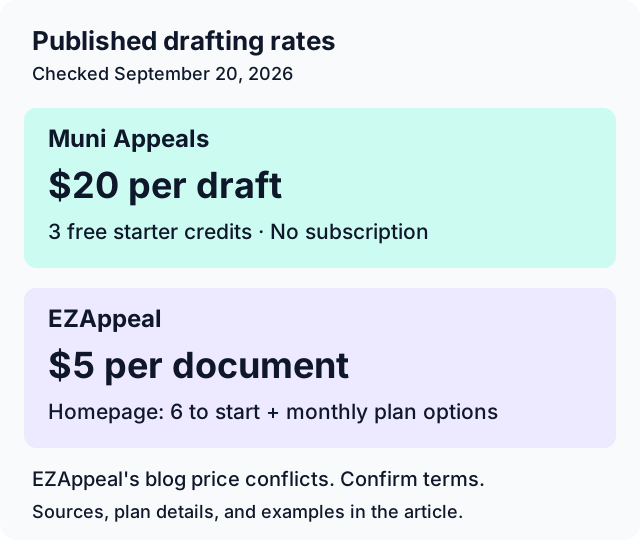
Published Pricing and Audience
| Dimension | Muni Appeals | EZAppeal |
|---|---|---|
| Pay-as-you-go | $20 per appeal draft; no subscription | Homepage: $5 per document; blog: $3 per letter |
| Starter allowance | 3 free credits; no credit card | Homepage: 6 documents; blog: first letter free |
| Monthly plans | No Appeals subscription | Homepage: Starter $39/25 documents; Pro $199/100 documents; Enterprise custom |
| Stated audience | Independent practices | Billing companies, private practices, multi-specialty groups |
Sources: Muni pricing, Muni Appeals, EZAppeal's rendered homepage, and EZAppeal's guide, checked September 20, 2026. These audiences overlap. EZAppeal explicitly includes private practices; its positioning does not establish that it is only suitable for high-volume billing companies.
The EZAppeal sources disagree. The homepage advertises subscription and pay-as-you-go options; the guide still advertises $3 per letter and the first free. We have not verified checkout terms or established when either page changed. The examples below use the homepage's advertised pay-as-you-go terms, not the conflicting blog rate. EZAppeal defines a document there as a successfully drafted appeal letter or prior-auth request, so mixed usage can consume the same allowance.
Worked Costs: Starter Allowances vs. Paid Usage
The first table assumes a new account has its entire advertised free allowance available, uses it only for appeal drafts, and then pays as it goes. Each example is a separate scenario, not consecutive months or a subscription recommendation.
| Drafts needed | Muni: max(drafts - 3, 0) × $20 | EZAppeal: max(documents - 6, 0) × $5 |
|---|---|---|
| 3 | $0 | $0 |
| 5 | $40 | $0 |
| 20 | $340 | $70 |
Once the starter allowances are exhausted, the calculation is simply paid units multiplied by the published rate:
| Paid drafts or documents | Muni at $20 each | EZAppeal pay-as-you-go at $5 each |
|---|---|---|
| 5 | $100 | $25 |
| 20 | $400 | $100 |
| 50 | $1,000 | $250 |
These are drafting-charge examples, not estimates of total appeal costs, reimbursement, or the cheapest plan. They exclude staff review, filing, and follow-up. The starter allowances are not monthly allowances. EZAppeal also advertises volume rates of $4.50 at 100+ documents and $4 at 500+; none of these examples reaches those thresholds. A subscription can cost less for a particular volume: the homepage's $39 Starter plan includes 25 documents per month. Confirm billing, renewal, overage, and unused-document terms directly rather than assuming the same rules across plans.
Muni's pricing page describes a draft, supporting policy references to verify, an evidence checklist, and next-step guidance. Staff review and submission remain separate. This does not establish that EZAppeal lacks similar capabilities: evaluate each tool against your requirements rather than treating an untested feature as absent.
BAA Statements: Confirm the Agreement for Your Practice
Muni's terms, section 3 require HIPAA-covered entities to execute a Business Associate Agreement (BAA) before using the services and state that it is presented during account setup. That is the source for Muni's BAA requirement; a pricing page alone does not prove an agreement has been signed.
EZAppeal's guide describes its infrastructure as “AWS Bedrock BAA HIPAA infrastructure.” Its homepage also states that a BAA is included with every account. Both are vendor statements, not an independent compliance assessment or verification of a signed agreement with a particular practice. Do not treat the infrastructure wording as the vendor's only BAA statement.
HHS cloud guidance explains that appropriate BAAs and other HIPAA obligations apply when cloud services handle ePHI on behalf of covered entities or business associates. For either vendor, confirm the applicable agreement, permitted uses, and safeguards before sending patient data.
Copyable Vendor Evaluation Checklist
Use the same questions for both vendors. Start evaluation with synthetic cases, then follow your practice's approval process before uploading patient information.
Vendor and date checked:
Published price and source URL:
Free allowance remaining; any expiration or renewal terms:
Expected paid drafts x unit rate:
What counts as a billable generation, retry, or revision?
Which policy references and supporting documents must our staff verify?
How are missing evidence and uncertain deadlines surfaced?
Who reviews, signs, submits, and follows up on the appeal?
Which BAA will our practice execute before sending PHI?
What are the data retention, deletion, and subcontractor terms?
Synthetic-case observations: factual errors, missing evidence, correction effort.
Unanswered questions and written vendor responses:
Skip the blank template. Start with a review-ready draft.
Use the template as guidance, or let Muni prepare a payer-specific draft for your team to verify, sign, and submit.
First 3 appeals free, then $20 per appeal. Start with your denial letter or EOB and available records. No meeting or clearinghouse connection required.
Which Should You Evaluate?
EZAppeal's homepage advertises a lower pay-as-you-go document rate and subscription alternatives, but its conflicting blog price makes confirming the applicable offer important. If you want to assess Muni's drafting workflow, its starter credits let you review output before buying more. Neither price nor a free allowance proves accuracy, time savings, or appeal success.
For a broader evaluation framework, see the small-practice appeal automation buyer's guide. For other products, see our AI appeal generator ranking. For budgeting beyond software charges, see appeal automation cost vs. manual work.
Published vendor statements checked September 20, 2026. Pricing and terms can change. This comparison does not report a hands-on benchmark or provide legal or compliance advice.