

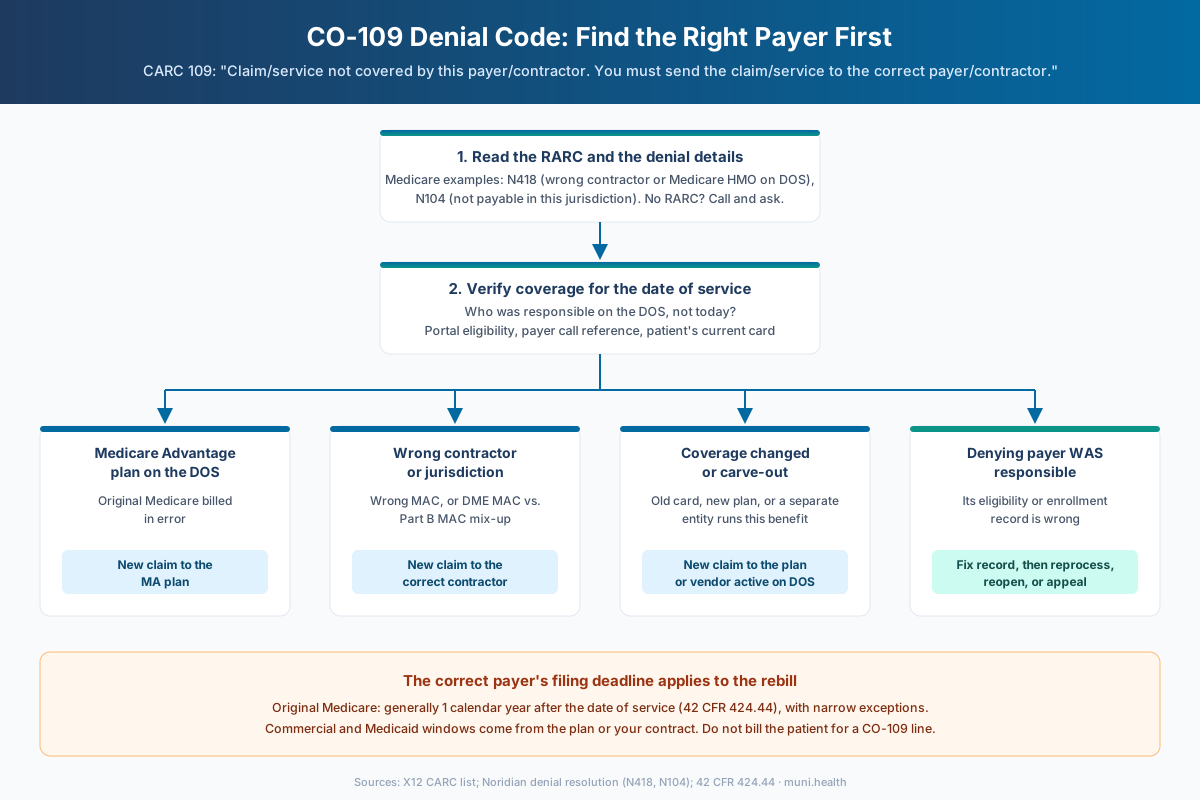
CO-109 means "Claim/service not covered by this payer/contractor. You must send the claim/service to the correct payer/contractor," per the X12 CARC list. It is a routing denial, not a medical-necessity or benefit decision. Most of the time the fix is to identify the payer that is actually responsible and submit a new claim there, inside that payer's own filing deadline. Common causes are a Medicare Advantage member billed to Original Medicare, a claim sent to the wrong Medicare contractor or jurisdiction, or a plan or carve-out the patient no longer has. Appeal only when you can show the denying payer was responsible on the date of service, for example because its eligibility record was wrong.
What Does CO-109 Mean?
CO-109 tells you the payer that received the claim says it is not the one that pays for this patient or this service. It does not say the service was unnecessary or excluded from the patient's benefits.
The official X12 definition of CARC 109 is "Claim/service not covered by this payer/contractor. You must send the claim/service to the correct payer/contractor." The second sentence is the instruction: the expected next step is a claim to someone else.
The CO group code means the payer treats the amount as a contractual obligation, so do not bill the patient because of a CO-109 line. The patient is not liable just because the claim was misrouted. Find the responsible payer instead.
The remark code (RARC) next to CARC 109 usually tells you why the payer thinks it is the wrong one. Noridian's Medicare guidance pairs CARC 109 with remark codes such as:
- N418: The claim was billed to the wrong contractor, or the beneficiary was enrolled in a Medicare HMO for the date of service. Noridian says to look up the plan name, address and plan ID in its portal and bill that plan (Noridian JA DME, updated Jun 6, 2025).
- N104: "This claim/service is not payable under our claim's Jurisdiction area." For DME MAC claims, Noridian says to submit to the jurisdiction of the beneficiary's permanent address on file with the Social Security Administration (Noridian JA DME, updated Jun 6, 2025).
Commercial payers use CARC 109 too, often without a specific RARC. When the remark code is missing or vague, call the payer and ask which entity it believes is responsible. Get a reference number.
Should You Appeal a CO-109?
Usually not. If another payer really is responsible, an appeal to the payer that denied the claim cannot get it paid, because that payer has already said it isn't responsible. The claim needs to go to the right payer.
An appeal makes sense in only one situation: you can show the denying payer was the responsible payer on the date of service. That usually means its own eligibility or enrollment record is wrong. For Original Medicare, Noridian's N418 guidance gives the order:
- The beneficiary or their legal representative contacts the Medicare Advantage plan to correct the enrollment record.
- Once the Medicare HMO record is updated for the date of service, the provider can request a self-service reopening in the Noridian portal.
- A redetermination with supporting documentation is the alternative.
The Medicare Part B reopening guide covers how reopenings differ from redeterminations. Requesting a reopening does not pause the appeal deadline.
The Clock That Matters Is the Correct Payer's
Rebilling the right payer is a new claim to that payer, so its timely filing limit applies. For Original Medicare, 42 CFR 424.44 generally requires filing within 1 calendar year after the date of service. Extensions are narrow, such as when a Medicare Advantage plan retroactively disenrolls the beneficiary and recovers its payment 6 or more months after the service. Commercial and Medicaid deadlines come from the plan or your contract. Don't let a CO-109 sit in a work queue while that window runs.
CO-109 Routing Decision Table
Sort every CO-109 by asking one question: who was actually responsible for this patient and this service on the date of service? The answer decides the route.
| What the remittance and eligibility show | Likely cause | What to do |
|---|---|---|
| Original Medicare denial; patient was in a Medicare Advantage plan on the DOS (often RARC N418) | Billed Original Medicare instead of the MA plan | Get the plan name and ID from the MAC portal's eligibility details, then submit a new claim to the MA plan |
| Medicare denial with a jurisdiction remark (for example N104) | Wrong MAC, wrong jurisdiction, or a DME MAC vs. Part B MAC mix-up | Confirm the contractor that handles this service and patient, then submit there |
| Commercial or Medicaid plan denial; coverage with that plan ended or changed | Patient changed plans, or the claim used an old ID card | Verify current coverage for the DOS and bill the plan active that day |
| Plan says a separate entity handles this service | Benefit carve-out (for example, a separate vendor or managed care entity for a service line) | Ask the plan who administers the benefit, and bill that entity |
| Patient has more than one plan and the secondary was billed first | Coordination of benefits error; may come back as CARC 22 instead | Bill the primary payer first, then send the secondary claim with the primary's remittance |
| Your records show the denying payer was responsible on the DOS | Payer's eligibility or enrollment record is wrong | Get the record corrected, then request reprocessing, reopening, or appeal with proof of coverage |
If the COB row fits, the coordination of benefits denial guide covers primary and secondary order in detail.
CO-109 vs. Codes That Look Similar
Several codes also mean "not us" or "not covered." Each one points to a different fix, so read the code before you route the claim.
| Code | X12 description | What it points to |
|---|---|---|
| CARC 109 | Claim/service not covered by this payer/contractor. You must send the claim/service to the correct payer/contractor. | Wrong payer or contractor: rebill the right one |
| CARC 22 | This care may be covered by another payer per coordination of benefits. | COB order: bill the primary first |
| CARC 24 | Charges are covered under a capitation agreement/managed care plan. | A managed care plan or capitation arrangement covers it (Noridian lists CO-24 as a top Part B Medicare Advantage denial) |
| CARC 27 | Expenses incurred after coverage terminated. | Coverage ended before the DOS: find the new coverage or the patient's responsibility |
| CARC 31 | Patient cannot be identified as our insured. | Member ID, name, or DOB mismatch: correct the demographics and resubmit |
| CARC 204 | This service/equipment/drug is not covered under the patient's current benefit plan | Right payer, excluded benefit: a benefit dispute, not a routing problem |
Definitions are from the X12 CARC list. The CO-24 note is from Noridian JF Part B's Q4 2025 top denials, which tells providers to verify eligibility and bill the managed care plan. The difference between CARC 109 and CARC 204 matters most. A 109 means you sent the claim to the wrong place. A 204 means the right payer looked at it and said the benefit isn't covered, which needs a benefit-language argument, not a rebill.
How to Fix a CO-109 Claim
Fix a CO-109 by confirming the responsible payer, rebilling that payer with the right member details, and documenting the trail in case filing dates are questioned later.
- Read the RARC and the payer's denial details. For Medicare, the MAC portal's claim status and eligibility screens can show the Medicare Advantage plan on file for the DOS.
- Verify eligibility for the date of service, not today. Coverage that is active today may not have been active on the DOS. The eligibility verification call script covers the questions to ask.
- Get the patient's current card. A new plan, ID number, or carve-out vendor often appears only on the latest card.
- Submit a new claim to the correct payer. It is a first submission to that payer, not a corrected claim to the denying payer. The corrected claim vs. insurance appeal guide explains the difference.
- Check the correct payer's filing deadline before you send it. The timely filing limits by company guide lists published windows by payer.
- Close the loop on the original claim. Post the CO-109 as resolved by rebill so the line doesn't come back as open AR.
CO-109 Rebill Checklist
Fill this out for each CO-109 before you rebill or appeal. If the routing check shows the denying payer was not responsible on the DOS, rebill. Do not appeal.
CO-109 REBILL CHECKLIST

Original claim number: ______________________
Denying payer / contractor: ______________________
Date of service: ____________
Group code + CARC on remittance: [ ] CO-109  [ ] Other: ______
RARC(s) on remittance: ____________
Remittance date: ____________

STEP 1 - WHO WAS RESPONSIBLE ON THE DATE OF SERVICE?
[ ] Medicare Advantage plan (Original Medicare billed in error)
  Plan name / plan ID from MAC eligibility: ______________________
[ ] Different Medicare contractor or jurisdiction
  Correct contractor: ______________________
[ ] Different commercial or Medicaid plan (coverage changed)
  Plan active on DOS: ______________________
[ ] Carve-out vendor or separate managed care entity
  Entity administering this benefit: ______________________
[ ] Another payer is primary (COB)
  Primary payer: ______________________
[ ] Denying payer WAS responsible -> go to appeal section

How responsibility was verified:
[ ] Portal eligibility check   [ ] Payer call   [ ] Patient's current card
Call reference number / date: ____________

STEP 2 - REBILL THE CORRECT PAYER
Correct payer member ID: ______________________
Correct payer claims address / payer ID: ______________________
Correct payer's filing deadline for this DOS: ____________
Days remaining at time of rebill: ______
Date new claim submitted: ____________
New claim number / acknowledgment: ____________

STEP 3 - CLOSE OUT THE ORIGINAL
[ ] Original claim noted as "rebilled to correct payer"
[ ] Patient account updated with the correct coverage
[ ] Registration updated so future visits bill correctly

APPEAL SECTION (only if the denying payer was responsible)
Proof of coverage on DOS (eligibility printout, ID card, enrollment record): ____________
Record correction requested? [ ] Yes, date: ______  [ ] Not needed
Route: [ ] Reprocessing request  [ ] Reopening  [ ] Appeal / redetermination
Appeal deadline for the denying payer: ____________
Skip the blank template. Start with a review-ready draft.
Use the template as guidance, or let Muni prepare a payer-specific draft for your team to verify, sign, and submit.
First 3 appeals free, then $20 per appeal. Start with your denial letter or EOB and available records. No meeting or clearinghouse connection required.
CO-109 Appeal Letter Template
Use this only when you have proof that the denying payer covered the patient and the service on the date of service. If the payer requires its own form or portal submission, attach this as the supporting explanation.
[Your Practice Letterhead]
[Date]

[Payer Name]
[Appeals / Claim Review Department]
[Address, fax, or portal reference from the provider manual or remittance]

RE: Request for Reprocessing — CO-109 Applied in Error
  Patient: [Patient Name]    DOB: [Date of Birth]
  Member ID: [Member ID]
  Claim Number: [Claim #]
  Date(s) of Service: [DOS]
  Rendering Provider / NPI: [Name, NPI]
  Billing TIN: [Tax ID]
  Remittance Date: [Date]
  Payer Call Reference (if any): [Reference #, date]

To Whom It May Concern:

We request reprocessing of the claim referenced above. The remittance denied the claim with CARC 109 ("Claim/service not covered by this payer/contractor"), [and RARC [code]]. Our records show [Payer Name] was the responsible payer for this patient and service on the date of service.

Basis for this request:
- The patient's coverage with [Payer Name] was active on [DOS], as shown in the enclosed [eligibility response dated ____ / copy of the member ID card / enrollment confirmation].
- [If applicable:] The patient was not enrolled in [other plan named in the denial] on the date of service. [The enrollment record was corrected on [date], per [source].]
- [If applicable:] This service is administered by [Payer Name] and not by a separate carve-out entity, per [plan document or provider manual section].

We ask that [Payer Name] update its eligibility record if needed and reprocess the claim for payment. If [Payer Name] maintains that another payer is responsible, please identify that payer and the basis for the determination so we can bill correctly.

Enclosed:
- Remittance advice showing the CO-109 denial
- Proof of coverage on the date of service
- [Record correction confirmation, if applicable]
- Copy of the original claim

Sincerely,

[Your Name]
[Title]
[Practice Name]
[Phone] | [Email]
How to Prevent CO-109 Denials
You prevent most CO-109s at registration: confirm which payer covers the patient for the date of service before the claim is created.
Prepare this appeal packet with your team.
Draft the appeal, coordinate missing documents, and approve the reviewed packet. Keep your clearinghouse; your practice checks deadlines and submits through the payer’s accepted channel.
First 3 appeals free, then $20 per appeal. Start with your denial letter or EOB and available records. No meeting or clearinghouse connection required.
- Verify eligibility at every visit, not just the first. Noridian's denial guidance tells providers to check eligibility in the portal before billing, and its Q4 2025 JF Part B top-denials list includes Medicare Advantage and HMO billing errors.
- Ask Medicare patients whether they joined a Medicare Advantage plan. Ask for the plan's member card, not just the Medicare card.
- Scan the current card each visit. New plan, new ID, new carve-out vendor.
- Track CO-109 by payer and location. Repeated CO-109s from one payer often point to a registration pattern or an outdated payer mapping in your practice management system, not to a run of one-off mistakes.
How Muni Appeals Helps With CO-109 Denials
Most CO-109s need a rebill, not an appeal, and Muni Appeals does not submit claims for you. When the denying payer really was responsible, Muni Appeals drafts a review-ready reprocessing or appeal letter from the remittance, proof of coverage, and the claim details your staff provides. Your team still confirms the responsible payer, the route, and the deadline.
If you're sorting out which denials are worth appealing at all, the when to appeal an insurance denial decision framework helps you sort the queue first.
Frequently Asked Questions
What does denial code CO-109 mean?
CO-109 means the payer that received the claim says it isn't responsible for this patient or service and you must send the claim to the correct payer or contractor. The CO group code makes it a contractual adjustment, so don't bill the patient for it. Find the responsible payer instead.
Is CO-109 appealable?
Only when the denying payer actually was responsible on the date of service, usually because its eligibility or enrollment record is wrong. In that case, get the record corrected and request reprocessing, a reopening, or an appeal with proof of coverage. If another payer was responsible, rebill that payer instead.
What does CO-109 with N418 mean on a Medicare remittance?
Noridian's guidance says N418 with CARC 109 means the claim was billed to the wrong contractor, or the beneficiary was in a Medicare HMO (Medicare Advantage plan) for the date of service. Look up the plan name, address and ID in the MAC portal and bill that plan.
Is a CO-109 rebill a corrected claim?
No. A corrected claim replaces a claim with the same payer. A CO-109 rebill is a new claim to a different payer, so it carries that payer's member ID, claims address, and filing deadline.
Does a CO-109 stop the timely filing clock?
Don't assume it does. The correct payer's own filing limit applies to the rebill. For Original Medicare, the general limit is 1 calendar year after the date of service under 42 CFR 424.44, with narrow exceptions such as retroactive Medicare Advantage disenrollment. Check the correct payer's deadline as soon as the CO-109 posts.
What is the difference between CO-109 and CO-22?
CARC 109 says the claim was sent to the wrong payer or contractor. CARC 22 says the care may be covered by another payer under coordination of benefits, which usually means another plan is primary. Both lead to billing another payer, but CO-22 involves billing in primary-then-secondary order.
What is the difference between CO-109 and PR-204?
CO-109 is a routing problem: wrong payer. CARC 204 means the right payer reviewed the claim and says the service isn't covered under the patient's current benefit plan. A 204 needs a benefit check or a benefit-language appeal, not a rebill to another payer.
Route It Right, Then Appeal What's Left
A CO-109 usually isn't a fight with the payer. It means the claim went to the wrong place. Find who was responsible on the date of service, rebill them before their deadline, and save appeals for the cases where the payer's own records are wrong.
With Muni Appeals, your team gets:
- Review-ready reprocessing and appeal letters built from the remittance and proof of coverage your staff provides
- Letters that state the coverage facts and ask the payer to name the responsible payer if it still disagrees
- Staff control over payer routing, filing route, and deadline
This guide reflects the X12 CARC definitions, Noridian Medicare denial-resolution guidance, and 42 CFR 424.44 as available in November 2026. Remark codes, contractor jurisdictions, carve-out arrangements, filing deadlines, and reprocessing routes vary by payer, plan, and state. Verify the payer's current provider manual and your contract before rebilling or appealing. This guide is not legal or billing compliance advice.