

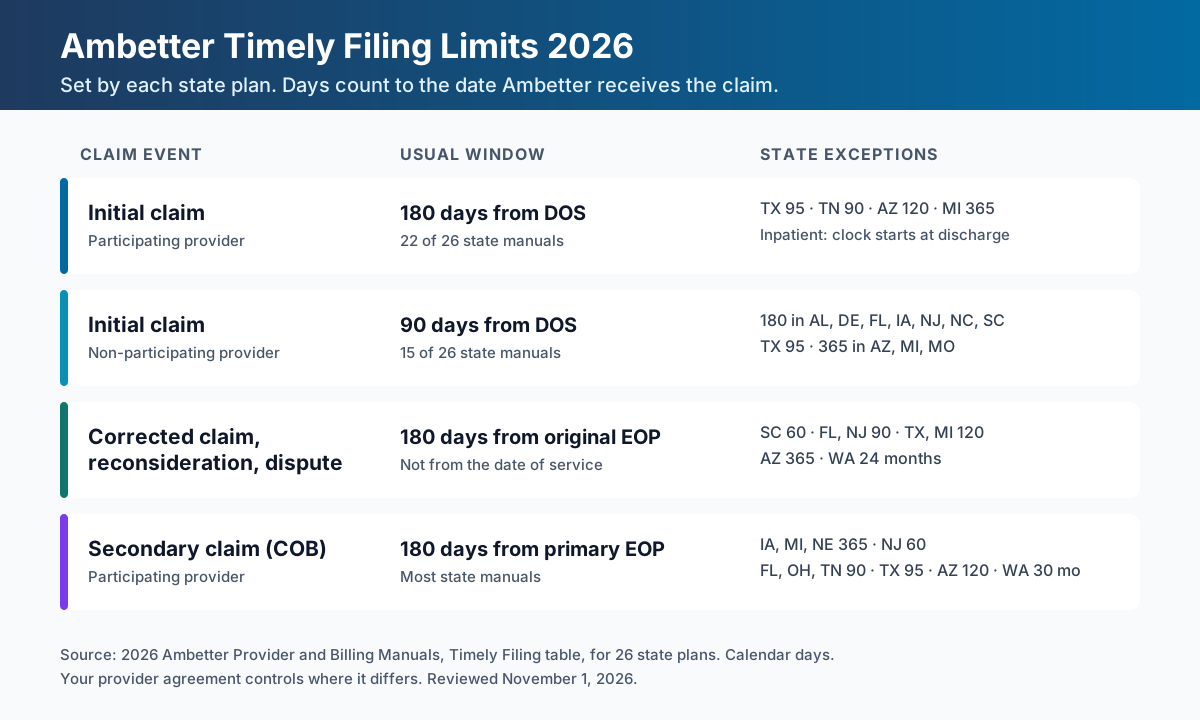
Ambetter has no single national timely filing limit. Each Centene state plan publishes its own window in its 2026 Provider and Billing Manual, split by participating (par) and non-participating (non-par) status. In 22 of the 26 state manuals we reviewed, participating providers get 180 days from the date of service. The exceptions are Texas (95 days), Tennessee (90), Arizona (120), and Michigan (365). Non-par windows are often shorter: 90 days in 15 states. Corrected claims, reconsiderations, and disputes run on a separate clock that starts at the original Explanation of Payment (EOP), usually 180 days but as short as 60 days in South Carolina. Every manual counts days to the date Ambetter receives the claim, not the date you sent it.
What Is Ambetter's Timely Filing Limit?
Ambetter's timely filing limit is set by the state plan, not by Centene nationally, and it is usually 180 days from the date of service for participating providers. Every 2026 state manual we reviewed has the same "Timely Filing" table. It has three columns (initial claims, reconsiderations or claim disputes, and coordination of benefits), each split into par and non-par. The numbers in those cells are what differ by state.
Ambetter is Centene's ACA Marketplace brand, sold under state plan names such as Ambetter from Sunflower Health Plan (Kansas), Ambetter from Superior HealthPlan (Texas), Ambetter from Peach State Health Plan (Georgia), and Ambetter from WellCare of Kentucky. The member's ID card tells you which state plan, and therefore which manual, applies. That is the plan you're billing, regardless of where your practice is.
Par and non-par windows are different
In 14 of the 26 states, a non-participating provider has only 90 days to file an initial Ambetter claim, half the par window. If you see Ambetter patients without a contract (common for emergency and out-of-area care), use the non-par column. Arizona and Missouri run the other way: non-par providers get 365 days.
Ambetter Timely Filing Limits by State (2026)
The table below lists every timely filing window in each state's 2026 Ambetter Provider and Billing Manual. "Initial claim" runs from the date of service, or the discharge date for inpatient and observation stays. The other columns run from an EOP.
Don’t guess the next step for this denial.
Choose the denial stage and available documentation to find a relevant synthetic example. Try preparation without an account, or start your real case now. No files are sent to a payer.
First 3 appeals free, then $20 per appeal. Start with your denial letter or EOB and available records. No meeting or clearinghouse connection required.
| State (Ambetter plan) | Initial claim, par / non-par (from DOS) | Reconsideration or dispute, par / non-par (from Ambetter EOP) | Corrected claim (from original EOP) | Secondary / COB, par / non-par (from primary EOP) |
|---|---|---|---|---|
| Alabama (Ambetter of Alabama) | 180 / 180 days | 180 / 90 days | 180 days | 180 / 90 days |
| Arizona (Ambetter from Arizona Complete Health) | 120 / 365 days | 365 / 365 days | 365 days | 120 / 365 days |
| Arkansas (Ambetter from Arkansas Health & Wellness) | 180 / 90 days | 180 / 90 days | 180 days | 180 / 90 days |
| Delaware (Ambetter Health of Delaware) | 180 / 180 days | 180 / 180 days | 180 days | 180 / 180 days |
| Florida (Ambetter Health, Sunshine State Health Plan) | 180 / 180 days | 90 / 90 days | 90 days | 90 / 90 days |
| Georgia (Ambetter from Peach State Health Plan) | 180 / 90 days | 180 / 90 days | 180 days | 180 / 90 days |
| Illinois (Ambetter of Illinois) | 180 / 90 days | 180 / 90 days | 180 days | 180 / 90 days |
| Indiana (Ambetter Health) | 180 / 90 days | 180 / 90 days | 180 days | 180 / 90 days |
| Iowa (Ambetter Health, Iowa Total Care) | 180 / 180 days | 180 / 180 days | 180 days | 365 / 365 days |
| Kansas (Ambetter from Sunflower Health Plan) | 180 / 90 days | 180 / 180 days | 180 days | 180 / 90 days |
| Kentucky (Ambetter from WellCare of Kentucky) | 180 / 90 days | 180 / 90 days | 180 days | 180 / 90 days |
| Louisiana (Ambetter from Louisiana Healthcare Connections) | 180 / 90 days | 180 / 90 days | 180 days | 180 / 90 days |
| Michigan (Ambetter from Meridian) | 365 / 365 days | 120 / 120 days | 120 days | 365 / 365 days |
| Mississippi (Ambetter from Magnolia Health) | 180 / 90 days | 180 / 90 days | 180 days | 180 / 365 days |
| Missouri (Ambetter from Home State Health) | 180 / 365 days | 180 / 180 days | 180 days | 180 / 365 days |
| Nebraska (Ambetter Health) | 180 / 90 days | 180 / 90 days | 180 days | 365 / 365 days |
| Nevada (Ambetter from SilverSummit Healthplan) | 180 / 90 days | 180 / 90 days | 180 days | 180 / 90 days |
| New Hampshire (Ambetter from NH Healthy Families) | 180 / 90 days | 180 / 90 days | 180 days | 180 / 90 days |
| New Jersey (Ambetter from WellCare of New Jersey) | 180 / 180 days | 90 / 90 days | 90 days | 60 / 60 days |
| North Carolina (Ambetter Health) | 180 / 180 days | 180 / 180 days | 180 days | 180 / 180 days |
| Ohio (Ambetter from Buckeye Health Plan) | 180 / 90 days | 180 / 90 days | 180 days | 90 / 90 days |
| Oklahoma (Ambetter of Oklahoma) | 180 / 90 days | 180 / 180 days | 180 days | 180 / 90 days |
| South Carolina (Ambetter from Absolute Total Care) | 180 / 180 days | 60 / 60 days | 60 days | 180 / 180 days |
| Tennessee (Ambetter of Tennessee) | 90 / 90 days | 180 / 180 days | 180 days | 90 / 90 days |
| Texas (Ambetter from Superior HealthPlan) | 95 / 95 days | 120 / 120 days | 120 days | 95 / 95 days |
| Washington (Ambetter from Coordinated Care) | 180 / 90 days | 24 / 24 months | 24 months | 30 / 30 months |
Source: each state's 2026 Ambetter Provider and Billing Manual, "Timely Filing" table and "Corrected Claims, Requests for Reconsideration or Claim Disputes" section. All are calendar days. The Nevada manual is SilverSummit's 2026 edition. Reviewed November 1, 2026. Your provider agreement controls where it sets a different deadline.
Source manuals (2026): Alabama · Arizona · Arkansas · Delaware · Florida · Georgia · Illinois · Indiana · Iowa · Kansas · Kentucky · Louisiana · Michigan · Mississippi · Missouri · Nebraska · Nevada · New Hampshire · New Jersey · North Carolina · Ohio · Oklahoma · South Carolina · Tennessee · Texas · Washington
Most state plans have also posted a 2027 manual. For the 17 states where we compared the two, the 2027 timely filing tables match 2026. Check which edition applies to your date of service before you file.
States not in this table
We didn't find a 2026 Ambetter provider manual for New Mexico on Ambetter's site, and Ambetter in New York is offered through Fidelis Care, which publishes its own provider materials. For any state not listed, check the manuals page for that state at ambetterhealth.com and your agreement before relying on a number.
Which Date Starts the Ambetter Clock?
Ambetter counts from the date of service to the date it receives the claim, so mailing a claim on day 179 of a 180-day window does not guarantee timely receipt. The same definitions appear in every 2026 manual:
- Initial claims: days run from the date of service (DOS) to the date Ambetter receives the claim. For observation and inpatient stays, the clock starts at discharge.
- Reconsiderations and disputes: days run from the date of the EOP Ambetter issued to the date Ambetter receives the request.
- Coordination of benefits: days run from the primary payer's EOP date to the date Ambetter receives the secondary claim. If Ambetter is secondary, you are not on the date-of-service clock for that claim.
Two practical consequences:
- Rejected claims never started. The 2026 Kansas manual explains that upfront rejections "do not enter our claims adjudication system, so there is no Explanation of Payment (EOP)." A claim that fails front-end edits was never received. Fix it and resubmit it inside the original window, and watch your clearinghouse rejection reports so a rejected claim doesn't sit unnoticed until the window closes.
- Mail time comes out of your window. Because the clock stops when Ambetter receives the claim, paper claims lose transit days. Electronic submission through a clearinghouse or the portal gives you a dated acceptance report to prove receipt.
Ambetter Corrected Claim Timely Filing
An Ambetter corrected claim is due within the state's corrected-claim window from the original EOP, usually 180 days, not from the date of service. Each 2026 manual says corrected claims, reconsiderations, and claim disputes "must be received within" that state's window "from the date of the original explanation of payment or denial." Outside that window, "prior processing will be upheld." Florida is the one manual that states the corrected-claim rule on its own: 90 days from the original EOP.
That is different from payers like Oscar, where a corrected claim must fit inside the original filing window. With Ambetter, the shorter state windows matter more: 60 days in South Carolina, 90 in Florida and New Jersey, and 120 in Texas and Michigan.
How to mark a corrected claim, per the 2026 Kansas and Nevada manuals:
- Electronic (837I or 837P): CLM05-3 = 7, with the original claim number in the Loop 2300 REF segment using the F8 qualifier.
- Paper: the original claim number in field 22 of the CMS-1500 or field 64 of the UB-04, with the frequency code in field 22 (CMS-1500) or field 4 (UB-04). Use standard red-and-white forms; handwritten corrected claims are rejected up front.
- Portal: submit the correction through the Secure Provider Portal.
The Nevada manual adds that a corrected EDI claim without the original claim number is rejected up front (error code 76).
For corrected-claim windows at other payers, see the corrected claim timely filing limits guide.
Exceptions: When Ambetter Accepts a Late Claim
Ambetter's manuals list two "qualifying circumstances" for accepting a late corrected claim, reconsideration, or dispute, and both need documentation. Per the 2026 Kansas manual:
- A catastrophic event that substantially interferes with the provider's normal business operations, or damage or destruction of the office or records by natural disaster, mechanical or administrative delays, or errors by Ambetter or a federal or state regulator.
- The member was eligible, but you didn't know it. This applies only if your records show the member refused or was physically unable to provide their ID card or information, you kept pursuing payment from the patient until eligibility was found, and you hadn't filed a claim for that member before the one under review.
If neither applies, a claim received outside the window is upheld as denied. Don't count on a general good-faith extension.
How to Contest an Ambetter Timely Filing Denial
Start with a request for reconsideration inside the state's window from the EOP, and attach proof that Ambetter received the original claim on time. The 2026 manuals use a two-step provider process:
- Request for reconsideration (Level I). File it through the Secure Provider Portal (Ambetter's preferred method), with the claim dispute form, or by letter with the member's name, member ID, date of service, total charges, provider name, and the original claim number or EOP. In Kansas, written requests go to Ambetter, Attn: Request for Reconsideration, PO Box 5010, Farmington, MO 63640-5010. Check your state manual for its address. Phone reconsiderations through Provider Services are only for requests that need no supporting documents, so they don't fit a timely filing denial, which needs proof of receipt.
- Claim dispute (Level II). Use it only after an unsatisfactory reconsideration response, on the state's claim dispute form, completed in full. The Kansas manual says disputes are resolved within 30 calendar days with a written decision.
For a timely filing denial, the reconsideration should include:
- Proof of receipt: a clearinghouse acceptance report (277CA or equivalent), a portal submission confirmation, or a payer acknowledgment dated inside the window.
- The governing window: quote your state manual's timely filing table or your agreement.
- Any later start date: the primary payer's EOP for a secondary claim, or the discharge date for an inpatient stay.
- A qualifying circumstance, if one applies, with its documentation.
For the full reconsideration process, see the Ambetter appeal guide. For letter language, the Ambetter appeal letter templates include a timely filing proof letter. To confirm what Ambetter received and when before you file, use the claim status call script.
Prepare Ambetter Reconsiderations With Muni Appeals
Muni Appeals helps organize the EOP, denial notice, and submission records you upload, and prepares a reconsideration or dispute letter draft for staff review. Your team confirms the state plan, picks the correct window from that state's manual or your agreement, and attaches proof of receipt. Staff then review the draft and file it through the portal or by mail.
Use Muni for document organization and draft preparation; keep the controlling window, its start date, and the submission confirmation in your team's deadline records.
Frequently Asked Questions
What is Ambetter's timely filing limit for 2026?
It depends on the state plan. In 22 of the 26 Ambetter state manuals we reviewed, participating providers have 180 days from the date of service. Texas is 95 days, Tennessee 90, Arizona 120, and Michigan 365. Non-participating providers have 90 days in 15 states. Check the table above for your state, and your agreement.
What is Ambetter's timely filing limit for corrected claims?
Ambetter measures corrected claims from the date of the original EOP or denial, not the date of service. The window is 180 days in most states, but 60 days in South Carolina, 90 days in Florida and New Jersey, 120 days in Texas and Michigan, 365 days in Arizona, and 24 months in Washington. Use frequency code 7 and the original claim number.
What is Ambetter's timely filing limit for out-of-network providers?
Use the non-par column for the member's state plan. It is 90 days from the date of service in 15 states, 180 days in Alabama, Delaware, Florida, Iowa, New Jersey, North Carolina, and South Carolina, and 365 days in Arizona, Michigan, and Missouri. Texas (95) and Tennessee (90) use the same number for par and non-par.
How long do I have to file an Ambetter reconsideration or dispute?
Within the state's reconsideration window, counted from the date of Ambetter's EOP to the date Ambetter receives your request. That's 180 days for participating providers in most states. It's 60 days in South Carolina, 90 in Florida and New Jersey, 120 in Texas and Michigan, 365 in Arizona, and 24 months in Washington. Several states give non-par providers 90 days.
How long do I have to file a secondary claim with Ambetter?
Use the coordination-of-benefits window, counted from the primary payer's EOP date. It's 180 days for participating providers in most states. Iowa, Michigan, and Nebraska allow 365 days; New Jersey allows 60.
Does a rejected Ambetter claim count as filed?
No. Upfront rejections never enter Ambetter's adjudication system and get no EOP, so the claim wasn't received. Correct and resubmit it inside the original timely filing window.
For how Ambetter compares with other payers, see timely filing limits by insurance company. For Centene's Medicare and Medicaid plans, see the Centene and WellCare provider appeal guide.
The deadlines in this guide come from each state's 2026 Ambetter Provider and Billing Manual (most marked internally approved June 26, 2026; Texas October 15, 2026; Nevada's SilverSummit edition September 26, 2025), reviewed November 1, 2026. Your Ambetter provider agreement controls where it sets different deadlines. Manuals, addresses, and forms change, so check the current manual for the member's state plan before relying on a date. This is administrative guidance, not legal advice.