

Ambetter, Centene's ACA Marketplace brand, gives providers a two-level appeal process — Level 1 Reconsideration within 90 days of the EOP, then Level 2 Dispute within 90 days of that denial — filed through the Secure Provider Portal or Availity, not the member grievance form. Members separately get 180 days to file an internal appeal, then up to 120 days to request binding external review by an Independent Review Organization. Deadlines vary by state; verify yours before filing.
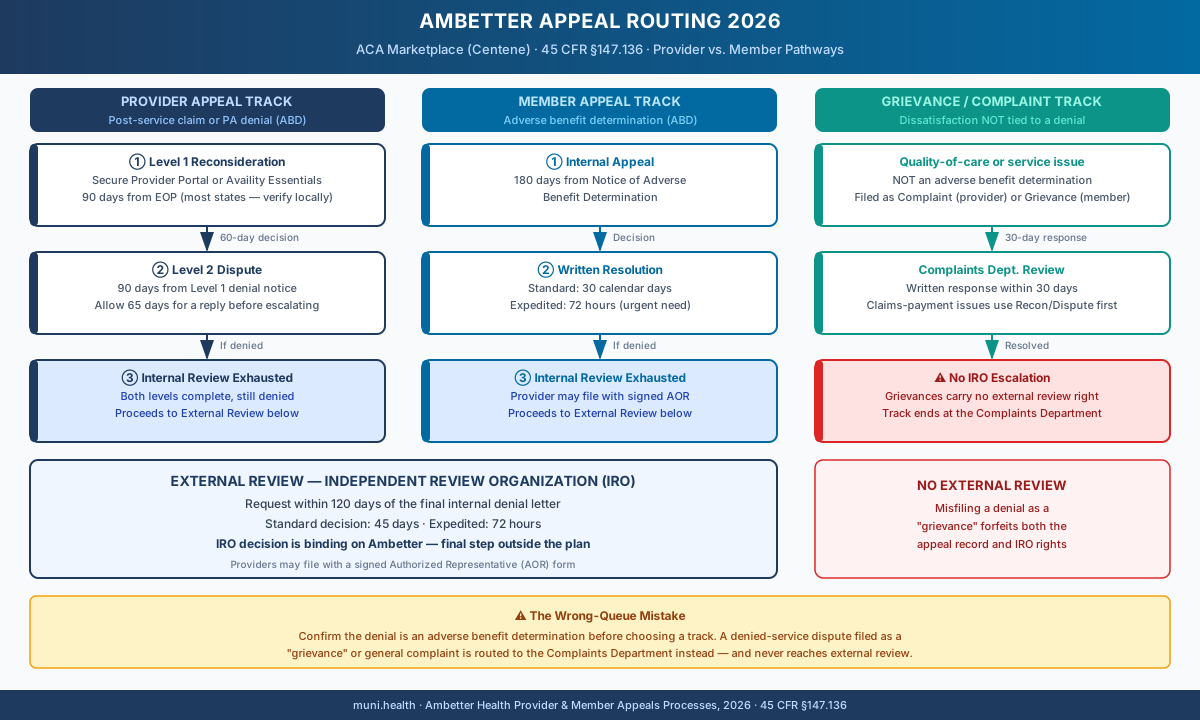
Ambetter's Two-Track Appeal System: Provider vs. Member
Ambetter runs two separate appeal tracks for the same denial, and filing under the wrong one is the most common way billing teams lose time on an Ambetter claim.
Ambetter Health is Centene Corporation's ACA Marketplace brand, sold under state-specific names — Ambetter from Sunshine Health (Florida), Ambetter from Superior HealthPlan (Texas), Ambetter from Peach State Health Plan (Georgia), and more than two dozen others. It is legally and procedurally distinct from Centene's Medicaid subsidiaries (Sunshine Health's Medicaid line, Buckeye, Meridian) and from WellCare, Centene's Medicare Advantage brand. Ambetter denials are governed by the ACA and 45 CFR §147.136, not the Medicaid rules in 42 CFR Part 438 or the Medicare Part C appeal ladder. If you also handle Centene Medicaid or WellCare denials, see our Centene & WellCare provider appeal guide for how those two frameworks differ from Ambetter's.
Within Ambetter itself, the provider and the member each have a distinct appeal path with different deadlines, different filing channels, and different escalation rights. A provider filing a Level 1 Reconsideration is not the same submission as a member filing an internal appeal, and mixing the two up — or filing a denial as a grievance instead of an appeal — routes the case to the wrong queue.
Appeals filed before the EOP are closed as invalid
Ambetter will not accept a Level 1 Reconsideration before the Explanation of Payment (EOP) has been issued. Wait for the EOP — filing early doesn't preserve your place in line, it gets the submission closed and forces a refile.
Provider Appeal vs. Member Grievance: Picking the Right Track
An appeal disputes a specific adverse benefit determination — a denied claim, a denied prior authorization, or a coverage decision. A grievance is dissatisfaction about anything else — quality of care, rudeness, access problems, or a policy the provider disagrees with — and by definition excludes adverse benefit determinations.
That distinction matters because the two tracks lead to different places. An appeal that follows the Reconsideration → Dispute → external review path can end in a binding, independent decision. A grievance goes to Ambetter's Complaints Department, gets a written response within 30 calendar days, and stops there — it never reaches an Independent Review Organization (IRO), because IRO rights attach only to adverse benefit determinations under the ACA.
| Provider Appeal | Grievance / Complaint | |
|---|---|---|
| Applies to | Denied claim, PA denial, or coverage decision | Service quality, access, rudeness, policy disagreement |
| Who files | Provider directly; member via AOR | Provider (complaint) or member (grievance) |
| Filing window | 90 days per level from EOP/denial notice | No fixed statutory deadline; file promptly |
| Decision timeline | 60 days per level (Ambetter recommends 65) | 30 calendar days |
| Escalation right | External Review (IRO) after internal appeal | None — resolved internally, no IRO right |
The failure mode that costs the most time: a claims-payment dispute gets described as a "complaint" and routed to the Complaints Department, when Ambetter's own provider manuals require claims-payment issues to go through the Reconsideration/Dispute process before any complaint is filed. If the denial reason code points to a coverage or medical-necessity decision, it is an appeal — not a grievance — from the start.
For denial-rate context across the payers your practice sees most, see our insurance denial rate by company guide.
How to File an Ambetter Provider Reconsideration and Dispute
Provider appeals of a post-service claim or PA denial go through a two-level process, both levels filed through the same channels.
Level 1: Reconsideration
- File within 90 days of the original EOP date (verify the exact window in your state's Ambetter provider manual — some states extend this further)
- Submit through the Ambetter Secure Provider Portal (preferred) or Availity Essentials — not by phone
- Ambetter has 60 calendar days to respond; plan for up to 65 days before escalating, to account for mail processing
- Include the EOP, the claim number, and the specific reason you believe the determination was incorrect
Level 2: Dispute
- File within 90 days of the Level 1 Reconsideration denial notice
- Use the same portal channel as Level 1
- A Dispute should only follow an unsatisfactory Reconsideration response — it is not a parallel first-step option
Registering for Availity Essentials
Availity Essentials offers a no-cost web portal for direct data entry and claim status, and most Ambetter subsidiaries accept Reconsiderations and Disputes through it. Register at availity.com/Essentials-Portal-Registration if your practice isn't already set up. For subsidiaries where Availity isn't the primary channel (some Health Net California and Trillium Oregon plans), use the plan-specific provider portal listed on the denial notice.
The Reconsideration cover letter should be short and specific — it accompanies your supporting documentation rather than replacing it. For separate letters covering timely filing proof, a Level II claim dispute, and a medical necessity appeal filed for the member, see our Ambetter appeal letter templates.
[Date]

Ambetter Provider Reconsideration
[Address from EOP/denial notice — verify per state subsidiary]

RE: Level 1 Reconsideration Request
Member Name: [Member Name]
Member ID: [ID Number]
Claim Number: [Claim Number]
Date of Service: [DOS]
EOP Date: [EOP Date]

To the Reconsideration Review Team:

This letter requests reconsideration of the above claim, denied for [denial reason as stated on the EOP]. We believe this determination should be reversed for the following reason(s):

[Specific basis — e.g., prior authorization was on file (Authorization #___), the service met the applicable clinical criteria, or the claim was submitted within the timely filing window (attach proof of original submission).]

Enclosed documentation:
- Original EOP / denial notice
- [Prior authorization approval / clinical documentation / proof of timely submission, as applicable]
- [Relevant coding or billing correction, if applicable]

Please reprocess this claim for payment. If additional information is required, contact us directly at [phone/fax].

Sincerely,

[Name, Title]
[Practice Name]
NPI: [Number]
[Phone] | [Fax] | [Email]

Enclosures: [List all attachments]
Skip the blank template. Start with a review-ready draft.
Use the template as guidance, or let Muni prepare a payer-specific draft for your team to verify, sign, and submit.
First 3 appeals free, then $20 per appeal. Start with your denial letter or EOB and available records. No meeting or clearinghouse connection required.
Ambetter Claims Timely Filing Limit (Original Claims)
The claims timely filing limit is separate from the appeal deadlines above — it governs when you must first submit the claim, not when you can dispute a denial of it.
| Filing Type | Standard Window | Notes |
|---|---|---|
| In-network, most states | 180 days from date of service | Counted in calendar days, no weekend/holiday extension |
| Tennessee (participating providers) | 90 days from date of service | State-specific exception |
| New York (Ambetter from Fidelis Care) | 90 days from date of service | State-specific exception |
| Out-of-network, most states | 365 days from date of service | Varies further by state and plan |
Because Ambetter's timely filing window is set state by state and can differ from the figures above, confirm the exact number in your specific state's Ambetter provider manual before treating a claim as at risk. If a claim is denied for missing the timely filing window and you have proof of an earlier, on-time submission — a clearinghouse confirmation, a fax transmission report, or a portal timestamp — that proof is the core of the Level 1 Reconsideration; Ambetter must show the original claim was actually received late, not simply assert it.
Medical Necessity and Prior Authorization Denials
Ambetter's medical necessity and prior authorization denial notices must state the specific clinical criteria applied — the appeal should respond to that stated criteria directly, not restate general medical necessity.
Under the ACA's claims and appeals rules (45 CFR §147.136), Ambetter must provide a written explanation of the denial, including the specific plan provision or clinical criteria relied on. A strong Reconsideration or Dispute package addresses that stated criteria point by point:
- Medical records — office notes, diagnostic results, imaging, and lab data tied to the denied service
- Letter of medical necessity — a physician statement connecting the service to the diagnosis, clinical presentation, and any failed conservative treatment
- Clinical guideline citation — the specific specialty-society guideline, CMS Local Coverage Determination (LCD), or National Coverage Determination (NCD) the denial should be measured against
- Prior authorization proof — if a PA was approved and the claim still denied, include the authorization number and approval correspondence
- Peer-to-peer notes — if a peer-to-peer review occurred, a summary of the discussion and the criteria the medical director raised
Generic templates underperform on Ambetter denials
Because Ambetter denial notices are required to name the specific clinical criteria applied, an appeal that engages with that exact language performs better than a generic medical-necessity argument. Pull the criteria straight from the denial notice and respond to each one.
Filing on Behalf of a Member: The Authorized Representative Path
If the provider appeal window has closed, the member's separate 180-day appeal window may still be open — and a provider can use it with a signed Authorized Representative (AOR) form.
Ambetter allows a member to designate a provider as their Authorized Representative in writing for the appeal, grievance, and external review process. This matters practically: the provider Reconsideration/Dispute track runs on a tighter 90-day-per-level clock, but the member's internal appeal window is 180 days from the Notice of Adverse Benefit Determination. If a claim was denied for medical necessity and the provider-track deadline has already lapsed, filing under the member's AOR-authorized appeal may still be timely — and it's the same underlying denial, addressed through the track that hasn't closed yet.
The AOR form itself is short — available from the state-specific Ambetter provider resources page — but it must be signed by the member (or their legal representative) before Ambetter will accept a provider-filed appeal or external review request on the member's track.
External Review: Escalating to an Independent Review Organization
After internal appeals are exhausted on either track, the case can go to an Independent Review Organization (IRO) — a neutral third party whose decision is binding on Ambetter.
Prepare this appeal packet with your team.
Draft the appeal, coordinate missing documents, and approve the reviewed packet. Keep your clearinghouse; your practice checks deadlines and submits through the payer’s accepted channel.
First 3 appeals free, then $20 per appeal. Start with your denial letter or EOB and available records. No meeting or clearinghouse connection required.
Request external review within 120 days of the final internal denial letter. Standard IRO decisions are due within 45 days; expedited reviews for urgent medical situations must be decided within 72 hours. Because Ambetter is a non-grandfathered ACA plan, IRO review is a statutory right under Section 2719 of the ACA once internal appeals are exhausted — the plan cannot substitute its own judgment for the IRO's if the IRO reverses the denial.
For the fuller mechanics of who can file, how state versus federal external review tracks differ, and what to expect from the IRO process, see our Independent Review Organization appeal guide.
Grievances never reach this step
External review is available only after an adverse benefit determination has gone through internal appeal. A complaint or grievance — because it was never an appeal of a denial — has no path to IRO review. This is the concrete cost of misrouting a denial as a grievance: it forecloses the strongest escalation option before the case ever gets there.
How Muni Appeals Helps With Ambetter Denials
Ambetter's split between a 90-day-per-level provider track, a 180-day member track, and a grievance track that leads nowhere is easy to get wrong under deadline pressure — especially across the two dozen state-specific Ambetter subsidiaries with their own portals and mailing addresses.
Muni Appeals helps billing teams work through Ambetter denials without losing the thread:
- Identifies whether a denial is an appeal or a grievance before it's filed, so claims-payment and medical-necessity issues go to the right queue
- Surfaces likely Level 1, Level 2, and member-window context from the uploaded notice; staff verifies and calendars each deadline
- Compiles documentation packages built around the specific clinical criteria stated in the denial notice
- Lists the portal confirmations, fax reports, and timestamps staff should retain for timely filing proof
If you're weighing whether appeal automation makes sense for your practice's Ambetter and other ACA-plan volume versus handling it manually or outsourcing to a billing service, see our appeal automation cost comparison.
Frequently Asked Questions
What is the deadline to appeal an Ambetter claim denial?
For providers, Level 1 Reconsideration must be filed within 90 days of the original EOP date, and Level 2 Dispute within 90 days of the Level 1 denial notice — both figures are typical but state-specific, so confirm in your state's Ambetter provider manual. Members have a separate 180-day window from the Notice of Adverse Benefit Determination.
What's the difference between an Ambetter appeal and a grievance?
An appeal disputes a specific adverse benefit determination — a denied claim or prior authorization. A grievance is dissatisfaction about anything else, such as service quality or access, and by definition excludes adverse benefit determinations. Only appeals carry the right to external review by an IRO; grievances are resolved internally within 30 days and stop there.
Where do I submit an Ambetter provider appeal?
Through the Ambetter Secure Provider Portal (preferred) or Availity Essentials for most subsidiaries. A small number of plans — including some Health Net California and Trillium Oregon plans — use a plan-specific portal instead; the correct channel is listed on the denial notice.
What is Ambetter's timely filing limit for claims?
180 days from the date of service for in-network claims in most states, with Tennessee and New York set at 90 days. Out-of-network claims typically get 365 days. These figures vary by state — verify the exact window in your specific state's Ambetter provider manual.
Can I request external review of an Ambetter denial?
Yes, after internal appeals are exhausted. Request external review within 120 days of the final internal denial letter. Standard IRO decisions are due within 45 days, expedited reviews within 72 hours, and the IRO's decision is binding on Ambetter.
Can a provider file an appeal on behalf of an Ambetter member?
Yes, with a signed Authorized Representative (AOR) form from the member. This is useful when the provider-track deadline (90 days per level) has passed but the member's 180-day internal appeal window is still open for the same denial.
How is Ambetter different from Centene's Medicaid plans or WellCare?
Ambetter is Centene's ACA Marketplace brand, governed by the ACA and 45 CFR §147.136. Centene's Medicaid subsidiaries (Sunshine Health's Medicaid line, Buckeye, Meridian, and others) follow 42 CFR Part 438 and escalate to a State Fair Hearing. WellCare, Centene's Medicare Advantage brand, follows the CMS Part C 5-level appeal ladder. Filing under the wrong framework's deadlines and escalation path is a common mistake when a practice sees multiple Centene brands. See our Centene & WellCare appeal guide for the full comparison.
What happens if I file an Ambetter appeal before the EOP is issued?
It gets closed as invalid. Wait for the Explanation of Payment before submitting a Level 1 Reconsideration — an early filing does not hold your place and forces a resubmission once the EOP is available.
Ready to Stop Losing Ambetter Appeals to the Wrong Queue?
Ambetter's two-track system — a 90-day-per-level provider path, a 180-day member path, and a grievance track with no external review right — is straightforward once you know which track a denial belongs on. The costly mistakes happen when that routing decision gets made under time pressure, or when a claims-payment issue gets filed as a complaint instead of going through Reconsideration and Dispute first.
Get Started:
- Routes each denial to the correct appeal or grievance track before filing
- Tracks Level 1 and Level 2 deadlines, plus the member's 180-day window as a backup path
- Builds documentation around the clinical criteria stated in the denial notice
- Keeps submission records organized for timely filing proof
This guide reflects 2026 Ambetter Health (Centene Corporation ACA Marketplace) appeal procedures and applicable federal regulations. Filing deadlines, submission channels, and mailing addresses vary by state-specific Ambetter subsidiary. Verify current timelines and addresses in your state's plan-specific provider manual or on the denial notice before filing. This information is for administrative and billing purposes and is not medical advice.