

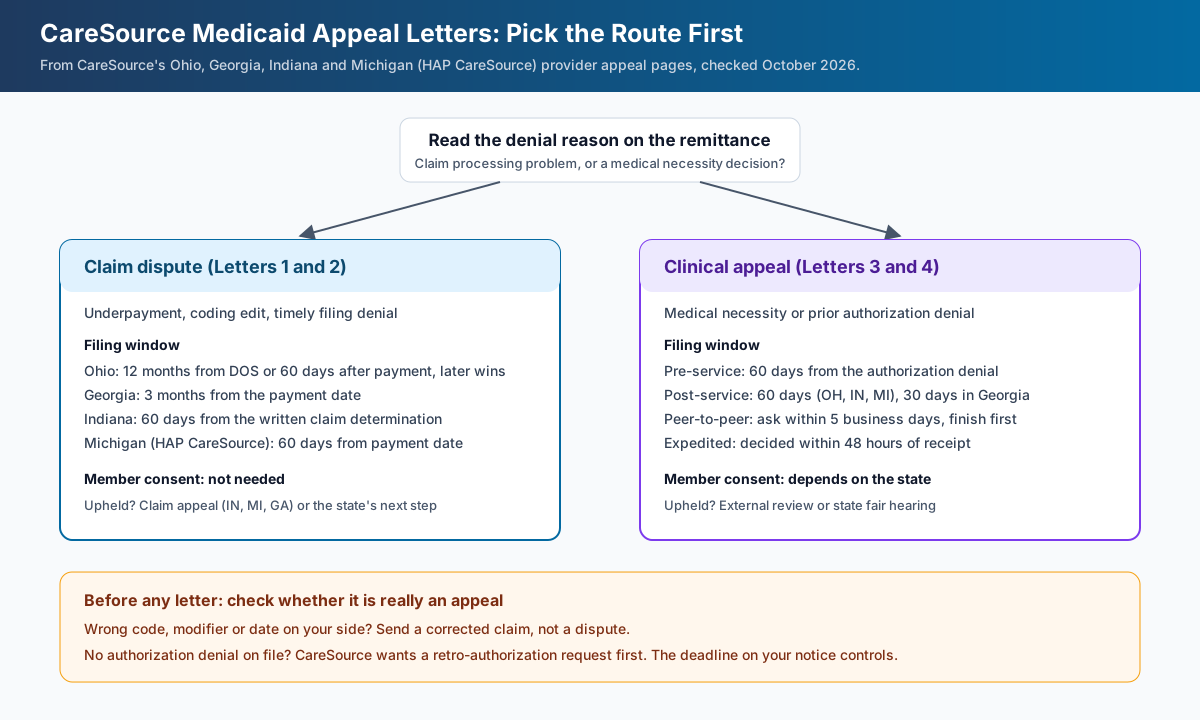
A CareSource appeal letter has to match the denial. For payment, coding and timely filing problems, send a claim dispute. For medical necessity and prior authorization denials, send a clinical appeal. The deadlines differ by state. A claim dispute is due within 3 months of the payment date in Georgia and within 60 days in Indiana and Michigan. Ohio allows 12 months from the date of service or 60 days after payment, whichever is later. Pre-service clinical appeals are due within 60 days of the authorization denial. Some states also require the member's signed consent. The four templates below cover each route. Always check the deadline printed on your own notice.
Which CareSource Appeal Letter Do You Need?
Choose the letter from the denial reason on the remittance advice. CareSource defines a claim dispute as the first formal review of how a claim was processed, and it excludes medical necessity denials. Clinical appeals are for prior authorization decisions based on medical necessity. Sending the wrong one wastes time you may not get back.
| Denial on the remittance | CareSource route | Letter below | Member consent? |
|---|---|---|---|
| Underpaid, wrong rate, bundling or code edit | Claim dispute | Letter 1 | No |
| Denied as untimely, but you filed on time | Claim dispute | Letter 2 | No |
| Medical necessity or prior authorization denial | Clinical appeal (pre-service or post-service) | Letter 3 | Depends on the state. See the deadline table |
| Waiting could seriously harm the member's life or health | Expedited clinical appeal | Letter 4 | Same as Letter 3 |
Two cases that are not appeals
If your own claim was wrong (a code, modifier or date), send a corrected claim, not a dispute. See corrected claim vs. insurance appeal. And if a service needed prior authorization but you never received a denial letter, CareSource's Ohio and Georgia pages say to submit a retro-authorization request first. Georgia dismisses retro-authorization requests that come in through the appeals process.
These templates are for CareSource Medicaid plans. CareSource also sells Marketplace and Medicare Advantage plans, and those plans use different appeal rules. Check the member's ID card before you pick a letter.
CareSource Appeal Deadlines by State (2026)
There is no single national deadline. Each state's CareSource provider appeals page sets its own windows, and they differ enough that a Michigan claim dispute filed on Georgia's three-month timeline can be late.
| State | Claim dispute | Clinical appeal | Member consent for clinical appeals | Source |
|---|---|---|---|---|
| Ohio | 12 months from date of service, or 60 calendar days after payment or denial, whichever is later | Pre-service: 60 days from the authorization denial. Post-service: same window as a claim dispute | Not required for pre-service requests | [CareSource Ohio Medicaid](https://www.caresource.com/oh/providers/provider-portal/appeals/medicaid/) |
| Georgia | 3 months from the payment date on the claim | Pre-service: 60 days. Post-service: 30 days from the authorization denial | Required for pre-service. Not required for post-service | [CareSource Georgia Medicaid](https://www.caresource.com/ga/providers/provider-portal/appeals/medicaid/) |
| Indiana | 60 days from the written claim determination | 60 days from the notice date (pre- and post-service) | Required for pre-service appeals and all post-service requests | [CareSource Indiana Medicaid](https://www.caresource.com/in/providers/provider-portal/appeals/medicaid/) |
| Michigan (HAP CareSource) | 60 calendar days from the payment date | 60 calendar days from the initial adverse determination | Required for pre- and post-service appeals filed by anyone other than the member | [HAP CareSource Michigan Medicaid](https://www.caresource.com/mi/providers/provider-portal/appeals/medicaid/) |
All four pages were checked on October 10, 2026. CareSource also runs a Medicaid plan in Nevada. We have not verified its provider appeal page, so use the deadline on the notice.
Every state also allows a peer-to-peer call with a CareSource medical director. It must be requested within 5 business days of the determination notice. In Ohio and Georgia, a requested peer-to-peer must be completed before the clinical appeal is submitted. It does not extend the appeal deadline.
Where member consent is required, use CareSource's "Consent for Provider to File an Appeal on Patient/Member's Behalf" form. It must be specific to the service, signed and dated by the member, and valid only for that appeal. Under federal Medicaid managed care rules, a provider may file a member appeal only with the member's written consent where the state requires it (42 CFR 438.402).
Letter 1: Claim Dispute (Payment or Coding Error)
Use this letter when you think CareSource paid the wrong amount or applied a coding edit in error. Georgia and Michigan list the same three things a dispute must contain: enough information to identify the claim, a statement of why an adjustment is needed and the outcome you expect, and supporting documentation. This template covers all three.
Ohio and Indiana also offer a dispute form (Ohio's Provider Dispute Form, Indiana's Claim Dispute Form). If you use the form, attach this letter as your explanation. The provider portal is the fastest channel in every state.
[Practice Letterhead]

[Date]

[CareSource plan name from the remittance, e.g., CareSource Ohio Medicaid]
[Ohio: CareSource, P.O. Box 2008, Dayton, OH 45401-2008 | Fax 937-531-2398]
[Georgia: CareSource, Attn: Provider Appeals Department,
P.O. Box 2008, Dayton, OH 45401 | Fax 937-531-2398]
[Michigan: HAP CareSource, Attn: Grievance & Appeals,
P.O. Box 1025, Dayton, OH 45401-1025 | Fax 937-396-3492]
[Indiana: submit through the Provider Portal or with the Claim Dispute Form]

RE: Provider Claim Dispute
Member Name: [Member name]
Medicaid ID: [Member ID]
Claim Number: [Claim number]
Date(s) of Service: [MM/DD/YYYY]
Remittance / EOP Date: [MM/DD/YYYY]
Billed Amount: $[Amount] | Paid Amount: $[Amount]
Provider Name / NPI / TIN: [Name] / [NPI] / [TIN]

To the Provider Appeals Team:

We dispute how the claim above was processed. The remittance dated
[date] shows [paid $___ / denied] with reason code [code]:
"[adjustment or denial language, quoted exactly]."

Why an adjustment is needed:
[Choose the one that applies and delete the others]
- The payment does not match our contracted Medicaid rate. Our
agreement effective [date] sets [CPT/HCPCS] at $[amount]; the
claim paid $[amount].
- The coding edit does not fit this encounter. [CPT] and [CPT] were
separate, distinct services, documented in the attached notes,
and modifier [__] was billed to show this.
- The service does not require prior authorization under the
[state] Medicaid prior authorization list dated [date], or
authorization #[number] was approved on [date] and is attached.

Expected outcome: reprocess the claim and pay $[amount], the
[contracted rate / allowed amount] for [code(s)].

Enclosed:
1. Remittance advice dated [date], with this claim marked
2. [Contract rate page, fee schedule excerpt, or authorization approval]
3. [Medical records, if the dispute involves a coding edit]

Please contact [name] at [phone] or [email] with any questions.

Sincerely,

[Name, Title]
[Practice Name]
[Phone] | [Fax]
Skip the blank template. Start with a review-ready draft.
Use the template as guidance, or let Muni prepare a payer-specific draft for your team to verify, sign, and submit.
First 3 appeals free, then $20 per appeal. Start with your denial letter or EOB and available records. No meeting or clearinghouse connection required.
CareSource's Ohio page says written dispute decisions go out within 15 business days of receipt for claim disputes. Georgia's page says 15 calendar days. Michigan's says 30 calendar days. If a Georgia or Michigan dispute is returned as incomplete, you have 10 calendar days from the date on that letter to resubmit.
Letter 2: Claim Dispute for a Timely Filing Denial
Use this letter when CareSource denied the claim as late but you have proof it was filed on time. The letter's only job is to point to that proof, so lead with it. A clearinghouse acceptance report (999 or 277CA) showing CareSource's payer ID is stronger than a screenshot from your billing system.
The CareSource appeal guide covers the original claim filing window and the shorter corrected-claim window. Check those first: if the claim truly went in late, a dispute won't fix it.
[Practice Letterhead]

[Date]

[CareSource plan name and the state dispute address or fax from Letter 1]

RE: Provider Claim Dispute - Timely Filing Denial Issued in Error
Member Name: [Member name]
Medicaid ID: [Member ID]
Claim Number: [Claim number]
Date(s) of Service: [MM/DD/YYYY]
Denial Date / Reason Code: [MM/DD/YYYY] / [code, e.g., CO-29]
Provider Name / NPI / TIN: [Name] / [NPI] / [TIN]

To the Provider Appeals Team:

CareSource denied this claim for timely filing on [date]. The claim
was filed within CareSource's filing limit. The original claim was
submitted on [MM/DD/YYYY], [__] days after the date of service.

Proof of timely filing (enclosed):
1. [Clearinghouse name] acceptance report (999/277CA) dated
 [MM/DD/YYYY], showing CareSource payer ID [ID] and claim
 control number [number]
2. [Provider portal submission confirmation, if filed by portal]
3. [If CareSource was secondary: the primary payer's EOB dated
 [MM/DD/YYYY] and the date we sent the secondary claim]
4. [Any CareSource rejection notice for an earlier submission, with
 the date we corrected and resubmitted]

Expected outcome: overturn the timely filing denial and process the
claim for payment under our [state] Medicaid agreement.

Please contact [name] at [phone] or [email] with any questions.

Sincerely,

[Name, Title]
[Practice Name]
[Phone] | [Fax]
Letter 3: Clinical Appeal for a Medical Necessity Denial
Use this letter when CareSource denied a service or prior authorization as not medically necessary. Ohio and Indiana list the same clinical records they expect: progress notes with symptoms and their duration, physical exam findings, conservative treatment already tried, preliminary procedures, and why the service is needed. Add specialist reports, prior diagnostic results and therapy notes. For a service already provided, include the original remittance advice.
Answer the criterion CareSource cited, point by point. Resending the original records without addressing the stated reason rarely changes the outcome. For more on building the clinical argument, see peer-to-peer review for insurance denials.
[Practice Letterhead]

[Date]

[Ohio: CareSource, Attn: Grievance & Appeals Department,
P.O. Box 2008, Dayton, OH 45401 | Fax 937-531-2398]
[Georgia, Indiana, Michigan: Provider Portal, or the Provider
Clinical/Claim Appeal Form for your state]

RE: [Pre-service / Post-service] Clinical Appeal
Member Name: [Member name]
Medicaid ID: [Member ID]
Date of Birth: [MM/DD/YYYY]
Authorization / Reference Number: [Number from the denial notice]
Claim Number (post-service only): [Number]
Service Requested: [Procedure, CPT/HCPCS, units, setting]
Diagnosis: [ICD-10 code(s) and description]
Denial Notice Date: [MM/DD/YYYY]
Treating Provider / NPI: [Name] / [NPI]
[Member consent form attached: Yes / Not required in this state]
[Peer-to-peer held on: MM/DD/YYYY / Not requested]

To the Grievance and Appeals Department:

We appeal CareSource's denial of [service] for the member above.
The notice dated [date] states: "[denial reason, quoted exactly],"
citing [clinical policy or criteria name, if stated].

The member meets these criteria:

1. [Criterion from the cited policy]: [How the record shows it,
 with dates. Example: symptoms present since MM/YYYY, documented
 in the progress notes of MM/DD/YYYY and MM/DD/YYYY.]
2. [Criterion]: Conservative treatment was tried and failed:
 [therapy/medication, dates, duration, result].
3. [Criterion]: [Exam findings or diagnostic results, with dates.]

Why this service is needed now:
[One short paragraph from the treating provider: what happens
clinically if the service is delayed or denied, and why a lower
level of care is not appropriate.]

Enclosed:
1. Denial notice dated [date]
2. Progress notes [dates]
3. [Imaging, lab or diagnostic reports]
4. [Specialist evaluation and therapy notes]
5. [Remittance advice, for a post-service appeal]
6. [Signed member consent form, where required]

We ask CareSource to overturn the denial and approve [service].
Please contact [name] at [phone] or [email].

Sincerely,

[Treating Provider Name, Credentials]
[Practice Name]
[Phone] | [Fax]
Standard clinical appeal decisions take 30 calendar days in Indiana and Michigan, and CareSource can extend an Indiana appeal by 14 days. If CareSource upholds the denial, the next step depends on the state and the denial type. Ohio routes medical necessity denials to an External Medical Review, which must be requested within 30 calendar days. Indiana's external review must be requested within 120 calendar days of the appeal decision. The member's state fair hearing is a separate path. See our Medicaid fair hearing guide for how provider and member rights differ.
Letter 4: Expedited Clinical Appeal Request
Use this letter only when waiting for a standard decision could seriously jeopardize the member's life, physical or mental health, or ability to regain maximum function. That is the standard on CareSource's Ohio page, taken from Ohio Administrative Code 5160-26-08.4. The letter must say how the member would be harmed, and records must back it up.
Prepare this appeal packet with your team.
Draft the appeal, coordinate missing documents, and approve the reviewed packet. Keep your clearinghouse; your practice checks deadlines and submits through the payer’s accepted channel.
First 3 appeals free, then $20 per appeal. Start with your denial letter or EOB and available records. No meeting or clearinghouse connection required.
CareSource's Ohio and Indiana pages say expedited appeals are resolved within 48 hours of receipt. If CareSource decides the case does not qualify, it is moved to the standard track. In Ohio, that means a decision within 10 calendar days. In Indiana, it means 30 calendar days. Call first, then send the letter. The expedited appeal lines on CareSource's pages are 1-800-488-0134 for Ohio and 1-844-607-2831 for Indiana.
[Practice Letterhead]

[Date] | [Time sent]

CareSource Grievance & Appeals - EXPEDITED APPEAL REQUEST
[Submitted by Provider Portal / with the Expedited Appeal Form]

RE: Expedited Pre-service Clinical Appeal
Member Name: [Member name]
Medicaid ID: [Member ID]
Date of Birth: [MM/DD/YYYY]
Authorization / Reference Number: [Number]
Service Requested: [Service, CPT/HCPCS]
Denial Notice Date: [MM/DD/YYYY]
Treating Provider / NPI / Direct Phone: [Name] / [NPI] / [Phone]
[Member consent form attached: Yes / Not required in this state]

I am the treating provider and I request an expedited appeal.
Waiting the standard appeal timeframe could seriously jeopardize
this member's [life / physical health / mental health / ability to
regain maximum function] because:

[2-4 sentences. State the condition, the specific harm expected
from delay, and the timeframe in which it is expected. Example:
"Without [service] within [X] days, the member is at risk of
[specific outcome], as shown in the [record] dated MM/DD/YYYY."]

The member meets [criterion/policy] because [one-line summary of
the clinical support]. Records enclosed:
1. Denial notice dated [date]
2. Most recent progress note and exam, dated [date]
3. [Diagnostic results supporting urgency]

Please call me directly at [phone] with the decision or to discuss
the case with a medical director.

[Treating Provider Name, Credentials]
[Signature]
For more on when a case qualifies for urgent review, see our expedited insurance appeal guide.
How Muni Appeals Handles CareSource Medicaid Denials
The hard part of a CareSource appeal is usually the setup, not the writing. You have to pick the right route for the denial, apply the right state's deadline, and remember the consent form where one is needed.
Muni Appeals reads the uploaded denial and drafts the matching letter. It also:
- Separates claim disputes from clinical appeals so a payment problem isn't sent into a medical necessity review
- Pulls the denial reason and cited criteria from the notice so the letter answers them directly
- Drafts the clinical argument from the records you upload, for the treating provider to review and sign
Muni drafts; your staff verifies the state-specific deadline and any required member consent, then files through CareSource's portal, fax or mail. Your first 3 appeals are free, then it's $20 per appeal. To compare the cost of writing appeals by hand with automated preparation, see Muni Appeals Pricing Explained.
Start 3 Free CareSource Appeals
Frequently Asked Questions
How do I write a CareSource appeal letter?
Start by matching the letter to the denial. Payment and coding problems go in a claim dispute, and medical necessity denials go in a clinical appeal. Include the member's name and Medicaid ID, the claim or authorization number, the date of service, and the denial reason quoted exactly. Then state why the decision is wrong and what outcome you expect, and attach the records that prove it.
What is the CareSource appeal deadline?
It depends on the state and the route. Claim disputes are due within 3 months of the payment date in Georgia and 60 days in Indiana and Michigan. In Ohio, they are due 12 months from the date of service or 60 days after payment, whichever is later. Pre-service clinical appeals are due within 60 days of the authorization denial. Georgia's post-service clinical appeals are due within 30 days.
Do I need member consent to appeal a CareSource denial?
Not for a claim dispute. For clinical appeals it depends on the state. Georgia requires written consent for pre-service appeals but not post-service. Indiana requires it for pre-service appeals and all post-service requests. Michigan requires it for any clinical appeal not filed by the member. Ohio's page says consent is not required for pre-service requests.
Where do I send a CareSource appeal?
The provider portal is the preferred channel in every state. For Ohio and Georgia disputes, the fax is 937-531-2398 and the mail address is P.O. Box 2008, Dayton, OH. Michigan's HAP CareSource uses fax 937-396-3492 and P.O. Box 1025, Dayton, OH 45401-1025. Indiana directs providers to the portal or its dispute and appeal forms.
Does a peer-to-peer review extend the CareSource appeal deadline?
No. A peer-to-peer must be requested within 5 business days of the determination notice, and the appeal deadline keeps running. In Ohio and Georgia, if you request one, it must be finished before you submit the clinical appeal.
What happens if CareSource upholds my appeal?
The next step depends on the state. Indiana offers binding arbitration for claim appeal decisions and external review for clinical decisions. Ohio routes medical necessity denials to an External Medical Review through Permedion. Georgia's upheld claim dispute letter explains the right to request an administrative law hearing. Members can also request a state fair hearing.
This guide reflects CareSource's Ohio, Georgia, Indiana and Michigan (HAP CareSource) Medicaid provider appeal pages as checked on October 10, 2026. Addresses, forms, deadlines and consent rules can change, and individual contracts may differ. The deadline and instructions on your own denial notice control. This guide is for administrative and billing purposes and is not legal advice.