

A Medicare Part B reopening is how you fix a clerical error, such as a wrong modifier, transposed code, or bad data entry, on a claim your Medicare Administrative Contractor (MAC) has already processed. Under 42 CFR 405.980(a)(3), MACs must handle clerical errors as reopenings, not redeterminations. You can request one within 1 year of the initial determination for any reason, or within 4 years if you have good cause. Two cautions. Requesting a reopening does not pause the 120-day redetermination clock (CMS Claims Processing Manual, ch. 34, §10), and whether to reopen is up to the MAC. Claims rejected as unprocessable (remark code MA130) aren't reopened at all. Correct them and send a new claim. Disputes about coverage or medical necessity go to a redetermination.
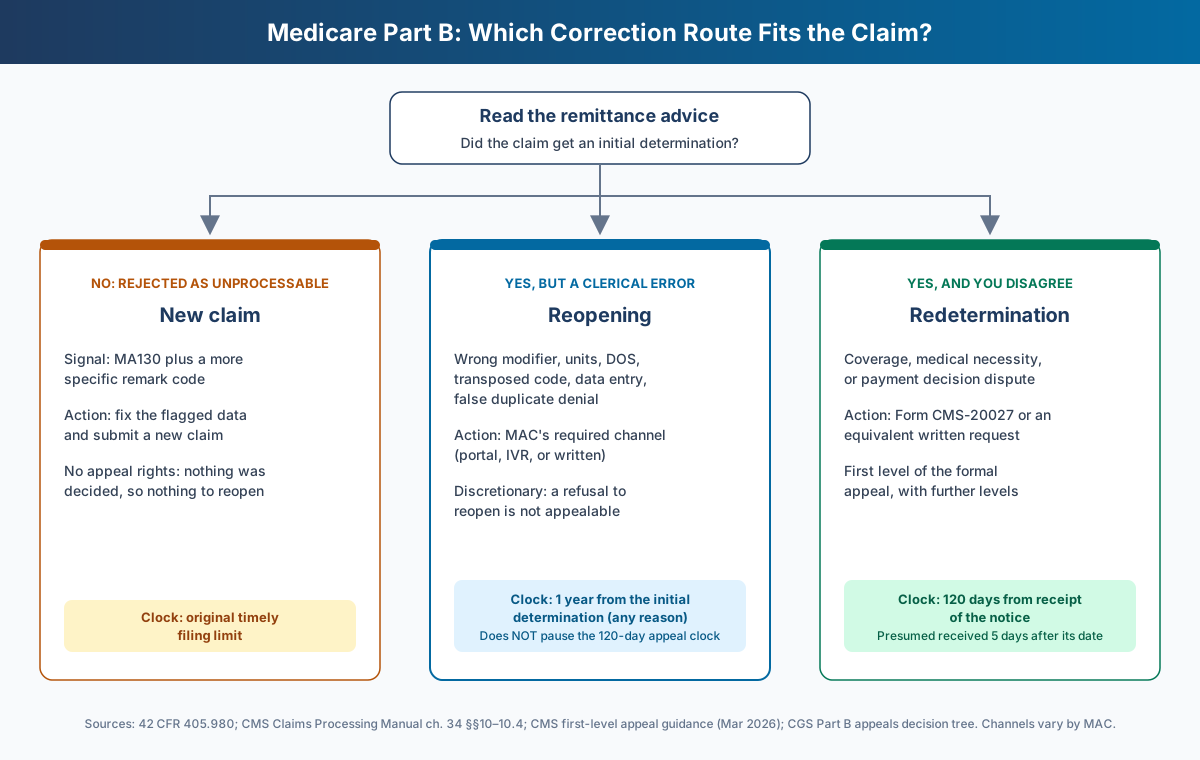
Reopening vs. Resubmission vs. Redetermination: Which One Fits
The choice depends on what kind of problem the claim has. If the claim never got an initial determination, resubmit it. If the MAC decided the claim but the decision rests on a clerical error, request a reopening. If you disagree with the decision itself, file a redetermination.
Many billing teams send all three kinds of problems through one workflow, and that's where Part B money gets lost. A claim rejected as unprocessable has no appeal rights. CGS's Part B decision tree says to correct it and send it as a new claim. A clerical error on a processed claim is outside the appeal process altogether. A real coverage dispute needs a redetermination, and that clock runs no matter what else you file.
| What happened | Signal on the remittance | Correct route | Clock to watch |
|---|---|---|---|
| Claim rejected before adjudication: missing or invalid data | MA130 with a more specific remark code; Noridian also names N704 | Correct the data and submit a new claim. There are no appeal rights on an unprocessable claim | Original timely filing limit for the claim |
| Claim processed, but the result rests on a clerical error you or the MAC made | Denial or underpayment traceable to a wrong code, modifier, units, date of service, provider number, fee-schedule misapplication, or a false duplicate | Reopening through the MAC's required channel (portal, IVR, or written request) | 1 year from the initial determination for any reason. The 120-day appeal clock keeps running |
| Claim processed, and you disagree with a coverage, medical necessity, or payment decision | Denial based on policy, documentation, or coverage criteria | Redetermination (Form CMS-20027 or an equivalent written request) | 120 days from receipt of the notice; presume receipt 5 days after its date only absent contrary evidence |
| Denied because a medical review documentation request (ADR) went unanswered | CO-50 with RARC M127 (per CMS ch. 34 §10.1) | Send the records with an appeal request. CMS rules say the MAC must treat it as a reopening | Treat the 120-day appeal deadline as the controlling date |
That last row matters. 42 CFR 405.980(a)(2) is a separate rule for denials issued after medical review requested records and never got them. It doesn't make every missing-documentation denial a clerical error. If the MAC reviewed your records and still found the service not reasonable and necessary, that's a decision, and the route is a redetermination.
For the commercial-payer version of this choice, where frequency-code-7 corrected claims are the normal tool, see corrected claim vs. insurance appeal.
What Counts as a Clerical Error on a Part B Claim
A clerical error is a human or mechanical mistake in the form or content of the claim, whether you made it or the contractor did. CMS's manual (ch. 34, §10.4) lists these examples:
- Mathematical or computational mistakes
- Transposed procedure or diagnosis codes
- Inaccurate data entry
- Misapplication of a fee schedule
- Computer errors
- Claims denied as duplicates that you believe were flagged wrongly
- Incorrect data items, such as a provider number, a modifier, or the date of service
The same section sets the limits. An omission does not include failing to bill an item or service. The MAC won't grant a reopening to add services that weren't on the original claim, except for a few codes that can't be billed on a claim alone. Errors by a third-party payer aren't clerical errors either. The MAC decides what fits the definition. If it decides your issue isn't clerical, the regulation says it dismisses the reopening request and tells you your appeal rights, as long as your appeal window hasn't closed.
Check your MAC's exclusions before you call it clerical
MACs publish their own lists of corrections they won't take as reopenings. As of its June 19, 2024 update, Noridian (Jurisdiction F, Part B) requires a redetermination instead for some modifiers, including GA, GY, GX, 22, and 66. It also requires one for claims reviewed by a Recovery Auditor, CERT, or UPIC. And it treats changes to the assignment, billing provider, or year of service, and adding or deleting claim lines, as too complex for a reopening. Other MACs publish different lists.
Reopening Deadlines and the Appeal Clock
A party can request a reopening within 1 year of the initial determination for any reason. From 1 to 4 years, a request needs good cause. After that, an unfavorable determination can be reopened only to correct the clerical error it was based on. Those are the windows in 42 CFR 405.980(c). None of them extends your appeal rights.
| Window | What qualifies | Practical reality |
|---|---|---|
| Within 1 year of the initial determination | Any reason | The normal working window. Noridian JF Part B lists one year as its reopening filing limit |
| 1 to 4 years after the initial determination | Good cause: new and material evidence, or an obvious error clear on the face of the evidence (CMS ch. 34 §10.11) | Third-party payer error is not good cause past 1 year |
| Any time | Only to correct a clerical error behind an unfavorable determination | CMS says it does not expect MACs to grant these regularly (ch. 34 §10.6.2). Noridian lists claims over 1 year old as too complex for a reopening |
Three timing rules come from CMS's manual (ch. 34, §§10, 10.1, 10.7, 10.8):
- The appeal clock keeps running. Asking for a reopening does not pause the 120-day redetermination deadline. If the reopening is refused after day 120, you may have no appeal left on the original decision.
- A refusal can't be appealed. The MAC's decision whether to reopen is final under §405.980(a)(5). If the reopening does produce an adverse revised determination, that revised decision carries new appeal rights, counted from its own date.
- Filing an appeal ends the reopening option. Once you file a valid appeal on an issue, the MAC loses jurisdiction to reopen that issue until the appeal rights are used up (§405.980(a)(4)). Don't file a reopening and an appeal on the same issue at the same time.
When a MAC agrees to reopen at a party's request, the manual tells it to finish within 60 days of receipt (§10.7). That doesn't apply to "big box" batches of 40 or more beneficiaries or claims with at least $40,000 in controversy. The 60 days is a processing standard, not a promise that the claim will be paid.
The practical rule: put the 120-day redetermination date on the calendar the day the remittance arrives, even if you plan to fix the claim through a reopening. If a reopening for a clean clerical fix hasn't produced a revised remittance well before that date, decide on purpose whether to file a redetermination instead. Don't let the date pass by default.
How to Submit a Part B Reopening (Channels Vary by MAC)
Use the channel your MAC requires for that type of correction. That's usually its provider portal first, then IVR or phone, then a written request for the items the portal can't handle. Channels differ by jurisdiction, so the examples below show how two MACs set it up, not a national rule.
- Noridian JF Part B: Starting January 1, 2024, corrections the Noridian Medicare Portal can handle must be made there. Noridian dismisses portal-eligible reopenings that arrive by other routes. Portal fixes include billed amount, diagnosis, most modifiers, month or day of service, place of service, procedure code, rendering and referring NPI, and units. Items like CLIA numbers, IDE numbers, and post-operative dates go by phone or in writing. Noridian also says to wait at least three business days after the ERA before requesting a reopening.
- First Coast (Part B): First Coast's clerical reopening page (dated May 1, 2026) lists three channels: SPOT for registered users, the Reopening Gateway without registration, and IVR for providers without online access. IVR callers need the NPI, PTAN, TIN, beneficiary identifiers, and the ICN.
- CGS (Part B): CGS's decision tree routes minor errors and omissions to a reopening through myCGS or its Clerical Error Reopening Form.
If you're not sure which MAC handles your claims, check the contractor named on your remittance advice. The Medicare redetermination guide covers MAC routing for appeals.
Part B Reopening Request Worksheet (Copy and Use)
This worksheet sits next to your MAC's own form or portal. It gathers what every channel asks for and keeps the appeal deadline in view while the reopening is pending. It doesn't replace any MAC form. Fill it in from the remittance, not from memory, and keep patient identifiers in your billing system, not in shared notes.
MEDICARE PART B REOPENING — ROUTING AND SUBMISSION WORKSHEET
(Internal tracking. Submit through your MAC's required channel.)

1. CLAIM IDENTIFICATION
 MAC / jurisdiction: ______________________
 Internal Control Number (ICN): ______________________
 Billing NPI / PTAN: ______________________
 Date of service: ____/____/______
 Initial determination (remittance) date: ____/____/______

2. ROUTING CHECK (check one; stop if the answer is not "Reopening")
 [ ] Unprocessable (MA130 / N704): correct and submit a NEW claim. No reopening.
 [ ] Clerical error on an adjudicated claim: REOPENING. Continue below.
 [ ] Disagree with coverage / medical necessity / payment decision: REDETERMINATION.
 [ ] Denied for unanswered medical review ADR: send records with an appeal request.
 [ ] Issue is on my MAC's "redetermination required" list: check remaining appeal rights and file a timely REDETERMINATION.
 [ ] Other MAC reopening exclusion (such as claim-line additions or an old claim): STOP. Check the MAC's permitted correction route and any remaining appeal rights; an exclusion does not itself create an appeal right.

3. ERROR DETAIL (one line per claim line affected)
 Line #: ____  Field: ______________  Current value: ________  Correct value: ________
 Line #: ____  Field: ______________  Current value: ________  Correct value: ________
 Error type: [ ] Our data entry  [ ] Transposed code  [ ] Modifier  [ ] Units
             [ ] Date of service  [ ] Provider number  [ ] Fee schedule misapplied
             [ ] False duplicate denial  [ ] Contractor error
 Confirmed this is NOT a service that was never billed: [ ] Yes

4. SUPPORTING EVIDENCE ON FILE
 [ ] Remittance advice showing the error
 [ ] Source document supporting the correct value (encounter form, op note, charge entry)
 [ ] Prior claim/ERA showing the "duplicate" was a distinct service (if false duplicate)

5. TIMING
 Days since initial determination: ______  (reopening for any reason within 1 year)
 Applicable receipt date for the initial determination: ____/____/______
 Receipt basis: [ ] Documented receipt (evidence on file)  [ ] Notice date + 5 calendar days, only if no contrary receipt evidence
 Redetermination deadline (applicable receipt date + 120 days): ____/____/______
 Decision point if no revised remittance: ____/____/______  (set well before the deadline)

6. SUBMISSION
 Channel used: [ ] MAC portal  [ ] IVR / phone  [ ] Written request  [ ] Other: ________
 Submitted on: ____/____/______   By: ______________
 Confirmation / reference number: ______________________
 No appeal filed on this same issue: [ ] Confirmed

7. OUTCOME
 [ ] Revised remittance received ____/____/______. Payment posted: [ ] Yes
 [ ] Request dismissed / not accepted ____/____/______. Appeal window still open: [ ] Yes [ ] No
 [ ] Adverse revised determination ____/____/______. New appeal deadline: ____/____/______
 Next action / owner: ______________________
Prepare this appeal packet with your team.
Draft the appeal, coordinate missing documents, and approve the reviewed packet. Keep your clearinghouse; your practice checks deadlines and submits through the payer’s accepted channel.
First 3 appeals free, then $20 per appeal. Start with your denial letter or EOB and available records. No meeting or clearinghouse connection required.
Muni Appeals helps prepare a formal appeal when that is the appropriate route. Your team handles reopening requests through the MAC; Muni does not prepare or submit those requests.
Section 5 is the part most practices skip. A reopening request that's still pending on day 121 can leave the original decision with no appeal, so the decision-point date is the most important line on the sheet.
Common Reopening Mistakes That Cost Appeal Rights
Most Part B reopening losses come down to timing or routing, not the merits of the correction. Watch for these:
Prepare this appeal packet with your team.
Draft the appeal, coordinate missing documents, and approve the reviewed packet. Keep your clearinghouse; your practice checks deadlines and submits through the payer’s accepted channel.
First 3 appeals free, then $20 per appeal. Start with your denial letter or EOB and available records. No meeting or clearinghouse connection required.
- Treating a reopening as a stand-in for an appeal. CMS's manual says MACs may not use reopenings to give an appeal where no formal appeal is available. If the dispute is about the decision, file the redetermination.
- Requesting a reopening for an unprocessable claim. A claim returned with MA130 never got an initial determination, so there's nothing to reopen. Correct it and submit it new.
- Adding a service through a reopening. Forgetting to bill a line isn't a clerical error under §10.4. Check your MAC's guidance on adding late charges instead.
- Using the wrong channel. At Noridian, a portal-eligible correction sent by fax or mail gets a dismissal letter pointing you back to the portal. The appeal clock keeps running while that happens.
- Filing both a reopening and an appeal on the same issue. The valid appeal takes jurisdiction, and the MAC can no longer act on the reopening.
- Relying on the "any time" clerical exception for old claims. It exists in regulation, but CMS expects MACs to grant it rarely. Work corrections inside the first year.
To decide whether a denial is worth contesting in the first place, use the denial appeal decision framework. For how informal reviews and formal appeals work at commercial payers, see reconsideration vs. appeal.
When the Reopening Path Ends and the Appeal Begins
When the MAC says the issue isn't clerical or refuses to reopen, check its permitted correction route and any remaining appeal rights. An adverse revised determination may carry its own appeal rights. When a formal appeal is available and appropriate, Muni Appeals helps prepare it.
Muni doesn't submit reopenings or work MAC portals for you. Those stay in your billing workflow. When a Part B claim needs a redetermination, Muni Appeals drafts the appeal from the denial and your documentation, flags the deadline, and organizes the evidence checklist. Your staff reviews it and files it with the MAC. For the full five-level ladder after that, see the Medicare redetermination guide.
Frequently Asked Questions
What is a reopening in Medicare Part B?
A reopening is a way to change a claim determination that's already final, separate from the appeal process. MACs must use it for clerical errors and minor omissions, such as a wrong modifier, transposed code, or data-entry mistake. The MAC decides whether to accept the request. If it reopens and revises the claim, you get a revised remittance. A refusal to reopen can't be appealed.
How long do I have to request a Medicare reopening?
You have 1 year from the date of the initial determination for any reason, and up to 4 years with good cause. Good cause means new and material evidence, or an obvious error on the face of the evidence. After that, a reopening is available only to correct a clerical error behind an unfavorable determination, and CMS expects MACs to grant those rarely.
Does a reopening request extend my appeal deadline?
No. CMS's Claims Processing Manual (ch. 34, §10) states that requesting a reopening does not toll the time to request an appeal. The 120-day redetermination deadline keeps running from your receipt of the initial determination. Calendar it separately.
What is the difference between a reopening and a redetermination?
A reopening fixes clerical errors and minor omissions outside the appeal process, and the MAC decides whether to grant it. A redetermination is the first level of the formal appeal process, used when you disagree with a coverage, medical necessity, or payment decision. You must file it within 120 days, and it comes with further appeal rights.
Can I request a reopening on a claim denied with MA130?
No. MA130 means the claim was unprocessable and received no initial determination, so it has no appeal rights and there's nothing to reopen. Read the remark codes paired with MA130 to find the problem, correct it, and submit a new claim within the timely filing limit.
Can I file a reopening and a redetermination at the same time?
Don't do it for the same issue. Under 42 CFR 405.980(a)(4), once you file a valid appeal, the MAC can't reopen that issue until the appeal rights are used up. Pick one route based on whether the problem is clerical or a real disagreement with the decision.
Can I add a missed service through a reopening?
Generally no. CMS's manual says omissions don't include failing to bill for items or services. MACs shouldn't grant a reopening to add services that weren't previously billed, apart from a few codes that can't be billed on a claim alone.
This guide covers Original Medicare Part B fee-for-service professional claims as of October 2026, based on 42 CFR 405.980, the CMS Medicare Claims Processing Manual chapter 34, and published MAC guidance from Noridian, First Coast, and CGS. It does not cover Medicare Advantage, Part D, Part A claim adjustments, DME-specific procedures, or overpayment recovery. Reopening channels, exclusion lists, and form requirements vary by MAC and change over time. Check your MAC's current instructions before you submit.