

Confirm effective dates, copay/coinsurance/deductible status, whether prior authorization is required for the CPT code, network status, and who's primary for coordination of benefits. Get a reference number and the rep's name before hanging up, and read every figure back. Check the portal first — call only when it can't answer a specific question, since portal and phone answers can disagree.
Why the Call Still Happens When You Have a Real-Time Portal
Most eligibility checks today don't need a phone call. Electronic 270/271 eligibility transactions reached 94% adoption for the medical industry in 2023, up from 90% the year before, and eligibility and benefit verification is the single highest-volume administrative transaction type — 54% of all medical eligibility, claims, and payment transactions, according to the CAQH Index (2023 data, published February 2024). The same report found a manual verification still eats roughly 16 minutes of staff time that an electronic check resolves in a fraction of that, with $9.3 billion in annual industry savings still on the table from closing the remaining gap.
So the phone call isn't the default anymore — it's the exception handler. It comes up when the portal shows nothing for a newly effective plan, when a prior-auth flag needs a human to interpret, or when two answers from two sources disagree and someone has to resolve it before the patient is in the chair.
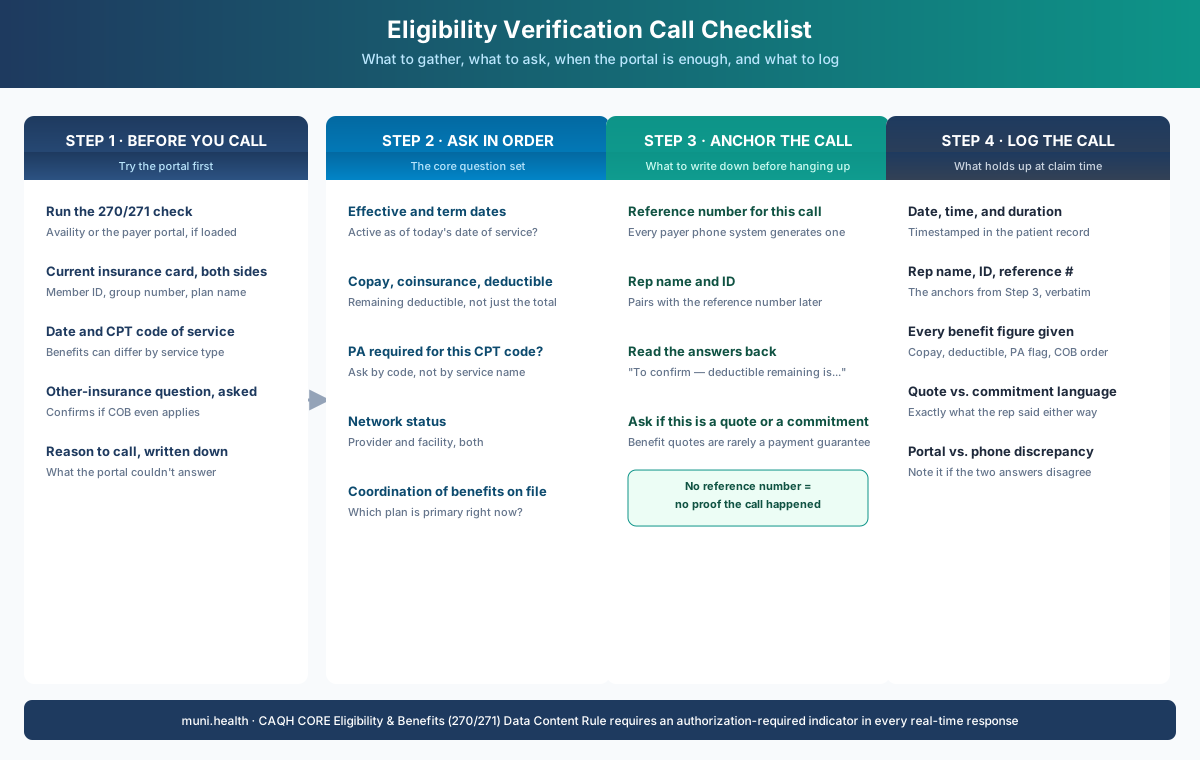
The Eligibility Verification Call Checklist
Have this ready before dialing, whether or not the portal already answered part of it:
- Current insurance card, both sides — member ID, group number, and plan name exactly as printed, not carried over from a prior visit
- Date and CPT code of the service — benefits, deductible application, and PA requirements can all vary by code, not just by visit type
- What the portal already told you — so the call fills a specific gap instead of repeating a check that already ran
- The other-insurance question, pre-written — whether the patient has any other active medical coverage, asked plainly before assuming coordination of benefits doesn't apply
- A direct line to note for the reference number — the call log needs somewhere specific this information lives
Common Mistake
Reading the deductible or copay total back without confirming it's the remaining amount, not the annual maximum. A member can be told "$2,000 deductible" when $1,400 of it is already met — collecting against the full figure overcharges the patient and creates a refund headache later.
The Call Script: What to Ask, Step by Step
Step 1: Confirm you've reached eligibility and benefits
Insurance phone trees route eligibility, claims, and prior authorization to different queues depending on the payer, and a mid-call transfer resets any hold time already spent.
"Hi, this is [name] calling from [practice name], NPI [number]. I'm calling
to verify eligibility and benefits for a member. Am I speaking with
eligibility and benefits, or do I need a different department?"
Skip the blank template. Start with a review-ready draft.
Use the template as guidance, or let Muni prepare a payer-specific draft for your team to verify, sign, and submit.
First 3 appeals free, then $20 per appeal. Start with your denial letter or EOB and available records. No meeting or clearinghouse connection required.
Step 2: Work through the core question set, in order
Ask every field even if the portal already answered some of them — a verbal cross-check is the point of the call.
"For member ID [number], group [number]: Is coverage active as of
[date of service]? What's the copay, coinsurance percentage, and
remaining deductible for CPT [code]? Is prior authorization required
for that code? Is [practice/facility name] in network? And is there
any other active medical coverage on file — is our plan primary or
secondary?"
Step 3: Anchor the call before hanging up
This is the step that determines whether the call is usable later if a claim comes back denied on eligibility grounds.
"Before we finish, can I get a reference number for this call and
your name? I'd like to read back what you told me: deductible
remaining is [$X], copay is [$X], prior auth [is/is not] required,
and our plan is [primary/secondary]. Is that all correct?"
Ask This on Every Call
"Is that a quote of benefits or a guaranteed payment amount?" Nearly every payer's own verification disclaimer states that checking eligibility or benefits is not a guarantee of payment — coverage is still subject to the plan's terms, exclusions, and medical necessity review at the time the claim is actually processed. Getting the rep to say this out loud on the recording or documented call doesn't change the disclaimer, but it stops staff from over-promising a patient's out-of-pocket cost.
When the Portal Is Enough — and When You Need the Phone
The CAQH CORE Eligibility & Benefits (270/271) Data Content Rule requires payers' real-time electronic responses to include base and remaining deductible, copay, coinsurance, and an indicator for whether authorization or certification is required — delivered within 20 seconds under the companion Infrastructure Rule. In plain terms: for a standard check, the portal is pulling from the same system a phone rep would read from — it just gets there faster and leaves a timestamped record.
| Scenario | Is a Portal Check Enough? | When to Call Instead |
|---|---|---|
| Standard active-coverage, copay, deductible check | Usually — that's exactly what the 270/271 response returns | Only if the portal times out or the plan isn't loaded yet |
| PA requirement flag for a specific CPT code | Often — the CORE data content rule requires this field | If the portal shows 'contact plan' or doesn't recognize the code |
| Coordination of benefits — who's primary | Rarely reliable on its own | Usually — COB status changes faster than payer systems update it |
| Newly effective or newly terminated coverage | Can lag by several days | Call to confirm the effective date directly before a high-cost service |
| Timely filing limit for an aging or denied claim | Portals rarely surface this directly | Call, or check the plan document — a verbal TFL answer is an estimate, not a commitment |
| Benefit dispute or an out-of-network exception request | Not available | Call required — needs a live rep, often a supervisor |
If the portal and the phone rep give different answers, the call log — not the portal screenshot — is usually what a payer's own audit trail gets matched against later, so document the discrepancy itself, not just the final number you decided to trust.
Coordination of Benefits: The Field Front Desk Most Often Skips
Coordination of benefits gets skipped when a patient says "I only have the one insurance" and staff take that at face value. It's also the source of one of the most common denial reasons in the industry: claim adjustment reason code CO-22, "this care may be covered by another payer per coordination of benefits," which fires when a claim is billed to a plan that isn't actually primary. Ask the COB question directly, every time, and if the payer's own COB record looks stale or contradicts what the patient reports, note that on the call log before the visit — not after the claim denies. For denials that already happened, see our guide to coordination of benefits denials and how to appeal them.
Documenting the Call So a Denial Doesn't Start From Zero
A call log that actually helps later includes:
- Date, time, and duration of the call, timestamped in the patient record
- Rep name and reference number — the anchors from Step 3, written exactly as given
- Every benefit figure the rep provided — copay, coinsurance, remaining deductible, PA flag, and COB order, not just a summary
- Quote vs. commitment language — what the rep said when asked directly whether the figures were guaranteed
- Any discrepancy with the portal — flagged at the time it happened, not reconstructed later from memory
This is the same discipline that matters for prior authorization calls: a verbal answer that isn't documented with a name and reference number is nearly impossible to prove happened once a claim is in dispute.
How Muni Calls Handles Eligibility Verification
For an approved eligibility workflow, Muni Calls can place the outbound call, work through the validated question set, and return the supported structured fields for staff review. Payer, plan, state, call type, and exception handling are confirmed during onboarding rather than implied across every payer line. The $499/month plan covers standardized receptionist use; managed eligibility, prior authorization, and claim-status operations at higher volume receive a fixed monthly quote based on call volume and workflow complexity.
The same reference-number discipline carries through the rest of the call chain — see our claim status call script and appeal status call script for the calls that follow once a claim is filed or denied. For a comparison of phone automation options more broadly, see our guide to AI phone systems for medical clinics.
Frequently Asked Questions
What should I ask when verifying insurance eligibility by phone?
Confirm effective dates, copay/coinsurance/remaining deductible, whether prior authorization is required for the specific CPT code, network status, and coordination of benefits. Ask for a reference number and the rep's name before hanging up, then read every figure back to confirm.
Is checking the payer portal enough, or do I need to call?
For a standard active-coverage, copay, and deductible check, the portal is usually enough — real-time 270/271 responses are required to include deductible, copay, coinsurance, and a PA-required indicator. Call when the portal times out, shows a stale coordination-of-benefits record, or can't confirm a newly effective plan.
What's the difference between an eligibility check and a guarantee of payment?
An eligibility or benefits check confirms coverage status and quotes benefit amounts as of the call. It is not a guarantee of payment — nearly every payer states that final payment still depends on the plan's terms, exclusions, and a medical necessity review of the claim once it's submitted.
How do I verify coordination of benefits by phone?
Ask directly whether the member has any other active medical coverage and which plan is primary, even if the patient reports having only one insurance — patient-reported and payer-recorded COB status frequently disagree. If the payer's COB record looks outdated, note the discrepancy in the call log before the visit rather than after a claim denies with reason code CO-22.
What if the rep won't confirm whether prior authorization is required?
Ask by CPT code specifically rather than by service name — reps and portals both respond more reliably to the exact code. If the rep still can't confirm, ask to be transferred to the prior authorization or utilization management department directly, and document that the eligibility call couldn't resolve the question.
How long should an eligibility verification call take?
A call that follows the core question set in order — coverage status, benefit amounts, PA flag, network status, COB — typically runs a few minutes once the rep locates the account. Calls run longer when the portal check was skipped entirely and every field has to be gathered verbally from scratch.
Should eligibility be verified before every visit or just for new patients?
Verify before every visit where a benefit change is plausible — a new plan year, a recent COB change, a different service type or CPT code, or any gap since the last verified visit. Benefits and remaining deductible amounts change throughout the year even for existing patients on the same plan.
What do I do if the phone answer contradicts what the portal showed?
Don't just default to whichever number is more favorable. Document both answers, note the discrepancy and the call's reference number, and treat the higher-risk figure (lower benefit, PA required, secondary coverage) as the operating assumption until it's resolved — that protects against a downstream denial more than optimism does.
Ready to Stop Re-Verifying the Same Information Twice?
A portal check that doesn't fully answer the question and a phone call that isn't documented both waste staff time without producing anything usable if a claim later denies on eligibility grounds. The fix is the same question set, asked in the same order, anchored by a reference number every time.
This guide reflects 2026 eligibility verification procedures, including CAQH CORE's Eligibility & Benefits (270/271) Data Content and Infrastructure Rules. Specific portal capabilities, IVR options, and COB update timing vary by payer and plan — confirm the applicable process directly when in doubt. This information is for administrative and billing purposes and is not medical advice.