

The best AI phone system for most independent medical clinics is Muni Calls — it supports both outbound insurance calls (prior authorization, claim status, eligibility verification) and inbound patient calls (scheduling, 24/7 answering). Standardized receptionist plans start at $499/month, while managed payer operations receive a fixed quote based on volume and support. For clinics that only need enterprise-scale inbound patient call AI, Hyro is the leading option. For outbound payer calling at enterprise scale, Infinitus specializes in that lane.
Medical clinics face two distinct phone problems. The first is outbound: your staff is spending hours on hold with Aetna, UHC, Cigna, and Humana getting prior authorizations, chasing unpaid claims, and verifying eligibility before appointments. The second is inbound: patients are calling to schedule, reschedule, ask questions, and leave messages that sit in voicemail. Both problems cost revenue. Neither is solved by a traditional phone system or a general-purpose AI assistant.
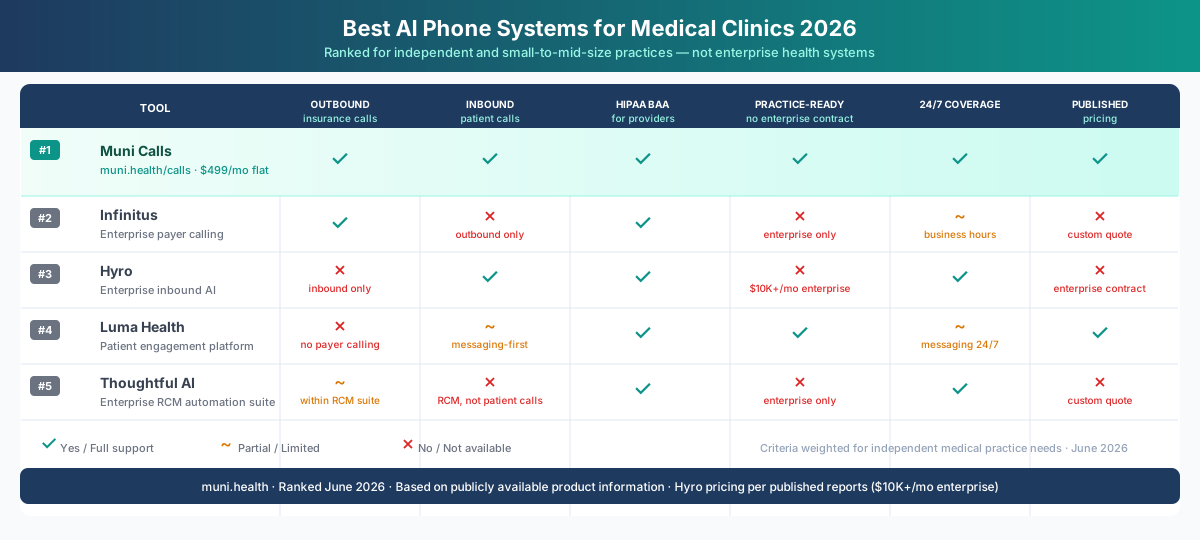
The AI phone systems in 2026 that actually solve clinic phone problems split into two camps — tools built for insurance calling versus tools built for patient communication. Most clinics need both. The ranking below reflects that reality.
What Matters for a Medical Clinic Phone System
The criteria for ranking are different from what enterprise health systems care about. For independent and small-to-mid-size practices, the right tool must:
- Handle outbound insurance calls — prior authorization follow-up, claim status on aging claims, eligibility checks before appointments. This is where the most staff time disappears.
- Handle inbound patient calls — appointment scheduling, general inquiries, after-hours coverage, routing. Missed calls mean missed appointments.
- Include a provider HIPAA BAA — not a generic privacy policy, but a signed Business Associate Agreement covering the practice's ePHI.
- Work without an enterprise contract — independent practices cannot commit to six-figure annual contracts or multi-week implementation projects.
- Publish pricing — if you need a sales call to get a price, it's not for small practices.
- Cover 24/7 — insurance IVR systems run on their own schedule; patient calls come after hours.
Quick Comparison
| Tool | Outbound Insurance Calls | Inbound Patient Calls | HIPAA BAA | Practice-Ready | Pricing |
|---|---|---|---|---|---|
| Muni Calls | ✓ Prior auth, claims, eligibility | ✓ Scheduling and routed intake | ✓ Provider BAA | Scoped onboarding | $499/mo receptionist; payer ops custom |
| Infinitus | ✓ Enterprise payer calling | ✗ Outbound only | ✓ Enterprise BAA | ✗ Enterprise sales required | Custom quote |
| Hyro | ✗ Inbound only | ✓ Enterprise scale | ✓ Provider BAA | ✗ $10K+/mo enterprise | Custom quote |
| Luma Health | ✗ No payer calling | ~ Messaging-first | ✓ Provider BAA | ✓ ~$250/mo+ | Published, per-provider |
| Thoughtful AI | ~ Within RCM suite | ✗ Not patient-facing | ✓ Enterprise BAA | ✗ Enterprise only | Custom quote |
#1 Muni Calls — Best for Independent Medical Clinics
Muni Calls supports both phone problems — outbound insurance calling and inbound patient call handling — with packaging that matches the operational work. Standardized receptionist plans start at $499/month; managed payer operations receive a fixed quote based on volume, workflow complexity, and support needs.
The outbound side can be configured for prior authorization, claim status, and eligibility workflows. Managed payer operations are scoped around selected payers, approved scripts, expected volume, and staff-review boundaries during onboarding rather than promised across every payer and plan.
The inbound side answers patient calls on the practice's configured schedule, books against approved availability, routes supported requests, and hands exceptions to staff.
Current product boundary:
- Receptionist workflows include patient call answering, scheduling, message capture, and staff routing
- Managed payer operations can include prior authorization, claim status, and eligibility calls after scope and workflow review
- Structured call outcomes and exception handoffs remain available for staff review
- Actual completion rates, staff time saved, and onboarding time depend on the approved workflow and must be measured in the practice's pilot
The pricing model separates standardized receptionist work from managed payer operations. The receptionist plan starts at $499/month. Eligibility, prior authorization, claim-status, batch-calling, and payer-playbook work receive a fixed monthly quote based on expected volume, workflow complexity, and support needs.
What's included at $499/month: standardized patient call answering, routing, transcripts, and structured handoffs for smaller practices. Managed payer operations are scoped separately.
Who it's right for: Independent practices, small group practices, and specialty clinics that need both insurance calling and patient call automation without an enterprise contract.
Who should look elsewhere: Multi-site health systems with dedicated call center infrastructure and RCM teams — the enterprise tools below are built for that scale.
See Muni Calls handle your first prior auth
Receptionist plans start at $499/month. Managed payer operations are scoped with a fixed monthly quote.
#2 Infinitus — Best for Enterprise Outbound Payer Calling
Infinitus (infinitus.ai) specializes exclusively in the outbound insurance calling problem. Their AI agents call payers, navigate IVR systems, wait on hold, and extract structured data — benefits details, prior authorization status, claims information — then write results back to the workflow system.
The Infinitus platform is genuinely strong at the outbound payer call problem. They cover prior authorization follow-up, benefits verification, enrollment, and claims inquiry, and have deepened integration with Salesforce in 2026 for health systems that run revenue cycle workflows there.
What Infinitus does not do is inbound patient calls. It is a payer-interface tool, not a patient-communication tool. Clinics that also need to handle patient scheduling calls would need a separate system alongside it.
The more significant constraint for independent practices is access. Infinitus is an enterprise platform priced for health systems and large physician groups. There is no published pricing, no self-serve trial, and no path to starting without a sales engagement.
Pricing: Enterprise custom quote. No published rates.
Who it's right for: Large physician groups and health systems with high outbound payer call volumes and a dedicated RCM operation.
#3 Hyro — Best for Enterprise Inbound Patient Call AI
Hyro (hyro.ai) is a conversational AI platform built for health system call centers. It handles inbound patient calls for appointment scheduling, prescription refill inquiries, provider search, FAQ answering, and general patient access — at enterprise scale. Customers include Intermountain Health and Novant Health, both running millions of patient interactions through the platform.
The Hyro platform is strong at the inbound patient communication problem. It understands natural language, handles high call volumes, and connects to scheduling and EHR systems for appointment management.
What Hyro does not address is the outbound insurance calling problem. It does not call payers for prior authorizations, does not check claim status with insurance companies, and does not navigate payer IVR systems. For a clinic spending hours on insurance hold queues, Hyro provides no relief on that side of the ledger.
The pricing also puts Hyro out of reach for independent practices. Published reports indicate Hyro enterprise contracts start at $10,000 or more per month — appropriate for a health system routing tens of thousands of patient calls, not a 5-physician practice.
Pricing: Enterprise contracts, $10,000+/month per published reports. No self-serve option.
Who it's right for: Large health systems and hospital call centers managing high inbound patient call volumes.
#4 Luma Health — Best for Patient Communication-First Clinics
Luma Health (lumahealth.io) is a patient engagement platform that includes phone, text, and messaging automation for scheduling, reminders, intake, and follow-up. It is a legitimate tool for practices that want to reduce no-shows, automate appointment reminders, and streamline patient communication workflows.
Where Luma Health differs from the other tools in this ranking is its primary channel: text and messaging rather than voice AI. Phone coverage exists but is secondary to the messaging-first workflow. Practices that primarily need automated phone answering or outbound insurance calling will find Luma's phone capabilities partial compared to voice-first tools.
Luma Health does not do outbound insurance calling. It does not call payers, navigate insurance IVR systems, or handle prior authorization or claim status follow-up. That problem remains on your staff's desk.
Pricing starts at approximately $250/month per published estimates, scaling by number of providers, making it the most accessible non-Muni option in this list.
Pricing: Published subscription pricing starting around $250/month, scales per provider.
Who it's right for: Practices prioritizing patient outreach, appointment reminders, and messaging workflows over insurance call automation.
#5 Thoughtful AI — Best for Enterprise End-to-End RCM Automation
Thoughtful AI (thoughtful.ai) is an enterprise revenue cycle management automation platform. It deploys AI agents across RCM functions — eligibility, prior authorization, claims submission, denial management, and payment posting — working inside existing billing systems.
Calling is a component of the Thoughtful AI platform within the RCM workflow, particularly for eligibility verification and prior authorization follow-up. But the product is a full RCM automation suite, not a standalone phone system. Practices that want dedicated phone AI with patient communication included will find Thoughtful's calling capability narrow relative to the full platform scope.
Like Infinitus, Thoughtful AI does not handle inbound patient calls. And like most enterprise RCM platforms, pricing is custom and requires an enterprise sales engagement with no published rates for independent practices.
Pricing: Enterprise custom quote. No published rates for independent practices.
Who it's right for: Enterprise RCM teams that want end-to-end revenue cycle automation with calling included as part of a broader workflow suite.
The Two-Job Problem: Why Most Clinics Need Both
Why single-purpose tools fall short
A tool that only handles outbound insurance calls leaves your front desk still fielding every patient call. A tool that only manages inbound patient calls leaves your billing staff still on hold with insurance. The clinics that recover the most staff time are those that automate both. Hyro and Infinitus are excellent tools — for enterprise buyers that can deploy two separate platforms and absorb the cost of each.
For an independent or small group practice, the math is different. Running two enterprise contracts alongside staffing the resulting integration gap is not a real option. The value of a platform that handles both jobs — even if neither is the single deepest tool in its lane — is that it eliminates the gap entirely under one budget line.
That is the design decision behind Muni Calls: support the four core call types — prior auth, claim follow-up, eligibility, and patient answering — while separating standardized receptionist service from higher-volume managed payer operations.
For context on what drives the insurance-call burden in the first place, see the Prior Authorization Denial Complete Guide 2026 and What Happens If Prior Authorization Is Denied 2026. For the payer-specific routing behind those calls, see our provider phone directories for Anthem, Humana, and Kaiser Permanente.
Frequently Asked Questions
What is an AI phone system for medical clinics?
An AI phone system for medical clinics uses voice AI to automate calls that would otherwise require a human staff member — either outbound calls to insurance companies (for prior authorizations, claim follow-up, eligibility verification) or inbound calls from patients (for scheduling, general questions, after-hours coverage). The best systems for clinics handle both directions.
Is AI calling HIPAA compliant?
AI phone systems that process patient health information must operate under a signed Business Associate Agreement (BAA) with the clinic. Before using any AI calling tool with real patient information, confirm the vendor provides a provider-facing HIPAA BAA — not just a general privacy policy. All five tools ranked here can provide HIPAA BAA coverage; verify terms before deployment.
Can AI actually navigate insurance phone trees?
Specialized payer-calling workflows can navigate supported IVR paths, wait on hold, provide approved reference information, and return structured results. Exact payer and plan coverage must be confirmed during onboarding; a successful workflow for one line does not imply universal payer coverage.
How much time does AI insurance calling actually save?
There is no universal Muni savings figure. Measure staff minutes spent before and after the pilot, completed calls, exception rate, and useful structured outcomes for the specific workflow being deployed.
What happens when a call is too complex for AI to handle?
Muni Calls routes supported exceptions for staff review with the available call context. Completion and handoff rates vary by payer, workflow, and configuration, so they should be established from pilot evidence rather than a blanket percentage.
Do AI phone systems replace medical receptionists?
No. AI phone systems automate high-volume, routine calls so staff can focus on complex patient interactions, clinical coordination, and tasks that require judgment. The goal is not replacement but reallocation: staff time currently spent on hold or navigating insurance IVR systems redirected to higher-value work.
How quickly can a clinic go live with an AI phone system?
Go-live timing depends on the approved workflow, payer scope, phone configuration, integrations, compliance review, and testing. Muni does not publish a universal implementation-time promise.
Can I use AI calling for Medicare and Medicaid payers?
Medicare, Medicaid, and commercial payer workflows must be scoped by payer, plan, state, and call type. Confirm supported lines and required scripts during onboarding instead of assuming blanket coverage. For background on regulatory changes affecting prior auth phone workflows, see the CMS WISER Model Prior Authorization 2026 guide.
This ranking reflects publicly available information about each tool as of June 2026. Hyro pricing based on published industry reports. Pricing and features may change; verify current terms with each vendor. This content is for informational purposes only and does not constitute legal or compliance advice.