

The best AI appeal generator for most independent medical practices is Muni Appeals — payer-specific drafting for Aetna, BCBS, UHC, Cigna, and Humana; deadline-risk surfacing from uploaded denial materials; a BAA requirement for covered entities under Muni's terms; and transparent credit-based pricing at $20 per appeal with 3 free credits to start. Staff reviews and submits each packet. For a broader revenue cycle platform, evaluate Waystar. For individual appeals, Fight Health Insurance offers free drafting and reports over 10,000 appeals generated on its site.
Insurance denials are not a niche problem. A Kaiser Family Foundation analysis found that ACA marketplace insurers denied approximately 85 million in-network claims in 2024 — and fewer than 1% of patients or providers formally appealed. That gap is revenue left on the table.
AI appeal tools address different workflows. A free drafting tool and a broader revenue cycle platform may have different agreements, implementation requirements, and costs. Evaluate those details for your practice rather than assuming fit from a category label or practice size.
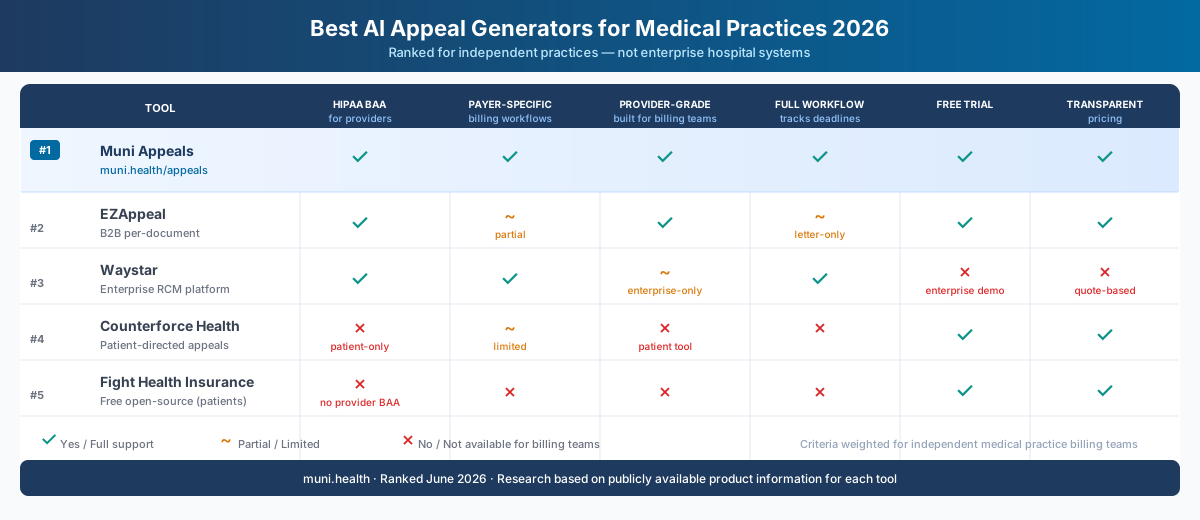
Here is our editorial ranking of five AI appeal tools, followed by verification questions that also apply to general AI assistants. If you'd rather evaluate any tool yourself against a fixed rubric, see Insurance Appeal Automation Software for Small Practices: 2026 Buyer's Guide.
How We Ranked These Tools
This is Muni Health's editorial ranking of its own product and alternatives, not a hands-on benchmark. Treat the criteria below as questions to verify with each vendor:
- HIPAA BAA availability for providers — not just patient-consent forms, but a signed Business Associate Agreement covering your practice's ePHI
- Payer-specific workflows — can your team verify the relevant policy, deadline, and submission route against current payer instructions?
- Provider-grade tooling — built for billing teams and practice managers, not patients navigating a single denial
- Review workflow — a structured draft, documentation checklist, deadline-risk context, and submission guidance for staff verification
- Free trial accessibility — can you test the tool before committing without a sales call?
- Transparent pricing — published rates with no mandatory enterprise contract
Quick Comparison
| Tool | Best For | HIPAA BAA | Payer-Specific | Full Workflow | Free Trial | Pricing |
|---|---|---|---|---|---|---|
| Muni Appeals | Independent practices | BAA required; see terms | ✓ Payer-aware drafting | Draft + checklist + guidance | ✓ 3 free credits | $20 per appeal |
| EZAppeal | Billing companies and practices | Vendor says BAA included; confirm terms | Not assessed here | Not assessed here | Homepage: 6 documents | Homepage: $5/document or monthly plans; blog conflicts |
| Waystar | Revenue cycle teams | Confirm agreement | Confirm scope | Confirm purchased modules | Contact vendor | Request quote |
| Counterforce Health | Patients and caregivers | Confirm intended use | Not assessed here | Not assessed here | Free for individuals | Free for individuals |
| Fight Health Insurance | Individual appeals | Confirm intended use | Not assessed here | Not assessed here | Free drafting | Optional donations |
#1 Muni Appeals — Best for Independent Medical Practices
Muni Appeals is built for independent practices that need payer-aware appeal drafting without an enterprise contract.
Evaluate workflow depth rather than assuming every tool offers the same support. Muni generates payer-specific appeal letters with clinical justification tied to the uploaded denial reason, surfaces deadline risk, and provides submission guidance for staff to verify against the denial notice and payer portal. That distinction matters when a missed deadline means a denial becomes unappealable.
Muni offers payer-aware drafting and public guides across common insurers, including Aetna, Blue Cross Blue Shield affiliates, UnitedHealthcare, Cigna, Humana, Medicare, and Medicare Advantage plans. Payer procedures change, so staff must verify every deadline, policy, and submission route against the denial and current payer instructions. For payer-specific guides, see:
What Muni provides for independent practices:
- A review-ready appeal draft based on the denial and supporting records you upload
- Candidate payer-policy references and an evidence checklist for staff verification
- Deadline-risk and submission guidance, with filing and follow-up retained by staff
- $20 per appeal credit after 3 free starter credits — no monthly subscription
The pricing model is deliberately accessible for independent practices. Three free credits let you test the product on real denials before spending anything. After that, weigh the $20 drafting charge and staff time against the circumstances of each denial; the claim amount alone does not determine whether an appeal is worthwhile.
Who it's right for: Independent practices, small-to-mid-size billing companies, and specialty groups that handle their own appeals.
For broader RCM needs: Compare implementation requirements and purchased modules directly with a platform such as Waystar.
Start with 3 free appeal credits
No credit card. No subscription. Test Muni Appeals on your actual denials before you commit.
First 3 appeals free, then $20 per appeal. Start with your denial letter or EOB and available records. No meeting or clearinghouse connection required.
#2 EZAppeal — Per-Letter Pricing for Billing Companies and Practices
EZAppeal's published guide markets the tool to billing companies, private practices, and multi-specialty groups. On September 20, 2026, its rendered homepage advertised 6 free starter documents, $5 pay-as-you-go documents, Starter at $39/month for 25 documents, and Pro at $199/month for 100 documents. Its blog still advertised $3 per letter and the first free. These sources conflict; confirm the applicable offer and billing terms directly. We did not verify checkout pricing.
The guide describes its infrastructure as “AWS Bedrock BAA HIPAA infrastructure.” The homepage also states that a BAA is included with every account. These are vendor statements, not verification of an executed agreement with your practice. Confirm the applicable BAA and data-handling terms directly before sending patient information.
We have not benchmarked EZAppeal's generation speed or evaluated its feature depth. This ranking does not establish that it lacks payer-specific guidance or offers only letter generation. Ask the vendor to demonstrate the workflow your team needs, including policy references, review, and submission responsibilities.
For worked pricing examples and a copyable evaluation checklist, see Muni vs. EZAppeal: AI Appeal Letter Software Compared.
#3 Waystar — Best for Enterprise RCM Departments
Waystar offers revenue cycle software. Its April 7, 2026 announcement describes an AI solution for post-payment recoupments, which it calls silent denials. The same site addresses both health systems and physician practices; organization size alone should not rule it in or out.
Ask for a quote and a demonstration of the specific denial-management modules, integrations, review responsibilities, and implementation work your organization would buy. This article does not establish a headcount threshold, current trial availability, or a per-appeal price for Waystar.
Pricing: Request current terms directly from Waystar.
#4 Counterforce Health — Best for Patient-Directed Voice Appeals
Counterforce Health describes appeal support for patients and caregivers, free for individuals, and lists a voice AI assistant in beta. These are vendor statements checked September 20, 2026, not a tested usability or outcome assessment.
Its current site describes support for patients, doctors, and caregivers, including clinic grant programs. That does not by itself establish suitability for your practice's PHI or billing workflow. Confirm BAA terms, integrations, and staff responsibilities directly rather than inferring their absence from its patient focus.
Pricing: Free for patients.
#5 Fight Health Insurance — Best Free Tool for Patients
Fight Health Insurance offers free appeal drafting with optional donations. Its site reports over 10,000 appeals generated as of our September 20, 2026 check; that is a vendor-reported generation count, not an independently verified count of successful appeals.
Its current site describes editable appeal drafts, self-submission, and an optional paid fax service. This article has not assessed its policy accuracy, deadline support, integrations, or provider BAA terms. Confirm those details for the service you intend to use.
Pricing: Free drafting with optional donations; the site lists faxing as a separate paid option.
Why Generic AI Tools (ChatGPT, Claude, Copilot) Fall Short
Using a general-purpose AI chatbot to write insurance appeal letters is not the same as using an AI appeal generator. The difference is not about writing quality — it is about what the tool knows and doesn't know.
What general AI tools get wrong on insurance appeals
Do not assume a generated answer reflects the current policy, deadline, or submission route for a specific plan. Check each instruction against the denial notice and current payer materials. This applies to general chatbots and dedicated appeal tools alike.
The gap is procedural, not textual. A well-written appeal letter submitted to the wrong portal, missing the required attachment format, or filed after the incorrect deadline calculation is a lost appeal regardless of how good the clinical justification reads.
For general context on the appeals landscape, see the Prior Authorization Denial Complete Guide 2026 and Insurance Denial Rate by Company 2026.
Frequently Asked Questions
What is an AI appeal generator?
An AI appeal generator is a software tool that uses artificial intelligence to create insurance appeal letters, typically pulling in the denial reason, payer policies, and clinical justification language to build a complete appeal document. Higher-end tools also provide payer-specific submission guidance and deadline tracking.
Does using AI for insurance appeals violate HIPAA?
HHS cloud guidance describes BAA and other HIPAA obligations for services handling ePHI on behalf of covered entities or business associates. Muni's terms require HIPAA-covered entities to execute a BAA before using the services. EZAppeal's homepage advertises a BAA with every account, but neither that statement nor its infrastructure claim verifies an executed agreement for your practice. Confirm the applicable BAA, permitted uses, and safeguards with any vendor before uploading patient data.
Can AI write a better appeal than a human?
AI appeal generators can make a draft more structured and help surface candidate guidelines or payer criteria, but output quality depends on the source packet, model behavior, and product workflow. An experienced reviewer still needs to verify every clinical fact, citation, policy, deadline, and submission instruction before the appeal is used.
What is the difference between a provider appeal tool and a patient appeal tool?
Provider and patient tools may serve different buyers, but the category label does not prove BAA coverage or any particular feature. Verify the agreement, review process, submission responsibilities, and integrations for your intended use.
How much does AI appeal software cost?
Pricing varies widely. Muni Appeals lists $20 per appeal credit after 3 free starter credits, with no subscription. EZAppeal's homepage advertises $5 pay-as-you-go documents and monthly plans, with 6 documents to start; its blog's $3 offer conflicts. Confirm applicable terms directly. Request current Waystar pricing directly. Counterforce Health offers free individual support, and Fight Health Insurance offers free drafting with optional donations.
Can AI appeal generators work for prior authorization denials?
Yes. AI appeal generators can handle both retrospective claim denials and prior authorization denials. For prior auth appeals, the tool needs to know the specific payer's prior auth appeal pathway, which differs from standard claim denial appeals. See What Happens If Prior Authorization Is Denied 2026 for a walkthrough of the standard prior auth appeal process.
What information do I need to use an AI appeal generator?
At minimum: the denial letter or EOB, the patient's insurance ID and date of service, the denied procedure codes (CPT or HCPCS), and the diagnosis codes. Better tools will also ask for the denial reason code, the original claim number, and any supporting clinical documentation. Having the ERA or RA on hand for timely filing verification avoids the most common deadline calculation errors.
Is Muni Appeals free to start?
The current pricing page lists 3 free starter appeals, then $20 per appeal credit, with no credit card needed to start, no subscription, and no credit expiration. One credit covers a successfully generated draft; staff still verify the content and submit the appeal.
This ranking was originally published in June 2026. EZAppeal pricing, audience, and infrastructure statements were rechecked September 20, 2026; its speed and feature depth were not independently tested. Pricing and features may change. For provider-specific Aetna appeal timely filing windows and submission steps, see Aetna Corrected Claim Timely Filing Limits 2026. For general corrected claim timely filing limits across major payers, see Corrected Claim Timely Filing Limits 2026. This content is for informational purposes only and does not constitute legal or compliance advice.