

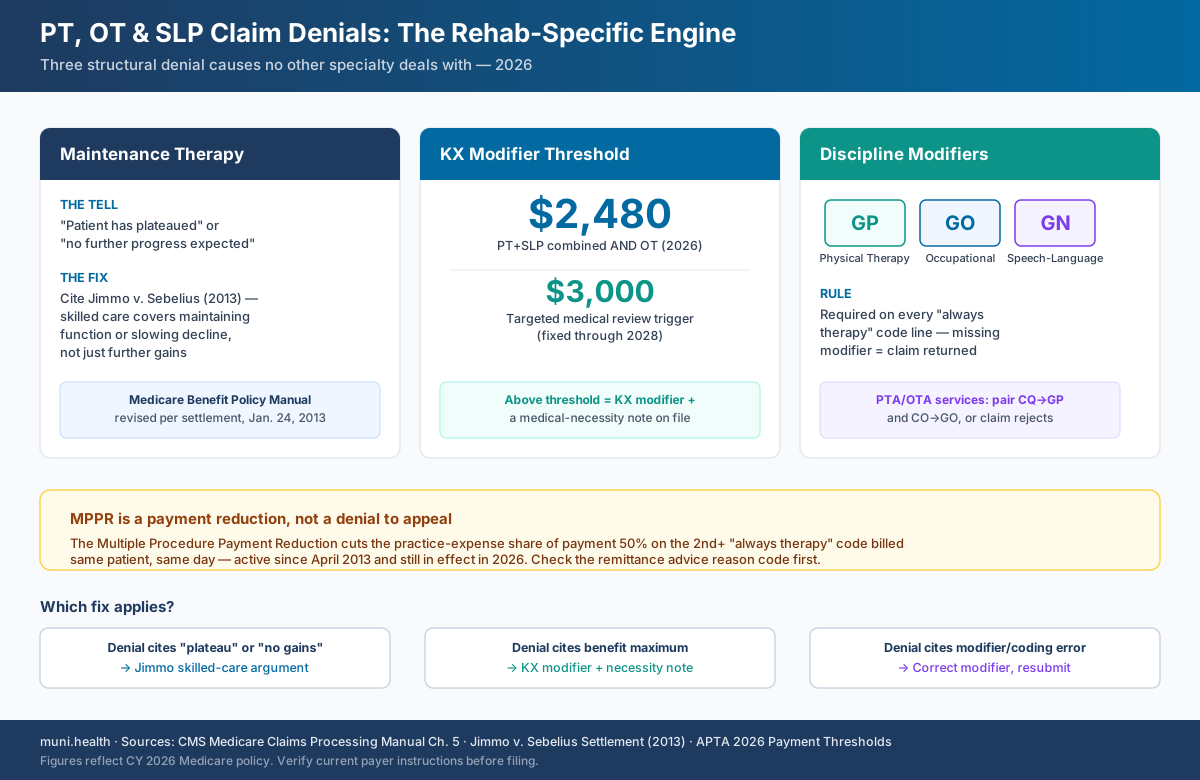
PT, OT, and SLP claim denials often turn on Medicare coverage and billing rules rather than a new clinical dispute. Check whether the denial misapplies the Jimmo maintenance-therapy standard, omits the KX modifier after the 2026 $2,480 threshold, or uses the wrong GP/GO/GN discipline modifier. Each path requires a different correction and supporting record.
Why PT, OT & SLP Denials Follow a Different Pattern Than Other Specialties
Medicare outpatient therapy claims have their own coverage and billing machinery. Medicare tracks PT, OT, and SLP charges against separate per-beneficiary dollar thresholds, requires discipline-specific modifiers on "always therapy" codes regardless of who furnishes the service, and applies a maintenance-coverage standard clarified after the 2013 Jimmo settlement. Commercial-plan rules vary, so verify the denial notice and the plan's current policy before applying any Medicare-specific correction.
This Guide Covers the Rehab-Wide Denial Engine, Not Code-Level Documentation
If your denial is specifically about CPT 97110 time documentation or the 8-minute rule, see the dedicated CPT 97110 appeal template guide — that guide covers unit calculation and session-note documentation in depth. This guide covers the structural denial causes that sit above the code level: the improvement standard, annual dollar thresholds, and modifier routing.
The Three Structural Denial Types
| Denial Type | What Triggers It | The Fix |
|---|---|---|
| Maintenance-therapy / "improvement standard" | Notes show a plateau, "no further progress expected," or "patient not improving" language | Cite Jimmo v. Sebelius and document the skilled care needed to maintain function or prevent/slow decline — not further gains |
| KX modifier threshold exceeded | Cumulative PT/SLP or OT charges cross the $2,480 (2026) annual threshold without the KX modifier | Append KX only when the medical record supports reasonable and necessary continued therapy; above $3,000, prepare for targeted medical review (TMR) documentation |
| Discipline modifier mismatch (GP/GO/GN) | Missing or incorrect PT/OT/SLP modifier on an "always therapy" code, or a PTA/OTA-furnished service missing its paired CQ/CO modifier | Confirm the modifier matches the plan of care's discipline and resubmit with the correct pairing |
Maintenance-Therapy Denials: The "Improvement Standard" Medicare Already Eliminated
A maintenance-therapy denial may cite language Medicare does not use as a coverage test. A denial letter that relies only on a patient having "plateaued," showing "no further progress expected," or "not improving" may be applying the so-called Improvement Standard — a rule of thumb that treated ongoing functional gain as a coverage requirement.
That practice ended with Jimmo v. Sebelius, a class-action settlement the federal court approved on January 24, 2013. Following the settlement, CMS revised the Medicare Benefit Policy Manual across the chapters covering skilled nursing facility care, home health, outpatient therapy, and inpatient rehabilitation facilities to correct the suggestion that coverage depends on a beneficiary's potential to improve. According to the Center for Medicare Advocacy's case summary, the revised manual language states that coverage "does not turn on the presence or absence of a beneficiary's potential for improvement, but rather on the beneficiary's need for skilled care" — and that skilled care may be necessary "to improve a patient's current condition, to maintain the patient's current condition, or to prevent or slow further deterioration of the patient's condition."
Use Jimmo for Medicare and Medicare Advantage
CMS confirms that the Jimmo skilled-care standard applies to traditional Medicare and Medicare Advantage plans. It does not control commercial-plan coverage. For a commercial denial, use the plan's current maintenance-therapy and medical-necessity criteria rather than assuming the Medicare standard applies.
What a maintenance-therapy appeal needs to show:
- The specific skilled intervention the therapist provides that a caregiver or the patient's own home program cannot safely replicate (progressive resistance calibration, fall-risk monitoring, swallow-safety assessment, compensatory strategy training)
- What happens to the patient's function without continued skilled care — not what has already improved
- That "plateau" in the progress notes describes the rate of measurable gain, not the absence of medical necessity
Use the template below for traditional Medicare or Medicare Advantage. For a commercial plan, replace the Jimmo section with the plan's own current maintenance-therapy criteria.
[Practice Letterhead]
[Date]

[Payer] Appeals Department
[Address from denial letter]

RE: Appeal — Maintenance Therapy / Skilled Care Denial
Patient: [Name] | DOB: [Date] | Member ID: [ID]
Claim #: [Claim Number] | DOS: [Date range]
Discipline: [PT / OT / SLP] | CPT Code(s): [Codes]
Denial Reason: [e.g., "patient has plateaued" / "no further progress expected"]

Dear Appeals Reviewer:

This claim was denied on the basis that [patient name] has reached a plateau
or is not showing continued functional improvement. This denial applies a
standard that does not reflect current Medicare coverage policy following
the Jimmo v. Sebelius settlement (D. Vt., approved January 24, 2013), under
which CMS revised the Medicare Benefit Policy Manual to confirm that
coverage of skilled therapy services "does not turn on the presence or
absence of a beneficiary's potential for improvement, but rather on the
beneficiary's need for skilled care." Skilled care may be medically
necessary to improve a patient's condition, to MAINTAIN the patient's
current condition, or to PREVENT OR SLOW further deterioration.

WHY SKILLED CARE REMAINS NECESSARY

[Patient name] continues to require the skilled judgment of a licensed
[PT/OT/SLP] for the following reasons:

1. [Specific skilled task — e.g., "progressive calibration of resistance
 and range-of-motion parameters based on real-time tolerance, which
 cannot be safely self-directed given [comorbidity/fall risk/pain
 response variability]"]
2. [Specific risk of decline without continued skilled care — e.g.,
 "discontinuation of skilled gait training risks loss of the current
 safe ambulation status achieved, given documented history of falls
 prior to this episode of care"]
3. [Specific reason a home program or caregiver cannot replace the
 skilled component — e.g., "compensatory swallow strategies require
 ongoing skilled cueing and reassessment; unsupervised practice risks
 aspiration"]

CLARIFYING THE PROGRESS NOTE LANGUAGE

The treatment notes cited in the denial describe the RATE of measurable
gain slowing, not an absence of medical necessity. [Patient name]'s
function without continued skilled intervention is expected to
[decline / be lost], as documented in the attached progress notes dated
[dates].

DOCUMENTATION ENCLOSED

- Progress notes for the denied dates of service
- Current plan of care with physician certification
- Functional outcome measures (baseline, current, and trend)
- [Any additional supporting clinical documentation]

I respectfully request that you overturn this denial and approve
continued coverage for the skilled [PT/OT/SLP] services described above,
consistent with the Jimmo v. Sebelius settlement and current CMS policy.

Sincerely,

[Provider Name], [Credentials]
[Practice Name]
[Phone] | [Fax]
Skip the blank template. Start with a review-ready draft.
Use the template as guidance, or let Muni prepare a payer-specific draft for your team to verify, sign, and submit.
First 3 appeals free, then $20 per appeal. Start with your denial letter or EOB and available records. No meeting or clearinghouse connection required.
KX Modifier Threshold Denials: What the $2,480 Number Actually Means
Every Medicare beneficiary has an annual per-beneficiary dollar threshold for outpatient therapy, tracked separately by discipline. For CY 2026, that threshold is $2,480 for PT and SLP services combined, and a separate $2,480 for OT services (CMS, 2026). Claims above the threshold need the KX modifier, which attests that continued therapy is reasonable and necessary and supported by documentation in the patient's medical record. CMS instructs contractors to deny claims above the threshold that omit KX; claims using KX remain subject to review of the supporting record.
Prepare this appeal packet with your team.
Draft the appeal, coordinate missing documents, and approve the reviewed packet. Keep your clearinghouse; your practice checks deadlines and submits through the payer’s accepted channel.
First 3 appeals free, then $20 per appeal. Start with your denial letter or EOB and available records. No meeting or clearinghouse connection required.
| Threshold (2026) | Amount | What Happens |
|---|---|---|
| PT + SLP combined | $2,480 per beneficiary, per year | KX modifier required on claims above this amount when the medical record supports continued therapy |
| OT (tracked separately) | $2,480 per beneficiary, per year | Same KX modifier requirement, separate running total from PT/SLP |
| Targeted medical review (TMR) | $3,000 per beneficiary, per discipline group (fixed through 2028) | Claims above this amount may be selected for additional documentation request by the supplemental medical review contractor |
A second, distinct trigger sits above the KX threshold: once a beneficiary's therapy claims in a discipline group cross $3,000, they become eligible for targeted medical review — not every claim above the threshold is reviewed. That $3,000 figure remains fixed until CY 2028, when CMS begins indexing it to the Medicare Economic Index (CMS, 2026).
An ADR Is Not a Denial Yet — Don't Miss the Response Window
A targeted-medical-review request is a request for records, not a denial. Missing the response deadline on the ADR is what turns it into one. Track the ADR due date the same way you'd track an appeal deadline, and respond with the same medical-necessity documentation described in the maintenance-therapy section above.
Discipline Modifier Mismatches: Why GP, GO & GN Denials Are Pure Routing Errors
Every "always therapy" CPT code — the codes CMS designates as always subject to therapy rules regardless of which provider bills them — requires a discipline modifier on the claim line: GP for services under a physical therapy plan of care, GO for occupational therapy, GN for speech-language pathology. Per the Medicare Claims Processing Manual, Chapter 5, contractors are instructed to return claims containing an always-therapy code that lack the appropriate modifier — this applies even when a physician or non-therapist provider bills the code, because the modifier identifies which plan of care the service falls under, not who performed it.
A second layer applies when a physical therapist assistant (PTA) or occupational therapy assistant (OTA) furnishes the service: the CQ modifier must pair with GP, and the CO modifier must pair with GO, reflecting the assistant-furnished payment differential Congress established in the Bipartisan Budget Act of 2018. A claim with CQ or CO but no matching GP/GO — or the reverse — is returned as unprocessable, not denied for medical necessity.
The fix for a modifier-mismatch denial is almost always a straight resubmission, not a documentation appeal:
- Confirm which discipline's plan of care actually governs the service billed
- Confirm PTA/OTA-furnished visits carry both the discipline modifier and its paired assistant modifier
- Resubmit with the corrected modifier — this is a coding correction, not a clinical argument, and typically doesn't need the full appeals process
MPPR Is a Payment Reduction, Not a Denial to Appeal
The Multiple Procedure Payment Reduction (MPPR) cuts the practice-expense portion of payment by 50% for the second and subsequent "always therapy" codes billed for the same patient on the same day — it has applied at that rate since April 2013 and remains in effect in 2026, despite a rehab-industry coalition pressing Congress in March 2026 to repeal the policy. A short payment on a multi-code visit day is frequently MPPR working as designed, not a processing error — check the remittance advice for the MPPR reason code before treating a lower-than-expected payment as a denial worth appealing.
How Muni Appeals Helps With Rehab Denials
Maintenance-therapy, KX-threshold, and modifier-mismatch denials share a pattern: the fix is matching the right documentation or code correction to the specific denial reason, not building a new clinical argument from scratch. Muni Appeals organizes uploaded denial materials and treatment records against the denial reason stated on the EOB, so staff can confirm whether a Medicare "plateau" denial needs a Jimmo-based skilled-care argument, a threshold denial needs documentation supporting KX in the medical record, or a modifier denial just needs a coding correction and resubmission.
For the broader documentation structure behind any medical-necessity argument, see the medical necessity justification letter guide. For denial-code lookups beyond the rehab-specific causes covered here, see the EOB denial code guide. Practices deciding whether to handle this volume manually or automate the appeal workflow should review the appeal automation software comparison for small practices before committing to either approach.
Frequently Asked Questions
What is the "improvement standard" and why isn't it a valid reason for a PT/OT denial in 2026?
The improvement standard was an unwritten practice of treating ongoing functional gain as a coverage requirement. It was formally corrected by the Jimmo v. Sebelius settlement, approved January 24, 2013, after which CMS revised the Medicare Benefit Policy Manual to state that skilled therapy coverage depends on the need for skilled care, not the potential for improvement — skilled care can be necessary to improve, maintain, or slow the decline of a patient's condition. A denial citing "plateau" or "no further progress" without addressing ongoing skilled-care necessity is applying a standard Medicare no longer uses.
What is the 2026 KX modifier threshold for physical therapy?
For Medicare in calendar year 2026, the KX modifier threshold is $2,480 for PT and SLP services combined, and a separate $2,480 for OT services. Claims above the threshold need the KX modifier when the patient's medical record supports reasonable and necessary continued therapy.
What happens when a patient's therapy claims cross the $3,000 targeted medical review threshold?
Claims above $3,000 per beneficiary, per discipline group, become eligible for targeted medical review, where a supplemental medical review contractor can request additional documentation before or after payment. This threshold is fixed through 2028. Missing the documentation-request deadline — not the review itself — is what typically turns this into a denial.
What are the GP, GO, and GN modifiers, and why do claims get denied without them?
GP identifies a service furnished under a physical therapy plan of care, GO under occupational therapy, and GN under speech-language pathology. Medicare requires one of these modifiers on every "always therapy" code regardless of which provider type bills it, and contractors are instructed to return claims that omit the appropriate modifier. This is a routing/coding error, not a medical-necessity dispute, and is fixed by resubmitting with the correct modifier.
Does the Jimmo v. Sebelius settlement apply to commercial insurance, not just Medicare?
CMS says the Jimmo skilled-care standard applies to traditional Medicare and Medicare Advantage plans. It does not control commercial coverage. For a commercial denial, use the plan's current maintenance-therapy criteria and the appeal instructions in the denial notice.
Is MPPR a claim denial I can appeal?
No. The Multiple Procedure Payment Reduction cuts the practice-expense portion of payment by 50% for the second and subsequent "always therapy" code billed for the same patient on the same day — it's a payment policy, not a coverage denial. Check the remittance advice for an MPPR-related reason code before treating a lower-than-expected payment on a multi-code visit as a denial.
How is this different from a CPT 97110 time-documentation denial?
CPT 97110 denials over the 8-minute rule or session-time documentation are a code-level, session-by-session problem — see the dedicated CPT 97110 appeal template guide for that. The denial types in this guide — maintenance therapy, KX threshold, and modifier mismatches — operate above the code level, at the benefit-tracking and claims-routing layer, and apply across PT, OT, and SLP regardless of which specific CPT code was billed.
Can Muni Appeals help with maintenance-therapy or KX-threshold denials?
Yes. Muni Appeals organizes uploaded denial materials and treatment records against the specific denial reason, surfacing whether a Medicare plateau denial needs a Jimmo-based skilled-care argument or a threshold denial needs documentation supporting KX in the medical record. Staff verify the clinical facts, current policy, and submission path before anything is sent. The first 3 appeals are free, then pricing is $20 per appeal.
This guide reflects 2026 Medicare therapy payment policy, including the CY 2026 KX modifier and targeted medical review thresholds, and the Jimmo v. Sebelius settlement's effect on Medicare coverage policy. Commercial payer policies vary by plan and state. This information is for administrative and billing purposes and is not legal or medical advice — verify current payer instructions before filing.