

CO-50 means the payer decided the service isn't medically necessary — a coverage decision, not a data error, so resubmitting the same information as a corrected claim won't address it. Use the denial notice to identify the appeal route, cite the applicable coverage policy, map the chart to each criterion, and request clinical review if the plan offers it.
Understanding CO-50: A Coverage Decision, Not a Claim Error
The official X12 definition of CARC 50 is "these are non-covered services because this is not deemed a 'medical necessity' by the payer." When it appears with the CO group code, the adjustment is assigned to contractual obligation rather than automatically to patient responsibility. Verify the remittance, contract, plan documents, and any required patient notice before deciding whether any amount may be shifted to the patient.
That distinction matters because it rules out the fastest fix billing teams reach for. CO-16 or CO-4 denials can point to missing information or coding issues that may require a corrected claim. CO-50 does not identify a missing claim field, so the response needs to address the coverage or medical-necessity basis in the denial notice using the documentation and appeal route the plan requires. See the EOB denial code guide for how CO-50 fits alongside the other common CARC codes.
Key Statistic
Medical necessity is a small share of denials but a disproportionately expensive one to get wrong. Only 5% of in-network claim denials for 2024 plan-year ACA Marketplace plans were attributed to lack of medical necessity, versus 25% for administrative reasons and 13% for excluded services (KFF, March 2026). Administrative denials are usually a data fix; medical necessity denials require the clinical documentation work this guide covers.
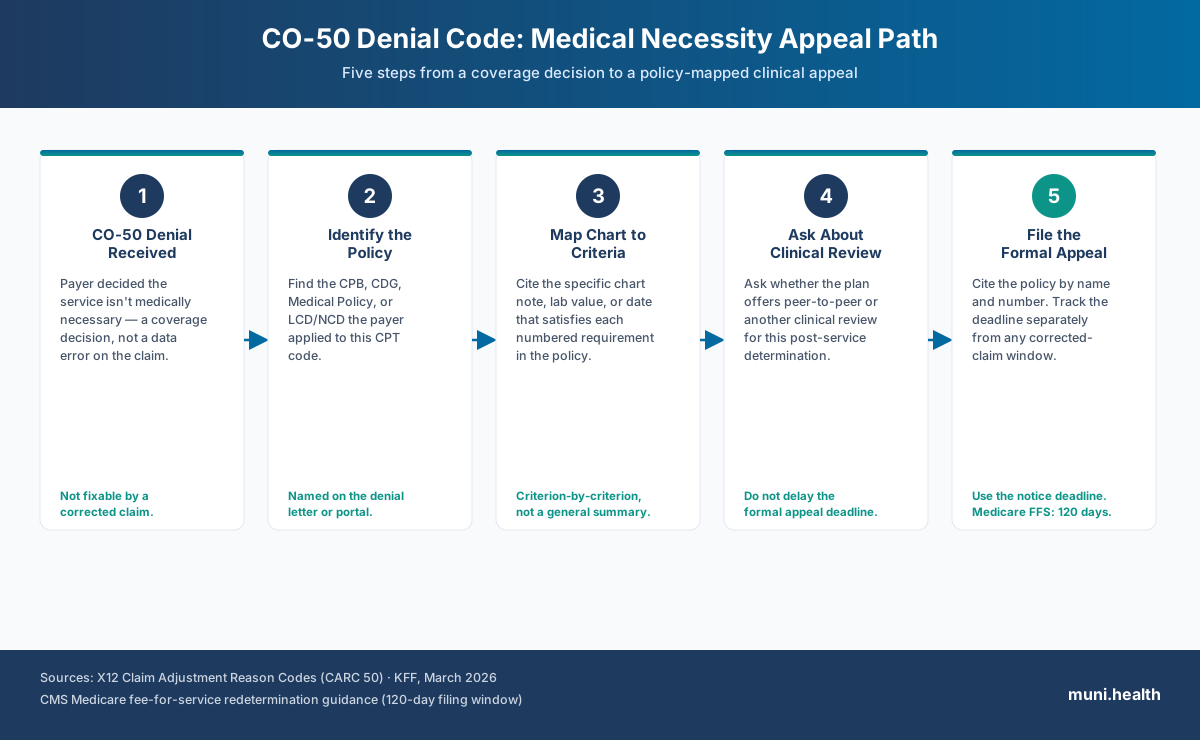
Step-by-Step: Building an Appeal That Can Actually Overturn CO-50
A CO-50 appeal succeeds or fails on whether it engages the specific policy the payer used to deny the claim. A generic letter restating that the service was necessary will not move a medical director who already reviewed the chart once.
Step 1: Identify the Exact Policy the Payer Applied
Start with the denial letter and remittance advice. They may name a Clinical Policy Bulletin, Coverage Determination Guideline, Medical Policy, or — for Original Medicare — a Local or National Coverage Determination. If no policy is identified, ask provider services which criteria supported the determination and document the response before drafting the appeal.
Step 2: Map the Chart to Each Numbered Criterion
Pull the policy and read it as a checklist, not a paragraph. Most CPBs and LCDs list numbered clinical criteria (prior conservative treatment, specific lab thresholds, imaging findings, failed alternatives). Quote each criterion in your appeal and cite the exact chart note, lab value, or date that satisfies it — do not summarize the chart and hope the reviewer connects the dots themselves.
Common Mistake
A general statement of medical necessity may not answer the criteria cited in the denial. When the notice identifies numbered requirements, address each one with the corresponding chart evidence; when it does not, request the criteria rather than guessing what the reviewer will apply.
Step 3: Ask Whether Clinical Review Is Available
Some plans offer a peer-to-peer or other clinical-review step, especially for pre-service or prior-authorization decisions; post-service claim appeals may proceed only through the written route in the denial notice. Ask what review options remain available and whether using one affects the formal appeal deadline. For context, KFF's analysis of 2024 HealthCare.gov claims found that fewer than 1% of denied claims were appealed and 34% of reported internal appeals reversed the denial. See the peer-to-peer review guide when the plan confirms that option is available.
Step 4: File the Formal Appeal Referencing the Policy by Name and Number
Cite the policy identifier (for example, Aetna CPB #0552 or a specific LCD number) directly in the appeal letter, not just "your medical necessity policy." Reviewers process a high volume of appeals, and citing the exact document signals the appeal engaged the actual denial reason rather than a generic template.
Step 5: Track the Appeal Deadline Separately From Any Corrected-Claim Deadline
CO-50 appeal windows run independently of corrected-claim windows and are usually longer — but they are not infinite, and they do not pause while you gather clinical documentation. Calendar the deadline the day the denial arrives.
Payer-Specific Policy Names for a CO-50 Denial
The document you're looking for has a different name depending on the payer. Search using the right term or you'll miss it.
| Payer | Policy Document Name | Where to Find It |
|---|---|---|
| Aetna | Clinical Policy Bulletin (CPB) | Numbered identifier, e.g. CPB #0552 — provider portal search |
| UnitedHealthcare | Coverage Determination Guideline (CDG) or Medical Policy | UHCprovider.com policy library |
| Cigna | Coverage Policy | CignaforHCP provider portal |
| BCBS affiliates | Medical Policy | Varies by affiliate — check the specific Blue plan's provider site |
| Humana | Medical Coverage Policy | Humana.com provider policy library |
| Original Medicare | Local Coverage Determination (LCD) or National Coverage Determination (NCD) | Your Medicare Administrative Contractor's LCD database, or CMS.gov for NCDs |
For an Original Medicare CO-50 denial, the appeal path is a formal redetermination with your Medicare Administrative Contractor rather than a payer-specific clinical appeal — see the Medicare redetermination guide for the 120-day filing deadline, the five-level appeal ladder, and a redetermination cover letter template built for LCD/NCD citations.
Template: CO-50 Medical Necessity Appeal Letter
This template is built specifically around a CO-50 denial — it opens by citing the denial code and the payer's specific policy, then structures the clinical argument as a criterion-by-criterion response rather than a general narrative. For prior-authorization-stage medical necessity letters and behavioral-health-specific language, see the medical necessity justification letter guide, which covers that earlier stage in more depth.
[Your Practice Letterhead]
[Date]

[Payer Name] Appeals Department
[Payer Appeals Address]

RE: Formal Appeal of Medical Necessity Denial — CO-50
  Patient: [Patient Name], DOB: [Date of Birth]
  Member ID: [Member ID]
  Claim Number: [Claim #]
  Date of Service: [DOS]
  CPT/HCPCS Code(s): [Code(s)]
  Denial Code: CO-50
  Policy Cited by Payer: [Policy Name and Number, e.g., "Aetna CPB #0552" or "LCD L#####"]

To Whom It May Concern:

This letter appeals the above claim, denied under CO-50 as not meeting [Payer Name]'s medical necessity criteria per [Policy Name and Number]. The patient's documented clinical presentation meets each criterion of that policy, addressed individually below.

Criterion 1 ([quote the policy's first requirement]):
[State the specific chart finding, lab value, or date that satisfies this criterion.]

Criterion 2 ([quote the policy's second requirement]):
[State the specific chart finding, lab value, or date that satisfies this criterion.]

Criterion 3 ([quote the policy's third requirement, add rows as needed]):
[State the specific chart finding, lab value, or date that satisfies this criterion.]

Prior treatment history: [Summarize conservative or alternative treatments attempted, with dates, if the policy requires documented failure of a lower-intensity treatment first.]

Supporting documentation enclosed:
- [Chart notes covering the relevant encounters]
- [Relevant lab/imaging results]
- [Physician letter of medical necessity, if separately prepared]

If [Payer Name] offers a peer-to-peer or other clinical-review step for this post-service determination, please provide the scheduling process without delaying or closing this formal appeal. Please direct scheduling information to [Contact Name and Phone Number].

Sincerely,

[Physician Name], [Credentials]
[Practice Name]
[Phone Number]
[NPI]
Skip the blank template. Start with a review-ready draft.
Use the template as guidance, or let Muni prepare a payer-specific draft for your team to verify, sign, and submit.
First 3 appeals free, then $20 per appeal. Start with your denial letter or EOB and available records. No meeting or clearinghouse connection required.
CO-50 vs. Other Non-Covered Denial Codes
CO-50 gets confused with codes that also read as "non-covered" but require a different response entirely.
| Code | What It Means | Correct Response |
|---|---|---|
| CO-16 | Claim is missing information needed to adjudicate | Corrected claim, fixing the field the RARC identifies |
| CO-50 | Payer decided the service isn't medically necessary | Clinical appeal citing the specific policy, plus peer-to-peer |
| CO-96 | Service is excluded from the plan's covered benefits | Appealable only if the exclusion was misapplied; otherwise a coverage determination with limited recourse |
| CO-97 | Service is bundled into another procedure billed same day | NCCI modifier review, or a formal appeal if the modifier indicator allows separation |
The distinction between CO-50 and CO-96 trips up billing teams the most: CO-96 means the service was never a covered benefit under the plan, so no amount of clinical documentation changes the outcome. CO-50 means the service is covered in principle but the payer says this specific patient's documentation doesn't meet the bar — which is exactly the gap a well-mapped appeal closes. For the full CARC/RARC framework these codes sit inside, see the EOB denial code guide; for the code that gets confused with CO-50 for the opposite reason — a claim data error rather than a coverage decision — see the CO-16 N-code lookup table.
In some specialties, a CO-50 denial arrives alongside a frequency-limit code (CO-119) that requires an entirely different response — verifying the payer's session count rather than building a clinical argument. Interventional pain management is the clearest example: see the pain management claim denials guide for how to tell the two apart before drafting an appeal.
When a Letter Alone Won't Be Enough
If the first-level clinical appeal does not resolve the denial, the next step depends on the plan type and the appeal rights stated in the decision notice.
Prepare this appeal packet with your team.
Draft the appeal, coordinate missing documents, and approve the reviewed packet. Keep your clearinghouse; your practice checks deadlines and submits through the payer’s accepted channel.
First 3 appeals free, then $20 per appeal. Start with your denial letter or EOB and available records. No meeting or clearinghouse connection required.
For commercial and Medicare Advantage plans, an unresolved internal appeal typically escalates to external review by an Independent Review Organization — a reviewer outside the payer makes the final determination. See the Independent Review Organization appeal guide for how that process works and its filing deadlines.
For Original Medicare, a denied redetermination escalates to reconsideration by a Qualified Independent Contractor, then to an Administrative Law Judge hearing for claims above the dollar threshold. The Medicare redetermination guide covers the full five-level ladder.
If the same LCD or CPB keeps producing CO-50 denials across multiple patients, that's a signal to request a formal policy reconsideration with the payer or MAC rather than re-fighting the same denial one claim at a time.
How Muni Appeals Handles CO-50 Denial Routing
When staff upload a CO-50 remittance, Muni Appeals surfaces candidate payer-policy citations, organizes the available documentation against the stated criteria, and drafts the appeal for staff review. The practice verifies the current plan, policy, deadline, and submission route before filing.
Weighing whether denial-routing automation is worth adding to an existing billing workflow? See appeal automation cost vs. manual processing for a breakdown of where the time actually goes.
Frequently Asked Questions
What does CO-50 mean on an EOB or remittance advice?
CO-50 means the payer decided the service does not meet its medical-necessity criteria. With the CO group code, the adjustment is assigned to contractual obligation rather than automatically to patient responsibility. Verify the contract, plan documents, remittance, and notice requirements before deciding whether any amount can be billed to the patient.
Can I resubmit a CO-50 denial as a corrected claim?
No. CO-50 isn't a data or coding error, so a corrected claim contains nothing to fix and will deny again for the same reason. The only effective response is a formal clinical appeal that addresses the payer's specific medical necessity policy.
What's the difference between CO-50 and CO-96?
CO-50 means the service is covered in principle but this patient's documentation doesn't meet the payer's medical necessity criteria — appealable with the right clinical evidence. CO-96 means the service is excluded from the plan's covered benefits entirely, which clinical documentation cannot override; it's only appealable if the exclusion itself was misapplied.
How do I find the specific policy a payer used to deny a CO-50 claim?
Search the payer's provider portal for the CPT/HCPCS code billed along with "clinical policy," "coverage determination," or "medical policy," depending on the payer. Aetna publishes numbered Clinical Policy Bulletins, UHC uses Coverage Determination Guidelines, and BCBS affiliates publish Medical Policies on their individual provider sites. For Original Medicare, check your Medicare Administrative Contractor's LCD database.
Does peer-to-peer review actually help with CO-50 denials?
It can when the plan offers that route, but availability depends on the plan and whether the decision was pre-service or post-service. Ask the payer whether a peer-to-peer or other clinical review remains available, get the timing in writing, and do not let that conversation replace or delay the formal appeal unless the denial notice says it does.
What if the payer denied CO-50 without citing a specific policy?
Contact provider services and ask which Clinical Policy Bulletin, Coverage Determination Guideline, Medical Policy, or LCD/NCD supported the determination. Record the representative, date, reference number, and policy identifier so the appeal can answer the actual criteria rather than an assumed standard.
Is a Medicare CO-50 denial handled differently than a commercial one?
Yes. Original Medicare CO-50 denials go through the formal five-level Medicare appeals ladder starting with redetermination by your Medicare Administrative Contractor, governed by LCDs and NCDs rather than a payer's internal Clinical Policy Bulletin. Medicare Advantage CO-50 denials, by contrast, follow the commercial-style internal appeal and external review process because the plan — not Original Medicare — made the coverage decision.
How long do I have to appeal a CO-50 denial?
Use the deadline printed in the denial or appeal-rights notice; commercial windows vary by plan and claim type. For Original Medicare, CMS says a redetermination request must be filed within 120 days of receiving the initial determination. See the insurance appeal deadlines guide for plan-specific starting points, then verify the current notice before filing.
Ready to Stop Losing CO-50 Appeals to Generic Letters?
CO-50 is the one denial code where the fix isn't a data correction — it's building an appeal that actually engages the payer's own criteria. The practices that lose these appeals aren't wrong about the clinical care; they're not citing the specific policy the reviewer is checking against.
Get started:
- Automated identification of the payer's applicable Clinical Policy Bulletin, Coverage Determination Guideline, or LCD/NCD
- Criterion-by-criterion documentation mapping built into the appeal draft
- Clinical-review options and deadline-risk guidance presented separately from corrected-claim workflows for staff verification
This guide reflects 2026 CARC code definitions and payer medical necessity appeal standards. Specific payer policies, appeal deadlines, and documentation requirements vary by plan, state, and Medicare Administrative Contractor. Verify current payer-specific policies before filing. This guide does not constitute legal or billing compliance advice.