

Anthem corrected-claim deadlines depend on the member's plan and state. There is no single nationwide deadline established by the policies below: Wisconsin's named Medicaid programs use 365 days from the date of service, while Indiana's named Medicaid programs use 60 days from the Explanation of Benefit. Identify the applicable policy and contract before calculating a deadline. A replacement corrects a prior claim; a void cancels it and does not establish a new filing window.
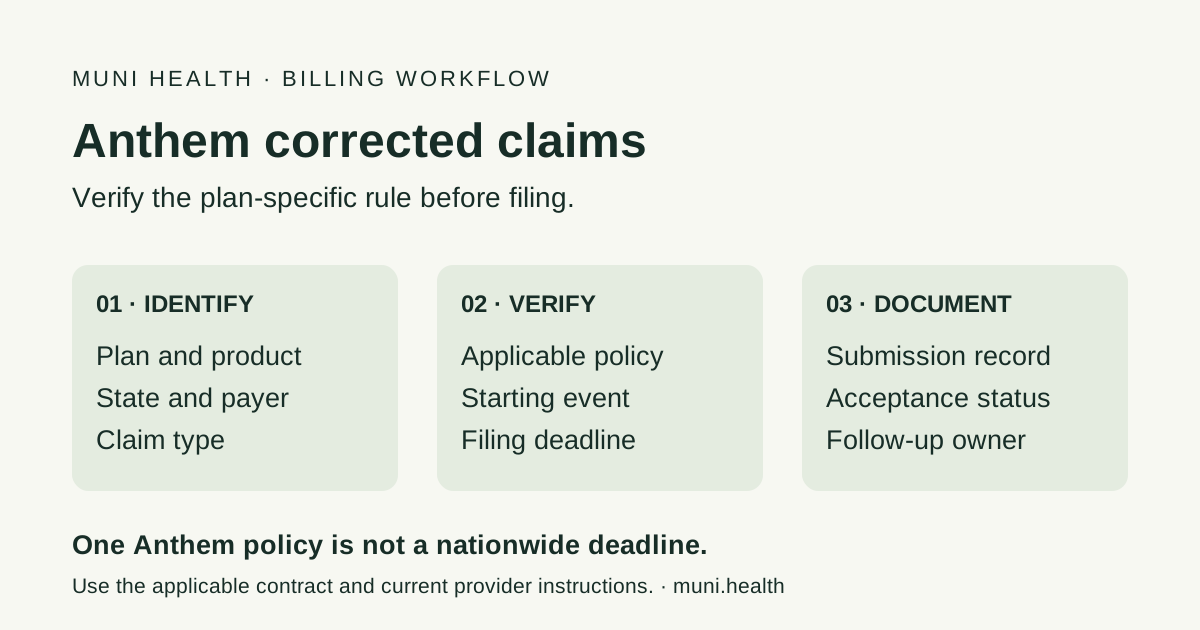
Which Anthem corrected-claim deadline applies?
Start with the member's state, product, and responsible Anthem entity. A policy number alone is insufficient: the documents below all use G-16001, but their filing rules differ. These are specific Medicaid examples, not deadlines for every Anthem member.
| Covered population in the cited policy | Published corrected-claim rule | Policy version | | --- | --- | --- | | Wisconsin BadgerCare Plus and Medicaid SSI | 365 days from date of service | Wisconsin policy, effective October 6, 2025 | | Indiana Hoosier Healthwise, Healthy Indiana Plan, and Hoosier Care Connect | 60 days from the Explanation of Benefit | Indiana policy, effective July 23, 2021; approved August 28, 2023 | | New York Medicaid | 60 days from the Explanation of Payment | New York policy, effective October 6, 2025 | | California Medi-Cal Managed Care | Six months from date of payment | California policy, effective October 6, 2025 |
Sources checked September 7, 2026. Each policy preserves applicable contractual or governmental exceptions. The Indiana document also directs providers working through specified medical groups or similar arrangements to follow their group's instructions. Confirm the governing version for the claim; do not convert a six-month rule into a 180-day rule.
Commercial, Medicare Advantage, Empire commercial, and Federal Employee Program claims need their own applicable instructions. The Medicaid documents above do not establish a nationwide deadline for those products. Request the relevant corrected-claim provision from the provider manual, agreement, or plan representative when it is unclear.
Choose a correction, cancellation, or appeal
A billing correction and a challenge to a payer's decision are different tasks. If submitted information is wrong, identify the replacement process. If the submitted claim is accurate and the disagreement concerns adjudication, find the applicable reconsideration or appeal process. See the corrected claim versus appeal guide for that decision.
The New York Medicaid policy's definitions identify frequency code 7 as replacement and 8 as void/cancellation. They describe a corrected claim as replacement of the entire claim. Do not use cancellation merely to change a billing field, or assume that cancelling creates more time. Verify the claim-type and payer instructions before transmitting either transaction.
Keep the original filing deadline, correction deadline, and dispute deadline as separate entries. Do not assume a universal 90-day original deadline or a 60-day appeal deadline based on the Anthem name alone. The cited corrected-claim policies do not promise that a correction revives a late original claim.
Verify the starting date before doing the arithmetic
The event that starts the clock matters as much as the number. Date of service, Explanation of Benefit, Explanation of Payment, and payment date are not interchangeable.
Record the rule exactly as written, alongside the source document and its effective date. If the rule refers to a remittance, retain the relevant remittance. If a contract exception appears to apply, keep that provision with the calculation. Escalate an ambiguous deadline promptly rather than waiting for a correction to be rejected.
Use a submission checklist, not an assumed portal path
Portal fields and available claim workflows can differ by plan and claim type. Before using Availity, your clearinghouse, or a paper process, confirm that the route supports the transaction you intend to submit.
- Match the member's plan, claim identifier, dates of service, and remittance to the applicable rule.
- Identify the billing information that needs correction and follow the payer's replacement-claim instructions, including any required original claim reference.
- Confirm that the transaction represents a replacement or cancellation as intended. Review the complete claim before sending it.
- Retain the submission acknowledgment and check subsequent acceptance or rejection status. A transmission confirmation alone should not be treated as conclusive proof that the payer accepted a timely claim.
- Follow up on a rejection while the applicable filing window remains open. Keep the status history with the claim record.
The Indiana policy requires separate corrected claims for each member and episode of care. That is not a basis for declaring that every electronic transmission containing multiple individual claims is prohibited; confirm the applicable EDI and clearinghouse requirements.
Copyable deadline-verification worksheet
Use this checklist inside your practice's approved claim-management system. Do not paste patient information into a public form or an unapproved tool.
Anthem corrected-claim verification

Plan / product / state:
Responsible payer entity:
Claim type and provider participation status:
Applicable policy or contract section:
Document version / effective date:
Rule quoted or summarized:
Starting event and its actual date:
Calculated deadline and reviewer:
Replacement, cancellation, or dispute route:
Required original claim reference:
Submission acknowledgment:
Payer acceptance / rejection status:
Next follow-up date and owner:
Skip the blank template. Start with a review-ready draft.
Use the template as guidance, or let Muni prepare a payer-specific draft for your team to verify, sign, and submit.
First 3 appeals free, then $20 per appeal. Start with your denial letter or EOB and available records. No meeting or clearinghouse connection required.
If a corrected claim is denied
Read the actual adjustment reason and any accompanying remarks before choosing the next action. The X12 claim adjustment reason list distinguishes a missed filing limit (29), an exact duplicate (18), and a service whose payment is included in another adjudicated service (97). These are not interchangeable explanations, and a missing claim reference does not establish which code the payer will return.
For a filing-limit dispute, compare the applied rule with the plan-specific policy and the available receipt evidence. Ask which dispute route, deadline, and supporting documents apply. A prior submission record can support review; it is not a reimbursement guarantee. Keep the claim, remittance, acknowledgments, policy version, and contact history together.
Anthem is one BCBS licensee among many
BCBS corrected-claim rules require source-specific scope. Highmark's PA/WV/DE notice covers Commercial, Medicare Advantage, and FEP with 455 days from original-claim finalization effective September 1, 2026, excluding BlueCard Home. BCBS Illinois defers to applicable filing deadlines and plan/contract terms; CareFirst's 2021 education describes 365 days from service. See the BCBS corrected claim timely filing guide for sources and applicability limits.
Frequently asked questions
Does every Anthem plan allow 365 days for a corrected claim?
No. That figure appears in the cited Wisconsin Medicaid policy. The Indiana, New York, and California examples above use different rules. Do not extend one policy to another population.
Does frequency code 8 restart the deadline?
Code 8 identifies cancellation. The cited definitions do not grant a deadline extension when a claim is voided. Confirm the applicable rule before cancelling a claim.
Can I use the appeal deadline for a corrected claim?
Do not substitute one deadline for another. Confirm the appropriate route and its filing requirements for the actual issue. A dispute about an accurate claim's adjudication may call for an appeal rather than a replacement.
What should I do when I cannot find the applicable rule?
Contact the plan through its approved provider channel and request the corrected-claim provision for the specific product and claim type. Document the response and reconcile it with the written policy or agreement before relying on it.
Prepare the right next step
If your next step is an appeal, organize the denial reason, governing plan provision, and supporting records before drafting. Explore Muni Appeals for help preparing an appeal letter. Keep the practice's filing and follow-up process in place.
Administrative education, not an individual coverage or reimbursement determination. Verify the applicable plan, contract, policy version, and filing instructions for each claim.