

Anthem's timely filing limit is 90 days from date of service for all commercial and Medicare Advantage professional claims, standardized across all Anthem-operated states in October 2019. Empire BCBS (New York) follows the same 90-day window for participating providers but extends to 15 months for non-participating. CO-29 denials are contestable with clearinghouse-documented proof of timely original submission.
Understanding Anthem's Timely Filing Framework
Anthem's 90-day timely filing limit is one of the shortest among major commercial insurers — tighter than Aetna, UHC, Cigna, and most other BCBS affiliates, which commonly run 180–365 days. Anthem standardized this 90-day window across its commercial and Medicare Advantage plans in October 2019, cutting what had been longer affiliate-specific windows. The change applied across all states where Anthem operates under the Elevance Health umbrella.
Anthem operates in 14 states under different corporate names: California (Anthem Blue Cross), Colorado, Connecticut, Georgia, Indiana, Kentucky, Maine, Missouri, Nevada, New Hampshire, New York (Empire BCBS), Ohio, Virginia, and Wisconsin. Despite the different affiliate names, all operate under the same 90-day commercial and MA timely filing standard. For a full comparison of how Anthem's window stacks up against other BCBS affiliates, see the BCBS timely filing limits guide.
Missing the 90-day window generates a CO-29 denial: "The time limit for filing has expired." In most cases this forfeits the revenue — Anthem has no blanket grace period. The only recovery path is a reconsideration with proof the original claim was transmitted within the window.
Contract Supersedes Published Defaults
Your individual provider agreement may specify a timely filing window different from Anthem's published 90-day standard. Your contract controls. Always verify your contract language before relying on the figures below — particularly if you renegotiated terms after the October 2019 policy change.
Anthem Timely Filing Limits by Plan Type
The 90-day standard applies to commercial and Medicare Advantage claims, but Medicaid managed care, corrected claims, and non-par billing follow different rules.
Prepare this appeal packet with your team.
Draft the appeal, coordinate missing documents, and approve the reviewed packet. Keep your clearinghouse; your practice checks deadlines and submits through the payer’s accepted channel.
First 3 appeals free, then $20 per appeal. Start with your denial letter or EOB and available records. No meeting or clearinghouse connection required.
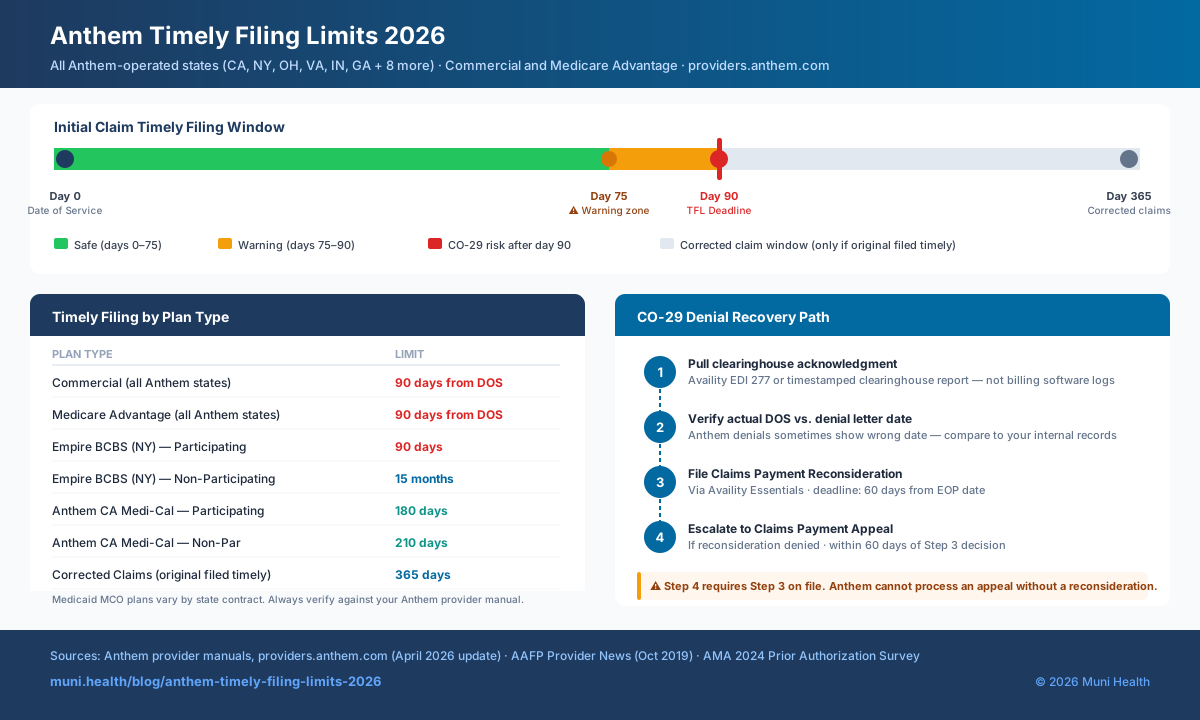
| Plan Type | Timely Filing Limit | Clock Starts | Key Notes |
|---|---|---|---|
| Commercial (all Anthem states) | 90 days | Date of service | Standardized Oct 1, 2019. Applies to all participating and non-par professional claims. |
| Medicare Advantage (all Anthem states) | 90 days | Date of service | Same limit as commercial. MA Attachment amended Oct 2019. CMS 12-month FFS rule does NOT apply. |
| Empire BCBS (NY) — Participating | 90 days | Date of service | Same as other Anthem affiliates for par providers. |
| Empire BCBS (NY) — Non-Participating | 15 months | Date of service | Exception for non-contracted providers in NY. Verify in Empire BCBS provider manual. |
| Anthem CA Medi-Cal — Participating | 180 days | Date of service | Per Anthem Blue Cross Medi-Cal Managed Care reimbursement policy, April 2026. |
| Anthem CA Medi-Cal — Non-Participating | 210 days | Date of service | Per Anthem Blue Cross Medi-Cal Managed Care reimbursement policy, April 2026. |
| Medicaid MCO (IN, KY, OH, VA, other states) | Varies by state contract | Date of service | State Medicaid contracts supersede Anthem standard. Verify in your state-specific Anthem provider manual. |
| Corrected Claims | Verify the plan-specific policy | Depends on the applicable rule | Do not infer a nationwide correction deadline or original-filing prerequisite from one state policy. |
| Secondary / COB Claims | 90–180 days from primary EOB | Date of primary payer EOB | Most Anthem affiliates allow 90–180 days from primary EOB. Verify in your state provider manual. |
| Federal Employee Program (FEP) | 365 days | Date of service | FEP follows BCBSA national rules, not Anthem commercial policy. Submit under FEP-specific payer ID — not standard Anthem commercial ID. |
Original claims, corrected claims, and appeals require separate deadline checks. The Medicaid corrected-claim policies use different starting events and limits; they do not establish a single rule for commercial or Medicare Advantage products. See the Anthem corrected-claim guide for scoped primary sources and a verification worksheet, and the correction-versus-appeal guide to choose the appropriate process.
How Anthem Calculates the Filing Clock
The clock starts at date of service — not date of EOB receipt, not date of denial, and not date the claim was entered into your billing system. Anthem calculates timely filing by subtracting the date of service from the date the claim was received by Anthem. If that difference exceeds 90 days, the claim flags automatically for CO-29.
For inpatient facility claims, the clock typically starts at date of discharge rather than date of admission. Professional claims use the individual service line date of service.
When Anthem's Denial Letter Shows the Wrong Date
Anthem CO-29 denial letters sometimes list an incorrect date of service or filing deadline — making a timely-filed claim appear late. This happens when a claim was initially rejected for a front-end edit error (invalid NPI, missing modifier, eligibility mismatch), corrected, and resubmitted. Anthem's system may assign the resubmission date rather than the original service date, generating a denial that implies the window was missed when the original transmission was actually within 90 days. Always compare your clearinghouse acknowledgment timestamp against the actual date of service from your records before accepting a CO-29 as valid.
When Anthem Issues a CO-29 Denial
A CO-29 from Anthem means one of two things: the claim arrived after day 90, or Anthem has no record of receiving the original submission. Both require the same first step — pull your clearinghouse records.
Scenario 1: Actual late filing. If the date of service was January 5 and the claim was transmitted April 10, that is 95 days — five past the window. Without a documented exception (system failure, natural disaster, COB delay), this is generally not recoverable. Prevention is the only protection here.
Scenario 2: On-time filing, no Anthem record. Clearinghouse-level rejections — invalid subscriber ID, missing secondary NPI, eligibility mismatch — can silently prevent a claim from reaching Anthem's adjudication queue even when your billing system shows "sent." If you don't catch the rejection report and resubmit before day 90, Anthem will deny CO-29 even though you attempted to file on time. This is one of the most common preventable CO-29 causes.
Scenario 3: Denial letter date error. The denial letter contains a DOS or deadline date that differs from your records. Compare your clearinghouse acknowledgment against the true service date. If the original transmission predates day 90 from actual DOS, file reconsideration with that documentation.
How to Appeal an Anthem CO-29 Denial
Step 1: Verify your original transmission date. Pull the Availity EDI 277 acknowledgment or your clearinghouse's timestamped submission report. This must show the date Anthem — not just the clearinghouse — accepted the claim. A billing software "claim sent" screen without a clearinghouse receipt is not sufficient proof.
Step 2: Calculate from actual DOS. Count 90 days from the date of service as recorded in your system, not the date on Anthem's denial letter. If your clearinghouse timestamp falls within that window, you have a viable reconsideration.
Step 3: Submit a Claims Payment Reconsideration. File via Availity Essentials (Anthem's preferred channel) or by fax and mail within 60 days of the remittance advice date. Include:
- Cover letter citing the CO-29 denial and the specific date discrepancy
- Clearinghouse acknowledgment with transmission timestamp
- Your internal records confirming the actual DOS
- A copy of the original claim
For language and structure, the Anthem appeal letter template covers the standard PDR dispute format. For the full Provider Dispute Resolution process — including clinical denial tracks — see the Anthem denial appeal guide.
Step 4: Escalate to Claims Payment Appeal. If reconsideration is denied, file a formal Claims Payment Appeal within 60 days of the Step 3 decision. Anthem cannot process an appeal without a completed reconsideration on file — skipping Step 3 forfeits your appeal eligibility.
Reconsideration Deadline: 60 Days from EOP Date
Anthem's Claims Payment Reconsideration must be filed within 60 days of the Explanation of Payment date — not the date you received it. A delay in your remittance workflow does not extend the deadline. File upon receipt of the EOP.
Acceptable Proof of Timely Filing at Anthem
Anthem's proof requirement is strict: documentation must come from a clearinghouse and must show Anthem's actual response to the claim transmission. Per Anthem's provider guidance (CABC-CM-039312-23, Timely Filing: Acceptable Forms of Proof):
Accepted:
- Availity EDI 277 transaction acknowledgment showing Anthem's receipt of the claim
- Clearinghouse timestamped submission report with Anthem as the named payer and a confirmed receipt date
- Change Healthcare, Office Ally, or equivalent clearinghouse reports showing payer-level acceptance
Not accepted:
- Billing software "claim submitted" screens without clearinghouse confirmation
- Internal batch transmission logs without payer acknowledgment
- Patient records, superbills, or encounter documentation
- Mailed claims without a certified mail tracking number and return receipt
For electronic claims, Availity Essentials is Anthem's preferred submission channel and the most reliable source of timestamped proof. If you submit through another clearinghouse, confirm it generates a payer-level acknowledgment — not just a 999 functional acknowledgment from the clearinghouse itself, which only confirms the file was received by the clearinghouse, not by Anthem.
Anthem Exception Rules for Timely Filing
Anthem will consider exceptions to the 90-day rule for documented circumstances outside the provider's control. These are not automatic — each request is reviewed case by case.
Natural disasters. Anthem may temporarily waive timely filing requirements following a federally declared disaster per applicable state guidance. Document the disruption in writing at the time it occurs, not retroactively.
Payer system failures. A documented outage of Anthem's submission systems or Availity during your filing window can support an exception request. Pull the outage notice from Anthem's provider communications or Availity's system status logs.
Coordination of benefits delays. When Anthem is the secondary payer, the filing clock typically starts at the date of the primary payer's EOB, not the date of service. Verify the specific COB rule in your state's Anthem provider manual — the window varies by affiliate.
Late EOB from primary payer. If you could not bill Anthem as secondary because the primary payer's EOB arrived after day 90 from DOS, include the primary payer's EOB date in your exception request along with documentation of when you received it.
Federal Employee Program (FEP) at Anthem: 365-Day Exception
Anthem administers FEP in all 14 states where it operates, but FEP claims follow BCBSA national program rules — not Anthem's 90-day commercial standard. Federal employees enrolled in the Blue Cross and Blue Shield Service Benefit Plan (FEHB) have their claims processed under FEP's national policies regardless of which Anthem affiliate handles the administration.
The FEP timely filing window is 365 days from date of service — four times longer than Anthem's standard commercial window. Practices that apply the 90-day rule to federal employees billing through Anthem will generate unnecessary CO-29 denials on claims that are still within the FEP window.
The most common trigger: a federal employee presents their Anthem-branded ID card, the billing team files it as a standard Anthem commercial claim using the 90-day mental model, and closes out claims at day 95 as forfeited. Those claims are still within the FEP 365-day window.
FEP Uses a Separate Payer ID — Not Standard Anthem Commercial
FEP claims must be submitted under the FEP-specific electronic payer ID, not the standard Anthem commercial payer ID. Filing under the wrong payer ID routes the claim to the wrong adjudication system and generates rejections that look like eligibility issues — not a timely filing problem. Verify the FEP payer ID in the Availity payer directory or through your clearinghouse before submitting any federal employee claim.
Three additional FEP distinctions matter for billing teams:
- Appeals go through FEP portals, not standard Availity. FEP disputed claims route through fepblue.org or the affiliate's FEP-specific portal. The reconsideration window is 18 months from an adverse determination. The formal appeal window is 60 days from the reconsideration decision.
- FEP fee schedules are separate from Anthem commercial rates. Your contracted Anthem commercial rates do not govern FEP reimbursement — FEP rates are set under the FEHB program nationally.
- The 90-day rule never applies to FEP. Even if your provider agreement with Anthem specifies shorter windows for commercial plans, BCBSA's national program rules set the FEP TFL at 365 days.
For the complete FEP timely filing comparison across all BCBS affiliates, see the BCBS timely filing limits guide.
How Muni Appeals Helps With Anthem TFL Denials
Anthem's 90-day window is tight enough that a single delayed billing cycle — end-of-year slowdowns, staff changes, EHR migrations, or a missed clearinghouse rejection — can quietly push claims past the deadline before anyone catches it. Muni Appeals uses the denial materials you upload to surface deadline risk and generate a review-ready CO-29 reconsideration letter. Staff must verify and calendar the controlling deadline.
Prepare this appeal packet with your team.
Draft the appeal, coordinate missing documents, and approve the reviewed packet. Keep your clearinghouse; your practice checks deadlines and submits through the payer’s accepted channel.
First 3 appeals free, then $20 per appeal. Start with your denial letter or EOB and available records. No meeting or clearinghouse connection required.
For practices billing across multiple Anthem affiliates, Muni organizes the uploaded denial context and relevant affiliate guidance, but staff must verify current rules against the denial notice, provider agreement, and payer instructions.
Frequently Asked Questions
What is Anthem's timely filing limit for commercial plans?
Anthem's commercial timely filing limit is 90 days from date of service, effective October 1, 2019. This applies across all 14 Anthem-operated states including California (Anthem Blue Cross), New York (Empire BCBS), and all other states operating under Elevance Health.
Does Anthem Medicare Advantage have a longer timely filing deadline than commercial?
No. Anthem's Medicare Advantage plans follow the same 90-day limit as commercial plans, effective October 2019. Many providers assume MA plans default to the CMS 12-month Medicare fee-for-service rule — they do not. Anthem's provider contract overrides CMS timely filing standards for MA, and the 90-day window applies regardless of CMS rules.
Does Empire BCBS (New York) have a different timely filing limit?
Empire BCBS follows the standard 90-day limit for participating providers. Non-participating providers in New York have 15 months from date of service. If you are non-contracted with Empire BCBS, verify this in the Empire BCBS provider manual — the 15-month non-par window is one of the more permissive in the Anthem network. For BlueCard claims involving Empire BCBS and out-of-state patients, see the BCBS BlueCard provider appeal guide.
What is the timely filing deadline for corrected claims submitted to Anthem?
Verify the plan and state. For example, the cited Wisconsin BadgerCare Plus/Medicaid SSI policy uses 365 days from service, while the Indiana Hoosier Healthwise/Healthy Indiana Plan/Hoosier Care Connect policy uses 60 days from the Explanation of Benefit. The Anthem corrected-claim guide links both policies and records their versions. Neither establishes a nationwide commercial or Medicare Advantage correction deadline.
My Anthem CO-29 denial letter shows the wrong date of service. What should I do?
Pull your clearinghouse acknowledgment and compare it to the actual date of service from your records. If your original transmission timestamp falls within 90 days of the true DOS — regardless of what Anthem's denial letter shows — file a Claims Payment Reconsideration via Availity with the clearinghouse acknowledgment as proof and a cover letter explicitly noting the date discrepancy. Anthem's system sometimes assigns encounter dates, resubmission dates, or correction dates to claim records rather than the original service date, and those errors are contestable.
How long do I have to appeal an Anthem timely filing denial?
You have 60 days from the remittance advice (EOP) date to file a Claims Payment Reconsideration, which is Anthem's Step 1 dispute. If reconsideration is denied, you have 60 days from the Step 1 determination to file a Claims Payment Appeal. Anthem will not process a formal appeal without a reconsideration on file — Step 3 must precede Step 4.
What proof does Anthem accept for a timely filing reconsideration?
Anthem requires clearinghouse-sourced proof showing the date the claim was received by Anthem's adjudication system. An Availity EDI 277 acknowledgment or a timestamped clearinghouse submission report with Anthem listed as the payer is the standard. Billing software batch logs, patient encounter records, superbills, and internal reports that do not include payer-level acknowledgment are not accepted. For mailed claims, certified mail tracking with return receipt is required.
What happens if I miss Anthem's 90-day window with no clearinghouse documentation?
Without clearinghouse proof of an on-time original transmission, a CO-29 denial after day 90 is generally not reversible through normal reconsideration. Anthem does not have a blanket late-filing exception process. The revenue is typically forfeited. Prevention — real-time submission through Availity with acknowledgments archived at the time of submission — is the only reliable protection against this outcome.
Does Anthem's 90-day timely filing limit apply to Federal Employee Program (FEP) claims?
No. FEP follows BCBSA national program rules, not Anthem's commercial policy. The FEP timely filing window is 365 days from date of service, even in states where Anthem administers the plan. Federal employees typically present Anthem-branded ID cards in Anthem states, which leads billing teams to apply the 90-day commercial rule — a common and costly mistake. FEP claims must also be submitted under the FEP-specific payer ID, not the standard Anthem commercial payer ID. See the BCBS timely filing limits guide for the full FEP comparison across affiliates.
Ready to Stop Losing Anthem Claims to Timely Filing Denials?
Anthem's 90-day window is shorter than almost every other major commercial payer. A single delayed billing cycle can quietly push a batch of claims past the deadline before anyone notices. The CO-29 recovery path requires having clearinghouse acknowledgments captured at the time of original submission — documentation that many practices do not archive systematically.
How Muni Appeals prepares the response:
- Surfaces claim-level timely-filing risk from the uploaded notice for staff verification and calendaring
- Surfaces coarse deadline risk from the uploaded Anthem notice; staff verifies and calendars the controlling window
- Generates CO-29 reconsideration letters with Anthem-specific dispute language and citation structure
- Provides candidate affiliate-specific rule context for staff to verify against the current payer source
This guide reflects 2026 Anthem timely filing procedures verified from Anthem provider manuals and official provider communications at providers.anthem.com. State-specific Medicaid managed care contracts, BlueCard cross-affiliate rules, and individual provider agreement terms may vary. Always verify filing windows against your current Anthem provider contract before relying on published manual defaults.