

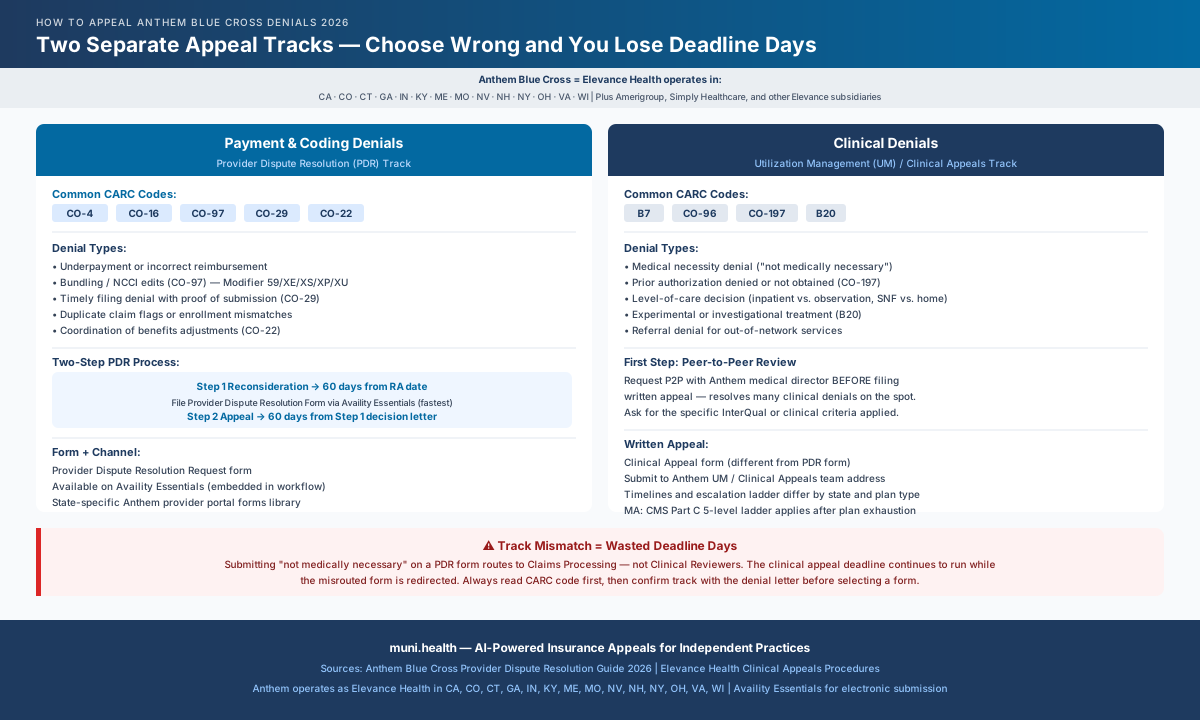
Anthem Blue Cross runs two separate appeal tracks. Payment and coding denials use the Provider Dispute Resolution (PDR) process: Step 1 Reconsideration within 60 days of your Remittance Advice date, Step 2 Appeal within 60 days of the Step 1 decision. Clinical denials — medical necessity, prior authorization, level-of-care — go through Anthem's Utilization Management team with separate forms, documentation requirements, and timelines. Using the wrong track for your denial type is the most common error that delays or forfeits an otherwise valid appeal.
Understanding Anthem Blue Cross Denial Types
Anthem Blue Cross Blue Shield — operating under Elevance Health in California, Colorado, Connecticut, Georgia, Indiana, Kentucky, Maine, Missouri, Nevada, New Hampshire, New York, Ohio, Virginia, and Wisconsin — issues two fundamentally different categories of denials that require different appeal paths.
Wellpoint Is a Separate Elevance Brand, Not Anthem
Elevance Health also owns Wellpoint — the rebranded former Amerigroup (and, in West Virginia, UniCare) Medicaid and Medicare Advantage business. A Wellpoint denial does not go through the Anthem PDR process described below. See our Wellpoint appeal guide if the denial notice says Wellpoint rather than Anthem.
Category 1: Payment and Coding Denials
These are administrative and billing disputes routed through Anthem's Claims Disputes unit:
- Incorrect reimbursement or underpayment
- Claim bundled or downcoded in error (NCCI bundling, CCI edits)
- Modifier 25, 59, or XE disputes
- Timely filing denials (with submission documentation)
- Duplicate claim flags or enrollment mismatches
- Coordination of benefits adjustments
These follow Anthem's Provider Dispute Resolution (PDR) process — the two-step Reconsideration → Appeal structure covered in detail below.
Category 2: Clinical Denials
These involve medical judgment and go through a separate team:
- Medical necessity denials
- Prior authorization denials (initial, retrospective, or concurrent)
- Level-of-care decisions (inpatient vs. observation, SNF vs. home health)
- Experimental or investigational treatment denials
- Referral denials for out-of-network services
These are handled by Anthem's Utilization Management (UM) and Clinical Appeals team. The forms, documentation, timelines, and escalation ladder are different from the PDR track.
Track Mismatch Wastes Deadline Days
Submitting a clinical denial (e.g., "not medically necessary") using the Provider Dispute Resolution form routes your appeal to the claims processing unit, not clinical reviewers. The clinical deadline continues to run while the misrouted submission is redirected. Check your denial reason code before selecting your appeal path.
Anthem Denial Routing Matrix
| Denial Type | Common Codes | Appeal Track | Primary Channel | Typical Filing Window |
|---|---|---|---|---|
| Underpayment / incorrect rate | CO-45, CO-97 | PDR — Reconsideration | Availity Essentials | 60 days from RA date |
| Bundling / downcoding error | CO-97, CO-B22 | PDR — Reconsideration | Availity Essentials or PDR form | 60 days from RA date |
| Timely filing denial | CO-29 | PDR — Reconsideration | PDR form + submission proof | 60 days from RA date |
| Medical necessity — commercial | CO-50, CO-57 | Clinical Appeals — UM | Appeal letter + clinical records | Check denial letter — varies by plan and state |
| Medical necessity — Medicare Advantage | CO-50, CO-57 | MA Clinical Appeal — Level 1 | Appeal letter + InterQual/EBMP evidence | 60 days from denial notice (CMS Part C) |
| Prior authorization denied | CO-15, CO-197 | Clinical Appeals — UM | Appeal letter + P2P request optional | Check denial letter for your plan type |
| Experimental / investigational | CO-49 | Clinical Appeals — UM + IRO | Appeal letter + clinical literature | Check denial letter — often 180 days for commercial |
Prepare this appeal packet with your team.
Draft the appeal, coordinate missing documents, and approve the reviewed packet. Keep your clearinghouse; your practice checks deadlines and submits through the payer’s accepted channel.
First 3 appeals free, then $20 per appeal. Start with your denial letter or EOB and available records. No meeting or clearinghouse connection required.
Always verify the filing window in your specific denial notice. Contract terms and state law can modify standard windows, particularly for commercial fully-insured plans. For CO-29 (timely filing) denials specifically — including how to challenge a date error in Anthem's denial letter, what clearinghouse proof Anthem requires, and affiliate-level variations — see the Anthem timely filing limits guide.
Appealing an Anthem Payment or Coding Denial
Payment and coding disputes use Anthem's two-step Provider Dispute Resolution process. Both steps have hard deadlines — missing Step 1 forfeits your right to file Step 2.
Step 1: File a Claim Payment Reconsideration
Deadline: Within 60 calendar days of the date on your Remittance Advice (RA) or Explanation of Payment (EOP).
Via Availity Essentials (recommended):
- Log in at availity.com → Claims & Payments → Disputes
- Search by claim number and select Dispute This Claim
- Choose the dispute reason: incorrect payment, bundling error, modifier dispute, or timely filing with documentation
- Upload supporting documents: original claim, RA, modifier rationale, or submission proof
- Submit and immediately save the Availity Confirmation or Case Number — this is your proof of timely filing
Via fax or mail: Complete the Provider Dispute Resolution Request form before submitting. Anthem does not process fax or mail submissions received without this form, and the deadline continues to run while Anthem waits for the resubmission. Verify the state-specific fax number or mailing address for your Anthem state at providers.anthem.com/[your-state]-provider.
Anthem typically issues a Step 1 decision within 60 calendar days of receiving a complete submission.
Step 2: File a Claim Payment Appeal
Deadline: Within 60 calendar days of the date on the Step 1 decision letter.
If Step 1 does not resolve the dispute, escalate to a formal Claim Payment Appeal. Include the Step 1 case number in your new submission. Reference any new documentation or arguments not previously submitted.
Step 1 Cannot Be Skipped
Anthem's two-step structure is sequential. A Step 2 appeal filed without an on-file Step 1 reconsideration decision will be returned as procedurally premature. Both steps must be completed in order.
For a detailed walkthrough of the Availity portal submission flow, the form requirements, and state-specific mailing addresses, see the Anthem Blue Cross Appeal Form Guide 2026.
Appealing an Anthem Clinical Denial
Clinical denials — medical necessity, prior authorization, level-of-care — follow a different path through Anthem's Utilization Management and Clinical Appeals team.
Step 1: Read the Denial Notice Carefully
Beginning in 2026, CMS-0057-F requires impacted payers to provide a specific reason for a denied prior authorization. This applies to non-drug prior authorization decisions by Medicare Advantage organizations, state Medicaid and CHIP fee-for-service programs, Medicaid and CHIP managed care entities, and Qualified Health Plan issuers on Federally-facilitated Exchanges. The rule requires a specific reason, not necessarily an exact clinical criterion citation.
Look for:
- The specific criterion Anthem states was not met (InterQual level, Evidence-Based Medical Policy number, or Anthem Clinical Policy Bulletin reference)
- The reviewer credentials listed (Anthem uses nurses for initial reviews; physician review is required for appeals)
- The stated deadline for appeal submission
Step 2: Consider a Peer-to-Peer Review
For complex clinical denials — particularly high-value inpatient admissions, specialty procedures, or services with strong clinical literature — a peer-to-peer review with Anthem's Medical Director often resolves denials faster than a written appeal alone.
Contact Anthem Provider Services at the phone number on your denial notice to schedule a peer-to-peer — if the notice doesn't list one, our Anthem provider phone directory has the current state-specific numbers. Be prepared to speak to the specific InterQual criterion or Anthem policy cited in the denial and how the patient's clinical presentation meets it. Request the peer-to-peer promptly after receiving the denial — the window is typically defined in your provider agreement and runs concurrently with the appeal deadline.
Time Peer-to-Peer Requests Carefully
The peer-to-peer window and the formal appeal deadline run simultaneously, not sequentially. Waiting until the peer-to-peer is scheduled or completed may reduce your remaining time to file a written appeal if the peer-to-peer outcome is unfavorable. Request the review within the first few days of receiving the denial.
Step 3: File a Formal Clinical Appeal Letter
Your clinical appeal letter should directly address the specific criterion Anthem cited in the denial. Generic appeal letters that restate the treatment history without engaging the specific policy reason rarely succeed.
A strong Anthem clinical appeal letter includes:
- Patient and claim identification: member ID, date of service, authorization or claim number
- Specific criterion addressed: name the InterQual criterion or Anthem Evidence-Based Medical Policy and explain — using the patient's documented clinical findings — why the patient meets it
- Organized clinical records: physician notes, labs, imaging, specialist letters, and prior treatment history arranged chronologically
- Treating physician attestation: a signed statement that the service is medically necessary for this specific patient's condition
- Relevant clinical literature: peer-reviewed studies or specialty society guidelines supporting the treatment for the diagnosis, where applicable
Submit through Anthem's clinical appeals submission channel or fax for your state. Clinical appeals should not be filed through the standard Availity Claims Disputes workflow — use the clinical appeals routing instructions in your denial letter.
If you need to submit the prior authorization request before a denial occurs — or if the denial identifies Carelon Medical Benefits Management (formerly AIM Specialty Health) or another delegated reviewer rather than Anthem directly — see the Anthem prior authorization template and routing guide. Verify delegation from the member's notice and plan rather than the service type alone.
What Anthem Clinical Reviewers Evaluate Against
Anthem affiliates and lines of business may use different criteria sources and review hierarchies. Possible sources include:
- The member's benefit plan and government-program rules — these can supersede general payer criteria
- Anthem Medical Policies and Clinical UM Guidelines — when incorporated for the member's affiliate and line of business
- Licensed criteria such as InterQual or MCG — where the current plan or program hierarchy identifies them
- Carelon Medical Benefits Management Clinical Appropriateness Guidelines — only when the notice or plan routes the review to Carelon MBM
Start with the denial's specific reason and any criteria it names, then verify the controlling source against the benefit plan, affiliate, and line of business. If the response does not supply an exact criterion, request it and address the stated reason without inventing a citation. For a copyable letter template organized around this notice- and plan-dependent check, see the Anthem medical necessity letter template. Anthem's ADMIN.00004 policy itself cautions that the covered individual's plan document controls benefit determinations.
Timelines by Plan Type
| Plan Type | Clinical Appeal Window | PDR Window | Expedited Option | Post-Internal Escalation |
|---|---|---|---|---|
| Commercial fully-insured | Check denial letter — typically 60-180 days by state and contract | 60 days from RA date | 72 hours for urgent/emergent (verify with plan docs) | State external review (IRO) — varies by state; see below |
| Self-funded ASO (ERISA) | Follows plan documents — often 60-180 days | 60 days from RA date | Plan-specific | No state external review; limited to federal ERISA remedies |
| Medicare Advantage (Part C) | 60 days from denial notice (CMS rule) | 60 days from RA date | Check the appeal notice; CMS-0057-F governs PA decisions, not appeal determinations | C2C Innovative Solutions (IRE, since 5/1/2026) → OMHA → MAC → federal court |
| Medicaid managed care | Varies by state Medicaid contract | Varies | State-required timelines | State fair hearing or Medicaid agency complaint |
Prepare this appeal packet with your team.
Draft the appeal, coordinate missing documents, and approve the reviewed packet. Keep your clearinghouse; your practice checks deadlines and submits through the payer’s accepted channel.
First 3 appeals free, then $20 per appeal. Start with your denial letter or EOB and available records. No meeting or clearinghouse connection required.
State-Specific Appeal Rights
Anthem operates as a distinct entity in each state. Some state differences that meaningfully affect your appeal options:
California (Anthem Blue Cross): Regulated by the California Department of Managed Health Care (DMHC). Under California Senate Bill 294 (effective January 1, 2026), coverage denial Independent Medical Reviews (IMRs) are substantially streamlined — providers and patients can request a DMHC IMR after exhausting Anthem's internal clinical appeal. The DMHC can order Anthem to cover the denied service if the IMR finds in your favor. Escalate at dmhc.ca.gov or 888-HMO-2219 after completing the internal process.
New York: Under New York's 2025 Healthcare Appeals Reform Act, Anthem New York must disclose when AI or algorithmic tools were used in a clinical determination, and must ensure physician review before issuing a denial. If a denial notice does not include this disclosure and your denial was clinical in nature, note this regulatory gap in your appeal letter.
Other Anthem states (CO, CT, GA, IN, KY, ME, MO, NV, NH, OH, VA, WI): Fully-insured commercial plans in these states have access to state external review under the ACA (45 CFR § 147.136) after exhausting internal appeals. Contact your state insurance department for the specific complaint and external review process.
Self-funded ASO plans in any Anthem state: ERISA preempts state external review rights. State insurance department complaint processes do not apply to self-funded employer health plans. Federal ERISA litigation is the final escalation path after internal plan remedies are exhausted.
External Review After Internal Appeals Are Exhausted
Fully-insured commercial plans: Federal external review under 45 CFR § 147.136 is available after an adverse benefit determination survives internal appeal. Anthem must provide contact information for a federally-approved Independent Review Organization in its final appeal denial letter. State external review rights (California DMHC IMR, New York DFS) may supplement or replace the federal process depending on the state.
Medicare Advantage: After Anthem Level 1 and Level 2 reviews, the case escalates automatically to the CMS-contracted IRE — C2C Innovative Solutions effective for requests received on or after May 1, 2026 (Maximus Federal Services handled this role for requests received through April 30, 2026). If the IRE upholds the denial, you may escalate to the Office of Medicare Hearings and Appeals (OMHA) — the amount in controversy must meet the threshold ($200 for ALJ hearings; $1,960 for federal court review as of 2026 CMS thresholds).
For a full breakdown of the federal external review process across all plan types, see the Independent Review Organization Appeal Guide 2026.
How Muni Appeals Helps With Anthem Denials
Anthem's dual-track system creates consistent workflow pressure for billing teams. A coding denial and a medical necessity denial from the same date of service require two different forms, two different teams, and two different documentation strategies — identified correctly from the denial reason code, not the claim type. For a quick-reference denial code triage table covering PDR-track and clinical-track routing, see the Anthem Denied Claim Guide 2026.
Muni Appeals surfaces likely Anthem track and deadline-risk context from the uploaded denial and builds a draft around the cited InterQual criterion or Anthem policy. Staff verifies the route and policy, calendars each PDR and clinical-appeal window, and manages the queue.
For practices billing across multiple Anthem states, Muni also maintains state-specific routing details — fax numbers, mailing addresses, and external review escalation paths — so billing teams aren't managing a separate reference sheet for each state network.
Frequently Asked Questions
What is the difference between the Anthem PDR process and a clinical appeal?
The Provider Dispute Resolution (PDR) process handles payment and coding disputes — underpayments, bundling errors, modifier denials, and timely filing issues. These go to Anthem's Claims Disputes unit. Clinical appeals — medical necessity, prior authorization, level-of-care denials — go to Anthem's Utilization Management and Clinical Appeals team. Different forms, different reviewers, different timelines. Check the denial reason code to identify which track applies to each claim before filing.
How long does Anthem take to decide a clinical appeal?
For commercial fully-insured plans, clinical appeal timelines vary by state and contract. Standard clinical appeals generally receive a decision within 30 calendar days of receipt of a complete submission, though this can vary. Check your denial notice for the specific timeline Anthem is committed to for your plan. For Medicare Advantage, use the appeal instructions and current program rules on the notice; CMS-0057-F's seven-day standard and 72-hour expedited timeframes govern covered prior authorization decisions, not the later appeal determination.
Is there a peer-to-peer review option with Anthem?
Yes. Contact Anthem Provider Services at the number on your denial notice to request a peer-to-peer review with an Anthem Medical Director. The peer-to-peer is most effective for complex clinical denials where the physician can directly address the specific InterQual criterion or Evidence-Based Medical Policy cited in the denial. Request it promptly after receiving the denial — the window runs concurrently with the formal appeal deadline.
Does Anthem use InterQual criteria?
Some Anthem affiliates and lines of business use InterQual for portions of utilization review, while others use different criteria products or review hierarchies. Do not infer InterQual from the service alone. Use the denial notice, benefit plan, and current affiliate materials to identify the controlling criteria; if they are not supplied, request them before finalizing the appeal letter.
What are Anthem's appeal rights for self-funded (ASO) plans?
Self-funded ASO plans are governed by ERISA, not state law, regardless of which Anthem state they are issued in. ERISA preempts state external review rights — California DMHC IMR, New York DFS complaint processes, and other state-level protections do not apply to self-funded employer health plans. For self-funded Anthem plans, internal ERISA remedies must be exhausted before federal litigation is an option. Review the Summary Plan Description (SPD) for appeal procedures specific to the employer plan.
How is Anthem different from the other BCBS affiliates I bill?
Anthem (Elevance Health) is one of several independent BCBS federation members. BCBS NC, BCBS TX (HCSC), Florida Blue (GuideWell), Premera (WA/AK), and Highmark (PA/DE/WV) operate entirely separately with their own portals, fax numbers, mailing addresses, and timelines. Anthem's 60-day PDR window is shorter than Florida Blue's 180-day window and Premera's 365-day claim submission window. For a side-by-side comparison of major BCBS affiliate deadlines, see the BCBS Timely Filing Limits 2026 guide.
How does the Anthem Medicare Advantage appeal ladder work?
Anthem MA clinical denials follow the CMS-mandated 5-level appeal ladder: (1) Anthem Level 1 internal review — file within 60 days of denial notice; (2) Anthem Level 2 internal review — file within 60 days of Level 1 decision; (3) Independent Review Entity (IRE) — C2C Innovative Solutions as of May 1, 2026, previously Maximus Federal Services — automatic escalation after Level 2; (4) Office of Medicare Hearings and Appeals (OMHA) — if the amount at issue meets the threshold; (5) Medicare Appeals Council; (6) federal district court for cases meeting the threshold. For letter drafting at any MA appeal level, see the Medicare Advantage Appeal Letter Template 2026.
What happens if Anthem misses its appeal response deadline?
For commercial clinical appeals, missing Anthem's self-imposed response deadline is typically treated as a deemed denial under state law in fully-insured plan states — you can escalate to external review without waiting for the written decision. Document the date you submitted the appeal and track the response window. For Medicare Advantage, a missed CMS deadline triggers automatic escalation to the IRE (C2C Innovative Solutions as of May 1, 2026; Maximus Federal Services previously held this role for requests received through April 30, 2026). If you are approaching the response window without a decision, request a written status update through Availity or by fax and document the date of that request.
Ready to Appeal Anthem Denials More Consistently?
Anthem's dual-track appeal system — separate workflows for payment disputes and clinical denials, 14-state geographic complexity, and distinct escalation paths by plan type — creates consistent workflow pressure for independent practices. A well-organized appeal process that correctly routes each denial from the first review recovers more claims without losing time to procedural errors.
Get Started:
- Route Anthem denials to the correct track (PDR vs. clinical) from the initial review
- Build appeal letters around the stated reason and any policy or criteria actually supplied for the member's plan
- Track Step 1 and Step 2 PDR deadlines separately from clinical appeal windows
- Maintain state-specific submission routing for Anthem California, New York, Ohio, and other states in your billing mix
This guide reflects 2026 Anthem Blue Cross Blue Shield appeal procedures under Elevance Health. State-specific regulations, individual provider contract terms, and plan-type distinctions (fully-insured commercial vs. self-funded ASO vs. Medicare Advantage) materially affect available appeal rights and timelines. Anthem operates independently in each state. Florida Blue, Premera, Highmark, BCBS NC, and other BCBS affiliates use separate processes — consult affiliate-specific guides for those networks.