

A modifier 25 denial means the payer decided your E/M service wasn't significant and separately identifiable from the minor procedure billed the same day, so it bundled the E/M into the procedure payment. An appeal needs documentation showing work above and beyond the procedure's usual pre- and post-operative care. Separate E/M and procedure sections are a strong documentation practice, but not a new universal CMS format mandate.
Understanding Modifier 25 Denials: The Bundle, Not the Code, Is the Problem
Modifier 25 tells the payer that an E/M service billed alongside a procedure was significant, separately identifiable, and above and beyond the routine pre- and post-procedure work already bundled into that procedure's payment. Payers don't deny the modifier for being used — they deny it when the chart doesn't back up the claim it makes.
CPT defines modifier 25 as covering a "significant, separately identifiable evaluation and management service by the same physician or other qualified health care professional on the same day of the procedure or other service," and specifies that the E/M service must be substantiated by documentation meeting the criteria for whatever E/M level is billed. Modifier 25 attaches only to the E/M code (99202-99215) — never to the procedure code.
Key Statistic
In a 2025 federal audit of Medicare payments for intravitreal (eye) injections, 42% of injection claims carried a same-day E/M service billed with modifier 25, and when the HHS Office of Inspector General pulled documentation for 24 of those claims, 22 (92%) did not support the modifier. Medicare paid $124 million for those E/M services during the audit period, and OIG recommended CMS recover nearly all of it.
That audit isn't the only warning. A separate OIG review completed November 18, 2025 found that dermatologists met Medicare requirements for 90 of 100 sampled same-day E/M services, but not the other 10; OIG projected $62.9 million in overpayments from the noncompliant portion. Many commercial payers also use NCCI-based edits or their own modifier 25 reimbursement policies, so the exact rule must be checked payer by payer.
Why Modifier 25 Claims Get Flagged in the First Place
Every minor procedure carries a global period — usually 0 or 10 days — and CMS bundles routine pre- and post-procedure evaluation into that procedure's payment automatically. The E/M work already priced into the procedure (reviewing the chief complaint that led to the procedure, a focused exam of the treated area, obtaining consent, brief post-procedure instructions) is never separately billable, modifier or not.
What modifier 25 is supposed to capture is different: a second, independent problem, or a level of evaluation clearly beyond what the procedure decision required, addressed in the same visit. The national correct-coding rule that governs this draws the line explicitly — a significant, separately identifiable E/M service unrelated to the decision to perform the minor surgical procedure is separately reportable; work that led to that decision is not.
Common Mistake
A common failure pattern on modifier 25 review is that the record does not let the reviewer distinguish the E/M work from the procedure. If the history, exam, and medical decision-making are mixed into the procedure narrative with no identifiable assessment of the separate service, the documentation may not support the modifier.
What the 2026 Rules Actually Require
The CMS National Correct Coding Initiative Policy Manual effective January 1, 2026 continues the core modifier 25 rule: the E/M must be significant, separately identifiable, and above and beyond the usual pre- and post-operative work of the procedure. It may relate to the same diagnosis, but it cannot include work inherent in the procedure or the decision to perform a minor procedure.
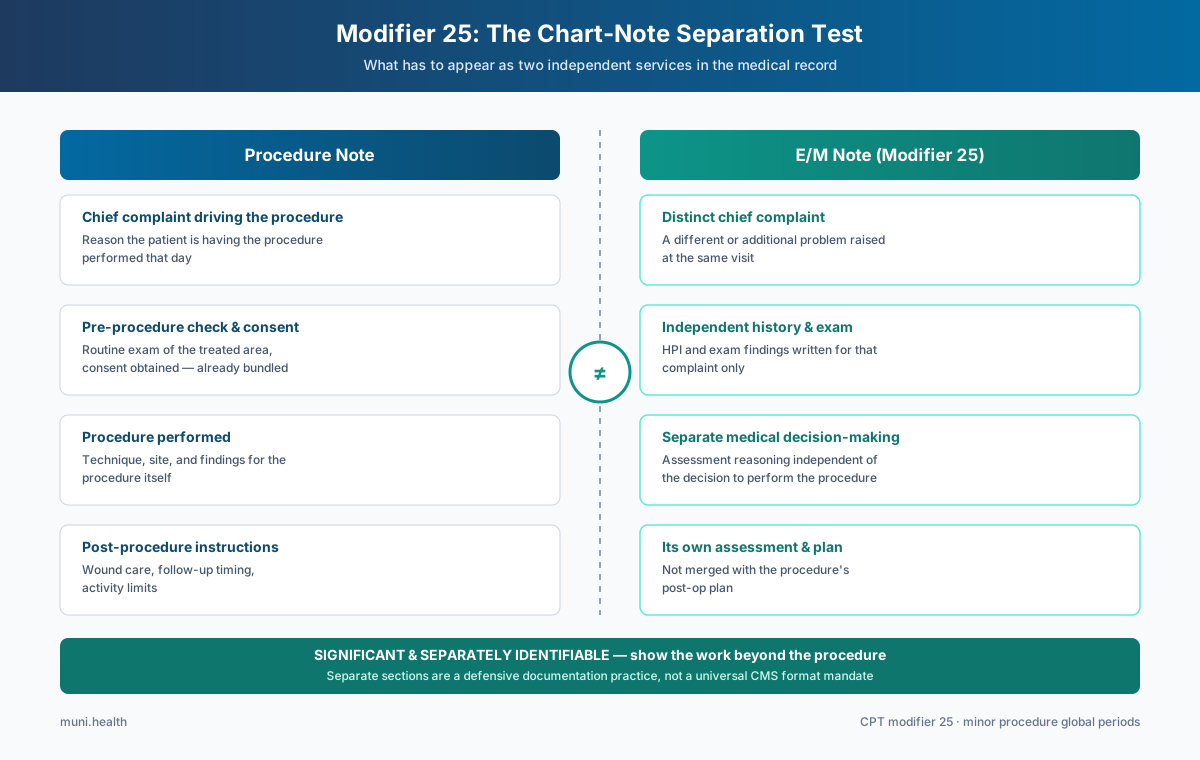
The 2026 CMS manual does not create a general requirement that every E/M and procedure be written as two separate notes or under separate headings. Distinct sections remain a defensible documentation practice because they help a reviewer identify the independent history, exam, and medical decision-making, but the controlling question is whether the record supports a separately billable service. Payer-specific rules can be more prescriptive.
| Source | Status / Date | What It Requires |
|---|---|---|
| CMS NCCI Policy Manual | Effective Jan 1, 2026 | E/M must be significant, separately identifiable, and above and beyond work inherent in the procedure; no universal two-note format rule |
| OIG — eye injection audit | Published May 28, 2025 | Found 92% of a sampled group of modifier 25 claims (22 of 24) lacked adequate documentation; $124M in same-day E/M payments reviewed |
| OIG — dermatology audit | Completed Nov 18, 2025 | 90 of 100 sampled services met requirements; OIG projected $62.9M in overpayments from the noncompliant portion |
| Cigna commercial policy M25 | Updated Feb 20, 2026 | Requires initial supporting documentation for certain specific NCCI edits, not every modifier 25 claim |
Cigna's current Modifier 25 reimbursement policy M25, last updated February 20, 2026, says only specific NCCI edits require supporting documentation with the initial claim. Its policy history records the broader 2023 proposal and delay. Check the payer's current reimbursement policy and the exact code pair instead of treating an old announcement as the live rule.
The Chart-Note Architecture That Survives an Appeal
The strongest evidence on a modifier 25 appeal is a chart that lets the reviewer identify the E/M work independently from the procedure, rather than one narrative that leaves the services impossible to distinguish.
Document the E/M as its own section
Write the history of present illness, exam findings, and medical decision-making for the E/M complaint as a distinct block, not folded into the procedure's pre-op note. The E/M section should read as complete on its own — a reviewer should be able to cover the procedure note entirely and still understand what problem was evaluated and how.
Address a different or additional problem
The strongest modifier 25 claims involve a second complaint the patient raised that day: a new symptom, an unrelated follow-up issue, or a chronic condition reviewed independently of the reason for the procedure. If the E/M and the procedure both trace back to the same single complaint, the E/M is far more likely to represent routine pre-procedure work that's already bundled.
Give the E/M its own assessment and plan
Close the E/M documentation with an assessment and plan that identifies the separately billable work rather than repeating the procedure's post-op instructions. A shared paragraph can make the two services harder to distinguish during review.
Same Diagnosis Code Doesn't Disqualify the Claim
CPT does not require a different diagnosis for the E/M and the procedure — a chronic condition reviewed and managed at the same visit as an unrelated minor procedure can still support modifier 25. What matters is that the documentation shows independent evaluation and decision-making, not that the ICD-10 codes differ.
Step-by-Step: Appealing a Modifier 25 Denial
Step 1: Read the Denial Reason Exactly as Written
Modifier 25 denials show up under a few different codes depending on the payer — often a bundling code (the service is "included in the allowance for another service billed the same day") or a modifier-specific rejection. Confirm which one you're dealing with before drafting, since a true bundling denial and a modifier-validity denial call for slightly different framing.
Step 2: Pull Both Notes and Check the Separation Test First
Before appealing, read the E/M and procedure documentation the way a reviewer will. If the E/M content only exists inside the procedure note, or the two share one assessment and plan, fix that in the current record if your system allows addenda, and be honest in the appeal about what the chart actually supports — a denial that's correct on the documentation isn't winnable by argument alone.
Step 3: Build the Appeal Around the Documentation, Not the Modifier
Don't argue that modifier 25 was "used correctly" in the abstract. Point to the specific chart elements that satisfy the standard: the complaint or condition evaluated, the relevant history and exam findings, the independent medical decision-making, and the work that went above and beyond what the procedure already includes. Separate labeled sections can make that evidence easier to review, but are not a universal CMS format requirement.
Step 4: Attach the Full Note, Not a Summary
Submit the complete chart note, not an excerpt or a billing summary. Reviewers denying modifier 25 are specifically checking documentation structure, and a partial submission that omits the separation you're arguing for undercuts the appeal before it's read.
Template: Modifier 25 Appeal Letter
Use this as a starting structure and adapt the bracketed sections to the specific documentation in the chart. Do not submit generic language in place of the bracketed clinical detail — reviewers are checking for exactly that kind of substitution.
[Your Practice Letterhead]
[Date]

[Payer Name] Claims Appeals Department
[Payer Appeals Address]

RE: Appeal of Modifier 25 Denial
  Patient: [Patient Name], DOB: [Date of Birth]
  Member ID: [Member ID]
  Claim Number: [Claim #]
  Date of Service: [DOS]
  CPT Codes: [E/M Code] with Modifier 25, [Procedure Code]
  Denial Reason: [Exact denial code/language from remittance]

To Whom It May Concern:

This letter appeals the denial of CPT [E/M Code]-25 billed on [DOS], denied as [not separately identifiable from / included in the allowance for] CPT [Procedure Code].

On the date of service, [Provider Name] evaluated and managed [describe the distinct problem, e.g., "a new complaint of right knee pain unrelated to the scheduled dermatologic procedure"], which was separate and independent from the decision to perform [Procedure Name]. The medical record documents this as follows:

History: [Summarize the distinct HPI content specific to the E/M complaint]

Examination: [Summarize the distinct exam findings specific to the E/M complaint]

Medical Decision-Making: [Summarize the distinct assessment and plan for the E/M complaint, separate from the procedure's post-op plan]

This E/M service went beyond the routine pre- and post-procedure evaluation already included in the payment for [Procedure Code], consistent with CPT's definition of modifier 25 and the applicable National Correct Coding Initiative guidance on significant, separately identifiable E/M services.

The complete office note for this date of service is attached, showing the E/M and procedure documentation as distinct sections of the record.

We request that this claim be reprocessed with payment for CPT [E/M Code]-25 as billed.

Sincerely,

[Provider Name], [Credentials]
[Practice Name]
[Phone Number]
[NPI]

Attachments: Complete office note, [DOS]
Skip the blank template. Start with a review-ready draft.
Use the template as guidance, or let Muni prepare a payer-specific draft for your team to verify, sign, and submit.
First 3 appeals free, then $20 per appeal. Start with your denial letter or EOB and available records. No meeting or clearinghouse connection required.
Modifier 25 vs. Modifier 24 vs. Modifier 57
These three modifiers all cover E/M services near a procedure, and mixing them up is its own denial category, separate from documentation quality.
Prepare this appeal packet with your team.
Draft the appeal, coordinate missing documents, and approve the reviewed packet. Keep your clearinghouse; your practice checks deadlines and submits through the payer’s accepted channel.
First 3 appeals free, then $20 per appeal. Start with your denial letter or EOB and available records. No meeting or clearinghouse connection required.
| Modifier | When It Applies | Global Period Context |
|---|---|---|
| 25 | Significant, separately identifiable E/M on the same day as a minor procedure | 0- or 10-day global procedures |
| 24 | Unrelated E/M service during a postoperative global period, by the same physician | Applies after a major procedure, during its 90-day global period |
| 57 | E/M service that resulted in the decision to perform a major surgery | Applies the day of or day before a 90-day global procedure |
Using 25 where the situation calls for 57 (or the reverse) produces a denial that has nothing to do with documentation quality — it's a modifier-selection error, and the fix is resubmitting with the correct modifier rather than appealing. For the full range of adjustment codes a modifier 25 denial can show up under on the remittance, see the EOB denial code guide.
A bundled E/M may turn on modifier-25 documentation and the payer's reimbursement policy. For a procedure-versus-procedure CO-97 denial, first confirm the payer's applicable bundling rule and date-of-service context; the NCCI modifier indicator controls modifier bypass only when the payer confirms that an NCCI PTP edit applies. Another payer policy or a misapplied edit may require correction, reprocessing, or appeal instead. See the CO-97 denial code appeal guide for that verification path.
If the procedure itself is also being challenged on medical-necessity grounds — not just the paired E/M — that's a separate fight with its own documentation standard; see the medical necessity justification letter guide for how that argument is built.
E/M level disputes aren't limited to modifier 25 bundling. Emergency department claims face their own MDM-driven downcoding fight — usually 99284 cut to 99283 — under the same 2023 AMA documentation framework applied to a different code range. See the emergency medicine claim denials guide for how that argument is built and cited.
How Muni Appeals Handles Modifier 25 Denials
When a modifier 25 denial comes in, Muni Appeals pulls the denial reason and the underlying chart note together so staff can see immediately whether the documentation actually supports a separate E/M service before drafting an appeal — instead of appealing first and finding out the chart doesn't hold up. For practices weighing whether automating that kind of denial triage is worth adding to an existing billing workflow, see appeal automation software for small practices for what the comparison actually looks like.
Frequently Asked Questions
What does a modifier 25 denial mean?
It means the payer decided the E/M service billed with modifier 25 wasn't significant and separately identifiable from the procedure billed the same day, so the E/M payment was bundled into the procedure and reduced to zero. The fix is showing, through chart documentation, that the E/M addressed an independent problem or exceeded the routine work already included in the procedure.
Can the E/M and the procedure share the same diagnosis code?
Yes. CPT does not require different diagnosis codes for the E/M and the procedure — a chronic condition managed at the same visit as an unrelated procedure can still qualify. What matters is that the documentation shows independent history, exam, and decision-making, not that the ICD-10 codes differ between the two services.
What's the difference between modifier 25 and modifier 57?
Modifier 25 applies to a same-day E/M billed alongside a minor procedure (0- or 10-day global period). Modifier 57 applies to the E/M visit where a physician decides to perform major surgery (90-day global period), billed the day of or the day before that surgery. Using 25 in a 57 situation, or the reverse, produces a modifier-selection denial that a documentation fix won't resolve — it needs a resubmission with the correct modifier.
Do Medicare's 2026 NCCI rules automatically apply to commercial payers?
No. The Medicare NCCI Policy Manual governs Medicare coding edits. Commercial payers may use NCCI-based edits, their own reimbursement policies, or plan-specific contract terms. Use CMS's significant-and-separately-identifiable standard as a baseline, but verify the payer's current modifier policy and the exact code pair before filing.
Is Cigna's modifier 25 documentation policy currently enforced?
Cigna's M25 policy, updated February 20, 2026, requires supporting documentation with the initial claim for certain specific NCCI edits. It does not state that every E/M 99212-99215 claim billed with modifier 25 requires records up front. Check the current Cigna policy and code edit because plan terms and edits can change.
What documentation problem commonly causes modifier 25 denials?
Documentation that does not identify what E/M work was performed above and beyond the procedure's usual care. A blended note can be harder to defend when it lacks an identifiable history, exam, assessment, or plan for the separately billed service.
Should I appeal a modifier 25 denial if the documentation genuinely doesn't separate the two services?
Generally no — an appeal is only winnable if the chart actually supports a distinct E/M service. If the documentation doesn't separate the two, the more productive move is fixing chart-note structure going forward (and submitting an addendum now, if your system allows it) rather than appealing a claim the record can't support.
How much time do I have to appeal a modifier 25 denial?
Appeal windows follow the payer's standard timely-filing rules for the plan type — the same clock as any other claim denial, not a modifier-specific deadline. See insurance appeal deadlines by payer for the current windows, and check the specific denial letter for the exact date.
Ready to Stop Losing Modifier 25 Appeals to Documentation Structure?
Modifier 25 denials are rarely about whether the visit happened — they're about whether the chart proves it was two services, not one. Fixing that upstream, in how the note is written, prevents more denials than any appeal argument can win back after the fact.
Get started:
- Denial-reason and chart-note review together, before an appeal gets drafted
- Modifier-selection checks (25 vs. 24 vs. 57) built into the appeal workflow
- Deadline-risk fields for staff to verify and calendar alongside each open modifier 25 denial
This guide reflects the 2026 CMS National Correct Coding Initiative manual and current payer guidance reviewed July 29, 2026. CPT content is summarized for education; specific payer reimbursement policies, documentation requirements, and appeal windows vary. Verify the current payer policy before filing. This guide does not constitute legal, coding, or billing compliance advice.