

Emergency medicine denials split into two unrelated fights. For plans subject to prudent-layperson protections, a "not an emergency" denial based only on the final diagnosis can conflict with the rule that emergency coverage turns on presenting symptoms and what a reasonable person would have believed at triage. E/M level downcoding (usually 99284 cut to 99283) is a documentation dispute over the three medical decision making elements. Check the denial letter and the plan's governing rule first.
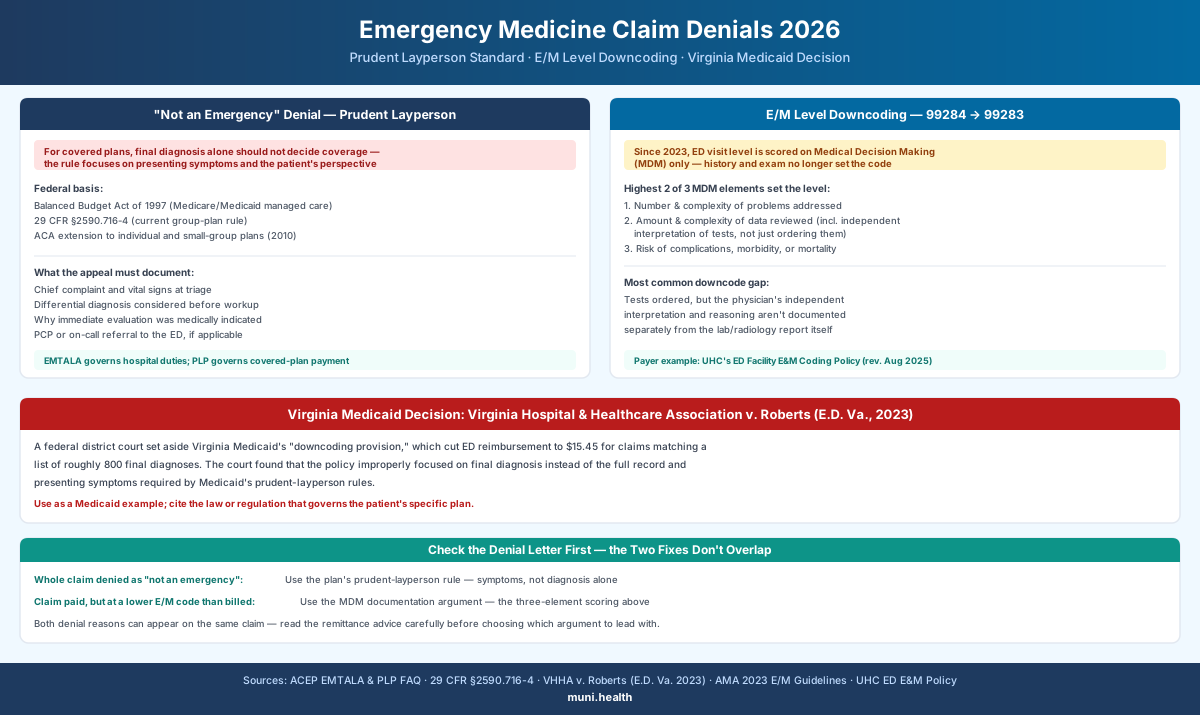
Why Emergency Medicine Denials Split Into Two Different Fights
Every other specialty on this site has one dominant denial pattern — a bundling rule, a prior-auth requirement, a medical-necessity criterion. Emergency medicine has two, and they don't respond to the same argument.
The first is a whole-claim denial: the insurer decides, after the fact, that the visit wasn't really an emergency and pays nothing or pays an urgent-care rate instead. The second is E/M level downcoding: the insurer accepts that the visit happened and was appropriate, but pays as if it were a lower-acuity visit than what was billed — usually cutting a Level 4 claim (CPT 99284) to Level 3 (99283). Sending a symptoms-based argument to a downcoding denial, or a documentation argument to a "not an emergency" denial, wastes the appeal window without addressing what the payer actually disputed.
EMTALA and the Prudent Layperson Standard Are Not the Same Thing
The Emergency Medical Treatment and Labor Act (EMTALA), passed in 1986, requires Medicare-participating hospitals to screen and stabilize anyone presenting to the ED regardless of ability to pay — it's an obligation on the hospital. The prudent layperson standard is a separate, later body of law that obligates the insurer to pay for that care based on the patient's presenting symptoms. A hospital can be required to treat a patient under EMTALA while an insurer still tries — improperly — to deny the resulting claim.
The Prudent Layperson Standard: What Federal Law Actually Requires
The prudent layperson standard defines an emergency medical condition as one presenting with symptoms — including severe pain — serious enough that a person with an average knowledge of health and medicine would reasonably expect that skipping immediate care could result in serious jeopardy to health, serious impairment of bodily function, or serious dysfunction of a bodily organ or part.
That definition is federal law, not insurer policy, and it has been law for nearly three decades. Congress applied it to Medicare and Medicaid managed care plans in the Balanced Budget Act of 1997. The U.S. Treasury Department extended it to Federal Employee Health Benefit plans in 1999. The Affordable Care Act extended it further in 2010 to individual- and small-group commercial plans. For plan years beginning in 2022 or later, 29 CFR § 2590.716-4 carries the federal emergency-services protections forward for group health plans and group health insurance issuers. ACEP estimates that self-funded employer plans subject to ERISA cover roughly 130–150 million Americans (ACEP EMTALA and Prudent Layperson Standard FAQ).
The operative rule is simple to state: coverage determinations must be based on the presenting symptoms documented at triage, not only on the diagnosis that turns out to be correct. A patient who arrives with crushing chest pain and shortness of breath may meet the prudent-layperson definition even if the final workup shows a musculoskeletal strain instead of a cardiac event. Symptoms that appear urgent can have a benign final diagnosis, which is exactly why the standard looks at the information available before the workup.
A Diagnosis Code List Is Not a Legal Coverage Standard
Some payers have used lists of "non-emergent" final diagnosis codes to flag or deny ED claims for automatic reduced payment. ACEP's guidance is direct on this: denials for emergency services cannot be based solely on a diagnosis code, and doing so is exactly the practice the prudent layperson standard was written to stop.
The 2023 Virginia Medicaid Decision
One recent application of the standard came out of Virginia. The state's Medicaid program had adopted a "downcoding provision" that automatically cut ED facility reimbursement to $15.45 for any claim matching a list of roughly 800 final diagnosis codes deemed non-emergent — regardless of the presenting symptoms that led to the visit.
The Virginia Hospital & Healthcare Association, the Medical Society of Virginia, and the Virginia College of Emergency Physicians sued the state Medicaid agency and CMS over the policy. In April 2023, the U.S. District Court for the Eastern District of Virginia set aside the downcoding provision and CMS's approval of it. The court concluded that coverage determinations must account for the full record and focus on presenting symptoms rather than final diagnosis (court opinion).
The decision directly addressed Virginia Medicaid. It is a useful example of a court rejecting final-diagnosis downcoding under Medicaid's prudent-layperson rules, but it is not nationwide commercial-plan precedent. For a commercial or self-funded appeal, pair the symptoms record with the law or regulation governing that plan — such as current 29 CFR § 2590.716-4 when applicable — rather than treating the Virginia decision as controlling every payer.
Why Insurers Still Scrutinize ED Claims Closely
Retrospective "avoidable ER visit" review isn't new. Anthem operated a program in several states starting in 2018 that denied ED claims it judged non-emergent after the fact, before withdrawing it in Georgia in March 2022 following a Georgia Court of Appeals ruling (Fierce Healthcare). UnitedHealthcare announced a similar retroactive review policy in 2021 and delayed it indefinitely after opposition from the American Hospital Association (HFMA). Neither history means a payer won't try a version of this review today — it means the legal ground for pushing back is well established if one does.
E/M Level Downcoding: Why a Level 4 Becomes a Level 3
The second failure mode has nothing to do with whether the visit qualified as an emergency — the payer isn't disputing that. It's disputing whether the documentation supports the E/M code billed, most commonly a cut from 99284 (moderate MDM) to 99283 (low MDM).
Since 2023, the AMA's CPT documentation guidelines changed how every ED E/M code from 99281 to 99285 is selected. History and physical exam no longer drive the code level at all — they still need to be documented, but the level is set entirely by medical decision making (MDM), scored across three elements, with the visit level determined by the highest two of the three:
| MDM Element | What Supports a Higher Level | Common Documentation Gap |
|---|---|---|
| Number & complexity of problems addressed | Acute complicated illness or injury, a chronic illness with severe exacerbation, or undifferentiated symptoms carrying high risk if not evaluated | The note lists only the final, benign-sounding diagnosis and drops the differential that was actually being worked up |
| Amount & complexity of data reviewed | Independent interpretation of imaging or test results (not just ordering them), review of external records, or discussion with another physician or qualified health professional | Labs and imaging are ordered, but the physician's own interpretation and reasoning aren't documented separately from the radiology or lab report |
| Risk of complications, morbidity, or mortality | Prescription drug management, a decision for hospitalization or escalation of care, or risk introduced by the patient's overall clinical or social situation | The treatment plan is documented, but the reasoning behind it — why discharge was safe, or why admission was warranted — is not |
Payers apply this framework in their own reimbursement policies — for example, UnitedHealthcare's Medicare Advantage Emergency Department Facility Evaluation and Management Coding Policy (revised August 2025) states that it uses CMS coding principles and CPT and HCPCS code descriptions, and specifically governs review of Level 4 and Level 5 ED claims. For a plan governed by such a policy, the appeal should cite the chart documentation supporting two of the three MDM elements at the billed level and answer the specific element the payer says is missing.
The Boundary Between 99283 and 99284 Is Where Most Downcoding Happens
Payers most often adjust a Level 4 claim to Level 3 when the record shows only a single data source reviewed, no prescription drug management, and a treatment plan that reads as straightforward rather than moderately complex. The fix is rarely "the visit was more complicated than documented" — it's "the complexity was there in the chart, but the physician's independent reasoning wasn't written down as its own line."
Emergency Medicine Claim Denial Appeal Letter
Use the checkboxes to route the letter to the correct argument — a "not an emergency" denial and an E/M downcode need different evidence, and a single template covering both keeps staff from having to build two letters from scratch.
[Practice/Facility Letterhead]
[Date]

[Payer] Appeals Department
[Address from denial letter]

RE: Appeal — Emergency Department Claim Denial / Downcode
Patient: [Name] | DOB: [Date] | Member ID: [ID]
Claim #: [Claim Number] | DOS: [Date of Service]
CPT Code Billed: [99283/99284/99285]
Denial Reason: [State exactly as written on the remittance advice]

Dear [Payer] Claims Review Team,

This claim is being appealed because the denial does not reflect the
presenting symptoms and medical decision making documented in the chart.

DENIAL BASIS (select one):
☐ "Not an emergency" — claim denied or reduced based on final diagnosis
☐ E/M level downcoded from [99284/99285] to [99283/other level]

IF "NOT AN EMERGENCY" DENIAL:
Presenting symptoms at triage: [Chief complaint, vital signs, pain level]
Differential diagnosis considered before workup: [List]
Reason immediate evaluation was medically indicated: [Explanation]
PCP/on-call referral to the ED, if applicable: [Referring provider, date]

Federal law requires emergency coverage determinations to be based on
presenting symptoms a prudent layperson would reasonably believe
constituted an emergency — not on the final diagnosis. This standard
For plans subject to the federal group-plan protections, see 29 CFR
§2590.716-4. Virginia Hospital & Healthcare Association v. Roberts
(E.D. Va., April 2023) is a Medicaid example in which a federal court
set aside a state policy that based ED reimbursement on final diagnosis
rather than presenting symptoms. Please apply the rule governing this plan.

IF E/M LEVEL DOWNCODE:
MDM Element 1 — Number/complexity of problems addressed:
  [Cite specific chart documentation]
MDM Element 2 — Amount/complexity of data reviewed:
  [Cite independent interpretation of tests, external records reviewed,
  or consultation documented]
MDM Element 3 — Risk of complications/morbidity/mortality:
  [Cite treatment plan, medication management, or disposition decision
  and the reasoning behind it]

Per the 2023 AMA CPT E/M guidelines, ED visit level is determined by
the highest two of these three MDM elements, not by history or exam.
The documentation above supports [Level 4/Level 5] under this
framework.

SUPPORTING DOCUMENTATION ENCLOSED:
- Triage note and vital signs
- Physician/QHP note documenting medical decision making
- Diagnostic test orders and physician interpretation
- PCP or on-call referral note, if applicable

I am available to discuss this case or provide additional documentation.

Respectfully,

[Provider Name, Credentials]
NPI: [Number]
Skip the blank template. Start with a review-ready draft.
Use the template as guidance, or let Muni prepare a payer-specific draft for your team to verify, sign, and submit.
First 3 appeals free, then $20 per appeal. Start with your denial letter or EOB and available records. No meeting or clearinghouse connection required.
How Muni Appeals Helps Emergency Medicine Billing Teams
Emergency medicine denials rarely turn on whether the care was justified — they turn on whether the appeal cites the right standard for the right denial reason: the prudent layperson definition for a whole-claim "not an emergency" denial, or the specific MDM element a payer flagged for a downcoded claim. Muni Appeals organizes uploaded denial materials and chart documentation against the applicable standard, so billing teams can confirm which argument fits before drafting a response instead of guessing.
Prepare this appeal packet with your team.
Draft the appeal, coordinate missing documents, and approve the reviewed packet. Keep your clearinghouse; your practice checks deadlines and submits through the payer’s accepted channel.
First 3 appeals free, then $20 per appeal. Start with your denial letter or EOB and available records. No meeting or clearinghouse connection required.
For the broader documentation habits that strengthen either argument, see the medical necessity justification letter guide; for a deeper look at MDM-driven E/M disputes outside the ED, see the modifier 25 denial appeal guide and the EOB denial code guide. If a downcoded or denied ED claim is escalated to a medical director, the peer-to-peer review guide covers what to prepare for that call.
Practices weighing whether to handle this volume manually or automate the appeal workflow should also see the appeal automation cost comparison before committing to either approach.
Frequently Asked Questions
What is the prudent layperson standard and how does it apply to ED claim denials?
It's a legal standard requiring covered emergency-service decisions to focus on the symptoms a patient presented with and what a prudent layperson would have believed, rather than only on the final diagnosis. It appears in rules for Medicare and Medicaid managed care and in federal group-plan protections, including current 29 CFR § 2590.716-4. The exact appeal authority depends on the patient's plan and state.
Can an insurer deny my ED claim just because the diagnosis turned out to be minor?
For a plan subject to prudent-layperson protections, a minor final diagnosis by itself should not decide emergency coverage. The appeal should document the symptoms and circumstances at triage, identify the rule governing the plan, and explain why a reasonable person could have expected that delaying care would be dangerous.
Why did my Level 4 ED claim (99284) get downcoded to Level 3 (99283)?
Since the 2023 AMA CPT documentation changes, ED visit level is set entirely by medical decision making across three elements: number/complexity of problems addressed, amount/complexity of data reviewed, and risk of complications. A downcode usually means the payer's reviewer found the chart supporting only one of these at the higher level rather than the required two of three — most often because a physician's independent interpretation of test results wasn't documented separately from the raw result.
What documentation does an E/M downcoding appeal need?
Cite the specific chart language supporting at least two of the three MDM elements: the complexity of problems addressed, the data reviewed (including independent interpretation, not just test orders), and the risk associated with the management decision. General statements that "the visit was complex" don't move a downcode — specific chart citations against each element do.
Does the prudent layperson standard apply to self-funded ERISA plans?
Federal group-plan regulations include prudent-layperson emergency-service protections, and ACEP estimates that self-funded employer plans subject to ERISA cover roughly 130–150 million Americans. Confirm whether the specific plan is subject to those protections and cite its governing documents and current regulation in the appeal.
What is the difference between EMTALA and the prudent layperson standard?
EMTALA (1986) requires Medicare-participating hospitals to screen and stabilize any patient presenting to the ED, regardless of ability to pay — it obligates the hospital to treat. The prudent layperson standard is separate federal law obligating the insurer to pay for that emergency care based on presenting symptoms. A hospital can be legally required to treat a patient under EMTALA while the insurer still improperly denies the resulting claim.
Does a PCP referral help a prudent layperson appeal?
Yes. If a primary care physician or on-call provider directed the patient to the ED, documenting that referral — who made it, when, and why — strengthens the argument that immediate evaluation was medically indicated based on the information available at the time, independent of what the final diagnosis turned out to be.
What happened in the Virginia prudent layperson court case?
In April 2023, a federal district court set aside a Virginia Medicaid policy that automatically cut ED reimbursement for claims matching a list of roughly 800 "non-emergent" final diagnosis codes. The court found the policy inconsistent with Medicaid's prudent-layperson requirements because it focused on final diagnosis instead of the full record and presenting symptoms. The decision directly concerned Virginia Medicaid; it should not be described as binding nationwide commercial-plan precedent.
Ready to Stop Losing ED Claims to the Wrong Standard?
Emergency medicine denials are recoverable once the appeal matches the actual dispute — a prudent layperson violation on a denied claim, or a specific MDM documentation gap on a downcoded one. Arguing the wrong standard, or citing general complexity instead of the specific chart element a payer flagged, burns the appeal window without fixing what was actually disputed.
Muni Appeals helps emergency medicine billing teams:
- Organize appeals by denial type instead of applying one argument to both failure modes
- Match documentation against the specific MDM element or prudent layperson criterion the payer cited
- Keep the federal standard and case citations on hand for whole-claim denials
This guide reflects 2026 emergency medicine billing and appeal procedures, including the prudent layperson standard and the 2023 AMA CPT E/M documentation framework. Payer reimbursement policies and state-specific requirements are updated regularly and vary by plan. This information is for administrative and billing purposes and is not medical advice.