

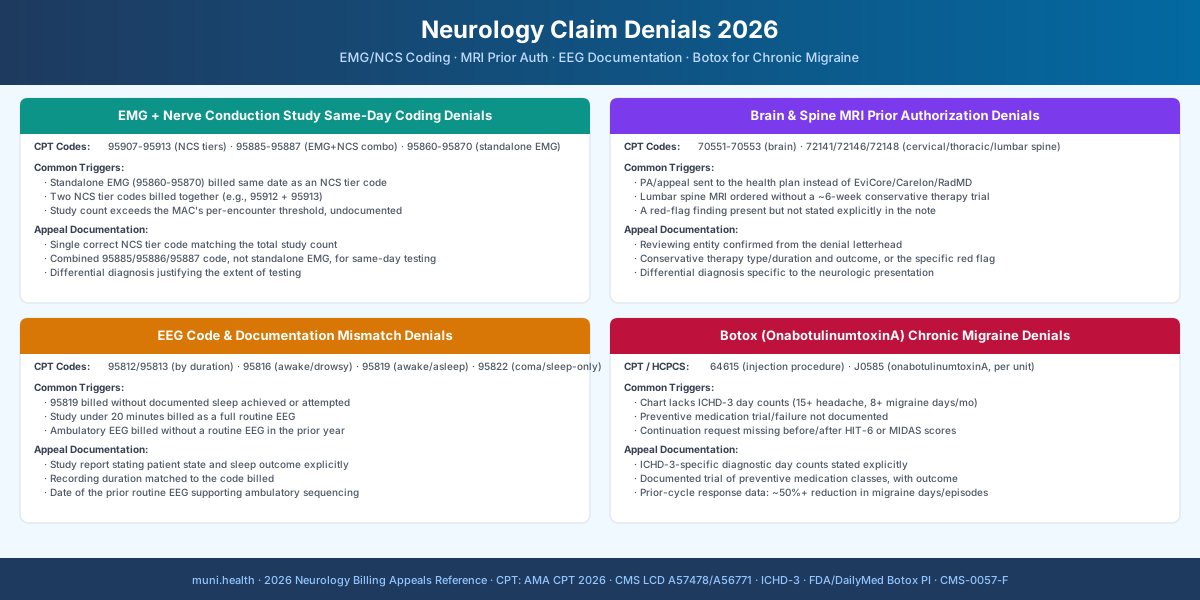
Neurology claim denials cluster into four categories: EMG/nerve conduction study (NCS) coding errors, brain and spine MRI prior authorization denied through a delegated radiology benefit manager, EEG documentation gaps between the routine EEG codes, and Botox (onabotulinumtoxinA) for chronic migraine denied for step therapy or missing continuation data. The single most common and most fixable error: billing a standalone EMG code (95860–95870) on the same date as a nerve conduction study, instead of the correct combined EMG-with-NCS code (95885–95887) — an automatic denial under Medicare's own coding rules.
Why Neurology Claims Face Elevated Denial Rates
Neurology billing combines four denial-prone service lines in a single practice: electrodiagnostic testing with strict same-day coding combination rules, advanced imaging that routes through a delegated benefit manager for most commercial plans, EEG codes selected by clinical state rather than just duration, and one of the most heavily prior-authorized injectable therapies in outpatient medicine. Missing any one of these turns a routine workup into a multi-week appeal.
According to the 2025 AMA Prior Authorization Physician Survey (n=1,000 physicians, fielded December 2025), practices complete an average of 40 prior authorizations per physician per week, and 32% of physicians report PA requests are often or always denied. Neurology carries a disproportionate share of that volume because electrodiagnostic testing, cross-sectional imaging, and specialty injectables are all reviewed through payer-specific criteria that change independently of each other.
CMS-0057-F (effective January 1, 2026) requires Medicare Advantage plans to issue standard prior authorization decisions within 7 calendar days and expedited decisions within 72 hours, and to state the specific clinical reason for any denial. That stated reason is the exact gap a neurology appeal needs to close.
The 4 Most Common Neurology Denial Types
Each denial type below traces to a different root cause and needs different documentation. Misidentifying which one applies is the most common reason a neurology appeal is submitted with the wrong evidence.
| Denial Type | Key CPT/HCPCS Codes | Primary Trigger | Appeal Focus |
|---|---|---|---|
| EMG + NCS same-day coding error | 95907-95913, 95885-95887, 95860-95870 | Standalone EMG code billed with an NCS tier code on the same date, or multiple NCS tier codes billed together | Correct code combination per Medicare coding rules; operative/testing note showing total study count |
| Brain/spine MRI prior authorization | 70551-70553, 72141, 72146, 72148 | PA sent to the health plan instead of its delegated radiology benefit manager; missing conservative-therapy documentation | Confirm reviewing entity from denial letterhead; document 6-week conservative therapy trial or red-flag exception |
| EEG code/documentation mismatch | 95812, 95813, 95816, 95819, 95822 | 95819 (with sleep) billed without documented sleep attempt or achievement; duration under 20 minutes billed as a full study | Study report specifying clinical intent, duration, and sleep state achieved |
| Botox for chronic migraine denial | 64615, J0585 | Missing ICHD-3 diagnostic criteria documentation; step-therapy trial not documented; continuation request missing response data | Headache diary/HIT-6 or MIDAS scores; documented preventive medication trial; prior-cycle response percentage |
EMG & Nerve Conduction Study (NCS) Coding Denials
This is the single highest-volume, most avoidable denial in neurology billing, and it comes from a same-day coding rule that catches even experienced billers: standalone EMG codes cannot be billed on the same date as nerve conduction study codes.
The combination rule. Nerve conduction study codes 95907 through 95913 are tiered by the total number of studies performed in the encounter — each motor nerve, sensory nerve, F-wave, and H-reflex study counts toward the total. Only one tier code from that series should be billed per encounter; billing two tier codes together (for example, 95912 and 95913 on the same date) conflicts with the National Correct Coding Initiative edit pair for that combination, and one of the two codes is denied automatically.
When EMG needle testing is performed at the same encounter as a nerve conduction study, the standalone EMG codes (95860–95870) are not the correct codes to bill. Per CMS's Local Coverage Article on nerve conduction studies and electromyography, the combined codes — 95885 (limited EMG, one extremity, with NCS), 95886 (complete EMG, one extremity, with NCS), and 95887 (EMG, non-extremity muscle, with NCS) — apply instead whenever both studies are performed on the same date. Billing 95860 alongside an NCS tier code is a documented cause of automatic denial, independent of medical necessity.
Per-Encounter Study Count Limits
Several Medicare Administrative Contractor Local Coverage Determinations flag total nerve conduction study counts above a commonly cited threshold of 8 studies per encounter as requiring additional documentation of medical necessity — a differential diagnosis broad enough to justify the extended workup, not just a symptom list. Confirm the specific threshold on the MAC's current LCD before an extensive multi-limb study, since it varies by contractor.
What a successful EMG/NCS coding-error appeal includes:
[Practice Letterhead]
[Date]

[Payer] Appeals Department
[Address from denial letter]

RE: Appeal — EMG/Nerve Conduction Study Coding Denial
Patient: [Name] | DOB: [Date] | Member ID: [ID]
Claim #: [Claim Number] | DOS: [Date of Service]
CPT Code(s) Billed: [95907-95913 tier code, 95885/95886/95887 if applicable]
Denial Reason: [Same-day EMG/NCS coding conflict / NCCI edit / study count]

Dear [Payer] Claims Review Team,

This claim is being appealed because it was denied for a coding conflict
between the nerve conduction study and EMG codes billed on [Date of
Service]. The codes submitted reflect the correct combination for the
studies actually performed, detailed below.

STUDY DETAILS:
Total nerve conduction studies performed: [number] (motor: [n], sensory:
  [n], F-wave: [n], H-reflex: [n])
Correct NCS tier code for total count: [95907/95908/.../95913]
EMG needle testing performed same date: [Yes/No]
If yes, correct combined code: [95885 - limited, one extremity /
  95886 - complete, one extremity / 95887 - non-extremity muscle]

CLAIM CORRECTION REQUESTED:
[ ] Reprocess with single correct NCS tier code (not multiple tier
    codes) reflecting the documented study count
[ ] Reprocess EMG service under the correct same-day combination code
    (95885/95886/95887) rather than a standalone EMG code
[ ] Confirm study count falls within/exceeds the payer's per-encounter
    threshold and reference the attached differential diagnosis

SUPPORTING DOCUMENTATION:
- Complete electrodiagnostic testing report identifying each nerve
  studied and the total study count
- Referring diagnosis and differential supporting the extent of testing
- Prior conservative treatment or imaging, if relevant to medical
  necessity

I am available to discuss this case or provide additional documentation.

Respectfully,

[Provider Name, Credentials]
NPI: [Number]
Skip the blank template. Start with a review-ready draft.
Use the template as guidance, or let Muni prepare a payer-specific draft for your team to verify, sign, and submit.
First 3 appeals free, then $20 per appeal. Start with your denial letter or EOB and available records. No meeting or clearinghouse connection required.
Brain & Spine MRI Prior Authorization Denials
Most commercial and Medicare Advantage plans require prior authorization for brain MRI (CPT 70551–70553) and spine MRI (72141 cervical, 72146 thoracic, 72148 lumbar), and most of those plans do not review the request internally — they delegate it to a radiology benefit manager. Sending the PA or appeal to the health plan instead of its delegate is a routing error that restarts the clock without a single clinician reviewing the clinical merits.
The delegation pattern is the same one that governs imaging PA across specialties: EviCore (Cigna commercial, Aetna commercial non-IFP, Humana, UHC Oxford plans), Carelon Medical Benefits Management (Anthem/Elevance and multiple BCBS affiliates), or Evolent/RadMD (regional BCBS and Medicaid managed-care plans) — with UnitedHealthcare's main commercial and Medicare Advantage business reviewing most imaging internally. See the imaging prior authorization denial appeal guide for the full routing table and how to confirm the reviewing entity from the denial letterhead before appealing.
Spine MRI carries an added documentation requirement beyond routing. Per the ACR Appropriateness Criteria for Low Back Pain, 2021 Update (American College of Radiology), imaging is not appropriate as the initial workup for subacute or chronic low back pain without red flags and without a prior trial of conservative management — patients with subacute or chronic low back pain who have failed roughly 6 weeks of conservative therapy and remain a candidate for intervention are the appropriate imaging population, unless a red flag is present. Red flags that justify imaging without the conservative-therapy trial include trauma, unexplained weight loss, suspected infection or malignancy, immunosuppression, and any focal neurologic deficit with progressive or disabling symptoms, including suspected cauda equina syndrome.
The Documentation Gap That Triggers Most Lumbar MRI Denials
A lumbar spine MRI ordered without either (1) a documented conservative-therapy trial of roughly 6 weeks, or (2) a specific red-flag finding, is the most common reason reviewers cite "not medically necessary" on a spine MRI PA request — the imaging itself may be entirely appropriate, but the note doesn't yet show why it's needed now rather than after conservative care.
What strengthens a brain or spine MRI PA appeal:
- Confirmation of the correct reviewing entity from the denial letterhead, with the appeal resubmitted to that entity if it was originally sent to the health plan
- For spine MRI without a red flag: documented duration and type of conservative therapy already tried (physical therapy, NSAIDs, activity modification) and its outcome
- For any red-flag presentation: the specific finding (trauma, neurologic deficit, suspected malignancy, etc.) stated explicitly rather than implied
- The referring neurologist's specific differential diagnosis, not a general symptom description
EEG Coding & Medical Necessity Denials
Routine EEG denials most often come down to a documentation gap between two adjacent codes rather than a true coverage dispute. The three routine EEG codes — 95816, 95819, and 95822 — cover recordings of roughly 20 to 40 minutes, and code selection depends on the patient's state during the recording, not just the study length: 95816 for awake and drowsy, 95819 for awake and asleep, and 95822 for coma or sleep-only recordings. Studies exceeding 40 minutes use duration-based codes instead — 95812 for 41 to 60 minutes, 95813 for studies longer than 60 minutes.
The 95816-vs-95819 gap is the most common denial trigger. Billing 95819 requires the study report to document both that a sleep recording was clinically intended and whether sleep was actually achieved or genuinely attempted. When sleep was ordered but not documented as achieved or attempted, the correct code is 95816 — billing 95819 without that documentation is a frequent cause of downcoding or denial on audit.
| CPT Code | Study Type | Documentation Required |
|---|---|---|
| 95812 | EEG, 41-60 minutes | Total recording duration; clinical indication supporting extended study |
| 95813 | EEG, greater than 60 minutes | Total recording duration; indication for extended/prolonged routine study |
| 95816 | Routine EEG, awake and drowsy | Patient state during recording; no sleep achieved or attempted |
| 95819 | Routine EEG, awake and asleep | Sleep recording clinically intended AND sleep achieved or attempted, documented explicitly |
| 95822 | Routine EEG, coma or sleep only | Patient's baseline consciousness state at time of recording |
Per CMS's Local Coverage Article on special electroencephalography, a routine EEG (95812, 95813, 95816, 95819, or 95822) must have been performed and billed within the year prior to an ambulatory continuous EEG for the ambulatory study to be considered medically necessary in most MAC jurisdictions — an ambulatory EEG PA denial should be checked against this sequencing requirement before assuming it's a coverage dispute.
Botox (OnabotulinumtoxinA) for Chronic Migraine Denials
Botox for chronic migraine (CPT 64615, HCPCS J0585) is one of the most heavily prior-authorized injectable therapies in neurology, and denials typically trace to one of three gaps: the diagnosis doesn't yet meet the chronic migraine threshold on paper, the required preventive-medication trial isn't documented, or a continuation request is missing the response data payers require to approve the next cycle.
Prepare this appeal packet with your team.
Draft the appeal, coordinate missing documents, and approve the reviewed packet. Keep your clearinghouse; your practice checks deadlines and submits through the payer’s accepted channel.
First 3 appeals free, then $20 per appeal. Start with your denial letter or EOB and available records. No meeting or clearinghouse connection required.
Diagnostic threshold. Chronic migraine, per the International Classification of Headache Disorders, 3rd edition (ICHD-3), requires headache on 15 or more days per month for more than 3 months, with at least 8 of those days meeting migraine-specific criteria (each lasting 4 or more hours if untreated). A chart note that documents "frequent headaches" without the specific day counts is the most common reason an initial Botox PA is denied before the clinical picture is even evaluated.
Step therapy. Payers require documentation that standard oral preventive medications were tried and failed (or were contraindicated) before approving Botox. Requirements vary by payer, but a February 22, 2026 update to Medicare's regional Local Coverage Determination for botulinum toxin A illustrates the pattern: it requires documentation of a 2-month trial, at target dose, of at least one agent from at least two of four preventive drug classes — antidepressants, beta-blockers, calcium channel blockers, and antiseizure medications — with any intolerances, side effects, or contraindications recorded, per the American Headache Society's summary of the updated LCD. This LCD applies only within specific Medicare Administrative Contractor jurisdictions, not nationwide — confirm the applicable MAC and its current policy before relying on these exact figures, and expect commercial payers to set their own, separately documented step-therapy requirements.
Continuation Requests Need Response Data, Not Just a Refill
The same February 2026 Medicare LCD update requires ongoing coverage to be supported by an objective, consistent functional-disability assessment — HIT-6 or MIDAS scores — taken before and after each treatment cycle, plus a demonstrated reduction of roughly 50% or more in monthly migraine days or migraine episodes. A continuation request submitted as a routine refill, without the prior cycle's before/after scores attached, is a common and avoidable denial reason.
Dosing reference. The FDA-approved PREEMPT protocol for chronic migraine is 155 units of onabotulinumtoxinA injected across 31 fixed sites spanning 7 head and neck muscle areas, administered no more often than every 12 weeks, per BOTOX's FDA-approved prescribing information (DailyMed, National Library of Medicine). An optional "follow the pain" protocol allows up to 195 units across 39 sites for refractory presentations. A claim billed above 195 units, or more frequently than every 12 weeks, will not match the approved dosing and is a documented cause of denial independent of medical necessity.
How Muni Appeals Helps Neurology Billing Teams
Most neurology denials are not clinical disputes — they're a same-day EMG/NCS code combination error, a PA routed to the health plan instead of its imaging delegate, an EEG code missing a documented sleep attempt, or a Botox continuation request submitted without the response data the payer already told you it needs. Fixing the underlying error resolves the denial; resubmitting the same claim without correcting it does not.
Muni Appeals organizes uploaded neurology denial materials, matches documentation to the cited payer criteria, and surfaces likely EviCore, Carelon, or direct-payer routing for staff verification. Staff confirms the current reviewer, deadline, and submission channel. Practices comparing workflows should see the appeal automation cost comparison.
Frequently Asked Questions
Why was my EMG claim denied when I also billed a nerve conduction study?
Standalone EMG codes (95860–95870) cannot be billed on the same date of service as a nerve conduction study (95907–95913). Use the combined codes instead — 95885 (limited EMG, one extremity), 95886 (complete EMG, one extremity), or 95887 (non-extremity muscle) — whenever EMG needle testing and NCS are performed at the same encounter. This is a coding rule under Medicare's own billing guidance, not a medical necessity dispute, so the appeal only needs to correct the code, not add new clinical evidence.
Can I bill more than one nerve conduction study tier code in the same encounter?
No. The 95907–95913 series is tiered by total study count, and only one code from that series should be billed per encounter. Billing two tier codes together — for example, 95912 and 95913 on the same date — conflicts with the applicable National Correct Coding Initiative edit, and one of the two will be denied.
Which entity reviews my brain or spine MRI prior authorization?
It depends on the payer, not just the plan type. Most Cigna, Aetna commercial (non-IFP), Humana, and UHC Oxford plans route through EviCore; most Anthem/Elevance and many BCBS affiliates route through Carelon; several regional BCBS and Medicaid managed-care plans route through Evolent/RadMD. UnitedHealthcare's main commercial and Medicare Advantage business generally reviews imaging internally. Confirm the reviewing entity from the denial letterhead before appealing — see the imaging prior authorization guide for the full routing table.
Do I need to document conservative therapy before ordering a lumbar spine MRI?
Usually, unless a red flag is present. Per the ACR's Appropriateness Criteria, lumbar spine MRI for subacute or chronic low back pain without red flags is appropriate after roughly 6 weeks of conservative therapy has failed and the patient remains a candidate for intervention. Red flags — trauma, suspected infection or malignancy, immunosuppression, or a progressive neurologic deficit — justify imaging without waiting on the conservative-therapy trial.
What counts as "chronic migraine" for a Botox prior authorization?
Per the ICHD-3 diagnostic criteria, chronic migraine requires headache on 15 or more days per month for more than 3 months, with at least 8 of those days meeting migraine-specific criteria. Documenting the specific day counts — not a general description like "frequent headaches" — is what most often separates an approved initial Botox PA from a denial.
What has to be documented for a Botox continuation (repeat cycle) request?
Payers generally want objective before-and-after functional assessment data from the prior cycle, not just a request to continue. A February 2026 update to Medicare's regional botulinum toxin A coverage policy requires HIT-6 or MIDAS scores taken before and after each cycle, plus roughly a 50% or greater reduction in monthly migraine days or episodes to support ongoing coverage. Submit that data with every continuation request rather than only when asked.
How many units of Botox does insurance typically approve for chronic migraine, and how often?
The FDA-approved PREEMPT protocol is 155 units across 31 fixed injection sites, with an optional extension to 195 units across 39 sites for refractory cases, administered no more often than every 12 weeks. A claim outside that range or frequency does not match the approved dosing and can be denied independent of the medical necessity determination.
What's the fastest way to resolve a neurology PA denial when the clinical picture is strong but documentation was incomplete?
Request a peer-to-peer review before filing a formal written appeal, when the payer or its delegate offers one — this is typically available in the days immediately following the denial and lets the ordering neurologist address the reviewer's specific concern directly. For Medicare Advantage cases requiring urgent resolution, see the expedited appeal process guide — CMS-0057-F requires a 72-hour turnaround on urgent requests.
Ready to Stop Losing Time to Neurology Coding and PA Denials?
Neurology denials are recoverable once the appeal matches the actual error — a same-day coding conflict, a misrouted imaging PA, an undocumented EEG sleep attempt, or a Botox continuation missing its response data. Submitting the same claim again without fixing the root cause just restarts the clock.
Muni Appeals helps neurology billing teams:
- Organize appeals by denial type instead of treating every denial the same way
- Match documentation requirements to the specific payer, delegated reviewer, and treatment cycle
- Provide likely EviCore, Carelon, or direct-payer routing guidance for staff to verify before filing
This guide reflects 2026 neurology billing and appeal procedures. CPT code requirements, payer prior authorization rules, and Local Coverage Determinations are updated regularly and vary by Medicare Administrative Contractor and commercial payer. State requirements and plan-level rules also vary. This information is for administrative and billing purposes and is not medical advice.