

Aetna delegates prior authorization review to different third-party vendors by service type — EviCore handles imaging and interventional pain, NIA handles MSK and physical medicine, and Aetna Behavioral Health runs a separate track. When a PA is denied, you must identify the issuing entity from the denial letter header and submit your peer-to-peer review request to that entity — not to Aetna NAU. EviCore and NIA both enforce a 7-day P2P window. Submitting to the wrong portal resets that clock and permanently closes the P2P option.
Why Aetna PA Denials Are More Complicated Than They Appear
Most billing teams treat an Aetna PA denial as a single-path problem: call Aetna, request a peer-to-peer review, file an appeal through Availity. That sequence is correct only if the denial came directly from Aetna's National Accounts Unit. For a large and growing share of Aetna denials, it is wrong — and following it costs the 7-day P2P window that is the highest-yield intervention after denial.
Aetna contracts with multiple third-party utilization management vendors to administer PA decisions for specific service categories. EviCore by Evernorth handles advanced imaging, cardiac procedures, interventional pain management, and radiation oncology. National Imaging Associates (NIA), a subsidiary of Magellan Health, handles musculoskeletal procedures, physical and occupational therapy, and certain neuromodulation cases. Aetna Behavioral Health administers a separate track for mental health and substance use PA. When those entities deny a PA request, the appeal goes to them — not to Aetna's central appeals department.
The practical consequence is significant. Filing a peer-to-peer review request with Aetna's provider line for an EviCore-managed denial can delay scheduling by days while representatives redirect the call. Filing a written appeal with Aetna NAU for an NIA-managed denial may be returned as a submission error. Neither outcome is recoverable if the P2P window has already expired.
The Denial Letter Header Tells You Where to File
The entity name in the denial letter header — "EviCore Healthcare," "National Imaging Associates," or "Aetna" — determines where the appeal is filed. Read the letter header before taking any action. Routing to Aetna NAU when EviCore issued the denial loses the 7-day P2P window.
How to Identify Which Vendor Denied Your Aetna PA
The fastest way to identify the correct entity is to read the first two lines of the denial letter.
EviCore denial letters are printed on EviCore letterhead and include an EviCore case reference number (format: EVC-XXXXXXXX). The mailing address, phone number, and fax on the denial letter all route to EviCore — not to Aetna. The appeal rights section cites EviCore's appeal procedures.
NIA denial letters similarly carry NIA branding and a RadMD case reference number. The submission address on the denial routes to NIA's processing center, and the P2P scheduling number connects to NIA's clinical review team.
When the denial letter shows Aetna's name and an Aetna case reference number, the denial came from Aetna's internal UM team. Use Availity and Aetna's provider phone lines for those cases.
If the denial letter is ambiguous — which occasionally happens when Aetna's processing center prints the letter on Aetna paper even for a vendor-managed case — call the clinical review number on the denial letter and ask explicitly: "Is this a delegated review case, and if so, which entity is managing the appeal?"
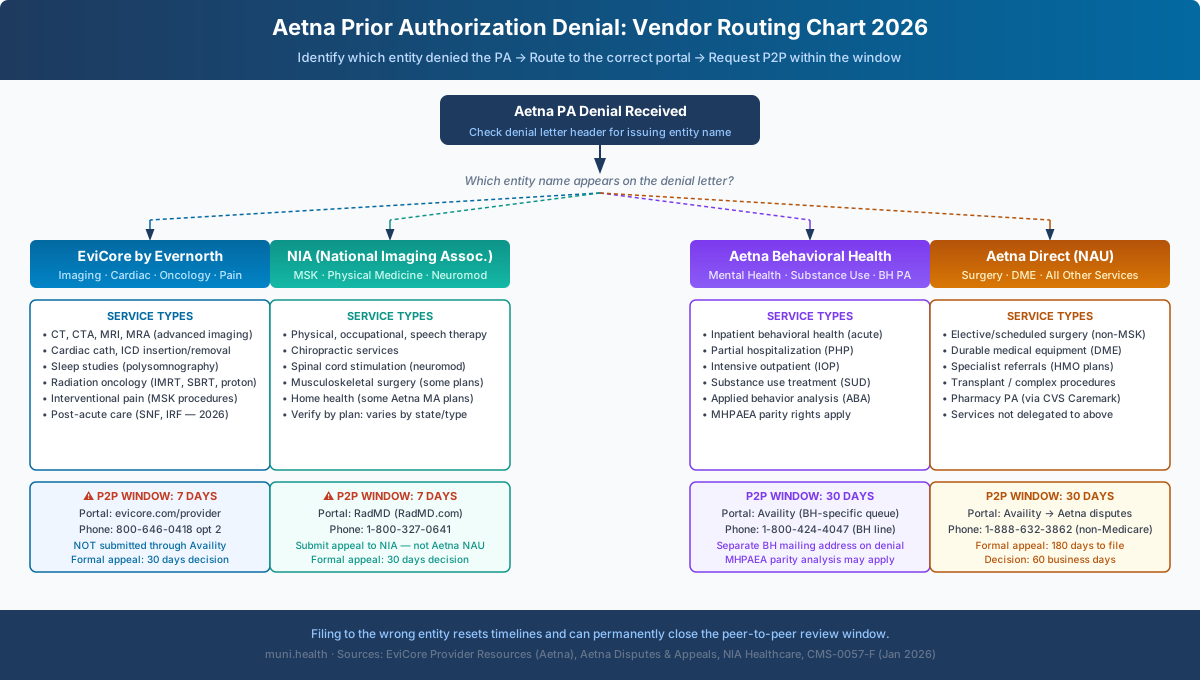
EviCore-Managed Aetna PA Denials: The 7-Day P2P Deadline
EviCore by Evernorth manages utilization review for Aetna across the highest-volume PA service categories. According to EviCore's published provider resources for Aetna plans, the services delegated to EviCore include:
- Advanced imaging: CT, CTA, MRI, MRA
- Cardiac procedures: diagnostic cardiac catheterization, elective ICD insertion, removal, and upgrade
- Sleep studies: attended polysomnography and split-night studies
- Interventional pain management: MSK and spine procedures
- Radiation oncology: 2D/3D conformal, IMRT, SBRT, SRS, proton beam, and brachytherapy
- Post-acute care (effective January 1, 2026): skilled nursing facility (SNF) and inpatient rehabilitation (IRF) for Aetna Medicare members in NJ, NY, PA, and WV
The P2P request window at EviCore is 7 calendar days from the denial date. This window is strict. EviCore denial letters display the formal appeal rights prominently — typically 30 days for the appeal itself — which leads billing teams to assume they have 30 days for everything. The 7-day P2P window is not prominently labeled. Build a same-day triage step into your denial intake process: every EviCore denial should trigger an immediate P2P scheduling call.
How to Request Peer-to-Peer Review for an EviCore-Managed Aetna Denial
Request peer-to-peer review through the EviCore provider portal at evicore.com/provider, or by phone at 800-646-0418, option 2. The ordering physician — not a billing staff member — must initiate the call. Most P2P calls are scheduled within 24–72 hours and run 5–10 minutes.
Before the call, prepare a brief that directly addresses the specific criterion cited in the denial. Under CMS-0057-F (effective January 1, 2026), EviCore-managed Aetna Medicare Advantage PA denials must specify the exact clinical criterion used and why the patient did not meet it. Quote that criterion back in your P2P talking points — presenting a general clinical case without addressing the cited gap is the most common reason P2P calls fail to reverse a denial.
EviCore's Published Overturn Rate for P2P
EviCore's own provider resources state that peer-to-peer review is the most effective intervention after a PA denial. Across service categories, published data shows P2P overturning more than 50% of initial denials, with imaging and oncology approaching 70% when the ordering physician conducts the call rather than delegating to office staff.
Filing a Formal Appeal with EviCore
If peer-to-peer review does not result in reversal, file the formal appeal directly with EviCore — not with Aetna NAU. EviCore issues appeal decisions within 30 calendar days of receiving a complete submission, or earlier based on state-specific requirements.
A complete EviCore appeal submission includes:
- The original denial letter and EviCore case reference number
- Physician-signed letter of medical necessity citing the specific clinical criterion from the denial notice
- Supporting medical records covering the relevant treatment history
- Published clinical guideline citations supporting the requested service
- Completed EviCore appeal form (available on evicore.com/provider)
If EviCore upholds the denial after formal appeal, the next escalation is Aetna's Level 2 appeal process — at that point the case transitions back to Aetna's appeals department.
NIA-Managed Aetna PA Denials: MSK and Physical Medicine
National Imaging Associates (NIA) manages prior authorization for Aetna's musculoskeletal and physical medicine service categories. The Aetna/NIA Prior Authorization Program covers commercial fully insured and Aetna Medicare populations. Services in NIA's scope include physical therapy, occupational therapy, speech therapy, chiropractic services, and certain neuromodulation procedures such as spinal cord stimulation.
Like EviCore, NIA enforces a 7-day P2P request window. Providers who receive an NIA-branded denial and call Aetna's main provider line will be redirected — losing time in the process.
How to Request Peer-to-Peer Review for an NIA-Managed Denial
Submit P2P review requests through NIA's RadMD portal (RadMD.com) or by calling 1-800-327-0641. NIA's clinical review team schedules peer-to-peer calls for the ordering physician within 24–48 hours in most cases.
The formal appeal submission path is the same portal: RadMD.com. NIA appeal decisions follow the same 30-day standard timeline as EviCore. If NIA upholds the denial, escalation routes to Aetna's appeals process.
NIA and EviCore Are Not Interchangeable
Both EviCore and NIA manage Aetna PA, but for different service categories. An imaging denial goes through EviCore. A physical therapy denial goes through NIA. Submitting either type to Aetna NAU directly, rather than to the managing vendor, results in a routing delay that can consume most of the 7-day P2P window before the call is even scheduled.
How to Confirm NIA Scope for a Specific Plan
NIA's scope varies by Aetna plan type and geographic market. The most reliable method to confirm NIA management for a specific PA is to call Aetna's provider line and ask whether the service category is delegated to NIA for this specific plan. Aetna's provider portal on Availity also displays delegation notices by plan at the member eligibility screen for most commercial plans.
Behavioral Health PA Denials: The Separate Submission Path
Aetna Behavioral Health administers prior authorization for mental health and substance use disorder services separately from the medical PA process. The behavioral health PA pathway has a different phone line, a different submission address on appeal letters, and a distinct clinical criteria framework that includes federal Mental Health Parity and Addiction Equity Act (MHPAEA) parity requirements.
The P2P window for Aetna Behavioral Health denials is 30 days — consistent with Aetna's standard commercial window rather than the 7-day EviCore/NIA timeline. Behavioral health P2P calls are coordinated through Aetna's behavioral health provider line at 1-800-424-4047.
Services in the Aetna Behavioral Health PA track include:
- Inpatient psychiatric admission and concurrent review
- Partial hospitalization programs (PHP)
- Intensive outpatient programs (IOP)
- Residential substance use treatment
- Applied behavior analysis (ABA) therapy
- Transcranial magnetic stimulation (TMS) for treatment-resistant depression (plan-specific)
MHPAEA Creates a Different Legal Framework for BH Appeals
Behavioral health PA denials carry an additional appeal argument that medical PA denials do not: MHPAEA parity. Under federal law, insurers cannot apply more restrictive prior authorization criteria to mental health and substance use services than to analogous medical and surgical services. A behavioral health denial that cannot be reversed on clinical grounds alone may be reversed on a MHPAEA parity argument. The appeal letter should document the analogous medical/surgical service, its PA criteria, and the disparity. For more on mental health appeal strategy including parity frameworks, see the mental health insurance denials guide 2026.
Aetna Medicare Advantage PA Appeals Under CMS-0057-F
CMS Interoperability and Prior Authorization Final Rule (CMS-0057-F), effective January 1, 2026, changed the timelines and transparency requirements for all Aetna Medicare Advantage PA decisions. These changes apply to all Aetna MA plans — including EviCore-managed and NIA-managed categories within those plans.
New PA decision timelines for Aetna Medicare Advantage:
- Standard (non-urgent) PA decisions: 7 calendar days from receipt of the request
- Expedited (urgent) PA decisions: 72 hours from receipt of the request
The 7-day standard timeline is shorter than the 14-day window most MA plans previously used. If Aetna or its vendors miss this deadline for an MA PA decision, document the timeline failure and include it in any appeal or CMS complaint. A missed timeline can be grounds for a deemed-denial escalation.
Mandatory denial specificity: Under CMS-0057-F, every Aetna MA PA denial — whether issued by Aetna, EviCore, or NIA — must state the specific clinical criterion the request failed to meet and explain why the patient's documentation did not satisfy that criterion. A vague "medical necessity not established" denial without a specific criterion citation is now non-compliant for MA plans. When this occurs, request an immediate correction letter and use the cited criterion as the basis for your P2P talking points.
| Plan Type | P2P Window | Formal Appeal Deadline | Level 1 Decision Timeline | Expedited Decision |
|---|---|---|---|---|
| Aetna commercial (Aetna-direct) | 30 days from denial | 180 days from denial | 60 business days | 72 hours |
| Aetna commercial (EviCore-managed) | 7 calendar days from denial | 30 days from EviCore denial | 30 calendar days | 72 hours |
| Aetna commercial (NIA-managed) | 7 calendar days from denial | 30 days from NIA denial | 30 calendar days | 72 hours |
| Aetna Medicare Advantage | During Level 1 appeal period | 65 days from denial | 30 calendar days | 72 hours |
| Aetna Medicare Advantage (EviCore-managed) | 7 calendar days from denial | 65 days from denial (MA rules) | 30 calendar days | 72 hours |
For MA plans, note that the formal appeal deadline of 65 days is set by CMS regulation and supersedes any longer window an individual plan might advertise. The 65-day clock begins from the date of the denial notice. For a full walkthrough of Aetna Medicare Advantage appeal procedures, including the automatic escalation to the Independent Review Entity after Level 1 denial, see the Aetna Medicare Advantage denial appeal guide 2026.
Filing the Formal Appeal: Timelines, Submissions, and Documentation
Regardless of which entity managed the initial PA decision, the formal appeal process follows a consistent documentation framework. The specific submission portal differs by entity, but the evidentiary requirements are substantially the same.
Required Documentation for Any Aetna-System PA Appeal
A complete appeal package — whether submitted to EviCore, NIA, or Aetna NAU — should include:
- Completed appeal form from the denying entity (attached to or linked from the denial letter)
- Physician-signed letter of medical necessity that quotes the specific denial criterion verbatim and addresses it directly
- Relevant medical records covering at least 6 months of treatment history for the denied service
- Documentation of failed alternative treatments with specific dates, dose/frequency, and outcome notes
- Two to three published clinical guideline citations from national medical societies or peer-reviewed literature supporting the necessity of the requested service
- Aetna Clinical Policy Bulletin (CPB) citation if the applicable CPB supports coverage — Aetna's CPBs are publicly available and updated quarterly at aetna.com/cpb
Always Cite the Specific Denial Criterion, Not a Generic Necessity Argument
The most common reason Aetna-system PA appeals fail is that the submission addresses general clinical necessity without specifically rebutting the criterion cited in the denial notice. Every denial letter now specifies the exact coverage criterion under CMS-0057-F for MA plans, and Aetna has broadly applied the same practice to commercial denials. Build the letter around that specific criterion — not around the treatment's clinical value in general.
Submission Paths by Entity
EviCore-managed appeal:
Portal: evicore.com/provider (fastest — status tracking included)
Fax: per denial letter
Phone: 800-646-0418, option 2
Do NOT mail to Aetna's Hartford or Lexington addresses

NIA-managed appeal:
Portal: RadMD.com
Phone: 1-800-327-0641
Do NOT mail to Aetna's Hartford or Lexington addresses

Aetna Behavioral Health appeal:
Portal: Availity → Aetna → Behavioral Health dispute queue
Phone: 1-800-424-4047
Mail: address on denial letter (BH-specific P.O. Box)

Aetna NAU (all other commercial):
Portal: Availity → Aetna → Dispute and Appeal
Phone: 1-888-632-3862 (non-Medicare)
Mail: P.O. Box 14087, Lexington, KY 40512 (commercial)
       P.O. Box 14067, Lexington, KY 40512 (Medicare)
Skip the blank template. Start with a review-ready draft.
Use the template as guidance, or let Muni prepare a payer-specific draft for your team to verify, sign, and submit.
First 3 appeals free, then $20 per appeal. Start with your denial letter or EOB and available records. No meeting or clearinghouse connection required.
For a full set of Aetna appeal form links and mailing addresses organized by plan type, see the Aetna appeal form guide 2026. For every Aetna, EviCore, and NIA phone number in one directory — including hours and what to have ready before you call — see our Aetna provider phone numbers guide.
How Muni Appeals Handles Aetna's Delegation Matrix
The vendor routing problem does not resolve itself with checklists — it requires a system that matches every incoming Aetna PA denial to the correct appeal path before the P2P window expires.
Prepare this appeal packet with your team.
Draft the appeal, coordinate missing documents, and approve the reviewed packet. Keep your clearinghouse; your practice checks deadlines and submits through the payer’s accepted channel.
First 3 appeals free, then $20 per appeal. Start with your denial letter or EOB and available records. No meeting or clearinghouse connection required.
Muni Appeals reads the uploaded denial letter to identify the stated managing entity, surfaces the relevant P2P and appeal-window guidance, and builds the formal appeal package against the cited criterion rather than a generic clinical narrative. Staff must verify the current vendor instructions, schedule the P2P, calendar the controlling deadline, and submit through the required channel.
For practices with high volumes of imaging, MSK, or interventional pain PA, the EviCore 7-day window is the leverage point that most manual workflows miss. Muni captures it consistently.
Start 3 Free Aetna Prior Authorization Appeals
Frequently Asked Questions
How do I know if my Aetna PA denial was managed by EviCore or NIA?
Read the denial letter header and the case reference number format. EviCore denial letters carry EviCore branding and an EVC-XXXXXXXX case number. NIA denial letters carry NIA branding and a RadMD case number. If the letter shows Aetna's name without vendor branding, the denial came from Aetna NAU directly. When in doubt, call the phone number on the denial letter and ask explicitly whether the case is vendor-delegated — the representative is required to tell you.
What is the peer-to-peer review window for an EviCore Aetna denial?
EviCore enforces a 7-calendar-day window from the date of the denial notice. This window is not prominently displayed on the denial letter — the letter highlights the longer formal appeal deadline instead. The 7-day P2P deadline must be tracked independently. Missing it permanently closes peer-to-peer review as an option for that denial, leaving only the slower formal appeal path. Request P2P on the same day the denial is received.
Can I submit a P2P review request for an EviCore denial through Availity?
No. Availity routes to Aetna's processing systems, not to EviCore's scheduling queue. For EviCore-managed denials, peer-to-peer review must be requested through the EviCore provider portal at evicore.com/provider or by phone at 800-646-0418, option 2. Calling Aetna's main provider line for EviCore-managed denials delays scheduling while the call is rerouted, which can consume days of the 7-day window.
Does Aetna's 180-day formal appeal deadline apply to EviCore denials?
The 180-day formal appeal window for commercial plans applies to Aetna-direct denials filed with Aetna NAU. EviCore-managed denials follow EviCore's appeal timeline — typically 30 days for a formal appeal decision once the submission is complete. After EviCore's appeal process is exhausted (if the denial is upheld), the case transitions to Aetna's Level 2 appeals process under Aetna's standard commercial timelines. The initial 30-day EviCore appeal window is shorter than Aetna's 180-day window for direct appeals.
How does CMS-0057-F affect Aetna PA appeals in 2026?
CMS-0057-F, effective January 1, 2026, applies to Aetna Medicare Advantage plans, Medicaid managed care plans, and ACA marketplace QHPs. For those plan types, Aetna and its vendors must issue standard PA decisions within 7 calendar days and expedited decisions within 72 hours. Every denial must specify the exact clinical criterion used. If Aetna misses these timelines, the case can be treated as a deemed denial and escalated immediately to the Independent Review Entity. The rule does not apply to commercial self-funded ERISA plans, which follow their plan documents. For the full CMS-0057-F breakdown, see the prior authorization denial complete guide for providers 2026.
What happens if a PA denial involves both EviCore and Aetna review?
Some complex cases involve delegated vendor review followed by Aetna medical director review — particularly for services at the boundary of two categories, such as a cardiac MRI that could be classified as either imaging (EviCore) or a cardiac procedure (also EviCore, but potentially different reviewer team). In these cases, the denial letter should indicate which entity issued the final adverse decision. If both entities are cited, start with the entity that issued the denial notice and escalate to Aetna NAU only after that entity's appeal process is exhausted.
Should I appeal the denial or request peer-to-peer review first?
Request peer-to-peer review first, before filing a formal written appeal. At some payers, filing a formal appeal before requesting P2P closes the scheduling queue for that denial. P2P is faster (24–72 hours to schedule, resolved same day), requires less paperwork, and historically overturns more than 50% of denials when the ordering physician conducts the call. If P2P fails, the formal appeal window remains open — P2P does not consume appeal rights. For the full 5-step PA denial response sequence including P2P, reconsideration, Level 1 appeal, external review, and ALJ, see the prior authorization denial guide: what happens next.
Can billing staff handle the EviCore P2P call on behalf of the physician?
No. EviCore, NIA, and Aetna all require the ordering or treating physician to initiate and conduct the peer-to-peer call. Billing staff can handle the logistics — calling the scheduling line, booking the slot, and preparing a one-page clinical brief that maps the denial criterion to the patient's specific documentation. Physicians who conduct the call with a targeted brief that directly addresses the cited criterion outperform those who summarize clinical history without that structure.
Ready to Stop Losing the EviCore 7-Day Window?
The vendor routing problem at Aetna is solvable — but only with a triage process that identifies the managing entity on the same day the denial arrives and routes the P2P request before the window expires. Most billing teams discover the EviCore 7-day rule after the first time they miss it.
Muni Appeals handles:
- Denial letter triage to identify EviCore, NIA, Aetna BH, or Aetna NAU routing
- Same-day P2P scheduling request to the correct entity
- Appeal package built against the cited CPB criterion — not a generic narrative
- All Aetna service categories: imaging, MSK, cardiac, oncology, behavioral health, MA plans
Start 3 Free Aetna Prior Authorization Appeals
This guide reflects 2026 Aetna prior authorization appeal procedures. EviCore manages Aetna imaging, cardiac, interventional pain, and radiation oncology PA under a separate contract from Aetna's internal UM team; NIA manages Aetna MSK and physical medicine PA. Delegation scope, P2P windows, and appeal timelines may vary by plan type, state, and market. CMS-0057-F requirements apply to Medicare Advantage, Medicaid managed care, and ACA marketplace plans — not to commercial self-funded ERISA plans. This information is for administrative guidance and is not medical or legal advice.