

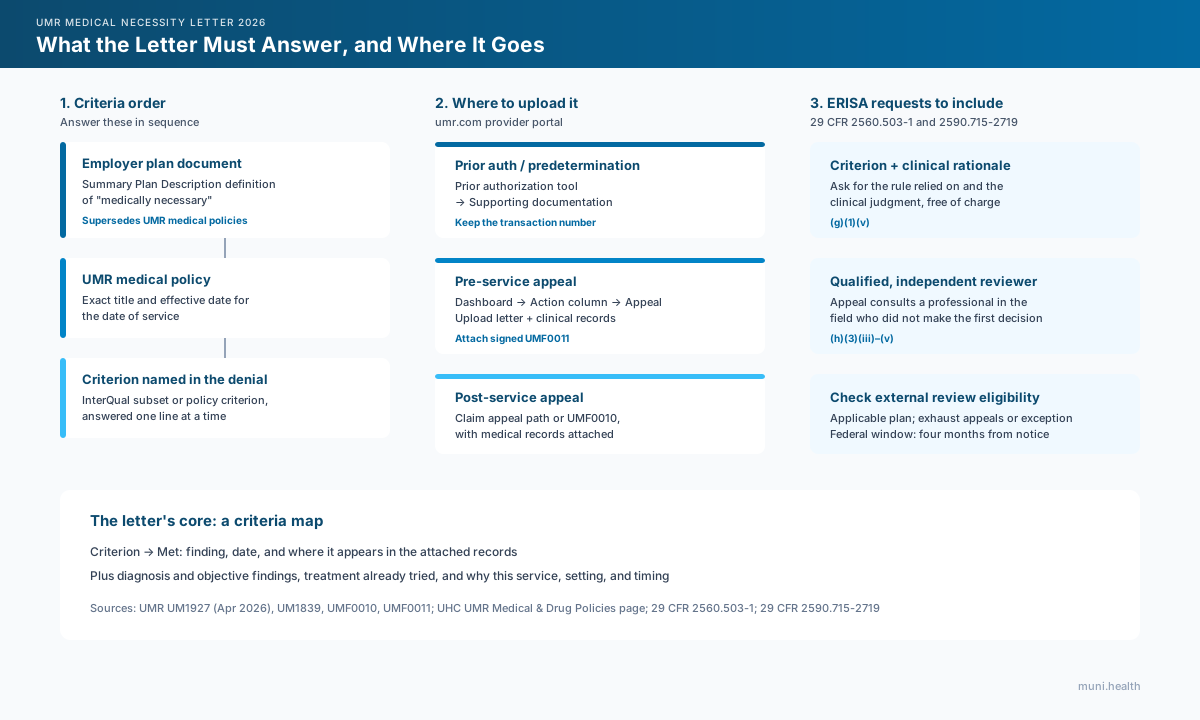
A UMR medical necessity letter has to meet the member's employer plan document first. UMR's medical policies and InterQual® criteria come second. UnitedHealthcare's UMR Medical & Drug Policies page says the member-specific plan document, such as the Summary Plan Description, supersedes those policies. Your letter should do four things: name the service and diagnosis codes, show the objective findings and prior treatment, answer the exact criterion in the denial or policy point by point, and ask for the criterion and clinical rationale the plan used. Upload it in the Supporting documentation section of UMR's prior authorization tool on umr.com. For a pre-service appeal, attach it to the Appeal request with the representative form UMF0011, as UMR's April 2026 tool guide (UM1927) describes.
Which UMR Review Is This Letter For?
Prior authorization requests, courtesy predeterminations, and appeals all take the same clinical letter. What changes is the request line at the top and where you upload it. UMR's prior authorization overview (UM1839) separates the first two cases. Prior authorization is a requirement of the patient's employer plan. Predetermination is not required by the plan. UMR offers it as a courtesy medical-necessity review before the service.
| Situation | What the letter asks for | Where it goes (umr.com provider portal) |
|---|---|---|
| Tool says "Prior authorization is required" | Approval of the service before it is rendered | Prior authorization submission → Supporting documentation (upload file or Additional comments) |
| Tool says "Medical necessity review needed / pre-determination recommended" | A courtesy medical-necessity review before the service | Request pre-determination → Supporting documentation |
| Prior authorization or predetermination denied | Reversal of a pre-service adverse determination | Prior authorization dashboard → Action column → Appeal; attach UMF0011 and clinical records |
| Claim denied as not medically necessary after the service | Reprocessing of a post-service claim | Patient search → Claim/Claims appeals → "Appeal/review this claim," or mail with UMF0010 |
Run the requirement search before you write anything. UM1927 says the tool shows plan-specific requirements. Some depend on patient age, dollar amount, visit threshold, or place of service, and it recommends adding a diagnosis code to narrow the results. If the result says no coverage for this service, the plan excludes the service. A medical necessity letter does not fix a coverage exclusion, so check the plan's benefit terms first.
For the post-service claim route, form fields, and the 72-hour member authorization step, see the UMR Appeal Form Guide. This post covers the clinical letter that goes inside those submissions.
What Criteria Does UMR Apply to a Medical Necessity Review?
The member's plan document wins. UMR's medical policies and InterQual are the tools reviewers use to apply it. UnitedHealthcare's UMR policy library page says coverage is determined by the member-specific benefit plan document, which supersedes the medical policies when they conflict. It also says the policies support those decisions with third-party tools including InterQual® criteria.
That gives your letter three layers to address, in this order:
- The plan's definition of medically necessary. It is in the Summary Plan Description. Because UMR administers self-funded employer plans, two UMR members can have different definitions, exclusions, and prior authorization lists. Quote the plan's language when you have it.
- The UMR medical policy for the service. UMR keeps its own library of medical policies and medical benefit drug policies, separate from UnitedHealthcare's fully insured commercial library. UnitedHealthcare posts changes in a monthly UMR Medical Policy Update Bulletin. Cite the policy by its exact title and check the effective date against the date of service.
- The criterion named in the denial. If the denial names an InterQual subset or a policy criterion, answer it one line at a time. A general statement that the patient "needs" the service does not show which criterion is met.
Do Not Cite UnitedHealthcare's Commercial Policy by Default
A UMR card carries United branding, but UMR's medical policies are a separate library. Cite the UMR version of the policy, and lead with the employer plan's own language. A UnitedHealthcare commercial Coverage Determination Guideline may not match the plan being administered. For the fully insured UnitedHealthcare letter, use the UHC medical necessity letter template instead.
Clinical Review Rights and External Review Eligibility
Most UMR-administered plans are self-funded employer plans covered by ERISA's claims-procedure rule, 29 CFR §2560.503-1. That rule provides the first two clinical-review protections below. External review has separate eligibility rules. The UMR appeal letter template covers the general procedural rights: the denial notice contents, free access to the claim file, and deemed exhaustion.
| Provision | What it requires of the plan | Sentence to put in the letter |
|---|---|---|
| §2560.503-1(g)(1)(v)(A)–(B) | A denial notice must give the specific rule, guideline, or criterion relied on and an explanation of the scientific or clinical judgment, or state that they are available free on request | "Please provide the specific criterion and the clinical rationale applied to this determination." |
| §2560.503-1(h)(3)(iii)–(v) | An appeal of a medical-judgment denial must be decided after consulting a health care professional with appropriate training and experience in the field, who was not consulted on the original denial (or a subordinate of that person), and the plan must identify the experts consulted | "Please confirm that this appeal will be reviewed with a [specialty] professional not involved in the initial determination, and identify the reviewer consulted." |
| 29 CFR §2590.715-2719 | For applicable plans and eligible determinations, external review can address medical judgment after internal appeals are exhausted or an exception applies | Check external review eligibility and keep the record complete for an independent reviewer. |
The external review rule, 29 CFR §2590.715-2719, generally applies to non-grandfathered plans. Grandfathered plans are generally exempt, except for specified No Surprises Act claims; ordinary medical-necessity denials do not gain external review eligibility simply because the plan is ERISA-covered. Internal appeals ordinarily must be exhausted unless an exception applies, such as qualifying expedited review or deemed exhaustion.
For an eligible determination under the federal process, the filing window is four months after receiving the applicable adverse determination or final internal adverse determination notice. A qualifying state process must allow at least four months; follow the process and deadline in the plan's notice. The independent review organization guide covers that step. For the broader self-funded framework, see the ERISA self-funded plan appeal guide.
Confirm the Plan and Review Process
Church plans and government employer plans are generally outside ERISA, and some UMR-administered arrangements differ from the typical self-funded employer plan. Check ERISA coverage, grandfathered status, external review eligibility, and the review process in the denial notice and plan documents before relying on a specific provision.
UMR Medical Necessity Letter Template
Use one letter for both the prior authorization request and the appeal. Keep the version that matches your case in each bracketed choice, and delete any paragraph that does not apply. The physician who knows the patient should sign it.
[Practice Letterhead]

[Date]

UMR
[Prior authorization request: submitted through the umr.com prior authorization
tool, Supporting documentation section]
[Pre-service appeal: submitted through the Appeal action on the prior
authorization dashboard, with the Pre-Service Appeals Designation of Authorized
Representative form (UMF0011)]
[Post-service appeal: use the route and address on the denial notice]

RE: [Letter of Medical Necessity / Appeal of Adverse Benefit Determination
   Based on Medical Necessity]
Patient: [Name]                    DOB: [MM/DD/YYYY]
Member ID: [ID]                    Group/Plan number: [Number]
Employer plan sponsor: [Employer name, if known]
[Transaction number / Decision ID / Claim number]: [Number]
Service requested or denied: [CPT/HCPCS code(s) and description]
Diagnosis: [ICD-10 code(s) and description]
Date(s) of service: [Planned or actual date(s)]
Place of service / setting: [Office / outpatient facility / inpatient]
Ordering and rendering provider: [Name, credentials, NPI]

To the UMR Clinical Review Team:

I am writing [to request prior authorization for / to appeal the [date]
denial of] [service] for my patient, [name], whom I have treated since
[date] for [condition]. [For an appeal: The determination states that the
service is not medically necessary because "[quote the denial reason
exactly]."] The clinical record below shows that [service] meets the plan's
definition of medical necessity and the applicable criteria.

1. DIAGNOSIS AND CURRENT CLINICAL STATUS
- Diagnosis: [condition], confirmed by [imaging / labs / exam] on [date].
- Objective findings: [measurements, scores, imaging results, lab values
with dates and reference ranges].
- Functional impact: [specific limits on work, activities of daily living,
or mobility, with validated scale scores if used].
- Duration and course: [onset date, progression, current trajectory].

2. TREATMENT ALREADY TRIED
- [Treatment 1]: [dates], [dose/frequency/duration], [outcome or reason
stopped].
- [Treatment 2]: [dates], [dose/frequency/duration], [outcome or reason
stopped].
- [Treatments not appropriate for this patient]: [contraindication and the
supporting record].

3. HOW THIS PATIENT MEETS THE CRITERIA
Plan definition of medically necessary: [quote the Summary Plan Description
language if available, with section number].
Applicable UMR medical policy: [exact policy title, policy number, and
effective date], [or the InterQual criteria subset named in the denial].

- Criterion: [criterion text] -> Met: [finding, date, and where in the
attached records it appears]
- Criterion: [criterion text] -> Met: [finding, date, and record location]
- Criterion: [criterion text] -> Met: [finding, date, and record location]

[If the patient does not fit a criterion exactly: explain the clinical
reason the exception is appropriate for this patient, and cite the
peer-reviewed literature or specialty-society guideline that supports it.]

4. WHY THIS SERVICE, SETTING, AND TIMING
- Expected clinical benefit: [specific, measurable goal].
- Why a less intensive alternative is not appropriate: [reason].
- Why this setting is appropriate: [reason, if site of care is at issue].
- Risk of delay or denial: [specific clinical consequence].

5. REQUESTS UNDER THE PLAN'S CLAIMS PROCEDURE
[Include for a denial or appeal. Delete for an initial request.]
- Please provide, free of charge, the specific rule, guideline, protocol,
or criterion relied on in this determination, and the explanation of the
scientific or clinical judgment applied, as described in 29 CFR
2560.503-1(g)(1)(v).
- Please confirm that this appeal will be decided after consultation with a
health care professional with appropriate training and experience in
[specialty] who was not consulted on the initial determination, and
identify the medical experts whose advice was obtained, as described in
29 CFR 2560.503-1(h)(3)(iii)-(iv).
- [If urgent: The patient's condition meets the plan's definition of urgent
care because [reason]. Please process this request on the expedited
timeline.]

6. ENCLOSURES
- [Office notes dated ___ to ___]
- [Imaging / lab / diagnostic reports dated ___]
- [Treatment history or medication records]
- [Cited guideline or literature: author, title, year]
- [Denial notice dated ___, if appealing]
- [UMF0011 Pre-Service Appeals Designation of Authorized Representative,
signed by the patient, if this is a pre-service appeal]

Based on this record, I ask that UMR [approve / reverse its determination
and approve] [service] for [patient name]. I am available for a
peer-to-peer discussion at [phone] on [days/times].

Sincerely,

[Physician name, credentials]
[Specialty]
NPI: [NPI]
[Practice name, address, phone, fax]
Follow-up contact for this request: [name, phone, email, fax]
Skip the blank template. Start with a review-ready draft.
Use the template as guidance, or let Muni prepare a payer-specific draft for your team to verify, sign, and submit.
First 3 appeals free, then $20 per appeal. Start with your denial letter or EOB and available records. No meeting or clearinghouse connection required.
Section 3 is the one most likely to decide the review. A criterion-by-criterion list lets the reviewer check the request against the policy without searching the attachments. Put the date and page reference for each finding in the letter.
How to Submit the Letter on umr.com
Submit the letter inside the request it supports. For pre-service requests and appeals, that means uploading it to the case in UMR's prior authorization tool. UM1927 (April 2026) describes these steps:
Prepare this appeal packet with your team.
Draft the appeal, coordinate missing documents, and approve the reviewed packet. Keep your clearinghouse; your practice checks deadlines and submits through the payer’s accepted channel.
First 3 appeals free, then $20 per appeal. Start with your denial letter or EOB and available records. No meeting or clearinghouse connection required.
- Sign in at umr.com → Provider with a One Healthcare ID, search the patient, and choose Prior authorization from the View drop-down.
- Run the requirement search with place of service, procedure code(s), diagnosis code, date of service, and rendering provider TIN. Save the Decision ID the tool returns.
- Start the request using the button the result shows: Prior authorization submission or Request pre-determination.
- Complete Follow-up contact information. All four fields are required: name, email, phone, and fax for the person who can answer clinical questions.
- Upload the letter and records in the Supporting documentation section, or paste a summary in Additional comments. Then submit and keep the transaction number.
- To appeal a pre-service denial, open the case from the dashboard and select Appeal in the Action column. Choose the denied code lines and write the reason in Reason for Appeal. Then upload the letter, the clinical records, and the signed UMF0011 form. UM1927 says that form is required to process the appeal.
For a post-service medical-necessity denial, use the claim appeal path. The Post-Service Appeal Request Form (UMF0010) says that if you send no medical documentation, the review relies on information already on file. Attach the letter and records every time.
Peer-to-Peer Is Separate From the Appeal
UMR's peer-to-peer scheduling form, UMF0057, arranges a discussion with the reviewer. It does not file an appeal or extend an appeal deadline. The peer-to-peer review call script can help you prepare. Keep the written appeal on its own track.
How Long Does UMR Have to Decide?
For an ERISA plan, the federal claims-procedure rule sets maximum decision times. The plan's own documents can be shorter. Under 29 CFR §2560.503-1:
| Request type | Initial decision (no later than) | Appeal decision (no later than) |
|---|---|---|
| Urgent care (pre-service) | 72 hours after receipt, except for the insufficient-information process below — §2560.503-1(f)(2)(i) | 72 hours after receipt of the appeal — (i)(2)(i) |
| Pre-service (non-urgent) | 15 days, with one possible 15-day extension in limited circumstances — (f)(2)(iii)(A) | 30 days for a single appeal level; 15 days per level if the plan has two — (i)(2)(ii) |
| Post-service | 30 days, with one possible 15-day extension in limited circumstances — (f)(2)(iii)(B) | 60 days for a single appeal level; 30 days per level if the plan has two — (i)(2)(iii)(A) |
For an initial urgent care request with insufficient information, the plan must notify the claimant within 24 hours and allow at least 48 hours to supply the information. It must then decide within 48 hours after the earlier of receiving that information or the response deadline. This exception concerns the initial request; the urgent appeal deadline remains separate.
These limits apply to the plan's decision. They are not your filing deadline. The first-level appeal window for an ERISA group health plan is at least 180 days from the denial notice. The plan document can allow more time but not less. The denial notice and Summary Plan Description set the actual date. The UMR timely filing guide explains how to find each plan's claim and appeal windows.
Common Mistakes on UMR Medical Necessity Letters
Treating a coverage exclusion as a medical-necessity problem. If the requirement search says no coverage, the plan excludes the service. Check the plan's benefit terms first. A clinical letter cannot add a benefit the plan does not include.
Citing the wrong policy library. Cite the UMR medical policy that was in effect on the date of service, and quote the employer plan's definition when you can. A UnitedHealthcare commercial guideline is a different document.
Writing a narrative instead of a criteria map. Reviewers check each criterion. A clear clinical story that never names the criteria makes the reviewer search for evidence that a criterion list would show directly.
Sending the letter without the records. UMF0010 says review relies on what is already on file when no medical documentation comes with the request. Attach the notes, reports, and treatment history the letter cites.
Leaving out UMF0011 on a pre-service appeal. UM1927 says the Pre-Service Appeals Designation of Authorized Representative form is required to process a portal appeal. Have the patient sign it early.
Filing only a peer-to-peer request. A discussion with the reviewer can resolve a case, but it is not the appeal. Calendar the appeal deadline separately.
How Muni Appeals Supports UMR Medical Necessity Letters
A strong UMR letter depends on matching the employer plan's language, the UMR policy in effect on the date of service, and the exact denial criterion. That matching takes the most staff time. Muni handles the document preparation. Staff still confirm the route, the authorization form, and the deadline.
Muni Appeals helps with these steps:
- Organizes uploaded denial notices, plan documents, and clinical records for staff review
- Drafts a letter that addresses the denial reason and flags missing documentation
- Shows a general deadline-risk category from the uploaded text; staff verify the exact deadline and calendar date
- Records the submission method and the date staff mark the appeal as submitted
To compare manual appeal-writing time with automated preparation, see Muni Appeals Pricing Explained.
Frequently Asked Questions
Does UMR have its own medical necessity form?
Not as a standalone form. For a prior authorization or predetermination, UMR collects clinical information in the Supporting documentation section of its umr.com prior authorization tool. You can upload a file or type in the Additional comments field. A letter of medical necessity uploaded there serves as the clinical narrative. Post-service appeals use the UMF0010 form with records attached.
What is the difference between UMR prior authorization and predetermination?
According to UMR's UM1839 overview, prior authorization is a requirement of the patient's employer plan. Predetermination is not required by the plan. UMR performs it as a courtesy review of medical necessity before the service. The requirement search tool tells you which one applies to the member, service, date, and provider.
Does UMR use InterQual?
UnitedHealthcare's UMR Medical & Drug Policies page says it uses third-party tools including InterQual® criteria to support coverage decisions. It also says the member-specific plan document supersedes the policies. Address the criterion named in the denial, and quote the plan's definition of medical necessity when you have it.
Who should sign a UMR letter of medical necessity?
The treating or ordering physician who can describe the patient's condition and treatment history should sign it. Include credentials, specialty, and NPI. For an urgent care claim, ERISA allows a health care professional with knowledge of the patient's condition to act as the patient's authorized representative (29 CFR §2560.503-1(b)(4)).
Is a UMR pre-service appeal decided faster than a post-service appeal?
Under the ERISA claims-procedure rule, yes. A non-urgent pre-service appeal must be decided within 30 days for a single appeal level. A post-service appeal has up to 60 days. An urgent care appeal must be decided within 72 hours. The plan's documents can set shorter times.
What if UMR upholds the medical necessity denial?
For applicable non-grandfathered plans, eligible medical-judgment determinations can go to external review under 29 CFR §2590.715-2719 after internal appeals are exhausted or an exception applies. Grandfathered plans are generally exempt apart from specified No Surprises Act claims. The federal filing window is four months from receiving the applicable notice; qualifying state processes must allow at least four months. Check the final denial notice and plan documents for the process that applies.
Get the UMR Letter Ready for Staff Review
A UMR medical necessity letter works when it answers the plan's own definition and the criterion actually applied, and when it reaches the right case in UMR's tool with records attached. Use the template above to build the criteria map. Then let staff verify the route, the authorization form, and the deadline before submitting.
Sources checked October 1, 2026: UMR UM1927 (April 2026), UM1839 (January 2025), UMF0010, UMF0011 (February 2026), UMF0057; UnitedHealthcare UMR Medical & Drug Policies page and UMR Medical Policy Update Bulletin archive; 29 CFR §2560.503-1 and §2590.715-2719. Plan terms, criteria, and submission instructions vary by employer plan. Verify the denial notice, plan documents, and current forms before submitting. This guide is administrative information, not legal or clinical advice.