

Kaiser Permanente has no single national corrected-claim deadline. Its 2026 provider manuals say a claim that arrived on time but was missing information must be corrected within 90 calendar days of the original Remittance Advice in Colorado, 365 calendar days in Georgia, Hawaii, the Mid-Atlantic States, and the Northwest, and within the same limit as the original claim in Northern and Southern California. Kaiser Permanente Washington runs a separate manual: commercial adjustment requests are due within 24 months of the date the claim was processed, and Medicare Advantage adjustments within 12 months of the date of service. Your Kaiser agreement, the correction notice, or state or federal law can set a different window. Submit the correction as a replacement (frequency code 7) with the original KP claim number.
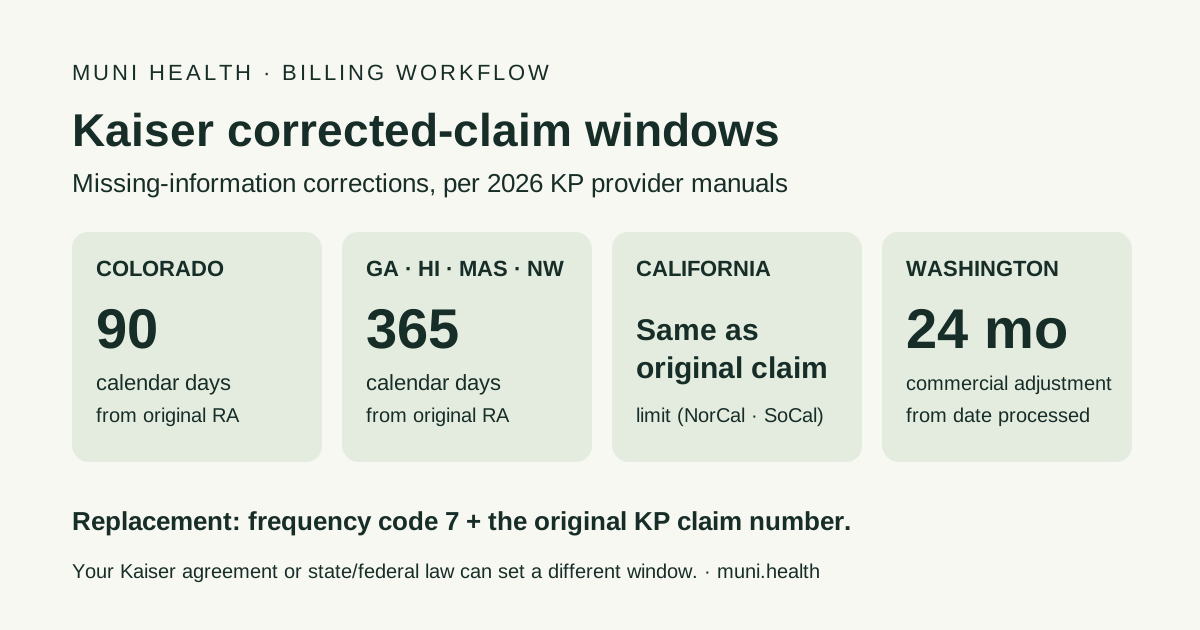
Kaiser corrected claim deadlines by region
The corrected-claim window depends on which Kaiser region adjudicates the claim. Kaiser's 2026 billing chapters, shared across the Northern California, Southern California, Colorado, and Mid-Atlantic manuals, list the same regional windows for correcting a claim that was received on time but missing information.
| Kaiser region | Corrected-claim window | Clock starts | Source |
|---|---|---|---|
| Colorado | 90 calendar days | Date of the original Remittance Advice | KP 2026 provider manuals, §5.9.1 |
| Georgia | 365 calendar days | Date of the original Remittance Advice | KP 2026 provider manuals, §5.9.1 |
| Hawaii | 365 calendar days | Date of the original Remittance Advice | KP 2026 provider manuals, §5.9.1 |
| Mid-Atlantic States (MD, VA, DC) | 365 calendar days | Date of the original Remittance Advice | KP Mid-Atlantic manual ch. 8 (July 2026), §8.9.1 |
| Northwest (Oregon, SW Washington) | 365 calendar days | Date of the original Remittance Advice | KP 2026 provider manuals, §5.9.1 |
| Northern and Southern California | Same limit as the original claim | Per the original claim rule | KP 2026 NorCal HMO manual, §5.9.1 |
| Washington (KPWA) — commercial/PPO/POS | 24 months | Date the claim was processed | KPWA Provider Manual (June 15, 2026), §6.2.22 |
| Washington (KPWA) — Medicare Advantage | 12 months | Date of service | KPWA Provider Manual (June 15, 2026), §6.2.22 |
| Washington (KPWA) — Medicaid | 24 months | Date the claim was processed | KPWA Provider Manual (June 15, 2026), §6.2.22 |
Sources checked September 28, 2026: the 2026 Northern California HMO Provider Manual, the 2026 Southern California HMO Provider Manual for contracted institutional providers, the 2026 Colorado Affiliated Provider Manual, Section 5, the Mid-Atlantic States Provider Manual, Chapter 8, and the Kaiser Permanente Washington Provider Manual.
Every one of these windows carries the same qualifier: it applies "unless a different timeline is specified in your Agreement or required by state or federal rule." Pull your Kaiser agreement before you calendar the deadline.
The Remittance Advice date, not the date of service
Outside California and Washington, the corrected-claim clock starts on the date of the original Remittance Advice. A claim with a service date in January and a remittance in March has a Colorado correction deadline 90 days after the March remittance. Keep the 835 or EOP that carries that date with the claim record.
Two kinds of correction, two deadline rules
Kaiser's manuals separate a correction for missing information from a correction Kaiser requests after denying a claim. They follow different deadline rules, so identify which one you have first.
Missing information on a timely claim (§5.9.1). This is the case the regional table covers: Kaiser received the claim inside the timely filing window, but a required element was missing. The 90-day, 365-day, or original-claim window applies from the original Remittance Advice.
A denied claim that needs correction (§5.9.2). When Kaiser denies a claim and sends a notice describing the error, "the timeframe for submitting corrections will be specified in the notice." If the notice gives no timeframe, the correction defaults to the timely filing limit in your agreement or applicable law. Read the denial notice before you do any arithmetic. It may carry its own deadline.
Kaiser also says replacement claims "should only be submitted after the original claim has been processed (paid, denied or otherwise finalized)." A replacement sent while the original is still pending is not a shortcut.
If the claim was billed correctly and you disagree with how Kaiser paid it, you need the dispute process rather than a corrected claim. The corrected claim vs. insurance appeal guide walks through that decision.
California: the original claim limit applies
In Northern and Southern California, a corrected claim uses the same limit as the original claim. The 2026 Northern California HMO manual asks providers to submit claims within 90 calendar days after the date of service or discharge, "unless a different submission period is specified in your Agreement or required by law."
That is a change from the 2025 Northern California HMO manual, which listed 365 calendar days as the outer limit while asking for submission within 90. If your billing rules were built from an older manual or an older guide, recheck them against the 2026 text and your agreement.
California regulation sets a floor under Kaiser's number. Under 28 CCR § 1300.71(b)(1), a Knox-Keene plan cannot impose a claim-receipt deadline of less than 90 days after the date of service for contracted providers or 180 days for non-contracted providers. A non-contracted emergency provider in California should not assume the 90-day figure applies to them.
Late claims are not automatically lost. The Northern California manual says claims denied for being filed late "may be accepted and adjudicated" through the provider dispute process, and it gives provider dispute notices 365 calendar days from Kaiser's most recent action on the claim (§6.2.3). A dispute asks Kaiser to reconsider; it is not a second filing window.
Washington: adjustment requests run from the processing date
Kaiser Permanente Washington (KPWA) publishes its own provider manual, and the other regions' billing chapters explicitly exclude it. KPWA ties its windows to the Revised Code of Washington and lists original-claim and adjustment deadlines by plan type.
| KPWA plan type | Original claim | Adjustment request |
|---|---|---|
| Commercial / PPO / POS | 12 months from date of service | 24 months from date claim was processed (RCW 48.43.605) |
| Medicare Advantage HMO and PPO | One calendar year from date of service | 12 months from date of service |
| Medicaid | 12 months from date of service | 24 months from date claim was processed (RCW 48.43.605) |
| Self-funded | 12 months from the original primary payment | 24 months from date claim was processed; confirm with the employer group |
| Claims with COB involvement | 12 months from the original primary payment | 30 months from date claim was processed |
Source: KPWA Provider Manual, §6.2.22 "Timely Filing of Claims," dated June 15, 2026. The manual also notes that self-funded timely filing limits vary by employer group and directs providers to the Provider Assistance Unit at 1-888-767-4670.
Note the Medicare Advantage row. The KPWA adjustment clock for MA runs from the date of service, not the processing date. A Medicare Advantage correction on a claim that took months to adjudicate can run out much sooner than a commercial one.
KPWA's reconsideration section also says: "If you are changing any data on your claim, submit your request as a corrected claim." Use a reconsideration for a payment disagreement, not for changed claim data.
How to submit a Kaiser corrected claim
Submit a Kaiser correction as a replacement claim with frequency code 7 and the original Kaiser claim number. The 2026 manuals ask for corrected professional claims via EDI when possible.
Electronic (837P or 837I). Enter claim frequency type code 7 in Loop 2300, CLM05-3, and the original claim number in Loop 2300 REF*F8. The 2026 manuals state that claims submitted without a valid original claim number will be rejected, and the 2025 Northern California HMO manual said Kaiser "only accepts claim frequency code 7 to replace a prior claim or 8 to void a prior claim." Get the original claim number (the DCN) from the 835 ERA or the Explanation of Payment.
Paper CMS-1500. Enter the resubmission code and the original claim number in field 22.
Paper UB-04. Use bill type xx7 in field 4 and the original claim number in field 64 (Document Control Number).
Replace the whole claim. Code 7 is a complete replacement of the previously processed claim. The 2025 Northern California manual recommended that if a charge was left off, you resubmit it together with all the previous charges as a replacement, rather than sending only the missing line.
Do not use code 8 to fix a field. Code 8 voids the original claim; the 2025 Northern California manual said that if the original was paid, Kaiser will request a refund of the prior payment. Void only when the claim should not exist at all.
Which Kaiser region is the claim in?
The corrected claim goes to the same regional Kaiser entity and payer ID as the original claim. Kaiser uses different payer IDs and mailing addresses by region. Take the routing details from the original remittance or the member's ID card, and see the Kaiser Permanente provider phone numbers guide for regional claims contacts.
Copyable corrected-claim deadline worksheet
Use this worksheet inside your practice's billing system or approved claim notes. Do not paste patient identifiers into a public tool.
Kaiser Permanente corrected-claim check

Kaiser region (NCAL / SCAL / CO / GA / HI / MAS / NW / WA):
Plan type (commercial / Medicare Advantage / Medicaid / self-funded):
Contracted or non-contracted:
Original KP claim number (DCN), from 835 ERA or EOP:
Original Remittance Advice date:
Date of service / discharge:

Correction type:
[ ] Missing information on a timely claim (§5.9.1 regional window)
[ ] Denied claim with a correction notice (§5.9.2: use the notice's timeframe)
[ ] WA adjustment request (KPWA §6.2.22)

Applicable window and clock start:
Agreement section checked (Y/N, section #):
Calculated deadline:
Frequency code 7 and original claim number entered (Y/N):
All charges for the date of service included (Y/N):
277CA / clearinghouse acceptance saved (Y/N, date):
Follow-up date and owner:
Skip the blank template. Start with a review-ready draft.
Use the template as guidance, or let Muni prepare a payer-specific draft for your team to verify, sign, and submit.
First 3 appeals free, then $20 per appeal. Start with your denial letter or EOB and available records. No meeting or clearinghouse connection required.
If Kaiser denies the corrected claim as untimely
Treat a timely-filing denial on a corrected claim as a proof problem first. Kaiser's 2025 Northern California manual said it will consider system-generated reports showing the original submission date, and that handwritten or typed documentation is not acceptable proof of timely filing. Assume the same standard unless your region's current manual says otherwise.
Prepare this appeal packet with your team.
Draft the appeal, coordinate missing documents, and approve the reviewed packet. Keep your clearinghouse; your practice checks deadlines and submits through the payer’s accepted channel.
First 3 appeals free, then $20 per appeal. Start with your denial letter or EOB and available records. No meeting or clearinghouse connection required.
Gather the 277CA acknowledgment or clearinghouse acceptance report for the original claim and the correction, the original Remittance Advice showing its date, and any correction notice Kaiser sent. Then file through the regional dispute or reconsideration route listed on the denial.
The dispute windows are regional too. For the full appeal path, including contracted versus non-contracted routes and Medicare Advantage reconsideration, see the Kaiser Permanente appeal guide. For original claim deadlines, see the Kaiser Permanente timely filing limits guide.
How Kaiser compares with other payers
Kaiser keys most corrected-claim windows to the original Remittance Advice by region. Other large payers use different starting events and different documents, so a rule learned on one payer does not transfer.
The UnitedHealthcare corrected claim guide covers a date-of-service-based, contract-governed window. The multi-payer corrected claim timely filing guide compares the major commercial payers side by side.
Frequently Asked Questions
What is Kaiser Permanente's corrected claim timely filing limit?
It depends on the region. Kaiser's 2026 provider manuals set 90 calendar days in Colorado and 365 calendar days in Georgia, Hawaii, the Mid-Atlantic States, and the Northwest, both measured from the original Remittance Advice. California uses the same limit as the original claim. Kaiser Permanente Washington allows commercial adjustment requests within 24 months of the date the claim was processed. Your agreement or applicable law can change any of these.
When does the Kaiser corrected claim clock start?
Outside California and Washington, the clock starts on the date of the original Remittance Advice, not the date of service. In California the original-claim limit applies, which runs from the date of service or discharge. In Washington, commercial and Medicaid adjustments run from the date the claim was processed, and Medicare Advantage adjustments from the date of service.
What frequency code does Kaiser use for a corrected claim?
Use frequency code 7 (replacement of prior claim) with the original Kaiser claim number in Loop 2300 REF*F8 electronically, field 22 on a CMS-1500, or field 64 on a UB-04. Kaiser's 2026 manuals say claims without a valid original claim number will be rejected, and the 2025 Northern California manual said Kaiser accepts only code 7 to replace a claim or code 8 to void one.
Is the Kaiser corrected claim deadline shorter in California?
It can be. In California, a corrected claim follows the original claim limit, and the 2026 Northern California HMO manual sets that at 90 calendar days after the date of service or discharge unless your agreement or the law sets a different period. California regulation requires at least 90 days for contracted providers and 180 days for non-contracted providers.
Can I send a corrected claim while the original Kaiser claim is still processing?
No. Kaiser's 2026 manuals say replacement claims should only be submitted after the original claim has been processed: paid, denied, or otherwise finalized. Check claim status on KP Online Affiliate or through your clearinghouse first.
Does a Kaiser correction notice change the deadline?
Yes. If Kaiser denies a claim and sends a notice detailing the error, the timeframe for correcting it is the one specified in that notice. If the notice does not specify one, the correction defaults to the timely filing limit in your agreement or applicable law.
Next step when a correction is not enough
A corrected claim fixes billing data. When the claim was right and Kaiser's decision is the problem, you need an appeal with the denial reason, the governing plan or contract provision, and the supporting records organized before you write. Muni Appeals helps prepare that appeal letter from the denial materials your team uploads. Your billing staff still verifies the Kaiser region, the deadline, and the filing channel.
Administrative education, not legal advice or a coverage or reimbursement determination. Deadlines above are taken from Kaiser Permanente's published 2026 provider manuals as of September 28, 2026. Your Kaiser agreement, correction notices, and state or federal law can set different requirements. Muni Health is not affiliated with Kaiser Permanente.