

Start a Medicare DME documentation appeal with the stated denial reason and the applicable item policy. In CMS's 2025 improper payment data, DMEPOS claims had a 24.1% improper payment rate, and about $1.8 billion of the $2.3 billion in errors came from missing or insufficient documentation. About $0.1 billion came from medical necessity findings (CMS CERT, 2025). These are projected improper-payment dollars, not denial counts or appeal success rates. Before you appeal, check five items: the standard written order, the face-to-face encounter, prior authorization, proof of delivery, and continued-need records. Then file a redetermination within 120 days that includes the missing piece.
Why DME Denials Are Different From Other Claim Denials
A DME denial may concern documentation, medical necessity, coding, or another coverage requirement. Read the denial before choosing the evidence to submit. Durable medical equipment, prosthetics, orthotics, and supplies (DMEPOS) run on a paperwork chain that office visits and procedures don't have. Depending on the item, requirements can include a written order, a timed face-to-face visit, a prior authorization tracking number, delivery records, and evidence of continued need and use.
CMS's own numbers show how much this matters. In the 2025 Medicare Fee-for-Service Supplemental Improper Payment Data, DMEPOS had a 24.1% improper payment rate on $9.4 billion in payments. The Medicare fee-for-service rate across all claim types was 6.6%. By error type, the DMEPOS column breaks down as follows:
| CERT error category (DMEPOS, 2025) | Projected improper payments |
|---|---|
| No documentation | $1.1 billion |
| Insufficient documentation | $0.7 billion |
| Other | $0.3 billion |
| Medical necessity | $0.1 billion |
| Incorrect coding | Under $0.1 billion |
| Total | $2.3 billion |
This distribution describes projected improper-payment dollars, not the frequency of denial reasons or the likelihood of winning an appeal. For a documentation denial, identify which requirement applies and whether records from the relevant period establish compliance. Appeal with that evidence; a later document cannot necessarily cure a requirement that had to be met before delivery.
Who This Guide Is For
The DME supplier bills the claim. The ordering practice's records are what carry it. This guide is for both sides: practices that write orders for DME, and practices that dispense and bill their own items, such as orthopedic, podiatry, pulmonary, and wound care clinics. The rules cited below are Medicare fee-for-service rules. Medicare Advantage and commercial plans set their own DME policies and prior authorization lists, so check the plan's current policy before applying them.
What Changes on October 28, 2026
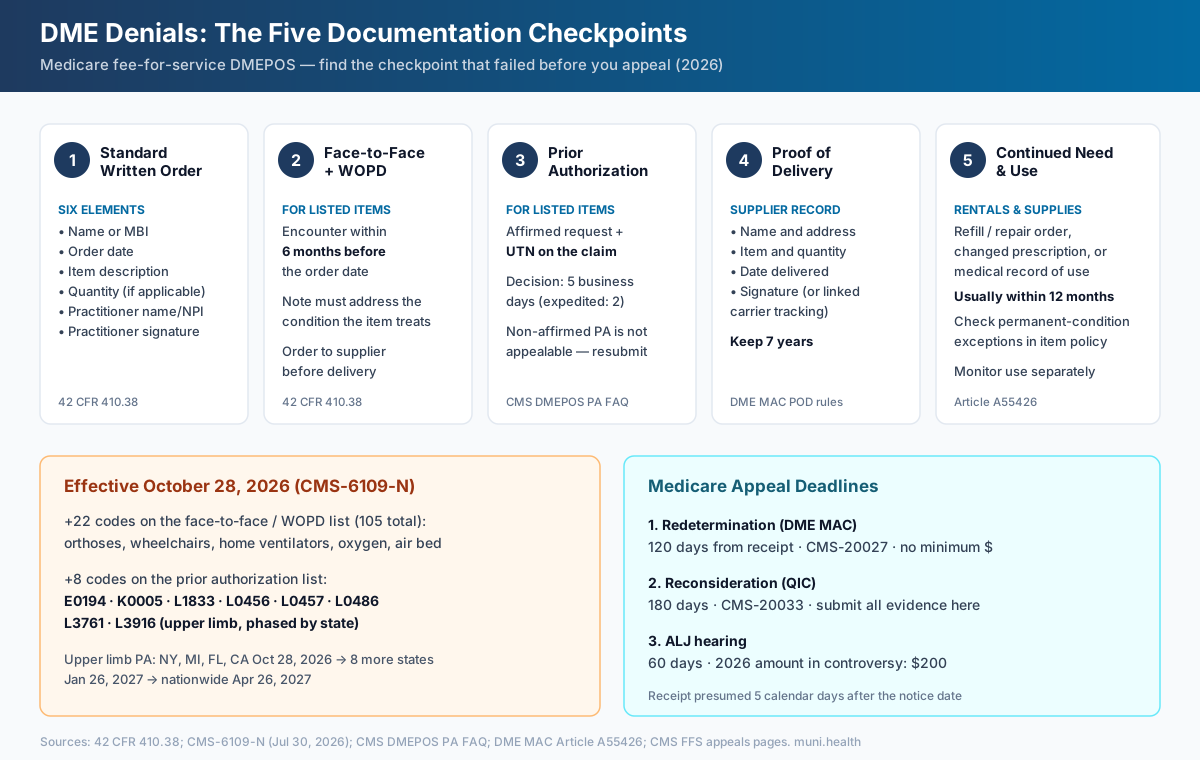
CMS is adding 22 HCPCS codes to the face-to-face and written-order-prior-to-delivery list and 8 codes to the DMEPOS prior authorization list, effective October 28, 2026. The change comes from a Federal Register notice published July 30, 2026 (CMS-6109-N). Items billed without the new documentation after that date will start producing denials.
- Face-to-face and written order prior to delivery (F2F/WOPD): 22 codes are added, bringing the required list to 105 codes. The additions cover lumbar-sacral, lower limb, and upper limb orthoses; eight manual and power wheelchair codes (K0002–K0007, E1161, K0831); three home ventilator codes (E0466–E0468); a portable oxygen fill system (K0738); and an air-fluidized bed (E0194).
- Prior authorization: eight codes are added: E0194 (air-fluidized bed), K0005 (ultralightweight wheelchair), L1833 (off-the-shelf knee orthosis), the thoracic-lumbar-sacral orthoses L0456, L0457, and L0486, and the upper limb orthoses L3761 and L3916. The 74 codes already on the list stay there.
- Upper limb orthoses phase in by state. Prior authorization for L3761 and L3916 starts October 28, 2026 in New York, Michigan, Florida, and California. It expands on January 26, 2027 to Pennsylvania, Massachusetts, Ohio, Illinois, Texas, Georgia, Arizona, and Oregon, and reaches all remaining states and territories on April 26, 2027.
CMS explained why it chose orthoses. From 2023 to 2025, CERT improper payment rates ran about 40% to 48% for upper limb orthoses and 35% to 47% for lower limb orthoses. Manual wheelchairs ranged from 22.1% to 42% over the same period (same notice). If your practice orders or dispenses braces, wheelchairs, or ventilators, update your order templates before October 28.
The Five Documentation Checkpoints
For a documentation denial, review these five checkpoints alongside the item-specific coverage policy. Find the one that failed before you decide how to respond.
| Checkpoint | What Medicare requires | Who controls it | Common failure |
|---|---|---|---|
| 1. Standard written order (SWO) | Six elements: beneficiary name or MBI, order date, general item description, quantity (if applicable), treating practitioner name or NPI, practitioner signature | Ordering practice | Missing signature, missing quantity, or order dated after delivery |
| 2. Face-to-face encounter + WOPD | For listed items, a treating practitioner encounter within the 6 months before the order date, documented in the chart, with the order communicated to the supplier before delivery | Ordering practice | Encounter older than 6 months, or a visit note that never addresses the condition the item treats |
| 3. Prior authorization (UTN) | For items on the Required Prior Authorization List, a provisionally affirmed request and its unique tracking number (UTN) on the claim | Supplier (with practice records) | Claim billed before a PA decision, or UTN left off the claim |
| 4. Proof of delivery (POD) | Beneficiary name, delivery address, item description, quantity, date delivered, and beneficiary or designee signature, kept 7 years | Supplier | Unsigned or undated delivery slip, or shipping records that can't be linked to the invoice |
| 5. Continued need and continued use | Recent refill or repair order, changed prescription, or timely medical-record evidence of use; generally within 12 months. Check item-specific permanent-condition exceptions. Monitor continued use separately | Both | No qualifying continued-need evidence or applicable exception; missing continued-use records |
1. Standard written order
Every DMEPOS item needs a written order with six elements under 42 CFR 410.38: beneficiary name or Medicare Beneficiary Identifier, a general description of the item, quantity to be dispensed (if applicable), order date, treating practitioner name or NPI, and treating practitioner signature. Missing any element makes the order defective. The most common fixes are a missing signature, a missing quantity on supplies, and an order date that falls after the delivery date for an item that requires a written order prior to delivery.
2. Face-to-face encounter and written order prior to delivery
For items on the F2F/WOPD list, the same regulation requires the treating practitioner to have a face-to-face encounter with the beneficiary within the 6 months before the date of the written order. The order must also reach the supplier before delivery. The encounter must be documented in the relevant part of the medical record, such as the history, exam, test results, or treatment plan. The note needs subjective and objective, beneficiary-specific information about the condition the item treats. Telehealth encounters can qualify when they meet Medicare's telehealth rules (CMS-6109-N).
This is the checkpoint most often under the practice's control. A visit within the window doesn't qualify if the note never mentions the mobility limitation, the knee instability, or the respiratory failure that justifies the item.
3. Prior authorization
Items on the Required Prior Authorization List need a provisionally affirmed decision before the claim is billed. CMS's DMEPOS prior authorization FAQ states that claims billed without a request and a provisional affirmation "will be denied payment," and that the claim must carry the UTN. The DME MACs decide initial requests within 5 business days, not to exceed 7 calendar days. Expedited requests take 2 business days when the standard timeline could seriously jeopardize the patient's life, health, or ability to regain maximum function (Noridian JD DME, updated March 2026).
A Non-Affirmed Prior Authorization Is Not Appealable
Per the CMS FAQ, "A prior authorization decision is not a payment determination and is not appealable." You have two routes. You can fix the documentation and resubmit the request, and DME MACs allow unlimited resubmissions. Or you can furnish the item, submit the claim with the UTN, and appeal the resulting claim denial through the standard Medicare process. Resubmitting is usually faster and doesn't expose you to a denied claim.
4. Proof of delivery
Proof of delivery is entirely the supplier's responsibility, and missing POD alone is enough to deny the claim. Noridian's proof of delivery requirements (updated June 30, 2026) cover two methods. For direct delivery, the record needs the beneficiary's name, delivery address, item description, quantity, date delivered, and the signature of the beneficiary or a designee. For shipped items, the supplier needs records that link its invoice to the carrier's tracking and show evidence of delivery. POD must be kept for 7 years from the date of service. Noridian says services without appropriate POD "will be denied and overpayments will be requested."
5. Continued need and continued use
For ongoing supplies and rented items, the DME MACs' Standard Documentation Requirements article (A55426) accepts a recent treating-practitioner refill order, repair order, changed prescription, or timely medical-record documentation of item use as continued-need evidence. The usual window is the preceding 12 months, unless the policy specifies another timeframe. Some items have a permanent-condition exception when the benefit category is met or continues to be met; consult the item's LCD-related policy article. A missing recent visit note alone does not establish a documentation failure or require a new visit. Continued use is a separate requirement: suppliers monitor rental items and ongoing supplies, using qualifying medical or supplier records.
Attestation Letters Don't Replace the Chart
A55426 states that "Supplier prepared statements and physician attestations by themselves do not provide sufficient documentation of medical necessity, even if signed by the ordering physician." When a supplier asks your practice to sign a letter after a denial, the letter only helps if the chart notes from the relevant period already support it. The records that win the appeal are the encounter notes, test results, and treatment plan.
Pre-Delivery Documentation Checklist
Use this checklist before the item ships. Every documentation denial caught here is one you never have to appeal.
DME PRE-DELIVERY DOCUMENTATION CHECKLIST (Medicare FFS)
Patient: [Name] | MBI: [ID] | Item / HCPCS: [Code + description]
Ordering practitioner: [Name, credentials, NPI]

[ ] 1. STANDARD WRITTEN ORDER (42 CFR 410.38) — all six elements present
  [ ] Beneficiary name or MBI
  [ ] Order date
  [ ] General description of the item
  [ ] Quantity to be dispensed (if applicable)
  [ ] Treating practitioner name or NPI
  [ ] Treating practitioner signature

[ ] 2. FACE-TO-FACE / WOPD (only if the HCPCS code is on the F2F/WOPD list)
  [ ] Checked the code against the current list (go.cms.gov/DMEPOSF2F);
      22 codes are added effective October 28, 2026
  [ ] Encounter date: [date] — within 6 months BEFORE the order date
  [ ] Encounter note addresses the condition the item treats
      (history, exam, findings, plan — beneficiary-specific)
  [ ] Order communicated to the supplier BEFORE delivery date

[ ] 3. PRIOR AUTHORIZATION (only if the code is on the Required PA List)
  [ ] Checked the code against the current list (go.cms.gov/DMEPOSPA)
  [ ] Upper limb orthoses (L3761, L3916): checked the state phase-in date
  [ ] PA request included the order, relevant medical records,
      and supplier-produced documentation
  [ ] Decision: provisionally affirmed — UTN: [14-character UTN]
  [ ] UTN entered on the claim

[ ] 4. PROOF OF DELIVERY (supplier)
  [ ] Beneficiary name and delivery address
  [ ] Item description and quantity
  [ ] Date delivered
  [ ] Beneficiary or designee signature (or carrier tracking linked
      to the invoice for shipped items)
  [ ] Stored for 7 years from date of service

[ ] 5. RENTALS / RECURRING SUPPLIES
  [ ] Continued need: recent refill/repair order, changed prescription,
      or medical-record evidence of use within the applicable timeframe
      (usually 12 months); check permanent-condition policy exceptions
  [ ] Supplier record of continued use / refill request

[ ] 6. ITEM-SPECIFIC POLICY
  [ ] Reviewed the LCD and policy article for this item for any
      additional coverage criteria (tests, trial periods, diagnoses)

Checked by: [Name] | Date: [Date]
Skip the blank template. Start with a review-ready draft.
Use the template as guidance, or let Muni prepare a payer-specific draft for your team to verify, sign, and submit.
First 3 appeals free, then $20 per appeal. Start with your denial letter or EOB and available records. No meeting or clearinghouse connection required.
How to Appeal a DME Denial
First identify which checkpoint failed. Then file a Medicare redetermination with the DME MAC within 120 days of receiving the denial, and attach the specific document that cures the defect. CMS presumes the notice was received 5 calendar days after its date. There is no minimum dollar amount to request a redetermination, and the MAC generally decides within 60 days. File on form CMS-20027 or with a written request that contains the required information.
| Level | Who decides | Deadline to file | Notes |
|---|---|---|---|
| 1. Redetermination | DME MAC | 120 days from receipt of the initial determination | Form CMS-20027; no minimum amount in controversy |
| 2. Reconsideration | Qualified Independent Contractor (QIC) | 180 days from receipt of the redetermination | Form CMS-20033; evidence not submitted here may be excluded at later levels without good cause |
| 3. ALJ hearing | Office of Medicare Hearings and Appeals | 60 days from the QIC decision | 2026 amount in controversy: $200 |
Sources: CMS redetermination, CMS reconsideration, CMS ALJ hearing, and the CY 2026 amount-in-controversy notice.
Put Everything In by Reconsideration
CMS warns that documentation not submitted at the reconsideration level "may be excluded from consideration at subsequent levels of appeal unless good cause is shown." Collect the complete chart, order, delivery, and prior authorization record before the QIC stage, not at the ALJ stage.
Match the fix to the denial
- Defective order: get the missing element added or a compliant order produced. Include the order and any chart note that supports the order date. Don't backdate anything. A new order that postdates delivery doesn't cure an item that required a written order prior to delivery.
- Face-to-face encounter: submit the qualifying encounter note from the 6-month window and point to the sections that address the condition. If no qualifying encounter happened in the window, a letter written after the fact won't satisfy the rule.
- No UTN or no prior authorization: check whether a request was made and affirmed. If it was, submit the affirmation letter and correct the claim. If no request was made, the denial generally stands for that claim, and the fix is a process change.
- Proof of delivery: submit the signed delivery slip or the linked carrier tracking record.
- Continued need: check for a qualifying refill/repair order, changed prescription, or medical-record evidence of use within the policy timeframe, or an applicable permanent-condition exception. Submit evidence relevant to the denied dates; do not infer that a new visit is required solely because a recent visit note is absent.
- Medical necessity or coverage criteria: build the argument from the item's LCD criteria and the chart, using the same structure as a medical necessity justification letter.
[Supplier or Practice Letterhead]
[Date]

[DME MAC Name] — Redeterminations
[Address from the initial determination / remittance notice]

RE: Request for Redetermination — DMEPOS Claim
Beneficiary: [Name] | MBI: [ID]
Claim / ICN: [Number] | Date(s) of service: [Dates]
Item: [HCPCS code(s) and description]
Supplier: [Name] | PTAN/NPI: [Numbers]
Ordering practitioner: [Name, credentials, NPI]
Denial reason as stated: [Copy the reason/remark codes and text]
Date of initial determination: [Date]

Dear Redetermination Reviewer:

We request redetermination of the claim above. The denial states that
[restate the specific defect — e.g., "the face-to-face encounter was not
documented within 6 months prior to the written order" / "proof of
delivery was not provided" / "the claim did not include a UTN"].

The enclosed documentation shows that the requirement was met:

1. [CHECKPOINT] — [e.g., Face-to-face encounter on (date), (X) days before
 the written order dated (date), performed by (practitioner). The
 encounter note documents (condition), (objective findings), and
 (plan for the item). See Exhibit A, pages (x–y).]

2. [CHECKPOINT] — [e.g., Standard written order dated (date) containing
 all elements required by 42 CFR 410.38, communicated to the supplier
 on (date), before delivery on (date). See Exhibit B.]

3. [CHECKPOINT] — [e.g., Proof of delivery signed by the beneficiary on
 (date), listing the item, quantity, and delivery address. See
 Exhibit C.]

[If applicable: The item was provisionally affirmed under prior
authorization on (date), UTN (number). See Exhibit D. The UTN was omitted
from the original claim in error.]

Because the documentation requirement cited in the denial was satisfied,
we ask that the claim be reprocessed for payment.

ENCLOSURES
Exhibit A — Treating practitioner encounter note(s), [dates]
Exhibit B — Standard written order
Exhibit C — Proof of delivery
Exhibit D — Prior authorization decision letter (if applicable)
Exhibit E — Copy of the initial determination / remittance notice

Sincerely,

[Name, Title]
[Organization]
[Phone] | [Fax] | [Email]
Medicare Advantage and Commercial DME Denials
Medicare Advantage and commercial plans cover DME under their own prior authorization lists and medical policies. Many route DME through a delegated vendor, and the appeal process follows the plan's rules, not the DME MAC's. Read the denial notice for the plan's deadline and submission address. The documentation habits in this guide still help: a signed order, a recent encounter note that addresses the condition, and proof of delivery are the core of most plan reviews. For plan-level timelines, see the Medicare Advantage appeal guide and the insurance appeal deadlines reference. If the plan denied the prior authorization itself, start with what happens when a prior authorization is denied.
Prepare this appeal packet with your team.
Draft the appeal, coordinate missing documents, and approve the reviewed packet. Keep your clearinghouse; your practice checks deadlines and submits through the payer’s accepted channel.
First 3 appeals free, then $20 per appeal. Start with your denial letter or EOB and available records. No meeting or clearinghouse connection required.
How Muni Appeals Helps With DME Denials
For a documentation denial, match the available records to the stated denial reason. Muni Appeals organizes uploaded denial notices and records against that reason. Staff can see whether the claim needs the encounter note from the 6-month window, the signed order, the delivery record, or qualifying continued-need evidence. It then drafts a redetermination request that cites the specific documents. Staff review the facts, current policy, and submission route before anything is sent.
For the broader prior authorization picture, see the complete prior authorization denial guide. Practices deciding whether to keep appeals manual or automate them can compare approaches in the appeal automation software guide for small practices.
Frequently Asked Questions
What is the most common reason Medicare denies DME claims?
The CERT dollar distribution does not establish the most common denial reason. In CMS's 2025 CERT data, about $1.1 billion of the $2.3 billion in DMEPOS improper payments was classified as no documentation and $0.7 billion as insufficient documentation. About $0.1 billion was classified as medical necessity. Those figures measure projected improper-payment dollars, not denied claims. Check the specific denial notice and item policy.
Does continued need require a new visit every 12 months?
No automatic annual visit rule follows from A55426. Its alternatives and permanent-condition exceptions are explained under checkpoint 5 above. Check the item policy and existing qualifying records before arranging additional documentation; continued use remains a separate requirement.
What must a DME standard written order include?
Under 42 CFR 410.38, the order must include the beneficiary's name or MBI, the order date, a general description of the item, the quantity to be dispensed (if applicable), the treating practitioner's name or NPI, and the treating practitioner's signature.
How recent does the face-to-face encounter need to be for DME?
For items on the Required Face-to-Face Encounter and Written Order Prior to Delivery list, the treating practitioner must have a face-to-face encounter with the beneficiary within the 6 months before the written order date. The order must also reach the supplier before delivery. The encounter must be documented in the medical record and address the condition the item treats.
Can I appeal a non-affirmed DME prior authorization?
No. CMS states that a DMEPOS prior authorization decision is not a payment determination and is not appealable. You can correct the documentation and resubmit the request, and DME MACs allow unlimited resubmissions. Or you can submit the claim and appeal the resulting claim denial through the standard Medicare appeal levels.
What DME items were added to Medicare prior authorization in 2026?
A Federal Register notice published July 30, 2026 adds eight codes to the Required Prior Authorization List effective October 28, 2026: E0194, K0005, L1833, L0456, L0457, L0486, L3761, and L3916. Prior authorization for the two upper limb orthoses (L3761 and L3916) phases in by state from October 28, 2026 through April 26, 2027. The same notice adds 22 codes to the face-to-face and written-order-prior-to-delivery list, for 105 codes in total.
How long do I have to appeal a Medicare DME denial?
You have 120 days from receipt of the initial determination to request a redetermination from the DME MAC. CMS presumes receipt 5 calendar days after the notice date. The next level, reconsideration by a QIC, must be requested within 180 days of receiving the redetermination decision.
Will a physician attestation letter fix a DME medical necessity denial?
Not by itself. The DME MACs' Standard Documentation Requirements article says supplier-prepared statements and physician attestations "by themselves do not provide sufficient documentation of medical necessity, even if signed by the ordering physician." The appeal needs the underlying medical record, such as encounter notes, test results, and the treatment plan from the relevant period.
This guide reflects Medicare fee-for-service DMEPOS rules current as of September 27, 2026, including CMS-6109-N (effective October 28, 2026), 42 CFR 410.38, DME MAC Standard Documentation Requirements (A55426), and the 2025 CERT supplemental improper payment data. Required lists, item policies, and Medicare Advantage or commercial plan rules change. Verify the current list, LCD, and denial notice before filing. This information is for administrative and billing purposes and is not legal or medical advice.