

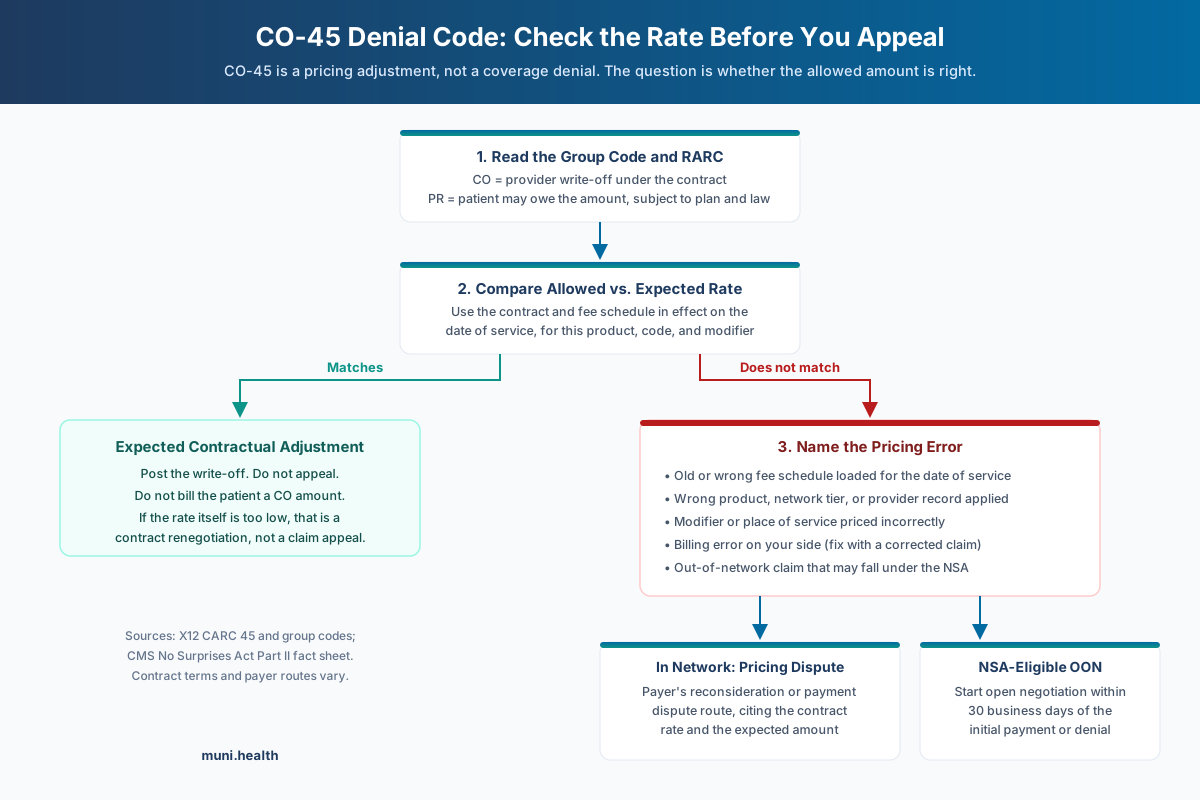
CO-45 means the billed charge exceeded the payer's fee schedule, maximum allowable, or contracted or legislated fee arrangement, and the CO group code assigns that difference to the provider as a contractual write-off. In most cases it is not a denial to appeal: if the allowed amount matches the rate your contract sets for that code, product, and date of service, post the adjustment and do not bill the patient for it. Dispute CO-45 only when the allowed amount is wrong, for example because an outdated fee schedule, the wrong network product, or incorrect modifier pricing was applied. Use the payer's pricing reconsideration or payment dispute route and cite the contract rate. For an out-of-network claim covered by the No Surprises Act, the remedy is open negotiation and federal IDR, not a standard appeal.
What Does CO-45 Mean?
CO-45 is a pricing adjustment: the payer allowed less than you billed because your charge is higher than the amount it pays for that service. It is not a coverage decision, and it does not mean the claim was rejected.
The official X12 definition of CARC 45 is "Charge exceeds fee schedule/maximum allowable or contracted/legislated fee arrangement." X12's usage note adds that the adjustment cannot equal the full service or claim charge, must not duplicate adjustments already taken by a prior payer, and is used only with group code PR or CO, depending on who is liable.
The group code decides who absorbs the difference. X12 lists four active claim adjustment group codes: CO (Contractual Obligation), OA (Other Adjustment), PI (Payor Initiated Reduction), and PR (Patient Responsibility).
- CO-45: The difference is a contractual obligation. For an in-network claim, it is the discount you agreed to when you signed the contract, and the patient is not billed for it.
- PR-45: The payer is saying the patient may be responsible for the difference. Whether you can actually collect it depends on your network status, the plan, and federal or state balance-billing law. Confirm before sending a statement.
Practices commonly set their standard charges above what payers allow, so CO-45 lines are routine on paid claims. The code only matters when the allowed amount is wrong.
Should You Appeal a CO-45?
Usually not. A CO-45 adjustment that matches your contracted rate is the contract working as written, and an appeal of that adjustment has nothing to argue.
Filing appeals on correctly priced CO-45 lines costs staff time and does not change the rate. The real question is whether the allowed amount is correct. Answer that before you choose any route:
- Find the expected rate. Pull the fee schedule or reimbursement exhibit that applied to this payer, product, and date of service. For Medicare Part B physician services, the CMS Physician Fee Schedule Look-up Tool gives payment amounts by MAC locality, including limiting charges for non-participating providers. For commercial and Medicare Advantage plans, the rate is whatever your contract says.
- Adjust for pricing rules. Account for modifiers, place of service, multiple-procedure reductions, and any other methodology your contract adopts. A lower allowable on a second procedure is often a separate multiple-procedure adjustment (CARC 59), not a CO-45 error.
- Compare. If allowed equals expected, post the write-off and move on. If allowed is lower and you can name the reason, you have a pricing dispute.
Low Rate vs. Wrong Rate
A CO-45 you don't like is not the same as a CO-45 that is wrong. If the payer paid exactly what the contract says and the contracted rate is too low, the fix is renegotiating the contract. A claim-level dispute can only recover the difference between what was paid and what the contract already requires.
When CO-45 Is Actually Wrong
A CO-45 is worth disputing when you can point to a specific mismatch between the allowed amount and the rate the payer owed. These are the patterns to check first:
| What went wrong | How it shows up | What to check | Likely route |
|---|---|---|---|
| Outdated or incorrect fee schedule loaded | Allowed amount matches last year's rate or a different code's rate | Contract amendments and fee schedule effective dates against the date of service | Pricing reconsideration or payment dispute |
| Wrong product or network tier applied | A commercial PPO claim priced at an HMO, narrow-network, or Medicare Advantage rate | Member's product on the date of service and which products your contract covers | Pricing reconsideration or payment dispute |
| Provider or location record mismatch | Rate reflects a different provider type, specialty, TIN, or location | Payer's credentialing and demographic record for the rendering provider | Update the record, then request reprocessing |
| Modifier or place of service priced incorrectly | Facility vs. non-facility or professional/technical split priced wrong | The modifier and POS on the claim, and your contract's pricing rules for them | Reprocessing if the payer erred; corrected claim if you did |
| Your billing error | Wrong units, code, modifier, or POS on the original claim | The claim as submitted against the chart | Corrected claim, not an appeal |
| Out-of-network claim that may fall under the NSA | Emergency, air ambulance, or certain non-emergency services at an in-network facility paid at a rate you dispute | Whether the service qualifies and whether a state law applies instead | Open negotiation, then federal IDR if eligible |
If the error is on your side, a dispute letter won't fix it. Submit a corrected claim with the right data. The corrected claim vs. insurance appeal guide covers how to tell which one a denial needs, and reconsideration vs. appeal explains why many payers want a reconsideration before a formal appeal.
How to Dispute an Underpaid CO-45 Claim
Dispute an underpaid CO-45 through the route your payer contract and provider manual name for payment or pricing disputes. Payers label it differently (reconsideration, payment dispute, or claim review), and some handle it through a portal instead of a letter.
Before you send anything:
- Confirm the route and deadline. Check your contract's dispute clause and the payer's current provider manual. The filing window, required form, and submission channel vary by payer, product, and state.
- Call to confirm the pricing basis. Ask the payer which fee schedule, product, and pricing rule produced the allowed amount. Get a reference number. The claim status call script includes a CO-45 line for that conversation.
- Build the math. Show the expected rate, the allowed amount, and the difference for every disputed line. A dispute with a specific dollar amount and a contract citation is easier to review than one that just says "underpaid."
- Batch when the cause is systemic. If a fee schedule load error affected every claim with a given code since a certain date, ask the payer or your provider representative whether it will run a project to reprocess all affected claims rather than making you dispute each claim separately.
CO-45 Rate-Check Worksheet
Fill this out before you decide whether to dispute. If the variance is zero, stop and post the write-off.
CO-45 RATE-CHECK WORKSHEET

Claim number: ______________________
Payer / product (e.g., commercial PPO, HMO, Medicare Advantage): ______________________
Network status on date of service: [ ] In network  [ ] Out of network
Date of service: ____________
Group code on remittance: [ ] CO-45  [ ] PR-45
RARC(s) on remittance: ____________

LINE-LEVEL CHECK (one row per disputed line)
CPT/HCPCS: ______  Modifier(s): ______  POS: ______  Units: ______
Billed charge: $__________
Allowed amount on remittance: $__________
Expected rate from contract / fee schedule for this DOS: $__________
Source of expected rate (exhibit name, amendment, effective date): ______________________
Variance (expected - allowed): $__________

ROOT-CAUSE CHECK
[ ] Allowed amount matches contract -> post write-off, no dispute
[ ] Our claim had wrong code, units, modifier, or POS -> corrected claim
[ ] Payer used an outdated or incorrect fee schedule
[ ] Payer applied the wrong product or network tier
[ ] Payer's provider / location record is wrong
[ ] Payer priced a modifier or POS incorrectly
[ ] Out-of-network service that may qualify under the No Surprises Act

ROUTING
Dispute route per contract / provider manual: ______________________
Filing deadline for this payer and product: ____________
Payer call reference number: ____________
Same issue on other claims? [ ] No  [ ] Yes -> list claim numbers for a batch request
Skip the blank template. Start with a review-ready draft.
Use the template as guidance, or let Muni prepare a payer-specific draft for your team to verify, sign, and submit.
First 3 appeals free, then $20 per appeal. Start with your denial letter or EOB and available records. No meeting or clearinghouse connection required.
CO-45 Pricing Dispute Letter Template
Use this when the worksheet shows a payer-side pricing error on an in-network claim. If the payer requires a specific form or portal submission, attach this as the supporting explanation.
[Your Practice Letterhead]
[Date]

[Payer Name]
[Provider Disputes / Claim Reconsideration Department]
[Address, fax, or portal reference from the provider manual]

RE: Payment Dispute — Incorrect Pricing on CO-45 Adjustment
  Patient: [Patient Name]    DOB: [Date of Birth]
  Member ID: [Member ID]
  Claim Number: [Claim #]
  Date(s) of Service: [DOS]
  Rendering Provider / NPI: [Name, NPI]
  Billing TIN: [Tax ID]
  Payer Call Reference (if any): [Reference #, date]

To Whom It May Concern:

We request reprocessing of the claim referenced above. The remittance applied a CO-45 adjustment that reduced the allowed amount below the rate required by our agreement with [Payer Name].

Contract basis:
[Agreement name], [reimbursement exhibit / fee schedule name], effective [date], applicable to [product/line of business] for the date of service.

Line-level pricing:
Line [#] — CPT/HCPCS [code] [modifier], POS [##], [units] unit(s)
  Contracted rate for DOS: $[amount]
  Allowed amount on remittance: $[amount]
  Underpayment: $[amount]
[Repeat for each disputed line]

Total underpayment requested: $[amount]

Reason for the discrepancy:
[State the specific cause, e.g., "The claim appears to have been priced using the fee schedule in effect before the [date] amendment," or "The claim was priced under the [product] rate, but the member's coverage on the date of service was [product]."]

Enclosed:
- Remittance advice for this claim
- The applicable fee schedule page or reimbursement exhibit
- [Contract amendment showing effective date, if relevant]
- [Member eligibility showing product on DOS, if relevant]

Please reprocess the claim at the contracted rate and issue the underpaid amount. If you determine the original pricing was correct, please identify the fee schedule, product, and pricing rule applied so we can reconcile it against our agreement.

[If the same error affects other claims, add:] The same pricing discrepancy appears on the claims listed in the attached schedule. We ask that [Payer Name] review and reprocess these claims together.

Sincerely,

[Your Name]
[Title]
[Practice Name]
[Phone] | [Email]
CO-45 on Out-of-Network Claims
For out-of-network claims, CO-45 typically reflects that the payer priced the service at its own out-of-network allowable instead of your billed charge. Whether you can dispute that amount depends on which law applies to the service, not on the CARC.
Prepare this appeal packet with your team.
Draft the appeal, coordinate missing documents, and approve the reviewed packet. Keep your clearinghouse; your practice checks deadlines and submits through the payer’s accepted channel.
First 3 appeals free, then $20 per appeal. Start with your denial letter or EOB and available records. No meeting or clearinghouse connection required.
The No Surprises Act created a federal payment dispute process for certain out-of-network services: emergency services, non-emergency services from out-of-network providers at in-network facilities, and air ambulance services, per the CMS Part II interim final rule fact sheet. The timeline is strict:
| Step | Deadline | Source |
|---|---|---|
| Start open negotiation | Within 30 business days, starting on the day of the initial payment or notice of denial | CMS Part II IFR fact sheet |
| Open negotiation period | Lasts 30 business days | CMS About IDR page |
| Start federal IDR if negotiation fails | Within 4 business days after open negotiation ends, unless the Departments grant an extension | CMS About IDR page |
CMS notes that not every service is eligible and that some states have their own balance-billing and out-of-network payment laws. Check which process applies before you start the clock. The No Surprises Act IDR guide walks through eligibility, the open negotiation notice, and what the IDR entity weighs.
If the out-of-network service is not covered by the NSA or a state law, the payer's own out-of-network payment policy and appeal process controls. The group code on the line (CO or PR) tells you what the payer thinks you can bill the patient for, but your balance-billing rights still depend on the plan and applicable law.
CO-45 vs. Codes That Look Similar
CO-45 is the general "charge exceeds allowable" code. Several other codes reduce payment for more specific reasons, and each needs a different response.
| Code | What it means | Correct response |
|---|---|---|
| CO-45 | Charge exceeds fee schedule, maximum allowable, or contracted/legislated fee arrangement | Compare allowed vs. contracted rate; write off if correct, dispute the pricing if not |
| CO-42 | Old code for charges exceeding the fee schedule. X12 stopped it on 06/01/2007 and directs payers to use CARC 45 | Treat as CO-45; ask the payer to confirm if it still appears on a current remittance |
| CARC 59 | Processed under multiple or concurrent procedure rules (e.g., multiple surgery, diagnostic imaging, concurrent anesthesia) | Check ranking and the payer's multiple-procedure policy, not the base fee schedule |
| CARC 131 | Claim-specific negotiated discount | Match against the single-case or claim-level agreement you signed |
| CARC 172 | Payment adjusted when performed or billed by a provider of this specialty | Verify the payer's specialty record and the policy it cites |
| CARC 253 | Sequestration, a reduction in federal payment | Expected on applicable federal program payments; not a pricing error |
| CO-97 | Payment included in another service already adjudicated | Verify the bundling rule; see the CO-97 guide |
Definitions are from the X12 CARC list. For bundling denials, see CO-97 denial code. For documentation and data gaps, see CO-16. For medical necessity, see CO-50. The EOB denial code guide maps how these codes fit together.
How Muni Appeals Helps With CO-45 Disputes
Muni Appeals drafts review-ready appeal and dispute letters from the remittance, claim details, and supporting documents your staff provides. For CO-45, your team still does the rate check: confirming the contract rate, the product, and the right dispute route. Muni turns that into a clear, line-by-line request.
Deciding whether letter-drafting automation is worth it for your volume? The appeal automation cost vs. manual processing breakdown shows where staff time actually goes.
Frequently Asked Questions
What does denial code CO-45 mean?
CO-45 means the billed charge exceeded the payer's fee schedule, maximum allowable, or contracted or legislated fee arrangement. The CO group code means the difference is a contractual obligation the provider writes off. It is a pricing adjustment on a paid or partly paid line, not a coverage denial.
Can I bill the patient for a CO-45 adjustment?
No. A CO group code assigns the adjustment to the provider under the contract. If the line shows PR-45 instead, the payer is indicating possible patient responsibility, but confirm your network status, the plan terms, and federal or state balance-billing rules before billing the patient.
Is CO-45 appealable?
Only when the allowed amount is wrong. If the payer paid your contracted rate, there is nothing to appeal. If it applied an outdated fee schedule, the wrong product, or incorrect modifier or place-of-service pricing, file a pricing dispute or reconsideration under your contract and the payer's provider manual.
What is the difference between CO-45 and PR-45?
Both use CARC 45, meaning the charge exceeded the allowable. CO assigns the difference to the provider as a contractual obligation. PR indicates the payer considers the patient responsible for it. Whether you can collect a PR amount still depends on the plan and applicable law.
What is the difference between CO-45 and CO-42?
CO-42 is an older code for charges exceeding the fee schedule. X12 set its stop date as June 1, 2007, and directs payers to use CARC 45 instead. If CO-42 appears on a current remittance, treat it like CO-45 and ask the payer to confirm the pricing basis.
How do I know if a CO-45 underpayment is worth disputing?
Calculate the variance between the contracted rate and the allowed amount for each line. A small variance on one claim may not justify the staff time, but the same error repeated across every claim with that code often does. When the cause is systemic, ask the payer whether it will reprocess all affected claims together.
Does the No Surprises Act apply to CO-45 on an out-of-network claim?
It can. For qualifying emergency services, non-emergency services by out-of-network providers at in-network facilities, and air ambulance services, the provider or payer must start open negotiation within 30 business days of the initial payment or denial. If negotiation fails, either side can start federal IDR within 4 business days. Some states use their own process instead.
Stop Appealing Correct CO-45s and Recover the Wrong Ones
Most CO-45 lines are the contract doing what it says. The payoff is in catching the ones that aren't: a stale fee schedule, the wrong product, or a pricing rule applied incorrectly. Run the rate check first, then dispute with the contract rate and exact math.
With Muni Appeals, your team gets:
- Review-ready dispute and appeal letters built from the remittance and documents staff provides
- Line-by-line pricing requests that cite the contract rate and variance
- Staff control over the rate check, dispute route, and filing deadline
This guide reflects the X12 CARC and group code definitions and CMS No Surprises Act guidance available as of September 2026. Contract terms, fee schedules, dispute routes, filing deadlines, and balance-billing rules vary by payer, product, and state. Verify your contract, the payer's current provider manual, and applicable law before filing. This guide is not legal or billing compliance advice.