

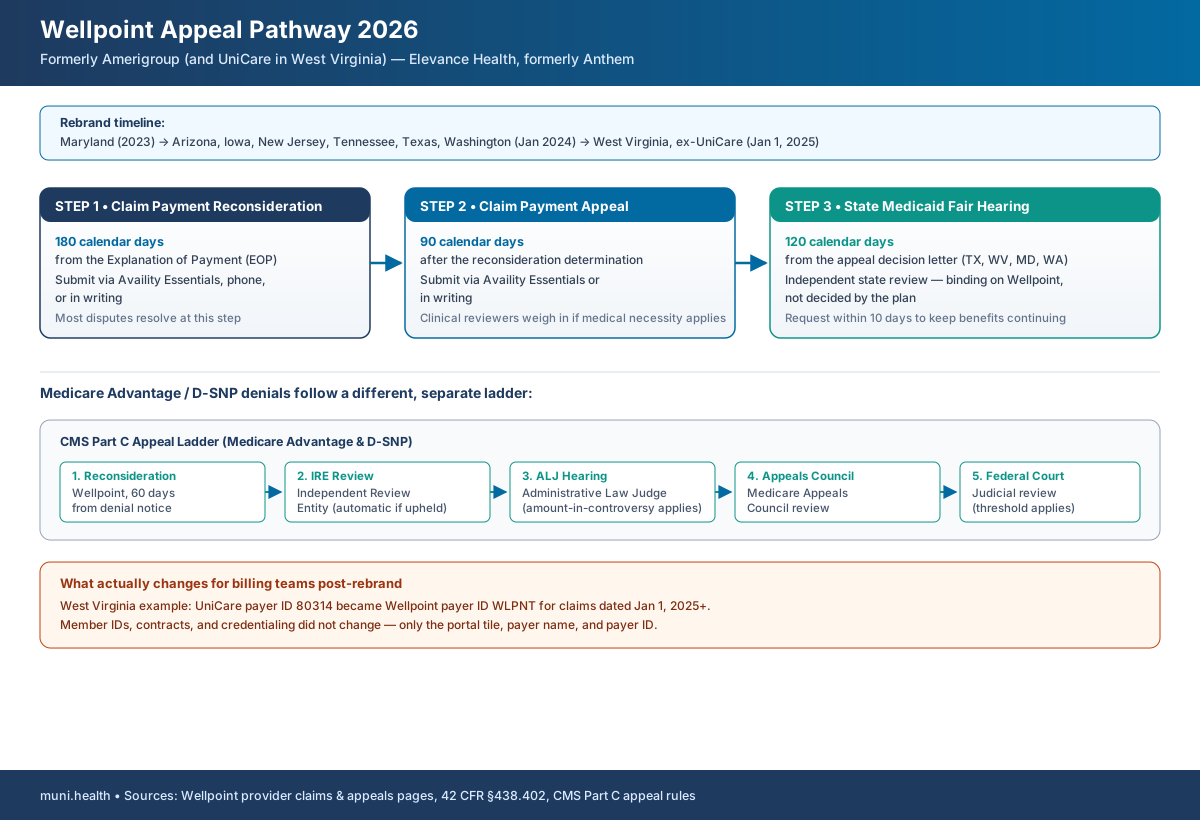
Wellpoint is Elevance Health's rebranded Amerigroup (and, in West Virginia, UniCare) Medicaid and Medicare Advantage business. A provider dispute runs through a claim payment reconsideration (180 days from the Explanation of Payment) then a claim payment appeal (90 days after), both via Availity Essentials. Medicaid denials can escalate to a binding state fair hearing (120 days in Texas, West Virginia, Maryland, and Washington). Medicare Advantage and D-SNP denials instead follow the separate CMS Part C appeal ladder.
What Is Wellpoint? Understanding the Amerigroup Rebrand
Wellpoint is not a new insurer — it's the rebranded name Elevance Health (formerly Anthem Inc.) gave its Amerigroup Medicaid and Medicare Advantage subsidiary, and separately its UniCare Health Plan of West Virginia. The rebrand rolled out state by state: Amerigroup Maryland became Wellpoint in 2023, then Amerigroup plans in Arizona, Iowa, New Jersey, Tennessee, Texas, and Washington converted in January 2024, followed by UniCare Health Plan of West Virginia on January 1, 2025 (Healthcare Dive, 2023; Wellpoint West Virginia provider news, 2025).
Elevance framed the change as consolidating its Medicaid, Medicare, and commercial business under one name in markets where it doesn't already sell Blue Cross Blue Shield products directly (Healthcare Dive, 2023). For billing teams, the practical effect is narrower but still disruptive: a new plan name, a new payer ID in some states, and a claims/appeals process that is separate from — and easy to confuse with — Anthem's commercial Blue Cross Blue Shield appeal process.
A Wellpoint Denial Is Not an Anthem Commercial Denial
Anthem Blue Cross Blue Shield commercial plans still use the Anthem name and Provider Dispute Resolution (PDR) process described in our Anthem denial appeal guide. Wellpoint is a separate Medicaid/Medicare Advantage book of business with its own claim reconsideration, appeal, and fair-hearing rules. Filing a Wellpoint claim on an Anthem PDR form — or vice versa — routes it to the wrong queue and burns days off your deadline.
Which States Have Made the Switch
The rebrand did not happen everywhere at once, and it hasn't necessarily reached every state Amerigroup previously served. Confirm the current status for your state at wellpoint.com/state-partners/states-we-serve before assuming a plan has converted.
| State | Former Brand | Rebrand Effective | What Changed for Providers |
|---|---|---|---|
| Maryland | Amerigroup Maryland | 2023 | Plan name, portal branding, provider service lines |
| Arizona | Amerigroup Arizona | January 2024 | Website, provider service phone numbers |
| Iowa | Amerigroup Iowa | January 2024 | Website, provider service phone numbers |
| New Jersey | Amerigroup New Jersey | January 2024 | Website, provider service phone numbers |
| Tennessee | Amerigroup Tennessee | January 2024 | Website, provider service phone numbers |
| Texas | Amerigroup Texas | January 2024 | Website, provider service phone numbers |
| Washington | Amerigroup Washington | January 2024 | Website, provider service phone numbers |
| West Virginia | UniCare Health Plan of WV | January 1, 2025 | Payer ID 80314 → WLPNT; new payer-space tile in multi-payer portals |
Member benefits, coverage, and provider network contracts did not change as part of the rebrand in any state — Elevance and Wellpoint have been explicit that credentialing and reimbursement terms carried over (AAFP/FPM, 2023; Wellpoint West Virginia provider news, 2025). What did change, concretely, is the name on the remittance advice, the portal tile you click, and — in West Virginia — the payer ID on the claim itself.
The West Virginia Payer ID Change Is the Clearest Example
When UniCare Health Plan of West Virginia became Wellpoint on January 1, 2025, claims submitted on or after that date had to use the new Wellpoint payer ID (WLPNT) instead of the old UniCare payer ID (80314). A claim submitted with the wrong payer ID after the cutover typically rejects at the clearinghouse before it ever reaches a human reviewer — it isn't a "denial" you can appeal, it's a routing error you have to fix and resubmit.
The Wellpoint Provider Appeal Ladder: Two Internal Steps, Then Fair Hearing
Wellpoint's provider-facing claim dispute process runs through two internal steps before a Medicaid case can escalate externally.
| Stage | Deadline to File | Submission Channel | Notes |
|---|---|---|---|
| Claim Payment Reconsideration | 180 calendar days from the Explanation of Payment (EOP) date | Availity Essentials, phone, or in writing | Most claim disputes resolve at this step |
| Claim Payment Appeal | 90 calendar days after the reconsideration determination | Availity Essentials or in writing | Reviewed by clinical staff if medical necessity is at issue |
| State Medicaid Fair Hearing / External Medical Review | 120 calendar days from the appeal decision letter (confirmed in TX, WV, MD, WA) | State hearing body, per the decision letter | Independent of Wellpoint; decision is binding on the plan |
This structure is confirmed across Wellpoint's Texas, Maryland, New Jersey, Washington, Iowa, Tennessee, and West Virginia provider claims pages (Wellpoint provider claims and disputes, 2026). Under 42 CFR §438.402, a Medicaid managed care plan like Wellpoint can require only one level of internal appeal for adverse benefit determinations before the member (or provider with member consent) has the right to an independent state fair hearing — the claim payment reconsideration and appeal together satisfy that single internal level.
Step 1: Filing a Wellpoint Claim Payment Reconsideration
A claim payment reconsideration is the first, non-adversarial request to have Wellpoint re-examine how a claim was processed — underpayment, a coding disagreement, a timely filing question, or a straightforward denial you believe was processed in error. If you're unsure whether your situation calls for a reconsideration or a full formal appeal, see our reconsideration vs. appeal comparison guide.
File within 180 calendar days of the EOP issue date. Wellpoint accepts reconsiderations through three channels:
- Availity Essentials — select the claim, choose "Dispute the Claim," and Availity routes it as a reconsideration automatically
- Phone — for straightforward disputes not requiring documentation
- Written submission — required if you're attaching supporting documentation beyond what's already on file
Care providers are not penalized for filing a claim payment reconsideration, and no action is required from the member — this step exists specifically to resolve routine payment errors without a formal appeal.
Step 2: Filing a Wellpoint Claim Payment Appeal
If the reconsideration determination doesn't resolve the issue, you have 90 calendar days from that determination to file a claim payment appeal — also through Availity Essentials or in writing. This is where the process forks based on what's actually being disputed.
If the appeal involves clinical judgment — medical necessity, level of care, or a prior authorization denial — Wellpoint routes it to clinical reviewers rather than the claims processing team that handled the reconsideration.
Prepare state-specific Wellpoint appeals
Muni Appeals surfaces likely state-program and deadline context from the uploaded denial. Staff verifies and calendars every reconsideration, appeal, and fair-hearing deadline.
First 3 appeals free, then $20 per appeal. Start with your denial letter or EOB and available records. No meeting or clearinghouse connection required.
Clinical Denials: Medical Necessity, Prior Authorization, and Peer-to-Peer Review
Medical necessity and prior authorization denials at Wellpoint go through a separate track from routine payment disputes, with a peer-to-peer option before the formal appeal.
A peer-to-peer review lets a treating clinician speak directly with a Wellpoint peer reviewer to present clinical information that wasn't part of the initial review, or to clarify why existing documentation should meet medical necessity criteria. In New Jersey, providers have 7 business days from the denial notification to request a peer-to-peer review (Wellpoint New Jersey provider news, 2026); confirm the exact window and contact number for your state, since peer-to-peer timelines are set at the state-plan level.
Peer-to-Peer Review Doesn't Pause Your Appeal Deadline
If the peer-to-peer call results in the denial being upheld, you're directed to the standard appeal process — and the clock on your formal clinical appeal deadline has kept running during the peer-to-peer conversation. Request the peer-to-peer review promptly, but don't wait on its outcome before also preparing the formal appeal.
Clinical appeals are reviewed by a peer clinician who was not involved in the original denial decision. An "expedited clinical appeal" is available for clinically urgent situations — including prior authorization for pending treatment, emergency care denials, and concurrent hospitalization reviews — and is decided on a faster timeline than a standard appeal.
State Medicaid Fair Hearing: The External Escalation
Once a Wellpoint Medicaid claim payment appeal is upheld, the member (or a provider with the member's consent) can request an independent state fair hearing. This is not run by Wellpoint — it's conducted by the state, and its decision is binding on the plan.
| State | Fair Hearing / External Review Deadline | Continuation of Benefits |
|---|---|---|
| Texas | 120 calendar days from the date the appeal decision letter was mailed | Available if requested within 10 days of the decision letter |
| West Virginia | 120 calendar days after receiving the written appeal decision | Available if requested within 10 days of the decision letter |
| Maryland | 120 days from the date of the MCO's appeal decision | Available if requested within 10 days of the decision letter |
| Washington | 120 calendar days from the date on the appeal decision letter | Available if requested within 10 days of the decision letter |
Wellpoint's dispute-then-fair-hearing structure mirrors what we've documented at other Medicaid managed care organizations — see our CareSource Medicaid appeal guide and Centene/WellCare appeal guide for how the same state fair hearing overlay applies across different MCOs. This 120-day window and the 10-day continuation-of-benefits trigger are consistent across Wellpoint's Texas, West Virginia, Maryland, and Washington Medicaid programs (Wellpoint Texas Medicaid grievances and appeals; Wellpoint West Virginia grievances and appeals; Wellpoint Maryland appeal and grievance rights; Wellpoint Washington grievance and appeal process). Iowa, New Jersey, and Tennessee Medicaid contracts may set different windows — always use the deadline printed on the specific appeal decision letter rather than assuming it matches the states above.
Continuation of Benefits Has a Short, Separate Trigger
Requesting the state fair hearing within 10 days of the appeal decision letter — not the full 120-day window — is what preserves a member's right to keep receiving a disputed service while the hearing is pending, provided they were already receiving it during the internal appeal. Missing that 10-day trigger doesn't forfeit the right to a hearing, but it does forfeit the benefit continuation.
Wellpoint Medicare Advantage and D-SNP: A Different Appeal Ladder Entirely
Wellpoint also sells Medicare Advantage plans — including D-SNP (Dual Eligible Special Needs Plans) that coordinate with state Medicaid — in several of its states. These denials do not go through the state Medicaid fair hearing process described above. They follow the federal CMS Part C appeal ladder instead:
- Reconsideration — filed with Wellpoint, generally within 60 days of the denial notice
- Independent Review Entity (IRE) — automatic if Wellpoint upholds the reconsideration
- Administrative Law Judge (ALJ) hearing — available if the amount in controversy meets the annual CMS threshold
- Medicare Appeals Council review
- Federal court review — subject to its own amount-in-controversy threshold
For a D-SNP member, a single bad outcome can sometimes touch both ladders — the Medicaid side (state fair hearing) and the Medicare side (CMS Part C appeal) — depending on which benefit was denied. Confirm which coverage (Medicare or Medicaid) actually issued the denial before choosing an appeal path.
Common Denial Reason Codes and First Response
| Denial Code | Reason | First Response |
|---|---|---|
| CO-50 | Medical necessity — service not covered per clinical criteria | Request a peer-to-peer review; file a clinical appeal with updated documentation |
| CO-197 | Authorization absent or invalid | Confirm whether prior authorization was actually required for the state/plan; request retro-authorization if applicable |
| CO-29 | Timely filing exceeded | Submit proof of the original claim's earliest submission date (clearinghouse confirmation or EDI acknowledgment) |
| CO-16 | Claim lacks required information | Review the remittance for the specific missing field and resubmit within the timely filing window |
| CO-22 | Coordination of benefits — other payer primary | Verify payer order and resubmit with the primary carrier's EOB attached |
How Muni Appeals Handles Wellpoint Denials
Billing teams managing Wellpoint claims across more than one state are the ones most likely to apply the wrong deadline or the wrong portal — especially right after a state converts from Amerigroup or UniCare.
Muni Appeals supports preparation by:
- Surfacing the likely Wellpoint state program and deadline context for staff verification
- Suggesting likely payment-dispute versus clinical-appeal context so staff can verify the review track
- Flagging payer ID and portal changes tied to a state's rebrand date, so claims aren't submitted under a retired payer ID
- Distinguishing Medicaid state fair hearing escalation from the separate CMS Part C appeal ladder for Medicare Advantage and D-SNP denials
Frequently Asked Questions
Is Wellpoint the same company as Anthem?
Wellpoint is owned by Elevance Health, the same parent company that also operates Anthem Blue Cross Blue Shield commercial plans, but they are separate brands with separate appeal processes. Wellpoint is the rebranded former Amerigroup (and, in West Virginia, UniCare) Medicaid and Medicare Advantage business — not the commercial Anthem BCBS plans, which still use the Anthem name and a different Provider Dispute Resolution process.
What is the deadline to appeal a Wellpoint claim denial?
A claim payment reconsideration must be filed within 180 calendar days of the Explanation of Payment date. If that doesn't resolve the issue, a claim payment appeal must be filed within 90 calendar days of the reconsideration determination. Medicaid cases that exhaust both internal steps can request a state fair hearing, typically within 120 days of the appeal decision letter.
Which states has Amerigroup rebranded to Wellpoint?
Maryland converted in 2023; Arizona, Iowa, New Jersey, Tennessee, Texas, and Washington converted in January 2024; and UniCare Health Plan of West Virginia converted on January 1, 2025. Confirm current status for your state directly on Wellpoint's site, since Medicaid MCO contracts can change.
Did the rebrand change my Wellpoint provider contract or reimbursement rates?
No. Wellpoint and Elevance have stated that the rebrand did not change provider agreements, credentialing, or reimbursement terms in any converted state. What changed was the plan name, portal branding, and — in West Virginia — the payer ID used on claims.
How do I request a peer-to-peer review on a Wellpoint medical necessity denial?
Call the peer-to-peer line listed on the specific denial notice promptly — in New Jersey, the window is 7 business days from the denial notification. A peer-to-peer conversation does not pause the formal appeal deadline, so file the clinical appeal on its normal timeline even if the peer-to-peer call is still pending.
What happens if Wellpoint upholds my Medicaid claim payment appeal?
The member, or a provider with the member's consent, can request an independent state fair hearing. This is conducted by the state, not Wellpoint, and its decision is binding on the plan. In Texas, West Virginia, Maryland, and Washington, the filing window is 120 calendar days from the appeal decision letter, with continuation of benefits available if the hearing is requested within 10 days.
Do Wellpoint Medicare Advantage denials go through the same fair hearing process as Medicaid?
No. Wellpoint Medicare Advantage and D-SNP denials follow the federal CMS Part C appeal ladder — reconsideration, then Independent Review Entity, then Administrative Law Judge hearing, Medicare Appeals Council, and federal court — rather than the state Medicaid fair hearing process.
How do I submit a Wellpoint claim dispute?
Availity Essentials is the primary channel for both the claim payment reconsideration and the claim payment appeal in every converted state. Phone and written submission are also accepted for the reconsideration step, and written submission remains available for the appeal step if you need to attach supporting documentation.
Ready to Stop Guessing Which Wellpoint Process Applies?
The costliest Wellpoint mistakes right now aren't clinical judgment calls — they're a claim filed under a retired payer ID, a clinical denial sent through the wrong form, or a fair-hearing request submitted after the continuation-of-benefits window. Muni Appeals surfaces likely state-program and deadline context from the uploaded denial; staff verifies the current process before filing.
Get Started:
- State-specific Wellpoint reconsideration, appeal, and fair-hearing deadline guidance for staff verification and calendaring
- Clinical versus non-clinical routing guidance for staff verification
- Payer ID and rebrand-cutover awareness for states still transitioning
- Medicaid fair hearing and Medicare Advantage CMS appeal tracked separately
This guide reflects Wellpoint provider claim dispute, appeal, and state fair hearing procedures as of July 2026, including the Amerigroup and UniCare rebrand timeline, under federal regulations at 42 CFR Part 438 and CMS Part C appeal rules. State-specific deadlines, portals, and rebrand status are subject to change — always confirm current details on the specific state's Wellpoint provider page or the denial notice itself. This guide is for administrative and billing purposes and does not constitute legal advice.