

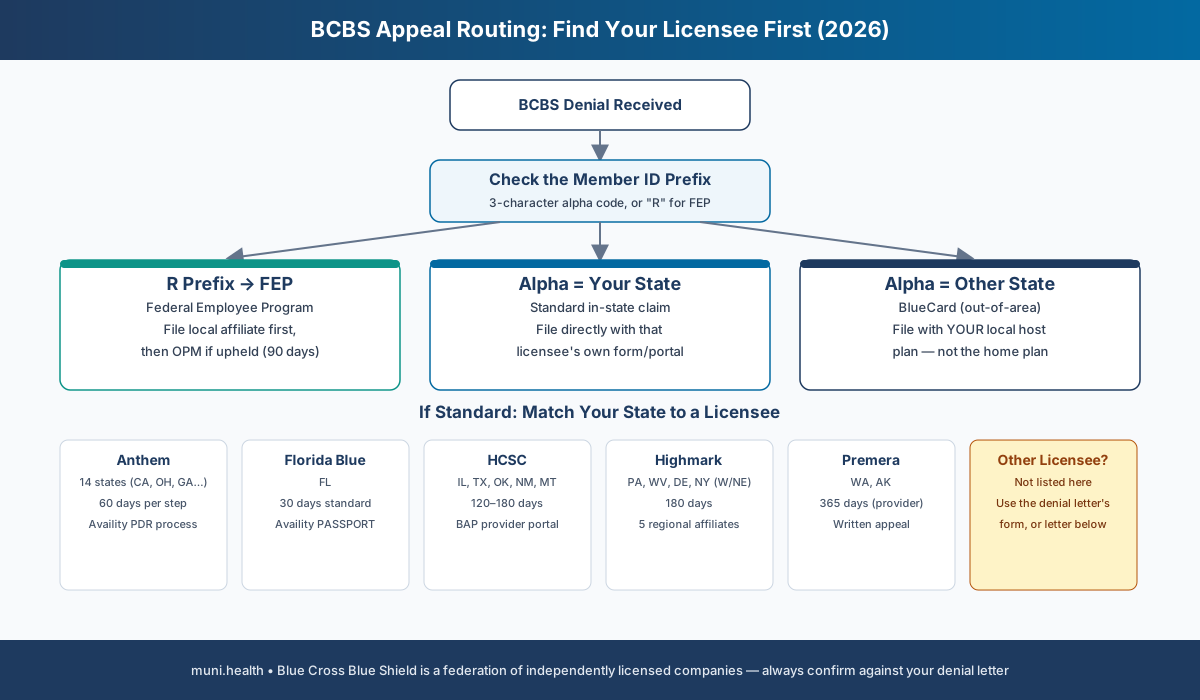
There is no single national "BCBS appeal form" — Blue Cross Blue Shield is a federation of independently operated licensee companies, and each one sets its own form, portal, and deadline. Identify the licensee first using the 3-character alpha prefix on the member's ID card (or an "R" prefix, which means Federal Employee Program), then file with that specific licensee. If the alpha prefix points to a plan outside your state, it's a BlueCard claim — file with your own local Blue plan, not the member's home-state plan. Most licensees accept a well-documented written appeal even when a specific form isn't required.
Why "The BCBS Appeal Form" Doesn't Exist
Every other major payer in this guide — Aetna, Cigna, UHC, Humana — is a single company with one national appeal form. Blue Cross Blue Shield isn't. It's a licensing brand used by a federation of independently operated companies, each with its own provider agreements, medical policies, and appeal procedures.
The exact count varies by source: the Blue Cross Blue Shield Association's own membership figure is commonly cited as 33 companies, though 34 and 36 also appear across industry references — including elsewhere on this site — because some counts treat regional sub-brands as separate entities. Highmark alone operates five distinct regional affiliates with five different mailing addresses (Highmark BCBS appeal letter guide). The exact number doesn't change what you need to do next: find out which specific company denied the claim before you file anything.
The Most Expensive BCBS Mistake
Submitting the right documentation to the wrong Blue plan doesn't just get rejected — it can burn your appeal deadline while you wait to discover the error, since the clock on most licensees' appeal windows doesn't pause for a misrouted submission. Confirming the licensee is step one, not an afterthought.
Step 1: Identify Your BCBS Licensee
Before choosing a form, confirm which company you're actually appealing to.
Check the 3-character alpha prefix on the member ID. Since 2018 this prefix has been alphanumeric (formats like "XYZ" or "X1A"), and it's the standard mechanism BCBS uses to route claims, eligibility checks, and appeals to the correct home plan through the BlueCard system. Record it exactly as printed — don't guess or truncate it. See our BlueCard provider appeal guide for the full mechanics of how this prefix routes claims.
Check for an "R" prefix instead. An ID beginning with the letter R and no 3-character alpha code — for example, R12345678 — identifies a Federal Employee Program (FEP) member. FEP is exempt from BlueCard and runs on an entirely separate federal appeals track. See our BCBS FEP claim denial appeal guide before filing anything for one of these.
Read the plan name on the EOB or denial letter. The remittance advice or explanation of benefits states the specific licensee (Anthem, Florida Blue, Highmark, HCSC, etc.), not just "Blue Cross Blue Shield." That name — not the state you practice in — determines which form and address apply.
Determine whether it's a BlueCard claim. If the member's home plan (from the alpha prefix) is a different Blue company than the one licensed in your state, you're dealing with an out-of-area BlueCard claim. The rule that trips up the most practices: you still file the appeal with your own local Blue plan — the host plan — which coordinates with the home plan internally. You never file directly with the member's home-state plan.
No Public Master Prefix Directory Exists
BCBS does not publish a single searchable table mapping every alpha prefix to its home plan — Availity and each local Blue plan's real-time eligibility check resolve it automatically when you submit one. If you need to confirm the home plan before that, call BlueCard Eligibility at 1-800-676-BLUE (2583) with the prefix, or run an eligibility check through your practice management system's payer ID lookup. See our BCBS provider phone numbers and routing guide for the full directory by licensee.
Step 2: Route to the Right Form
Once you know the licensee, use its specific process. The table below covers the licensees with the most provider-appeal volume; if yours isn't listed, the fallback approach at the bottom still applies.
| Licensee | States / Territory | Appeal Path | Filing Deadline | Full Guide |
|---|---|---|---|---|
| Anthem (Elevance Health) | CA, CO, CT, GA, IN, KY, ME, MO, NV, NH, NY (parts), OH, VA, WI | Two-step Provider Dispute Resolution: Claim Payment Reconsideration, then Claim Payment Appeal | 60 days per step, via Availity | How to appeal Anthem denials |
| Florida Blue | FL | Provider Clinical Appeal Form (medical necessity) or Provider Reconsideration/Administrative Appeal Form (coding/payment) | 30 days standard / 72 hours expedited (clinical) | Florida Blue appeal form guide |
| HCSC | IL, TX, OK, NM, MT | Blue Access for Providers (BAP) portal reconsideration; AIM Specialty Health for imaging/MSK; Magellan for behavioral health | 120 days (TX) to 180 days (IL), by state | HCSC BCBS appeal guide |
| Highmark | PA, WV, DE, Western & Northeastern NY (5 regional affiliates) | Written appeal to the specific regional affiliate; Carelon reconsideration first for imaging | 180 days (30-day response; 15 days for WNY/NENY) | Highmark appeal letter template |
| Premera Blue Cross | WA (excl. Clark County), AK | Written appeal to Premera's Member/Provider Appeals address | 365 days (provider) | Premera appeal guide |
| Federal Employee Program (FEP) | Any state — identified by R-prefix ID | Internal reconsideration with the local BCBS affiliate, then OPM Disputed Claims | 6 months, then 90 days to OPM | BCBS FEP appeal guide |
| BlueCard (out-of-area member) | Any state — home plan differs from where care was rendered | File with YOUR local host plan, not the member's home plan | Set by your local host plan's deadline | BlueCard provider appeal guide |
Every guide name above links to a dedicated, licensee-specific walkthrough elsewhere on this site — how to appeal Anthem denials, Florida Blue appeal form guide, HCSC BCBS appeal guide, Highmark BCBS appeal letter template, Premera Blue Cross appeal guide, BCBS FEP claim denial appeal, and BCBS BlueCard provider appeal guide.
Licensee Not Listed?
Dozens of smaller regional Blue plans — CareFirst, Independence Blue Cross, Regence, Wellmark, and single-state affiliates in states like Michigan, Massachusetts, North Carolina, and Tennessee — aren't covered by a dedicated guide yet. Check your denial letter for the required form first. If none is specified, most Blue licensees accept a complete written appeal in place of a proprietary form — see our BCBS appeal letter template guide or the universal cover letter below.
For General Denial Types and Deadlines
If you're past the routing question and need the underlying process — deadline math, denial categories, or what happens after you file — see How to Appeal BCBS Denials 2026 for the step-by-step process, BCBS Timely Filing Limits 2026 for original claim submission windows (a separate, usually longer clock than the appeal deadline), and BCBS Denied Claim Guide 2026 for a full denial-type triage across medical necessity, timely filing, coding, and bundling.
BCBS Appeal Routing Worksheet and Universal Cover Letter
Use this worksheet to work through the routing decision on a specific denial, then attach the cover letter only if your licensee's own denial notice doesn't require a proprietary form.
BCBS APPEAL ROUTING WORKSHEET — Complete Before You File
STEP 1 — IDENTIFY THE LICENSEE
Member ID prefix (first 3 characters, or "R" for FEP): __________
Plan/payer name printed on the EOB or denial letter: __________
State where the plan is licensed (from the EOB): __________
STEP 2 — DETERMINE THE TRACK
[ ] Standard plan issued by a single licensee in my own state
-> File with that licensee's own form/portal (see routing table above)
[ ] BlueCard / out-of-area member (home plan differs from where care
was rendered)
-> File with MY LOCAL host plan, not the member's home-state plan
[ ] FEP member (ID begins with "R", no 3-character alpha prefix)
-> File internal reconsideration with the local BCBS affiliate,
then OPM Disputed Claims if the reconsideration is denied
[ ] Licensee not covered by a dedicated guide on this site
-> Use the form named on the denial letter, or the cover letter
below if no specific form is required
STEP 3 — UNIVERSAL RECONSIDERATION COVER LETTER
(Use only when the licensee's denial notice does not require its own
specific form. Attach this ahead of your supporting documentation.)
[Date]
[BCBS Licensee Name — from the EOB]
Provider Appeals / Reconsideration Department
[Address or portal instructions from the denial letter]
RE: Provider Reconsideration Request
Member Name: [Full Name]
Member ID (include the alpha or R prefix): [ID]
Group Number: [Number]
Claim Number: [From EOB]
Date(s) of Service: [Date or range]
Provider Name / NPI: [Practice name / NPI]
Date of Denial Notice: [Date]
Reason for Denial (verbatim from the EOB): "[Quote the exact denial
reason and reason code]"
I am requesting reconsideration of the above claim within [Licensee
Name]'s filing deadline. [State specifically why the denial reason
does not apply — cite the relevant Medical Policy number or the
documentation now enclosed that addresses it directly.]
Enclosed:
- Copy of the Explanation of Benefits / denial notice
- Treating physician's letter of medical necessity
- Relevant clinical documentation, dated [range]
- [Applicable Medical Policy number, if citing one]
Please direct your written determination — including instructions for
the next level of appeal if this request is denied — to the address
below.
Sincerely,
[Name], [Title]
[Practice Name, Address, Phone, Fax, NPI]
Enclosures: [List each attached document]
Skip the blank template. Start with a review-ready draft.
Use the template as guidance, or let Muni prepare a payer-specific draft for your team to verify, sign, and submit.
First 3 appeals free, then $20 per appeal. Start with your denial letter or EOB and available records. No meeting or clearinghouse connection required.
How Muni Appeals Helps With Multi-Licensee BCBS Billing
Practices that see patients across several Blue plans — a local affiliate, a scattering of BlueCard out-of-area members, and the occasional FEP patient — end up tracking several different forms, portals, and deadlines under one insurer name. Muni Appeals organizes that workflow:
Prepare this appeal packet with your team.
Draft the appeal, coordinate missing documents, and approve the reviewed packet. Keep your clearinghouse; your practice checks deadlines and submits through the payer’s accepted channel.
First 3 appeals free, then $20 per appeal. Start with your denial letter or EOB and available records. No meeting or clearinghouse connection required.
- Surfaces likely licensee context from the member ID and uploaded claim details for staff verification
- Surfaces likely BlueCard versus in-state filing context; staff verifies the controlling plan and route
- Surfaces licensee and deadline-risk context from the uploaded denial; staff verifies and calendars the filing deadline
- Keeps FEP claims on their separate federal timeline instead of the standard commercial clock
For the underlying cost comparison between handling this manually and systematizing it, see our appeal automation cost vs. manual guide.
Frequently Asked Questions
Is there one official BCBS appeal form?
No. Each BCBS licensee — Anthem, Florida Blue, HCSC, Highmark, Premera, and dozens of others — sets its own appeal form, portal, and deadline. There is no single national form that works across all of them, though a complete written appeal is accepted in place of a specific form by most licensees when none is required.
How do I know which BCBS company actually denied my claim?
Check the plan name printed on the Explanation of Benefits or denial letter — it names the specific licensee, not just "Blue Cross Blue Shield." The member ID's 3-character alpha prefix (or an "R" prefix for FEP) also identifies the home plan and is the mechanism BCBS itself uses to route claims and appeals.
What if the member's ID prefix points to a different state than where I practice?
That's a BlueCard claim. File the appeal with your own local Blue plan — the host plan — not the member's home-state plan. The host plan coordinates the appeal with the home plan internally. See our BlueCard provider appeal guide for the full routing mechanics.
Is Anthem the same thing as Blue Cross Blue Shield?
Anthem (now part of Elevance Health) is one of the largest BCBS licensees, operating the Blue Cross and/or Blue Shield license across 14 states. It is not the entire BCBS federation — a denial from a member in a non-Anthem state, like Illinois or Pennsylvania, goes to a completely different company (HCSC or Highmark) with its own separate process.
How do I recognize a Federal Employee Program (FEP) claim?
The subscriber ID begins with the letter R and has no 3-character alpha prefix — for example, R12345678. FEP runs on a federal appeals track, not the standard commercial or BlueCard process, and state insurance departments have no jurisdiction over it. See our BCBS FEP appeal guide for the full timeline.
Do I need my exact licensee's proprietary form, or will a letter work?
Most BCBS licensees accept a well-structured written appeal in place of a proprietary form when the denial letter doesn't specifically require one. Some, like Anthem and Florida Blue, do require their own form for certain dispute types — check the specific licensee's guide linked above before assuming a generic letter is sufficient.
What's the deadline to appeal a BCBS denial?
It depends entirely on the licensee: Anthem gives 60 days per step, Highmark and most other affiliates use 180 days, and Premera gives providers 365 days. There is no single BCBS-wide deadline — confirm the figure on your specific denial letter or in the licensee-specific guide linked in the routing table above.
My BCBS licensee isn't in your routing table — what do I do?
Check the denial letter for the required form and submission address first; that's authoritative for your specific plan. If no form is specified, the universal cover letter above, combined with complete clinical documentation, is accepted by most Blue licensees as a substitute for a proprietary form.
Ready to Stop Guessing Which Blue Plan You're Appealing To?
The licensee-identification step is where BCBS appeals go wrong before the clinical argument even starts. Get the routing right, and the rest of the process is no different from any other payer appeal.
Muni Appeals keeps the licensee, the applicable form, and the deadline together for every BCBS claim instead of leaving it to memory across dozens of possible Blue plans.
Get started:
- Submit your first 3 appeals free, across any BCBS licensee
- BlueCard host-plan versus home-plan guidance for staff verification
- FEP deadline-risk context for staff to verify and calendar
- One workflow across Anthem, Florida Blue, HCSC, Highmark, and more
This guide reflects 2026 Blue Cross Blue Shield provider appeal procedures. BCBS operates through dozens of independently licensed companies, each of which sets its own forms, portals, and deadlines — verify the specific licensee's current requirements from your denial letter before filing. This information is for administrative and billing purposes and is not medical advice.