

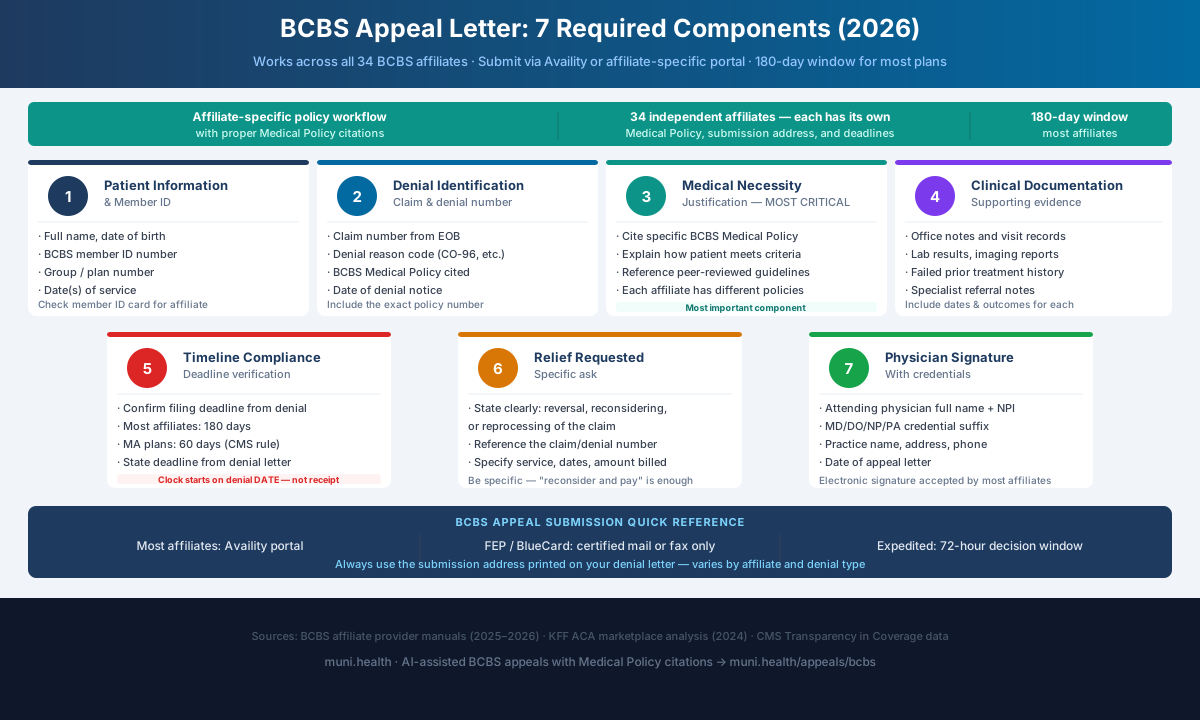
Blue Cross Blue Shield appeal letters require 7 core components: patient information with member ID, clear denial identification with claim number, medical necessity justification citing BCBS Medical Policy, supporting clinical documentation, timeline compliance (180-day filing deadline for most plans), specific relief requested, and physician signature with credentials. BCBS operates independently in each state with varying response times (30-60 days) and submission addresses, so always use the address on your specific denial letter. Include state-specific Medical Policy references and peer-reviewed evidence to achieve industry-leading overturn rates.
Where to Find BCBS Appeal Forms
Looking for the official BCBS appeal form? Blue Cross Blue Shield uses Reconsideration Request Forms for appeals, but the specific form varies by state since BCBS operates as 36 independent companies. For a licensee-by-licensee routing table — including how to identify which BCBS company denied your claim from the member ID prefix — see our BCBS appeal form guide. Here's how to find the right BCBS appeal form for your state:
How to Get Your State's BCBS Appeal Form:
- Check your denial letter - Most denial letters include the appeal form or instructions for requesting one
- Visit your state's BCBS provider portal - Navigate to Forms → Appeals/Grievances
- Call Provider Services - Request the "Provider Reconsideration Request Form" for your state
- Use the generic format below - If no specific form is required, a well-structured appeal letter (templates provided in this guide) is accepted by all 36 BCBS state plans
Appeal Form vs. Appeal Letter
Most BCBS states accept appeal letters in lieu of official forms. The templates in this guide include all required information and are accepted across all 36 BCBS state affiliates. However, some states (like BCBS of Michigan and BCBS of Florida) have specific forms they prefer—check your denial letter for instructions.
Common BCBS Appeal Form Names by State:
- BCBS Illinois/Texas/NC: "Provider Reconsideration Request Form"
- Anthem BCBS (multi-state): "Claim Appeal Form" or online portal submission
- BCBS Michigan: "Provider Dispute Resolution Form"
- BCBS Florida: "Provider Appeal Request Form"
- Horizon BCBS NJ: "Provider Claim Reconsideration Form"
Understanding BCBS's State-Based Appeal Structure
Blue Cross Blue Shield isn't a single insurance company—it's a federation of 36 independent companies operating under shared branding but with state-specific appeal procedures, medical policies, and timelines. This creates complexity for independent practices treating patients across state lines.
Critical: BCBS State Independence
A BCBS North Carolina Medical Policy citation will not work for a BCBS Texas appeal, and appeal addresses differ by state. Always verify your patient's specific BCBS affiliate (check their insurance card for the state name) and use that state's procedures and policies.
Key BCBS State Variations:
- Appeal timelines: 60-180 days depending on state plan
- Medical Policy structure: Each state maintains independent Medical Policy documents
- Submission addresses: Different P.O. Box for each state affiliate
- Response times: 30-60 days depending on service type and state regulations
Despite these variations, the core appeal letter structure remains consistent across all BCBS plans—this guide provides universal templates with notes on state-specific customization.
Industry Denial & Success Rates
Blue Cross Blue Shield's national aggregate denial rate for in-network ACA marketplace claims was 18% in Plan Year 2024, down from 22-23% in 2023 — though the affiliate-level range spans from below 10% to above 40% depending on state (see our BCBS denial rate by state breakdown). Separately, an AMA summary of Medicare Advantage data reports that 83.2% of prior authorization appeals in 2022 resulted in the insurer partially or fully overturning the initial denial. That figure is national Medicare Advantage appeal data, not a BCBS-specific rate.
BCBS Appeal Success Data
Peer-to-peer review gives the treating clinician a direct opportunity to address the plan's medical reviewer, but the AMA source above does not report a peer-to-peer-specific overturn rate. Request it when the denial notice or plan process makes it available, and follow the plan's stated timing and submission rules.
When to File a BCBS Appeal: Denial Types & Deadlines
Filing Deadlines by Plan Type
Commercial Plans (Most States):
- 180 days from date on Explanation of Benefits (EOB) or denial letter
- States include: NC, IL, TX, CA, MI, and most others
Medicare Advantage Plans:
- 60 days from organization determination denial
- Applies to all BCBS Medicare Advantage products nationwide
Medicaid Managed Care Plans (BCBS Medicaid):
- 60 days from Notice of Action Letter
- State-specific variations exist (check your denial letter)
Federal Employee Program (FEP):
- 180 days from denial notification
- Nationwide standard for federal employees
Missing the Deadline Forfeits Your Rights
BCBS strictly enforces filing deadlines. Missing the 180-day (or 60-day) deadline permanently forfeits your appeal rights and the associated revenue. Track denial dates immediately and calendar your appeal deadline minus 30 days for preparation time. Note: appeal deadlines vary by affiliate — see the BCBS timely filing limits guide for affiliate-specific windows.
Common BCBS Denial Reasons Worth Appealing
Before writing your appeal letter, identify the denial type from the EOB — each type has a different response path. For a step-by-step triage guide covering medical necessity (CO-96), prior auth (CO-197), timely filing (CO-29), and coding errors (CO-4), see the BCBS denied claim guide 2026.
These denial reasons consistently have the highest overturn potential when properly documented:
Medical Necessity Denials:
- "Not medically necessary per BCBS Medical Policy"
- "Does not meet clinical criteria in Medical Policy [number]"
- "Insufficient documentation of medical necessity"
- "Service considered investigational or experimental"
Prior Authorization Denials (where peer-to-peer review can add clinical context):
- "Prior authorization required but not obtained"
- "Requested service does not meet coverage criteria"
- "Alternative treatment should be tried first" (step therapy)
- "Service must be provided by network specialist"
Administrative/Coding Denials (often the most straightforward to overturn):
- Incorrect coding or code mismatches
- Missing or incomplete information
- Out-of-network denial when network adequacy is insufficient
- Timely filing disputes (when submission was actually timely)
Low-Success Denial Types (Skip These):
- Services explicitly excluded in member's plan document
- Cosmetic procedures with no functional component
- Services after policy termination date
- Experimental procedures without FDA approval or evidence base
Essential Components of a Winning BCBS Appeal Letter
After analyzing successful BCBS appeals across multiple state plans, these 7 components consistently separate approved appeals from denied ones:
1. Complete Patient & Provider Identification
Patient Demographics:
- Full legal name (as appears on insurance card)
- Date of birth
- BCBS Member ID (include prefix—varies by state: often 3 letters + numbers)
- Group number (if employer-sponsored plan)
- Plan type (PPO, HMO, POS, Medicare Advantage, FEP)
- State BCBS affiliate (e.g., "Blue Cross Blue Shield of North Carolina")
Provider Information:
- Provider name with credentials (MD, DO, etc.)
- Medical license number and state
- National Provider Identifier (NPI)
- Tax ID / Group NPI
- Practice name and full address
- Phone, fax, and email for peer-to-peer contact
2. Clear Denial Identification
Reference the exact denial from your Explanation of Benefits (EOB) or denial letter:
- Denial date (date on letter, not date received)
- Claim number (find on EOB, usually 10-15 digits)
- Service/procedure denied with CPT/HCPCS codes
- Date of service
- Denial reason (exact language from EOB)
- Denial code (if provided—alphanumeric code like "B7" or "CO-50")
- Billed amount
3. BCBS Medical Policy Citation & Compliance
This is critical. Each BCBS state affiliate maintains Medical Policy documents that define coverage criteria—similar to Aetna's CPBs but organized differently.
Finding Your State's Medical Policy:
- Visit [YourState]BlueCross.com → Providers → Medical Policies
- Search by procedure name or CPT code
- Note the Policy number and effective date
Common BCBS Medical Policy Structure:
- Each policy has a number (format varies: "2.01.500" or "MP-123")
- Policies list "Medically Necessary" and "Not Medically Necessary" criteria
- Policies cite clinical guidelines and evidence base
In Your Appeal Letter:
According to Blue Cross Blue Shield of [State] Medical Policy #[NUMBER] - [TITLE] (effective [DATE]), [service] is considered medically necessary when:

"[Quote exact policy language for criterion #1]"

[Patient Name] meets this criterion because [specific clinical evidence].

"[Quote exact criterion #2]"

[Patient Name] meets this criterion because [specific clinical evidence].

[Continue for all policy criteria]
Don’t guess the next step for this denial.
Choose the denial stage and available documentation to find a relevant synthetic example. Try preparation without an account, or start your real case now. No files are sent to a payer.
First 3 appeals free, then $20 per appeal. Start with your denial letter or EOB and available records. No meeting or clearinghouse connection required.
4. Medical Necessity Justification
Structure your clinical argument:
A. Patient Clinical History
- Diagnosis with ICD-10 codes
- Clinical presentation (symptoms, exam findings, functional limitations)
- Previous treatments attempted with outcomes (dates, duration, results)
- Why this specific treatment is necessary now
B. Evidence-Based Support
- Medical society guidelines (with year and version)
- Peer-reviewed research supporting treatment
- FDA approval status (for medications/devices)
- Standard of care documentation
C. Expected Outcomes
- Measurable treatment goals
- Timeline for improvement
- Consequences of denial (disease progression, disability, quality of life impact)
5. Supporting Clinical Documentation
Attach comprehensive evidence:
Clinical Records:
- Office visit notes documenting medical necessity
- Diagnostic test results (labs, imaging, pathology reports)
- Previous treatment records showing progression
- Specialist consultation notes (if applicable)
- Letter of medical necessity from treating physician
Policy & Evidence:
- Copy of denial letter/EOB
- Relevant pages from BCBS Medical Policy showing coverage criteria
- Medical society guideline excerpts
- Peer-reviewed journal abstracts (1-2 key studies)
Administrative:
- Prior authorization denial (if applicable)
- Prescription or treatment order
- Any correspondence with BCBS regarding this claim
6. Timeline Compliance Statement
Explicitly document timely filing:
"This appeal is submitted within the 180-day filing deadline, [X] days after receiving the denial notice dated [Date]."
7. Specific Relief Requested & Peer-to-Peer Offer
Be direct about what you want:
"I respectfully request that Blue Cross Blue Shield of [State] overturn this denial and approve payment for [specific service, CPT codes] in the amount of $[billed amount] as medically necessary and appropriate per BCBS Medical Policy #[number]."
Always include: "I am available for peer-to-peer review with a BCBS medical director at your earliest convenience. Please contact me directly at [phone] or [email] to schedule this discussion."
Peer-to-peer timing and outcomes vary by plan and case. Use the denial notice and provider portal to confirm whether a discussion is available, its deadline, and whether it supplements or replaces a written appeal.
Template 1: Level 1 Appeal Letter (Medical Necessity Denial)
Use this for your first appeal of a denied service:
[Date]

Blue Cross Blue Shield of [YOUR STATE]
Provider Appeals Department
[State-Specific Address - See Section Below]

RE: Level 1 Appeal - Medical Necessity Denial
Member: [Patient Full Name]
Member ID: [BCBS ID Number with Prefix]
Date of Birth: [MM/DD/YYYY]
Group #: [Group Number, if applicable]
Plan: [PPO/HMO/POS/Medicare Advantage/FEP]
Claim #: [Claim Number from EOB]
Date of Service: [MM/DD/YYYY]
Provider: [Your Practice Name]
Provider NPI: [Your NPI Number]

Dear Blue Cross Blue Shield Medical Director:

I am writing to appeal the denial of coverage for [SPECIFIC SERVICE/PROCEDURE] provided to the above-referenced patient on [DATE]. This appeal is submitted [X] days after the denial dated [DENIAL DATE], well within the 180-day appeal filing deadline.

DENIAL REASON IDENTIFICATION:
Blue Cross Blue Shield of [State] denied this claim stating: "[exact denial language from EOB]" (Denial Code: [code if provided]). This denial is medically inappropriate and should be overturned based on the patient's clinical presentation, medical necessity of this treatment, and compliance with BCBS Medical Policy #[NUMBER].

PATIENT CLINICAL PRESENTATION:
[Patient Name] is a [age]-year-old [gender] diagnosed with [CONDITION] (ICD-10: [CODE]) who presented on [date] with [SYMPTOMS/CLINICAL FINDINGS]. The patient's current condition includes:

[Describe clinical presentation with objective findings:]
- [Symptom/finding #1 with measurement if applicable]
- [Symptom/finding #2]
- [Functional limitations with specific impact]
- [Relevant exam findings with objective data]
- [Diagnostic test results confirming diagnosis and severity]

Prior to this treatment, conservative management was attempted including:
1. **[Treatment #1]:** [Duration, dates] - Outcome: [Objective result, why insufficient]
2. **[Treatment #2]:** [Duration, dates] - Outcome: [Objective result, why insufficient]
3. **[Treatment #3]:** [Duration, dates] - Outcome: [Objective result, why insufficient]

Despite adequate trials of conservative therapies, [Patient Name] continues to experience [disabling symptoms/functional limitations], necessitating the treatment that was denied.

BCBS MEDICAL POLICY COMPLIANCE:
According to Blue Cross Blue Shield of [State] Medical Policy #[NUMBER] - [POLICY TITLE] (effective [DATE], last reviewed [DATE]), [service/procedure] is considered medically necessary when:

**Policy Criterion 1:** "[Quote exact language from BCBS Medical Policy]"

[Patient Name] meets this criterion as evidenced by:
- [Specific clinical finding that satisfies this criterion]
- [Objective measurement or test result]
- [Connection to policy requirement]

**Policy Criterion 2:** "[Quote exact language from BCBS Medical Policy]"

[Patient Name] meets this criterion because:
- [Specific clinical evidence]
- [Documented finding from medical record]
- [How this satisfies the policy requirement]

**Policy Criterion 3:** "[Quote exact language from BCBS Medical Policy]"

[Patient Name] meets this criterion as demonstrated by:
- [Clinical evidence]
- [Supporting documentation]
- [Explanation of compliance with criterion]

[Continue for ALL criteria listed in the BCBS Medical Policy for this service]

CLINICAL GUIDELINE SUPPORT:
The requested treatment aligns with evidence-based clinical guidelines and standard of care:

**[Medical Society Name] Clinical Practice Guidelines ([Year]):**
"[Quote specific recommendation supporting this treatment for this diagnosis]"

[Explain how patient's condition matches the guideline recommendation]

**Peer-Reviewed Evidence:**
[Author et al.], [Journal Name], [Year] (n=[sample size if available]): Demonstrated [key finding supporting medical necessity of this treatment for this diagnosis/condition]. [Brief explanation of clinical relevance to this patient]

**FDA Approval Status [if applicable for medications/devices]:**
[Drug/device name] received FDA approval on [date] for [indication], specifically for treatment of [condition]. The requested use is on-label and appropriate for [Patient Name]'s diagnosis.

WHY THIS TREATMENT IS MEDICALLY NECESSARY:
[Provide 2-3 paragraph explanation of clinical rationale:]

[Paragraph 1: Why this specific treatment is necessary given the patient's condition, why alternatives are inadequate or contraindicated]

[Paragraph 2: Expected clinical outcomes, timeline for improvement, measurable goals]

[Paragraph 3: Consequences of denial - what will happen to patient without this treatment: disease progression, permanent disability, quality of life impact, increased healthcare costs from complications, etc.]

SUPPORTING DOCUMENTATION:
I have attached the following documentation supporting this appeal:
- Office visit notes from [dates] documenting medical necessity
- [Diagnostic test] results from [date] showing [findings]
- Treatment records from previous interventions ([dates])
- Copy of Blue Cross Blue Shield Medical Policy #[number]
- [Medical Society] Clinical Practice Guideline excerpts
- Peer-reviewed research abstracts supporting medical necessity
- Letter of medical necessity from treating physician

RELIEF REQUESTED:
I respectfully request that Blue Cross Blue Shield of [State] overturn this denial and approve payment for [specific service/procedure, CPT code(s)] in the amount of $[billed amount] as medically necessary and appropriate for [Patient Name]'s condition per BCBS Medical Policy #[number] and evidence-based clinical guidelines.

PEER-TO-PEER REVIEW REQUESTED:
I am available for peer-to-peer review with a Blue Cross Blue Shield medical director at your earliest convenience to discuss the clinical details of this case. Please contact me directly at:
- Phone: [direct phone number]
- Cell: [cell if willing to provide]
- Email: [email address]

This appeal is submitted [X] days after the denial notice dated [DATE], well within the 180-day appeal filing deadline. Per Blue Cross Blue Shield appeal procedures, I request a written response within 30 days [or 60 days for post-service claims, depending on your state's requirements].

Sincerely,

[Physician Signature]
[Physician Name, MD/DO with Credentials]
Medical License #: [Number] ([State])
NPI: [Number]
[Practice Name]
[Complete Address]
[Phone] | [Fax] | [Email]

Enclosures:
[List all attachments - typically 8-12 documents]
Template 2: Level 2 Appeal Letter (After Level 1 Denial)
If your Level 1 appeal is denied, most BCBS plans allow Level 2 internal review:
[Date]

Blue Cross Blue Shield of [State]
Level 2 Appeals / Appeals Review Committee
[State-Specific Level 2 Address]

RE: Level 2 Appeal - Reconsideration of Level 1 Denial
Member: [Patient Name]
Member ID: [BCBS ID]
Claim #: [Claim Number]
Level 1 Appeal Decision Date: [DATE]
Original Denial Date: [DATE]
Date of Service: [MM/DD/YYYY]

Dear Blue Cross Blue Shield Appeals Review Committee:

This Level 2 appeal requests reconsideration of the Level 1 appeal denial issued on [DATE] for [service/procedure] provided to [Patient Name]. This Level 2 appeal is filed [X] days after the Level 1 decision, within the required filing timeframe.

LEVEL 1 DENIAL BASIS:
The Level 1 reviewer denied the appeal stating: "[exact language from Level 1 denial letter]." This determination is medically inappropriate and contradicts Blue Cross Blue Shield's own Medical Policy #[NUMBER] for the following reasons:

ERRORS IN LEVEL 1 REVIEW:
The Level 1 reviewer's determination contains the following factual, medical, or policy interpretation errors:

**Error #1: [Description of Error]**
The Level 1 denial stated: "[quote from denial]."

However, this is incorrect because:
- [Explanation of why this is factually wrong]
- [Supporting evidence that contradicts the denial]
- [Reference to BCBS Medical Policy language that supports your position]

**Error #2: [Description of Error]**
The reviewer failed to consider [clinical factor, test result, or documentation] that was included in the Level 1 appeal submission.

Specifically:
- [What was overlooked]
- [Why this is critical to the medical necessity determination]
- [How this satisfies BCBS Medical Policy criteria]

**Error #3: Misapplication of BCBS Medical Policy**
The Level 1 reviewer applied [incorrect standard or criteria].

The correct standard per BCBS Medical Policy #[NUMBER] (effective [DATE]) is:
"[Quote correct policy language]"

[Patient Name] meets this standard as demonstrated by:
- [Clinical evidence]
- [Objective findings]
- [Documentation provided in Level 1 appeal]

ADDITIONAL CLINICAL EVIDENCE:
[If any new clinical information has developed since Level 1 submission, include it here:]

Since the Level 1 denial, the following additional clinical information demonstrates medical necessity:
- [New test results, clinical progression, outcomes data]
- [Any developments that strengthen the medical necessity argument]

[If no new evidence, state:]
All necessary clinical evidence was provided in the Level 1 appeal. The Level 1 denial did not dispute the clinical facts but rather misapplied BCBS Medical Policy criteria or overlooked submitted documentation.

PEER-REVIEWED EVIDENCE SUPPORTING MEDICAL NECESSITY:
[Include 2-3 peer-reviewed citations that were either in Level 1 or are new:]

1. [Author et al.], [Journal], [Year] (n=[sample size]): [Key finding supporting your position]

2. [Medical Society] Clinical Practice Guidelines ([Year]): "[Direct quote of recommendation]"

3. [Additional evidence as appropriate]

EXTERNAL REVIEW NOTICE:
If this Level 2 appeal is denied, [Patient Name] will pursue external review through [state]'s independent review process, as this denial meets criteria for external review:
- Denial based on medical necessity determination
- Financial responsibility exceeds [$500 or state-specific threshold]
- Treatment is supported by evidence-based clinical guidelines and BCBS's own Medical Policy

RELIEF REQUESTED:
I request that the Level 2 Appeals Review Committee overturn the Level 1 denial and approve coverage for [service/procedure] as medically necessary per BCBS Medical Policy #[number], evidence-based clinical guidelines, and the clinical facts of this case.

PEER-TO-PEER REVIEW:
I remain available for peer-to-peer discussion with a Blue Cross Blue Shield medical director or Appeals Review Committee physician to address any remaining questions about this case.
- Direct Phone: [number]
- Email: [email]

[If urgent clinical situation exists:]
**URGENT CLINICAL CONSIDERATION:**
[Patient Name]'s condition requires timely treatment. Continued delay poses risk of [specific clinical consequence: disease progression, permanent disability, etc.]. I request expedited Level 2 review given the urgent nature of the patient's medical needs.

Sincerely,

[Signature and Credentials]

Enclosures:
- Complete Level 1 appeal submission (all original documentation)
- Level 1 denial letter
- [Any new clinical evidence]
- Additional peer-reviewed evidence
Template 3: Expedited/Urgent Appeal Letter
When delay in treatment could harm the patient:
[Date]

**EXPEDITED APPEAL REQUEST - URGENT**

Blue Cross Blue Shield of [State]
Urgent Appeals Department
Fax: [State-specific urgent fax number]
Phone: [State-specific urgent phone number]

RE: EXPEDITED Appeal - Urgent Medical Necessity
Member: [Patient Name]
Member ID: [BCBS ID]
Claim/PA #: [Number]
Date of Service / Requested Service: [DATE]

Dear Blue Cross Blue Shield Urgent Review Medical Director:

I am requesting EXPEDITED appeal review for [service/procedure] for the above patient due to urgent medical necessity. Standard appeal timelines (30-60 days) pose unacceptable risk to this patient's health and potentially irreversible clinical consequences.

URGENT CLINICAL SITUATION:
[Patient Name] requires immediate [treatment] due to [urgent medical condition]. Any delay in care will result in [specific, measurable clinical consequences].

Current Urgent Clinical Status:
- **[Urgent finding #1]:** [Objective clinical data showing urgency]
- **[Urgent finding #2]:** [Time-sensitive clinical parameter]
- **[Risk of Delay]:** [Specific harm that will occur: disease progression timeline, permanent injury risk, quality of life deterioration]
- **Clinical Timeline:** Without treatment within [timeframe], the patient will likely experience [specific adverse outcome]

MEDICAL NECESSITY JUSTIFICATION:
[Provide condensed version of medical necessity argument, focusing on urgency:]

**Diagnosis:** [Diagnosis with ICD-10]

**Why This Treatment is Urgently Necessary:**
[2-3 paragraphs explaining:]
- Current critical clinical status
- Why immediate intervention is necessary
- Expected deterioration without prompt treatment
- Why this cannot wait for standard appeal timeline

**BCBS Medical Policy Compliance:**
Per Blue Cross Blue Shield of [State] Medical Policy #[NUMBER], [service] is medically necessary when [quote key criterion]. [Patient Name] meets this criterion urgently based on [clinical evidence].

**Clinical Guideline Support:**
[Medical Society] guidelines ([Year]) recommend [quote guideline regarding timing/urgency of intervention for this condition].

PREVIOUS DENIAL BASIS:
[Brief summary:]
Blue Cross Blue Shield denied [prior authorization / claim] on [date] stating "[denial reason]." This denial is medically inappropriate given:
- [Why denial reason is incorrect]
- [Clinical evidence supporting medical necessity]
- [Urgency factors requiring immediate approval]

PEER-TO-PEER IMMEDIATE AVAILABILITY:
I am available for IMMEDIATE peer-to-peer review 24/7 to discuss this urgent case:
- Direct Phone: [number]
- Cell Phone: [number]
- Email: [email]
- Best times to reach: [specify or state "any time"]

TIME-SENSITIVE REQUEST:
Per Blue Cross Blue Shield expedited review procedures, I request a decision within:
- **72 hours** for urgent pre-service determinations
- **24 hours** for emergency situations

To prevent irreversible harm to [Patient Name], I respectfully request immediate review and approval of this medically necessary, time-sensitive treatment.

RELIEF REQUESTED:
Immediate authorization for [service, CPT codes] to begin [treatment timeline: today, within 48 hours, etc.].

Sincerely,

[Signature]
[Physician Name with Credentials]
Medical License #: [Number]
NPI: [Number]
[Phone] | [Cell] | [Email]

**SUBMITTED VIA FAX FOR IMMEDIATE REVIEW: [Date/Time]**
**Follow-up phone call to confirm receipt: [Phone number for me to call to confirm]**

Enclosures:
- Clinical documentation demonstrating urgency
- Diagnostic test results
- Relevant BCBS Medical Policy excerpts
- Clinical guidelines supporting urgent intervention
Template 4: Medicare Advantage Appeal Letter (BCBS Medicare)
BCBS Medicare Advantage plans have specific appeal rights under CMS regulations:
[Date]

Blue Cross Blue Shield Medicare Advantage
Medicare Appeals Department
[Medicare-specific address for your state - see Section below]

RE: Medicare Advantage Organization Determination Appeal
Member: [Patient Name]
Medicare Advantage Plan: [Specific BCBS MA plan name]
Member ID: [Medicare ID, usually starts with plan code]
Claim #: [Claim Number]
Date of Service: [MM/DD/YYYY]

Dear BCBS Medicare Medical Director:

I am filing an organization determination appeal under Medicare Advantage regulations for the denial of [service/item] for the above Medicare beneficiary. This appeal is filed [X] days after the denial notice dated [DATE], within the required filing deadline.

DENIAL REASON:
Blue Cross Blue Shield Medicare denied coverage stating: "[exact denial language]." This contradicts Medicare coverage policy and medical necessity standards.

MEDICARE COVERAGE CRITERIA:
[Service/item] is covered by Medicare under the following provisions:

**CMS National Coverage Determination (NCD) [if applicable]:**
NCD #[number] - [NCD title] establishes coverage for [service] when [quote relevant Medicare coverage language].

**Local Coverage Determination (LCD) [if applicable]:**
LCD [number] for [MAC name] states: "[Quote relevant LCD coverage criteria]"

**BCBS Medicare Advantage Medical Policy:**
Blue Cross Blue Shield Medicare Advantage Policy #[NUMBER] (consistent with CMS coverage guidelines) states:
"[Quote BCBS MA policy language]"

PATIENT MEETS MEDICARE CRITERIA:
[Patient Name], a Medicare beneficiary age [XX], meets all Medicare and BCBS MA coverage requirements:

1. **[First Medicare/MA criterion]:** [How patient meets it with clinical evidence]
2. **[Second criterion]:** [How patient meets it]
3. **[Continue for all applicable criteria]**

CLINICAL JUSTIFICATION:
[Provide medical necessity justification following same format as Template 1, emphasizing Medicare medical necessity standards]

[Patient Name] has [condition, ICD-10 code] requiring [treatment]. The patient's clinical presentation includes:
- [Objective findings]
- [Functional limitations]
- [Previous treatments attempted]

Per Medicare guidelines and accepted standards of medical practice, [service] is medically reasonable and necessary for [Patient Name]'s condition.

SUPPORTING CLINICAL EVIDENCE:
[Include clinical guidelines, peer-reviewed evidence as in Template 1]

MEDICARE APPEAL RIGHTS:
As a Medicare Advantage enrollee, [Patient Name] has the right to:
- Organization determination review (current appeal)
- Reconsideration by Independent Review Entity (IRE) if this appeal is denied
- Administrative Law Judge (ALJ) hearing if claim exceeds Medicare threshold amount

This appeal requests favorable organization determination based on the clinical evidence provided and compliance with Medicare and BCBS MA coverage criteria.

RELIEF REQUESTED:
Overturn the denial and authorize coverage for [service, CPT codes] under Medicare Advantage plan provisions and Medicare coverage policy.

PEER-TO-PEER REVIEW REQUESTED:
I am available for peer-to-peer review at [phone] or [email].

I request a decision within 7 calendar days per Medicare Advantage appeal timelines [or 72 hours if expedited review is appropriate].

Sincerely,

[Signature]
[Physician Name with Credentials]
Medical License #: [Number]
NPI: [Number]
[Practice Information]

Enclosures:
- Denial notice
- Clinical documentation
- Medicare NCD/LCD excerpts [if applicable]
- BCBS MA Medical Policy documentation
- Peer-reviewed evidence
BCBS Appeal Submission: State-Specific Addresses
Since each BCBS state affiliate operates independently, submission addresses vary. Always use the address printed on your denial letter when available. Below are common appeal addresses for major BCBS states:
Don’t guess the next step for this denial.
Choose the denial stage and available documentation to find a relevant synthetic example. Try preparation without an account, or start your real case now. No files are sent to a payer.
First 3 appeals free, then $20 per appeal. Start with your denial letter or EOB and available records. No meeting or clearinghouse connection required.
Major State BCBS Appeal Addresses
Blue Cross Blue Shield of Illinois: Provider Appeals P.O. Box 805107 Chicago, IL 60680-4112
Blue Cross Blue Shield of Texas: Complaints and Appeals Department P.O. Box 660717 Dallas, TX 75266-0717
Blue Cross Blue Shield of North Carolina: Provider Appeal Department P.O. Box 2291 Durham, NC 27702
Blue Cross Blue Shield of Michigan: Provider Inquiry Unit P.O. Box 33842 Detroit, MI 48232-5842
Blue Cross of California: Appeals and Grievances P.O. Box 272540 Chico, CA 95927-2540
Anthem Blue Cross (Various States): Appeals and Grievances P.O. Box 105187 Atlanta, GA 30348-5187
CareFirst BlueCross BlueShield (MD, DC, VA): Appeals Department P.O. Box 14234 Lexington, KY 40512-4234
Highmark Blue Cross Blue Shield (PA, WV, DE, and WNY): Highmark operates five regional affiliates with separate mailing addresses. See the Highmark BCBS appeal letter template and affiliate address guide for the current address for each region (PA Western, PA Central/Eastern, WV, DE, and WNY). Note: the address below is the legacy Pittsburgh general address — use the affiliate-specific addresses in the linked guide for 2026.
Legacy: Provider Appeals, P.O. Box 22077, Pittsburgh, PA 15222
Horizon Blue Cross Blue Shield of New Jersey: Appeals and Grievances Department P.O. Box 420 Newark, NJ 07101-0420
Premera Blue Cross (WA, AK): Appeals Department P.O. Box 91059 Seattle, WA 98111-9159
Always Verify Your State's Address
BCBS has 36 independent state affiliates. The address above may not be current or may not match your specific state. Always use the appeal address printed on your denial letter or EOB. If no address is provided, call the provider services number on your remittance advice to obtain the correct appeals mailing address for your state.
Fax and Online Submission Options
Many BCBS state plans accept appeals via fax or online portal:
Online Submission (Most States):
- Log into your state's BCBS provider portal (usually [State]BlueCross.com/providers)
- Navigate to "Claims" → "Appeals" or "Disputes"
- Upload appeal letter and supporting documentation
- Save confirmation number
Fax Submission:
- Fax numbers vary by state (check denial letter)
- Mark first page: "PROVIDER APPEAL - [X] PAGES"
- Call to confirm receipt within 2 business days
- Keep fax confirmation as proof of submission
Best Practice: Submit appeals via two methods for time-sensitive cases (e.g., mail + fax, or online portal + mail) to ensure timely receipt and create redundant proof of filing.
BCBS Medical Policies: How to Find & Cite Them Effectively
Unlike Aetna's centralized CPB database, BCBS Medical Policies are maintained independently by each state affiliate. Here's how to access and cite them:
Finding Your State's Medical Policy
Step 1: Identify Your BCBS Affiliate Check the patient's insurance card for the state name (e.g., "Blue Cross Blue Shield of Illinois" or "Anthem Blue Cross of California").
Step 2: Access Medical Policy Database Visit: [State]BlueCross.com → Providers → Clinical Resources → Medical Policies
Example URLs:
- Illinois: BCBSIL.com/provider/clinical/medical-policies
- Texas: BCBSTX.com/provider/medical-policies
- North Carolina: BlueCrossNC.com/providers/medical-policies
Step 3: Search for Your Service
- Search by procedure name, CPT code, or diagnosis
- Most policies are organized by clinical category (e.g., "Surgical Procedures," "Imaging," "DME")
- Note the policy number and effective date
Medical Policy Structure (Most BCBS Plans)
Typical Components:
- Policy Number (format varies: "2.01.500," "SURG-123," "MP-789")
- Policy Title (e.g., "Physical Therapy Services")
- Effective Date and Last Review Date
- Medically Necessary Criteria (usually 3-6 specific requirements)
- Not Medically Necessary (exclusion criteria)
- References (clinical guidelines, evidence base)
Citing Medical Policies in Your Appeal
Effective Citation Format:
According to Blue Cross Blue Shield of [State] Medical Policy #[NUMBER] - [TITLE] (effective [DATE], last reviewed [DATE]), [service] is considered medically necessary when:

"[Quote exact policy language for criterion #1]"

[Patient Name] meets this criterion because:
- [Specific clinical evidence]
- [Objective measurement/finding]
- [Documentation reference]

"[Quote exact policy language for criterion #2]"

[Patient Name] meets this criterion as evidenced by:
- [Clinical finding]
- [Test result]
- [How this satisfies the criterion]

[Continue for ALL policy criteria]
Why This Works:
- Quotes policy verbatim (not paraphrased)
- Provides criterion-by-criterion response
- Uses objective clinical evidence
- Demonstrates compliance with insurer's own policy
Why Specificity Matters
Appeals that quote BCBS Medical Policy language verbatim and address each coverage criterion individually give reviewers a direct link between the clinical evidence and the policy requirement — a stronger position than a generic medical necessity statement that leaves the reviewer to make that connection.
Common BCBS Denial Reasons & Counter-Arguments
Based on analysis of successful BCBS appeals across state plans:
Denial: "Not medically necessary per BCBS Medical Policy"
Counter-Argument Structure:
- Cite the Medical Policy number and quote coverage criteria
- Demonstrate criterion-by-criterion compliance with objective clinical evidence
- Reference clinical guidelines from medical societies supporting medical necessity
- Document previous conservative treatments attempted (if step therapy applies)
- Explain clinical consequences of denial (disease progression, disability, quality of life impact)
Example Language: "BCBS's denial stating 'not medically necessary per Medical Policy #[number]' is contradicted by the clinical documentation submitted. Medical Policy #[number] states that [service] is medically necessary when [quote criteria]. The attached clinical records document [specific findings meeting criteria], including [objective measurements]. This determination aligns with [Medical Society] Clinical Guidelines ([year]) recommending [quote guideline]."
Denial: "Prior authorization required but not obtained"
If you need to prevent future PA denials or understand how to submit BCBS prior authorizations correctly — including Carelon-delegated specialty services and Availity ICR routing — see the BCBS prior authorization template and affiliate guide.
Counter-Arguments:
If Truly Emergent: "Service was medically urgent, meeting the prudent layperson standard for emergency care per [state] insurance regulations. [Patient Name] presented with [emergency condition] requiring immediate intervention. Delay for prior authorization would have resulted in [specific harm]. Per BCBS policy and [state] law, emergency services do not require prior authorization."
If Administrative Error: "Prior authorization was obtained on [date], confirmation number [PA number]. Attached is documentation of authorization approval. This claim should process as an authorized service."
If Oversight: "While prior authorization was not obtained due to [reason: administrative oversight, miscommunication, etc.], the service was medically necessary per BCBS Medical Policy #[number] as demonstrated by [clinical evidence]. Denying payment for an administrative technicality when medical necessity is clearly established violates [state]'s insurance fair claims practices. I request retroactive authorization based on the medical necessity documentation provided."
Denial: "Service deemed experimental or investigational"
Counter-Arguments:
-
FDA Approval: "[Drug/device/procedure] received FDA approval on [date] for [indication]. This is not investigational—it is an approved treatment for [patient's diagnosis]. Attached is FDA approval documentation."
-
Standard of Care: "This treatment is endorsed by [Medical Society] Clinical Practice Guidelines ([year]) as [standard of care / first-line therapy / recommended intervention] for [condition]. See attached guideline excerpts. BCBS Medical Policy may not have been updated to reflect current clinical standards."
-
Peer-Reviewed Evidence: "[Number] peer-reviewed studies published in [reputable journals] demonstrate efficacy and safety of this treatment for [condition]. This is no longer investigational—it is evidence-based standard care. See attached bibliography."
-
Comparable Coverage: "BCBS covers this same service for [similar condition] per Medical Policy #[number]. The clinical evidence supporting use for [patient's condition] is equally robust. Denying coverage for one indication while covering another is inconsistent with medical evidence and BCBS's own policies."
Denial: "Alternative treatment should be tried first"
Counter-Arguments:
-
Prior Treatment Failures: "Patient has systematically attempted [list all alternatives] from [start date] to [end date] without adequate response. See attached treatment records documenting [objective outcomes]. Further trials of failed therapies will delay definitive treatment and risk disease progression."
-
Medical Contraindication: "The suggested alternative treatment is medically contraindicated in this patient due to [specific reason: allergy documented on [date], previous adverse reaction, comorbid condition precluding use]. See attached clinical documentation. Requiring a contraindicated therapy as a prerequisite for coverage is medically inappropriate."
-
Guideline-Supported First-Line: "[Medical Society] Clinical Guidelines ([year]) recommend the requested treatment as first-line therapy for [patient's specific presentation], not as second-line after failure of [BCBS's suggested alternative]. The patient meets guideline criteria for this treatment as initial therapy."
-
Clinical Urgency: "Patient's condition is clinically urgent, requiring immediate definitive treatment. Delaying for a trial of [less-effective alternative] poses unacceptable risk of [specific clinical consequence]. [Medical evidence] supports use of requested treatment in urgent scenarios like this patient's presentation."
BCBS Appeal Response Times & What to Expect
Response timelines vary by BCBS state affiliate and appeal type:
Standard Appeal Response Times
Commercial Plans:
- Pre-service appeals: 30 calendar days
- Post-service appeals: 60 calendar days
- Some states mandate shorter timelines (15-30 days)
Medicare Advantage:
- Organization determination: 30 calendar days (standard) or 7 days (if health at risk)
- Expedited appeals: 72 hours
Medicaid Managed Care:
- Standard: 30 calendar days
- Expedited: 72 hours (if health at risk)
Expedited Appeal Timelines
When delay poses health risk:
- Most states: 72 hours (3 calendar days)
- Some states: 24-48 hours for true emergencies
- Medicare MA: 72 hours standard, 24 hours for some urgent situations
What Happens During Review
Days 1-7:
- Appeal logged into BCBS system
- Assigned to medical director or review nurse
- Verification that appeal is within filing deadline
Days 7-20:
- Medical director reviews clinical documentation
- May request additional records if needed
- Consultation with specialist reviewer if complex case
- Peer-to-peer review scheduled (if requested)
Days 20-30 (or 60):
- Final decision made
- Determination letter drafted
- Decision letter mailed to provider and member
If You Don't Receive a Decision:
- Day 31 (or 61): Call BCBS Provider Services to request appeal status
- Ask for: Date appeal was received, name of medical director reviewing, expected decision date
- Request expedited decision if past deadline
- Document all calls with date, time, representative name
Peer-to-Peer Accelerates Decisions
Requesting peer-to-peer review can give the plan's reviewer additional clinical context, but availability and timing vary by affiliate, plan, and denial type. Check the denial notice or provider portal for the applicable process, deadline, and whether the discussion supplements or replaces a written appeal. Include your direct phone number and availability in the request.
How Muni Prepares Affiliate-Aware BCBS Appeal Drafts
The complexity of 36 independent BCBS affiliates with state-specific Medical Policies, addresses, and procedures makes manual appeal preparation time-consuming and error-prone. Muni's AI identifies the patient's specific BCBS plan and auto-populates state-specific requirements.
State-Specific Automation
Manual Process (60+ minutes):
- Identify patient's BCBS state affiliate
- Find that state's provider portal
- Search Medical Policy database
- Read 10-20 page policy document
- Identify coverage criteria
- Look up appeal submission address
- Verify filing deadline and procedures
- Draft appeal with state-specific references
Muni-supported process:
- Enter patient's BCBS member ID
- Muni surfaces the likely state affiliate from the uploaded denial
- Muni surfaces candidate Medical Policy references for staff verification
- Muni prepares a criterion-by-criterion response draft
- Staff verifies the appeal address and submission instructions on the denial
- Includes state-specific filing deadlines
- You add patient clinical details and submit
Multi-State Practice Support
For practices treating patients across multiple states:
Challenge: Your dermatology practice sees BCBS patients from 8 different states, each with different Medical Policies for Mohs surgery, different appeal addresses, and different procedures.
Muni Solution:
- Maintains current Medical Policies for all 36 BCBS states
- Auto-selects correct policy based on patient's member ID
- Generates state-specific appeal letters with correct references
- Includes correct appeal address for each state
- Tracks state-specific filing deadlines
What Muni Prepares
- A draft matched to the identified BCBS affiliate and denial reason.
- The relevant Medical Policy language and an evidence checklist.
- A review-ready letter; the practice verifies the plan, signs, and submits it.
- No guaranteed turnaround, overturn rate, or recovery amount.
Generate Your First BCBS Appeal Free →
Try 3 free BCBS appeals with candidate affiliate Medical Policy references for staff verification. No credit card required.
Frequently Asked Questions
How long do I have to file a BCBS appeal?
Most commercial BCBS plans: 180 days from the date on your Explanation of Benefits (EOB) or denial letter. Medicare Advantage: 60 days from organization determination denial. Medicaid managed care: 60 days from Notice of Action (varies by state). Federal Employee Program (FEP): 180 days nationwide. Always check your specific denial letter for the exact deadline, as some state plans have shorter timelines (90-120 days). Missing the deadline forfeits your appeal rights permanently.
Does every BCBS state have different appeal procedures?
Yes. Blue Cross Blue Shield operates as independent companies with distinct Medical Policies, appeal addresses, and procedures. A BCBS Illinois Medical Policy cannot be assumed to apply to a BCBS Texas appeal. The core appeal letter structure is similar, but staff must verify the exact affiliate, policy, deadline, and submission route. Muni Appeals can surface likely affiliate context from the uploaded denial and prepare an affiliate-aware draft for that review.
Where do I find BCBS Medical Policies for my state?
Visit [YourState]BlueCross.com → Providers → Clinical Resources → Medical Policies. Example: Illinois BCBS policies are at BCBSIL.com/provider/clinical/medical-policies. Search by procedure name or CPT code to find the relevant policy. Note the policy number and effective date. If you can't access the policy online, call BCBS Provider Services (number on your remittance advice) and request the specific Medical Policy document by name or CPT code. You need this policy to cite in your appeal for maximum success.
Can I submit the same appeal letter to different BCBS states?
No. Each BCBS affiliate has independent Medical Policies with different numbers, criteria, language, and submission instructions. Use the denial notice and member card to verify the affiliate and current policy. Muni Appeals surfaces likely affiliate context and candidate policy references, but staff must confirm the policy, deadline, and address before filing.
How long does BCBS take to respond to appeals?
Commercial plans: 30 days for pre-service appeals, 60 days for post-service appeals (varies by state). Medicare Advantage: 30 days standard, 7 days if health at risk. Expedited appeals: 72 hours (3 days) when delay poses health risk. If you don't receive a decision within the applicable timeframe, call BCBS Provider Services (number on the denial notice or remittance advice) to request status. Document your follow-up call with date, time, and representative name. Peer-to-peer availability and timing vary, so use the denial notice and provider portal rather than assuming a separate decision window.
What is the difference between BCBS Medical Policy and clinical guidelines?
BCBS Medical Policies are the insurer's internal coverage criteria—these define when BCBS will pay for a service. Clinical guidelines (from medical societies like AMA, NCCN, AAD) are evidence-based treatment recommendations. In your appeal, cite both: (1) Quote the BCBS Medical Policy to show the patient meets the insurer's coverage criteria, and (2) Reference clinical guidelines to demonstrate the treatment is evidence-based standard of care. Medical Policy compliance is required for payment; clinical guidelines strengthen your medical necessity argument.
Should I request peer-to-peer review in my BCBS appeal?
Request one when the denial notice or plan process makes it available. A peer-to-peer discussion lets the treating clinician address the plan's medical reviewer directly, but timing and outcomes vary by affiliate and denial type. Include in your appeal letter: "I am available for peer-to-peer review with a BCBS medical director at your earliest convenience. Please contact me at [phone] or [email]." Provide your direct number and best times to reach you, and confirm the deadline and process in the denial notice or provider portal.
What happens if my Level 1 BCBS appeal is denied?
Most BCBS plans allow Level 2 internal appeal (second review by different medical director or appeals committee). Check your Level 1 denial letter for Level 2 instructions and deadline (usually 60 days from Level 1 decision). If Level 2 is also denied, you may be eligible for external review by an independent reviewer (if denial is based on medical necessity and exceeds state threshold amount, typically $500-$1,000). External review decisions are binding on BCBS. For Medicare Advantage denials, you can appeal to an Independent Review Entity (IRE), then potentially to an Administrative Law Judge.
Do BCBS Medicaid plans have different appeal procedures?
Yes. BCBS Medicaid managed care plans (like Aetna Better Health, BCBS Community Health Plans) follow state Medicaid regulations, which often differ from commercial BCBS procedures. Common differences: (1) Shorter filing deadlines (60 days vs 180 days), (2) Faster response times (30 days vs 60 days), (3) State-specific appeal forms required, (4) Different appeal addresses than commercial BCBS. Check your Medicaid denial letter for specific procedures, or visit [State]Medicaid.gov for your state's Medicaid managed care appeal requirements.
Can I appeal a BCBS prior authorization denial after services are already provided?
Yes, but it's more complex. If you provided services without prior authorization (because PA was denied or you missed the PA requirement), you can still appeal the claim denial, but success rates are meaningfully lower than a typical appeal filed before the service. In your appeal: (1) Acknowledge the PA requirement was not met, (2) Explain why (emergency, administrative oversight, PA was incorrectly denied), (3) Demonstrate clear medical necessity with comprehensive clinical documentation, (4) If PA denial was incorrect, explain why patient met PA criteria. Best practice: Appeal PA denials BEFORE providing elective services to maintain higher overturn rates.
How do I submit an expedited/urgent BCBS appeal?
For urgent situations where delay poses health risk: (1) Call BCBS Provider Services (number on denial letter) and state "expedited appeal request," (2) Fax your appeal marked "EXPEDITED APPEAL - URGENT" to the state-specific urgent fax number, (3) In your letter, document the urgent clinical situation, specific harm from delay, and why immediate treatment is necessary, (4) Include your 24/7 contact info for immediate peer-to-peer review, (5) Request 72-hour decision timeline (standard for expedited appeals). Follow up with a phone call 4-6 hours after faxing to confirm receipt and ensure expedited processing.
What should I do if I'm appealing BCBS for a patient from a different state?
Identify the patient's specific BCBS state affiliate from their insurance card. Use that affiliate's Medical Policies, not your practice's home state. Search the affiliate's official provider website, verify the current appeal address, and cite the controlling policy. Muni Appeals can use the uploaded denial and available policy sources to prepare an affiliate-specific draft for staff review.
Ready to Simplify Multi-State BCBS Appeals?
You know your treatment is medically necessary. You know the clinical evidence supports it. But navigating 36 different BCBS state affiliates—each with unique Medical Policies, appeal addresses, and procedures—wastes hours you should be spending on patient care.
Muni prepares affiliate-aware BCBS appeal drafts so your team can focus its review.
What You Get:
- ⚡ Affiliate-aware appeal drafting from the denial and records you upload
- 📋 Candidate affiliate Medical Policy references for staff verification
- 📍 Correct appeal addresses auto-populated by state
- 📋 Policy-compliant appeals citing BCBS's own Medical Policy language
- 💰 3 free appeal credits to try it risk-free (no credit card required)
How It Works:
- Enter patient's BCBS member ID
- Muni identifies state affiliate (e.g., BCBS Illinois)
- AI retrieves that state's Medical Policy for your service
- Generates appeal with state-specific policy citations
- You add clinical details (2-3 minutes) and submit
Generate Your First BCBS Appeal Free →
Stop rebuilding state-specific Medical Policy research from scratch. Generate the draft, verify the affiliate and clinical record, then submit through the payer's accepted channel.
This guide reflects BCBS sources reviewed in January 2026. Affiliates operate independently with different policies and procedures. Verify current affiliate requirements, deadlines, and submission instructions before filing.