

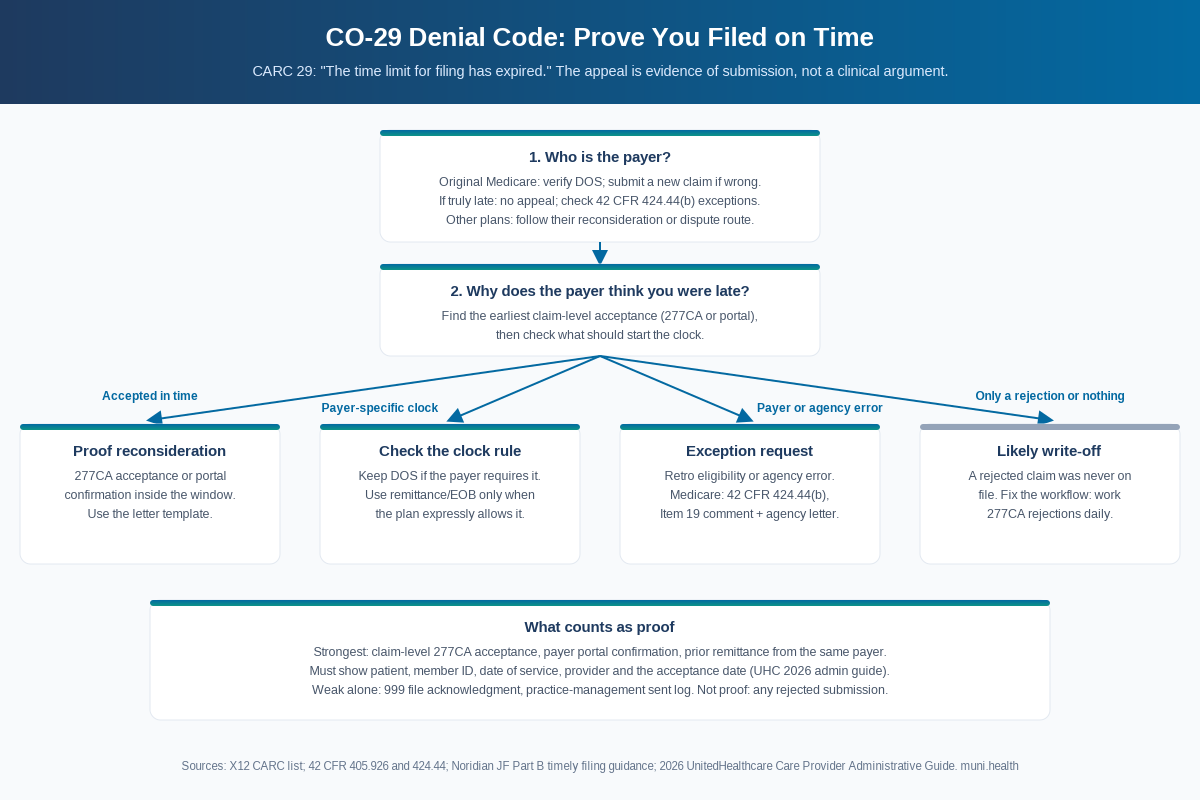
CO-29 means "The time limit for filing has expired," per the X12 CARC list. The payer says it received the claim after your filing deadline. You win a CO-29 with dated evidence, not a clinical argument. That evidence is proof the payer received and accepted the claim inside the window, or proof that a payer or government error caused the delay. A clearinghouse 277CA acceptance or a portal confirmation that shows the patient, date of service and acceptance date is the strongest proof. A 999 or a "sent" log alone usually isn't enough. For Original Medicare, first verify the date of service: Noridian JF Part B instructs providers to submit a new claim with the correct date if it was wrong. An actual timely filing denial has no appeal rights; if the claim really was late, check the documented exceptions under 42 CFR 424.44.
What Does CO-29 Mean?
CO-29 means the payer applied its timely filing limit and decided your claim arrived too late. The official X12 definition of CARC 29 is "The time limit for filing has expired."
The CO group code makes it a contractual obligation. Under most network agreements you cannot bill the patient for a CO-29 line. The write-off sits with the practice unless you show the payer got the date wrong.
The denial tells you nothing about the service itself. Medical necessity, coding and coverage were never reviewed. So a clinical appeal letter is the wrong tool. The only question in play is a date: when did the payer receive a claim it accepted?
That is also why CO-29 is one of the few denials where your billing records, not your clinical notes, decide the outcome.
Is a CO-29 Denial Appealable?
With commercial, Medicare Advantage and Medicaid managed care plans, usually yes. You file the payer's reconsideration or appeal with proof of timely filing. Original Medicare is different, and it trips up many billing teams.
Original Medicare: Noridian's JF Part B timely filing guidance pairs CO-29 with remark code N211 ("Alert: You may not appeal this decision") and states that "A claim denied for timely filing is not afforded appeal rights" (Noridian JF Part B, updated Apr 30, 2025). The rule comes from 42 CFR 405.926(n), which lists "Determinations that a provider or supplier failed to submit a claim timely" among actions that are not initial determinations. A redetermination request will not work.
First verify the date of service submitted. Noridian instructs providers to submit a new claim with the correct date of service if the submitted date was incorrect. This corrects the claim data; it does not create an appeal right or extend the filing limit.
If the date of service is correct and the claim actually was late, check whether an exception applies under 42 CFR 424.44(b). The general limit is 1 calendar year after the date of service, and the regulation extends it in four situations:
- Administrative error: the delay was caused by error or misrepresentation of an HHS employee, Medicare contractor or agent acting within the scope of its authority.
- Retroactive Medicare entitlement.
- Retroactive entitlement involving a state Medicaid agency that recovered its payment 6 or more months after the service.
- Retroactive disenrollment from a Medicare Advantage plan or PACE organization that recovered its payment 6 or more months after the service.
For a government-agency error, Noridian says to resubmit and "include an appropriate comment in Item 19 of the CMS 1500 Claim Form or the electronic equivalent." Keep the agency letter that documents the error. Under 424.44(b)(5), an administrative-error extension is not granted if the request is made more than 4 years after the date of service.
Everyone else: commercial, Medicare Advantage and Medicaid managed care plans generally handle a disputed CO-29 through their reconsideration or claim dispute process. UnitedHealthcare's 2026 Care Provider Administrative Guide (Chapter 10) lists proof of timely filing for a claim denied for untimely filing as a typical reconsideration. Some payers have a checkbox for it on the dispute form. Ambetter of Florida's reconsideration and claim dispute form, for example, includes "Claim was denied for untimely filing in error (attach proof of timely filing)."
The appeal clock is separate from the filing clock
The CO-29 says your filing window closed. Your window to dispute the CO-29 is a different deadline, and it runs from the denial or remittance date. Check the payer's reconsideration deadline the day the denial posts. The insurance appeal deadlines guide collects these by payer.
What Counts as Proof of Timely Filing?
Proof of timely filing must show that the payer received and accepted the claim inside the window, for the right patient and the right date of service. Proof that you only sent it is weaker.
UnitedHealthcare's 2026 guide is the clearest published standard. It says proof must include the date the claim was submitted, the date it was accepted, member identification, the date of service and provider identification. It also says rejected claims "are not proof of timely filing as rejections require further action from the provider." Other payers word it differently, but they look for the same five elements.
| Evidence | What it shows | How strong |
|---|---|---|
| 277CA claim acknowledgment showing the claim accepted | The payer's own pre-adjudication system accepted this claim on a specific date | Strongest for electronic claims. Pull the claim-level line, not just the batch. |
| Payer portal submission confirmation with claim or reference number | The claim entered the payer's system on a specific date | Strong. Screenshot or save it with the patient and DOS visible. |
| Payer EOB, remittance or letter on an earlier version of the claim | The payer had the claim in hand, and when | Strong. Often settles corrected-claim and resubmission CO-29s. |
| Other payer's EOB or denial letter (wrong payer, COB, retro eligibility) | Why the claim reached this payer late, and when you learned it | Strong when the payer's rules extend the window from that date |
| Certified mail or courier delivery receipt matched to the claim | Paper delivery date | Moderate. It proves an envelope arrived, so attach a copy of the claim inside it. |
| Fax transmission confirmation | A transmission to a fax number on a date | Moderate, and only where the payer accepts claims by fax |
| 999 acknowledgment alone | The batch file passed a syntax check | Weak. It is not claim-level acceptance. |
| Practice management 'claim sent' log or billing software statement | Your system says it sent the claim | Weak alone. UHC lists a billing software statement as acceptable, but most payers want payer-side confirmation. |
| 277CA rejection, or any rejected submission | The claim was not accepted | Not proof. A rejected claim was never on file. |
The 999 versus 277CA difference matters most. CGS Medicare's EDI guidance describes the sequence: the contractor returns a 999 for the file, and if the 999 is accepted, a 277CA is generated. The 277CA carries the claim control number (ICN/DCN) for accepted claims (CGS Part B EDI FAQ, reviewed Dec 5, 2025). The 999 only means the file was readable. The 277CA tells you whether each claim was accepted for adjudication or rejected. A clean 999 with a claim-level rejection on the 277CA means the claim was never on file. Correct it and resubmit it, inside the window.
CO-29 Routing: Which Case Do You Have?
Sort every CO-29 by why the payer thinks you were late before you write anything. The route and the evidence change with the cause.
| What the record shows | Likely cause | What to do |
|---|---|---|
| Your 277CA or portal confirmation shows acceptance inside the window | Payer received date recorded wrong, or a rework lost the original date | Reconsideration with the acceptance report. Use the letter below. |
| The denied claim is a corrected or replacement claim | The correction missed the applicable limit, or the payer used a clock inconsistent with its rule | Verify the contract/manual correction rule first. Keep DOS where required; use a remittance-based window only if the payer expressly provides it. Dispute a mismatch with that rule and the submission proof. |
| The claim is secondary, or went to another payer first | Window should run from the other payer's EOB or denial, per the payer's rules | Attach the other payer's EOB or denial letter and cite the payer's COB or wrong-payer rule |
| Eligibility was retroactively changed (retro enrollment, retro termination, Medicaid recoupment) | You couldn't have billed this payer earlier | Attach the retro-eligibility notice. For Original Medicare, use the 424.44 exception route. |
| Your only record is a rejection, or no record at all | The claim was never accepted inside the window | Usually a write-off. Fix the workflow so it doesn't recur. |
| Original Medicare CO-29 with N211 | Incorrect or illegible DOS, or actual late filing | Verify DOS first. If incorrect, Noridian says to submit a new claim with corrected DOS. If actually late, no appeal; check whether a 424.44 exception applies. |
Corrected claims do not automatically get a new filing clock. For example, UnitedHealthcare’s 2026 guide (Chapter 10, printed page 145) applies the agreement’s filing period from the service, discharge or last outpatient service date to corrections too. Include the original claim number as required, but do not assume that linking the claim restarts the clock. Use a remittance-based window only when the applicable payer/plan expressly provides one. The corrected claim timely filing guide covers each major payer's correction window. Payer-specific CO-29 details for corrected claims are in the Aetna and Cigna corrected claim guides.
If the CO-29 followed a wrong-payer rebill, check the CO-109 denial code guide for how the correct payer's window applies. For primary-then-secondary order, see the coordination of benefits denial guide.
How to Appeal a CO-29 Denial
Build the CO-29 packet in this order: confirm the payer's window, prove when the payer accepted the claim, then show your math.
- Look up the payer's filing limit and what starts the clock. Windows vary by payer, plan type, contract and network status. The timely filing limits by company guide links each payer's sourced limit. Your contract overrides the general limit.
- Find the earliest accepted submission. Search your clearinghouse for the claim-level 277CA acceptance, not just the batch 999. Check the payer portal for an earlier claim number.
- Match the proof to the claim. The report must show the patient, member ID, date of service, billing provider and acceptance date. Crop or highlight the relevant line instead of sending a 40-page batch report.
- Do the date math in writing. State the clock start required by the applicable contract or manual, the acceptance date, the window and the days elapsed. Use a remittance or EOB date only when that rule expressly permits it.
- Use the payer's dispute route. That might be a portal reconsideration, a dispute form, or the payer's written appeal address. Check any form checkbox for timely filing.
- Calendar the dispute deadline and follow up. Get a reference number when you submit. The claim status call script covers the follow-up call.
CO-29 Proof of Timely Filing Reconsideration Letter
Use this when you have payer-side proof that the claim was received and accepted inside the applicable window. Any later clock start must be expressly supported by the payer/plan rule; a correction or original claim number alone does not establish one. For Original Medicare with an incorrect DOS, follow the contractor’s new-claim correction instruction instead of this reconsideration letter. If the payer requires its own form or portal, attach this as the supporting explanation.
[Your Practice Letterhead]
[Date]

[Payer Name]
[Claim Reconsideration / Provider Disputes Department]
[Address, fax, or portal reference from the provider manual or remittance]

RE: Request for Reconsideration — Timely Filing Denial (CARC 29) Issued in Error
  Patient: [Patient Name]    DOB: [Date of Birth]
  Member ID: [Member ID]
  Claim Number (denied): [Claim #]
  Original Claim Number (if different): [Original Claim #]
  Date(s) of Service: [DOS]
  Billing Provider / NPI: [Name, NPI]
  Billing TIN: [Tax ID]
  Denial / Remittance Date: [Date]

To Whom It May Concern:

We request reconsideration of the claim above, which was denied with CARC 29 ("The time limit for filing has expired"). The claim was filed within the applicable filing limit, as documented below.

Filing limit that applies:
- [X] days from [the date of service / the original remittance date of ____ / the primary payer's EOB dated ____ / the eligibility notice dated ____], under [our participation agreement, section ____ / the provider manual, section ____ / applicable state rule].
- [If using a remittance, EOB or notice date rather than DOS, identify the express payer/plan rule permitting it: _____. A corrected claim or original claim number alone does not restart the clock.]
- Filing deadline for this claim: [Date].

Proof of timely filing (enclosed):
- [Clearinghouse 277CA claim acknowledgment showing the claim accepted by [Payer Name] on [date], payer claim or reference number [#].]
- [Payer portal submission confirmation dated [date], reference number [#].]
- [Prior remittance or EOB from [Payer Name] dated [date] showing the claim was on file.]
- [Primary or prior payer EOB / denial letter dated [date] establishing the later clock start.]

Each enclosed document identifies this patient, member ID, date of service and billing provider.

Date math:
- Clock start: [Date]
- Date [Payer Name] accepted the claim: [Date]
- Days elapsed: [#] of [X] allowed

Because [Payer Name] received and accepted this claim within the filing limit, we ask that the CARC 29 denial be reversed and the claim be processed for payment. If [Payer Name] maintains the denial, please identify the received date it relied on and the filing limit it applied, so we can review the discrepancy.

Enclosed:
- Remittance advice showing the CARC 29 denial
- Proof of timely filing listed above
- Copy of the claim as submitted
- [Relevant contract or provider manual excerpt]

Sincerely,

[Your Name]
[Title]
[Practice Name]
[Phone] | [Email]
Skip the blank template. Start with a review-ready draft.
Use the template as guidance, or let Muni prepare a payer-specific draft for your team to verify, sign, and submit.
See Muni Handle This DenialFirst 3 appeals free, then $20 per appeal. Start with your denial letter or EOB and available records. No meeting or clearinghouse connection required.
CO-29 Proof Packet Checklist
Run this before you send the letter. If you cannot fill in the acceptance line, you probably have a write-off, not an appeal.
CO-29 PROOF PACKET CHECKLIST

Claim number: ______________   Payer: ______________
Date of service: ____________  Denial date: ____________
RARC on remittance (e.g., N211): ______
[ ] Original Medicare + N211 -> verify DOS first; if wrong, follow Noridian’s new-claim correction instruction
[ ] Original Medicare actually late -> no appeal; check whether a 42 CFR 424.44 exception applies

STEP 1 - WINDOW
Filing limit: ______ days   Source: [ ] Contract  [ ] Provider manual  [ ] State rule
Clock starts from: [ ] DOS  [ ] Original remittance  [ ] Primary EOB  [ ] Eligibility notice
[ ] Start date matches the express payer/plan rule; a correction does not automatically reset it
Clock-start date: ____________   Deadline: ____________

STEP 2 - PROOF (payer-side acceptance preferred)
[ ] 277CA claim-level ACCEPTANCE   Date: ______  Payer claim/ref #: ______
[ ] Portal submission confirmation  Date: ______  Ref #: ______
[ ] Prior remittance/EOB from this payer  Date: ______
[ ] Other payer EOB / denial / retro-eligibility notice  Date: ______
[ ] Certified mail receipt + copy of claim enclosed  Date: ______
Weak or not proof on its own: 999 only / PM "sent" log / any rejection

STEP 3 - MATCH
[ ] Patient name and member ID visible
[ ] Date of service visible
[ ] Billing provider / NPI visible
[ ] Acceptance date visible and inside the window

STEP 4 - SUBMIT
Route: [ ] Portal reconsideration  [ ] Dispute form (timely filing box checked)  [ ] Written appeal
Dispute deadline (from denial date): ____________
Date submitted: ____________   Reference #: ____________
Follow-up date: ____________
How to Prevent CO-29 Denials
You prevent most CO-29s by working rejections fast and saving acceptance proof when the claim goes out, not months later when the denial arrives.
Prepare this appeal packet with your team.
Draft the appeal, coordinate missing documents, and approve the reviewed packet. Keep your clearinghouse; your practice checks deadlines and submits through the payer’s accepted channel.
Try Muni Appeals FreeFirst 3 appeals free, then $20 per appeal. Start with your denial letter or EOB and available records. No meeting or clearinghouse connection required.
- Work the 277CA rejection queue daily. A rejected claim isn't on file, and the filing clock keeps running while it sits.
- Archive the claim-level acceptance with the claim. Pulling a 277CA from a clearinghouse a year later is harder than saving it on day one.
- Track the deadline per claim, not per payer. Verify the applicable correction, secondary-claim or retro-eligibility rule. Keep the DOS-based deadline where required; use another start date only when the payer/plan expressly permits it.
- Verify eligibility before the claim is built. Wrong-payer and COB detours burn filing time. The eligibility verification call script covers the questions to ask.
- Send corrections the payer's required way. Include the required original claim number and frequency code to identify the replacement; those fields do not themselves create a new filing window.
How Muni Appeals Helps With CO-29 Denials
A CO-29 rises or falls on your submission records, and Muni Appeals doesn't submit claims or pull clearinghouse reports for you. When you have proof that the claim was accepted on time, Muni Appeals drafts a review-ready reconsideration letter from the remittance, the acceptance report, and the claim details your staff provides. The letter lays out the date math and lists the enclosed proof. Your team still confirms the filing limit, the route and the dispute deadline.
If you're deciding which denials in the queue are worth working at all, start with the when to appeal an insurance denial decision framework.
Frequently Asked Questions
What does denial code CO-29 mean?
CO-29 means "The time limit for filing has expired." The payer says the claim arrived after its filing deadline. The CO group code makes it a contractual adjustment, so under most network agreements you can't bill the patient for it.
Can you appeal a CO-29 denial?
With most commercial, Medicare Advantage and Medicaid managed care plans, yes. You dispute it through the payer's reconsideration or appeal process with proof the claim was received and accepted on time. Original Medicare timely filing denials have no appeal rights under 42 CFR 405.926(n). First verify the DOS: Noridian instructs providers to submit a new claim with the correct DOS if it was wrong. If the claim actually was late, check whether an exception under 42 CFR 424.44 applies.
What is acceptable proof of timely filing?
Payer-side evidence that the claim was accepted inside the window, for the right patient and date of service. A claim-level 277CA acceptance, a payer portal confirmation, or a prior remittance from the same payer is strongest. UnitedHealthcare's 2026 guide says rejected claims are not proof of timely filing.
Is a 999 acknowledgment proof of timely filing?
Usually not on its own. A 999 confirms the batch file passed a syntax check. The 277CA shows whether each claim was accepted or rejected for adjudication. Send the 277CA acceptance line for the specific claim.
What does CO-29 with N211 mean?
On a Medicare remittance, N211 means "Alert: You may not appeal this decision." Paired with CARC 29, it identifies a timely filing denial with no redetermination available. First verify the DOS: Noridian says to submit a new claim with corrected DOS if it was incorrect. If the claim actually was late, check whether a 42 CFR 424.44 exception applies, such as an administrative error or retroactive entitlement.
Why did my corrected claim get a CO-29?
The correction may have missed the payer/plan’s filing limit, or the payer may have applied its rule incorrectly. Verify the contract or manual before disputing the clock. UHC’s 2026 guide keeps corrections within the agreement’s service-, discharge- or last-outpatient-service-based limit. Use an original-remittance-based window only when the applicable rule expressly provides it. Include the required original claim reference separately; it does not restart the clock.
What is the difference between CO-29 and CO-18?
CARC 29 means the filing limit expired. CARC 18 is an exact duplicate claim or service. A resubmission that should have been sent as a corrected claim can produce either one. The fix depends on which code the payer used.
The CO-29 Appeal Is a Records Fight
A CO-29 isn't decided on clinical merit. It's decided on whether you can show the payer accepted the claim in time. Save the acceptance proof when the claim goes out, work rejections before the window closes, and dispute wrong denials with the date math laid out.
With Muni Appeals, your team gets:
- Review-ready reconsideration letters built from the remittance and the acceptance proof your staff provides
- Letters that lay out the clock start, the acceptance date and the days elapsed
- Staff control over the filing limit, the dispute route and the deadline
This guide reflects the X12 CARC definitions, 42 CFR 405.926 and 424.44, Noridian JF Part B timely filing guidance, CGS Medicare EDI guidance, and the 2026 UnitedHealthcare Care Provider Administrative Guide as available in November 2026. Filing limits, clock-start rules, accepted proof and dispute routes vary by payer, plan, contract and state. Verify the payer's current provider manual and your agreement before you file. This guide is not legal or billing compliance advice.