

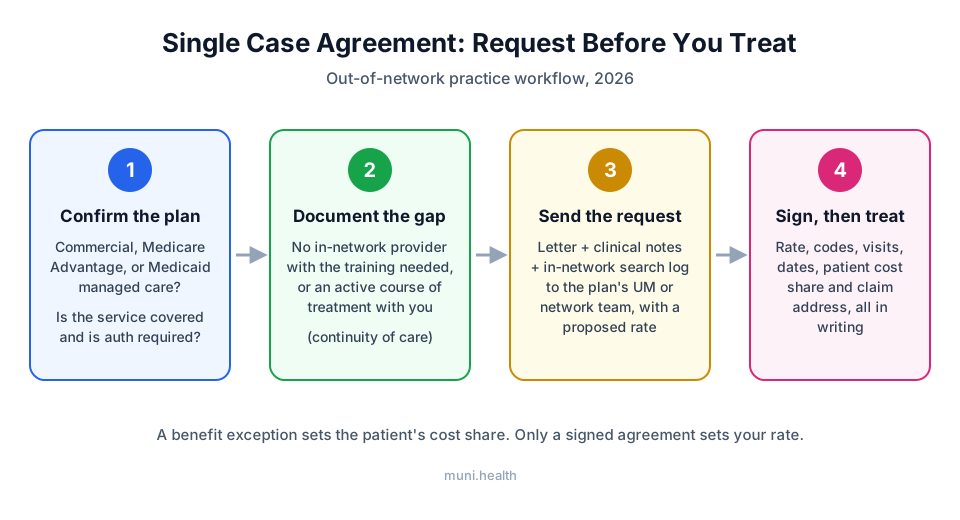
A single case agreement (SCA) is a one-patient contract between an out-of-network provider and a health plan. It sets the rate and terms for a defined course of care. Request it before you treat, from the plan's utilization management or network team. Your strongest case is that no in-network provider with the right training is reasonably available, or that the patient is mid-treatment with you. Federal rules back both arguments for many patients. Medicare Advantage coordinated care plans must cover medically necessary care out of network at in-network cost sharing when network providers are unavailable or inadequate (42 CFR 422.112(a)(1)(iii)). Medicaid managed care plans must cover those services out of network for as long as their network can't (42 CFR 438.206(b)(4)). Get two things in writing: the patient's in-network benefit level and your rate. The letter and terms checklist below cover both.
What a Single Case Agreement Actually Covers
An SCA covers one patient, one course of care, and one rate, for a set date range. It isn't a network contract, and it doesn't make you in-network for the plan's other members.
Practices often mix up three things that plans keep separate:
| Request | What it decides | What it does not decide |
|---|---|---|
| Network gap / network exception (benefit exception) | The patient's benefit level: in-network cost sharing for an out-of-network provider | Your payment rate. Without an agreement the plan may pay its out-of-network allowed amount |
| Single case agreement | Your rate, covered codes, visit or unit count, dates, and billing terms for this patient | Medical necessity. Prior authorization is usually still a separate requirement |
| Prior authorization | Whether the specific service is approved as medically necessary | Network status or rate |
| Continuity / transition of care | Whether a patient mid-treatment can keep seeing you at in-network terms for a limited period | Anything after the transition period ends |
Plans name these differently. Cigna, for example, uses a Medical Network Exception Request form under its Network Adequacy Provision coverage policy (UM20). That form asks the requesting provider to document specialized experience, training, or certification and to attach a letter of medical necessity or clinical information. Check the plan's own form and process before you send a letter.
The exception is not the agreement
An approved network exception can leave the patient at in-network cost sharing while your claim still pays at the plan's out-of-network allowed amount. If the rate matters to you, ask for a signed single case agreement, not just the benefit exception. Ask the plan whether you may balance bill under its terms, and get the answer in writing.
When You Have Grounds to Request an SCA
You have the strongest grounds when the plan's network can't supply the care, or when the patient is already in active treatment with you. Convenience, patient preference, or a better outcome reputation alone rarely carry a request.
| Situation | Rule that supports it | Evidence to attach |
|---|---|---|
| Medicare Advantage (coordinated care plan): no in-network provider available or adequate for the patient's needs | MA plans must arrange for and cover medically necessary covered benefits outside the network at in-network cost sharing (42 CFR 422.112(a)(1)(iii)) | In-network search log, clinical notes showing the specific need, your credentials |
| Medicaid managed care: network can't provide a necessary covered service | Plan must cover it out of network adequately and timely, for as long as the network can't, with enrollee cost no higher than in network (42 CFR 438.206(b)(4)–(5)) | Same as above, plus any state Medicaid contract language the plan cites |
| Commercial plan in a state with a specialty-referral law | Example: New York requires a referral to an appropriate out-of-network provider when the network has no provider with appropriate training and experience, at in-network cost to the insured (NY Ins. Law § 4804) | Search log, specialty-match explanation, physician statement |
| Coverage subject to the No Surprises Act: qualifying contract termination while the patient is a continuing care patient | For covered group plans and group or individual insurance, eligible patients may elect up to 90 days at prior in-network terms; terminations for fraud or failure to meet applicable quality standards are excluded (42 U.S.C. 300gg-113) | Coverage type, termination reason and notice date, treatment plan, the patient's qualifying category |
| Patient is new to the plan and mid-treatment with you | Plan transition-of-care policy (varies by plan and state) | Treatment plan, start date, planned remaining visits |
Sources: 42 CFR 422.112 (last amended 91 FR 17581, April 6, 2026); 42 CFR 438.206 (last amended 89 FR 41276, May 10, 2024); 42 U.S.C. 300gg-113; NY Insurance Law § 4804 (revision dated May 29, 2026).
The No Surprises Act continuity protection applies to covered group health plans and group or individual health insurance, including applicable commercial coverage, when a qualifying termination changes the patient's network benefits. Contract expiration and nonrenewal can qualify; termination for fraud or failure to meet applicable quality standards does not. Medicare Advantage and Medicaid managed care readers should use their applicable program and plan transition-of-care rules instead: CMS excludes Medicare and Medicaid from these No Surprises requirements.
For this protection, a continuing care patient is someone who is undergoing treatment for a serious and complex condition, in institutional or inpatient care, scheduled for nonelective surgery (including postoperative care), pregnant and in treatment for the pregnancy, or terminally ill and receiving treatment for that illness. The patient may elect transitional care on the prior terms until 90 days from the plan's notice or until the person stops being a continuing care patient, whichever is earlier (42 U.S.C. 300gg-113). It applies to plan years beginning on or after January 1, 2022.
State rules vary widely. Self-funded employer plans generally follow federal rules, not state insurance law. Confirm the plan's funding type before you cite a state statute.
The Evidence That Wins a Network-Gap Request
Prove the gap, not your quality. Reviewers ask whether an in-network provider could do this, for this patient, within a reasonable distance and time. Your letter should answer that question with records.
- An in-network search log. List the in-network providers you or the patient contacted, the date, and the result. Typical results are "not accepting new patients," "first available in X weeks," "doesn't perform CPT [code]," or "no subspecialty training in [condition]." A dated log carries far more weight than "no one is available."
- The specific clinical need. Name the diagnosis, the procedure or therapy, and why it needs your training. "Pediatric eating-disorder program" is a specific need. "Specialist care" isn't.
- Your credentials, mapped to the need. Give the board certification, fellowship, certification, or program experience that matches the clinical need. That is the exact field Cigna's exception form asks for.
- Continuity facts, if they apply. Give the treatment start date, the visits completed, the visits remaining, and the clinical risk of switching providers mid-course.
- A proposed rate. Plans can't agree to terms you haven't proposed. Name a basis such as a percentage of the Medicare fee schedule, your usual rate, or a per-session amount, and attach your fee schedule for the codes involved.
The plan's distance, appointment-wait, and specialty standards differ by product and state. Plan documents and the plan's network adequacy policy are the primary sources. Don't cite a number you haven't confirmed for that plan.
Single Case Agreement Request Letter Template
Send this before the first date of service, with the clinical notes and search log attached. Address it to the plan's utilization management or network management department. If the plan has a required exception form, submit the form and attach this letter as the supporting narrative.
[Practice Letterhead]
[Date]

[Health Plan Name]
Attn: [Utilization Management / Network Management / Single Case Agreements]
[Address] | Fax: [Number] | Portal reference: [If submitted online]

RE: Request for Single Case Agreement and In-Network Benefit Exception
Member: [Name] | DOB: [MM/DD/YYYY]
Member ID: [Number] | Group: [Number] | Plan type: [Commercial / Medicare
Advantage / Medicaid managed care]
Requesting provider: [Name, credentials], NPI [Number], TIN [Number]
Network status: Out-of-network [or: formerly in-network, terminated on (date)]
Diagnosis: [ICD-10 code(s) and description]
Requested services: [CPT/HCPCS codes, units or visits]
Requested dates: [Start date] through [End date]
Prior authorization reference (if any): [Number / pending]

REQUEST
We request (1) a single case agreement for the services above and (2) that
the member's in-network benefit level apply to these services.

WHY AN IN-NETWORK PROVIDER IS NOT AVAILABLE
[Select and complete what applies]
[ ] Network gap: The member needs [specific service] for [specific clinical
    need]. We contacted the in-network providers listed in the enclosed
    search log between [date] and [date]. None can provide this service
    within a clinically appropriate time and distance: [summarize results].
[ ] Specialized training: [Provider] holds [board certification /
    fellowship / certification] in [area], which matches the member's need
    for [clinical reason]. The in-network providers contacted do not offer
    [specific capability].
[ ] Continuity of care: The member has been in active treatment with us
    since [date] for [condition]. [Number] visits are complete and
    [number] remain in the treatment plan. Changing providers mid-course
    risks [specific clinical risk documented in the enclosed notes].
[ ] Qualifying contract termination under the No Surprises Act:
    [Use only for covered group plans or group/individual insurance;
    delete for Medicare Advantage or Medicaid managed care.]
    Our agreement with the plan ended on [date] for [reason], not for
    fraud or failure to meet applicable quality standards. The member is
    a continuing care patient because [qualifying category] and elects
    continued care on the prior in-network terms under 42 U.S.C.
    300gg-113. The requested period begins with the plan's notice on
    [date] and ends at 90 days or when the member no longer qualifies
    as a continuing care patient, whichever is earlier.
[ ] Medicare Advantage / Medicaid managed care transition of care:
    We request [terms and duration] under [applicable program or plan
    transition-of-care rule, with supporting reference attached], rather
    than the No Surprises Act provision above.

[Medicare Advantage or Medicaid managed care only, delete otherwise]
Federal rules require the plan to cover medically necessary covered
services out of network, at no greater cost to the member than in network,
when network providers are unavailable or inadequate to meet the member's
needs [42 CFR 422.112(a)(1)(iii) / 42 CFR 438.206(b)(4)-(5)].

PROPOSED TERMS
Reimbursement: [e.g., (X)% of the current Medicare fee schedule /
$(amount) per session / our attached fee schedule] for the codes listed.
Scope: [Number] visits/units of [codes] from [start] to [end].
Member cost share: in-network level per the member's plan.
Billing: claims submitted to [address/payer ID] with the agreement number.

ENCLOSURES
1. In-network provider search log
2. Clinical notes and treatment plan dated [date(s)]
3. Letter of medical necessity
4. Provider credentials (CV / board certification)
5. Fee schedule for the requested codes

Please send the decision and, if approved, the signed agreement to
[name] at [fax/email]. We are scheduled to begin care on [date]. If the plan
denies this request, please state the reason, the in-network provider(s) the
plan believes can provide this service, and the member's appeal rights.

Sincerely,

[Name, Credentials]
[Practice Name] | Phone: [Number] | Fax: [Number]
Skip the blank template. Start with a review-ready draft.
Use the template as guidance, or let Muni prepare a payer-specific draft for your team to verify, sign, and submit.
See Muni Handle This DenialFirst 3 appeals free, then $20 per appeal. Start with your denial letter or EOB and available records. No meeting or clearinghouse connection required.
The last paragraph matters. If the plan says an in-network provider is available, ask it to name that provider. Then call that provider and confirm whether it can actually take the patient. A named provider who isn't taking new patients is your strongest evidence in a resubmission or appeal.
The Terms to Get in Writing Before You Treat
Don't start care on a verbal approval. A call reference number shows that a conversation happened. It doesn't set a rate. Before the first date of service, check the signed agreement against this list.
Prepare this appeal packet with your team.
Draft the appeal, coordinate missing documents, and approve the reviewed packet. Keep your clearinghouse; your practice checks deadlines and submits through the payer’s accepted channel.
Try Muni Appeals FreeFirst 3 appeals free, then $20 per appeal. Start with your denial letter or EOB and available records. No meeting or clearinghouse connection required.
SINGLE CASE AGREEMENT TERMS CHECKLIST

[ ] Agreement or reference number, and the plan representative's name
[ ] Signed by an authorized plan representative (not a call note)
[ ] Member name, ID, and plan exactly as on the eligibility check
[ ] Rate stated with a basis: [% of Medicare fee schedule / flat $ per
  visit / % of billed charges], and the fee-schedule year it uses
[ ] Every CPT/HCPCS code you expect to bill, including add-on codes
[ ] Number of visits or units, and the start and end dates
[ ] Rendering provider(s) and location(s) covered
[ ] Member cost share stated (in-network deductible, copay, coinsurance)
[ ] Balance billing: whether you may bill the member beyond cost share
[ ] Whether prior authorization is still required, and its number
[ ] Claim submission address or payer ID, and any claim notation needed
[ ] Timely filing limit for claims under the agreement
[ ] How to extend: who to contact, and how far before the end date
[ ] Dispute or appeal route if a claim pays below the agreed rate

Before each claim:
[ ] Date of service falls inside the agreement dates
[ ] Visit count has not been exceeded
[ ] Agreement number is on the claim as the plan instructed
When an SCA claim pays below the agreed rate, treat it as a payment dispute and attach the signed agreement. The corrected claim vs. appeal guide explains which route fits which kind of underpayment.
If the Plan Denies the Request
Ask for the denial in writing, with the reason and the in-network alternative named, then decide whether to fix the gap evidence or appeal. Most denials say an in-network provider is available.
- "In-network provider available." Call the named provider. If it can't take the patient, or doesn't perform the service, document that and resubmit with an updated search log.
- "Not medically necessary." That is a coverage decision, not a network one. Handle it like any other necessity denial, with a medical necessity letter. If a reviewer is available, request a peer-to-peer review.
- Medicare Advantage or Medicaid managed care. A refusal to cover a service is an adverse decision that the member can appeal. For MA, see the Medicare Advantage appeal letter template. Behavioral health requests may also raise parity issues; see behavioral health denial appeals.
- Commercial, state-regulated plan. Check whether your state gives the member a right to an out-of-network referral, as New York does in § 4804. Then check how the state lets the member appeal or get an external review of a referral denial. Your state insurance department publishes both.
If you treated without an agreement and the plan paid out of network, a different set of rules may apply. Emergency and certain facility-based services fall under the No Surprises Act; see No Surprises Act balance billing appeals.
Frequently Asked Questions
What is a single case agreement in medical billing?
It is a contract between an out-of-network provider and a health plan for one patient's specified course of care. It sets the rate, the covered codes, the visit count, and the dates. It doesn't add the provider to the plan's network.
Who requests a single case agreement, the patient or the provider?
Either can start it, but the provider usually does the work. The provider supplies the clinical notes, credentials, proposed rate and, often, the in-network search log. Many plans route the request through utilization management or network management.
Is a network gap exception the same as a single case agreement?
No. A gap or network exception sets the member's benefit level, usually in-network cost sharing. An SCA sets the provider's payment terms. You can get an exception without an agreement, which can leave your rate at the plan's out-of-network allowed amount.
Do I still need prior authorization with a single case agreement?
Often yes. The agreement settles network and payment terms. Prior authorization settles medical necessity. Confirm with the plan whether both are needed and record both reference numbers.
Can Medicare Advantage plans refuse a single case agreement?
They may decline your proposed terms. But MA coordinated care plans must still arrange for and cover medically necessary covered benefits out of network at in-network cost sharing when network providers are unavailable or inadequate (42 CFR 422.112(a)(1)(iii)). If the plan refuses to cover the service, the member can appeal.
How long does a single case agreement last?
It lasts as long as the dates and visit count written into it. There is no standard length. Ask how to extend it before it expires, and request the extension before the last authorized visit.
Request the Agreement Before the First Visit
The SCA you can collect on is the one signed before care starts, with a rate, codes, and dates on it. Prove the network gap with a dated search log, propose specific terms, and don't treat on a call note.
Muni Appeals helps practices:
- Organize the denial, clinical notes, and supporting evidence when a request or claim is denied
- Research and draft appeal and medical necessity arguments for staff review
- Prepare a draft that staff check against the plan's current requirements
This guide reflects federal regulations and the cited state and plan materials as published as of November 2026. Plan names, forms, and processes for network exceptions and single case agreements vary by plan, product, and state. Confirm the current process with the plan before you submit. This information is for administrative and billing purposes and is not legal or medical advice.