

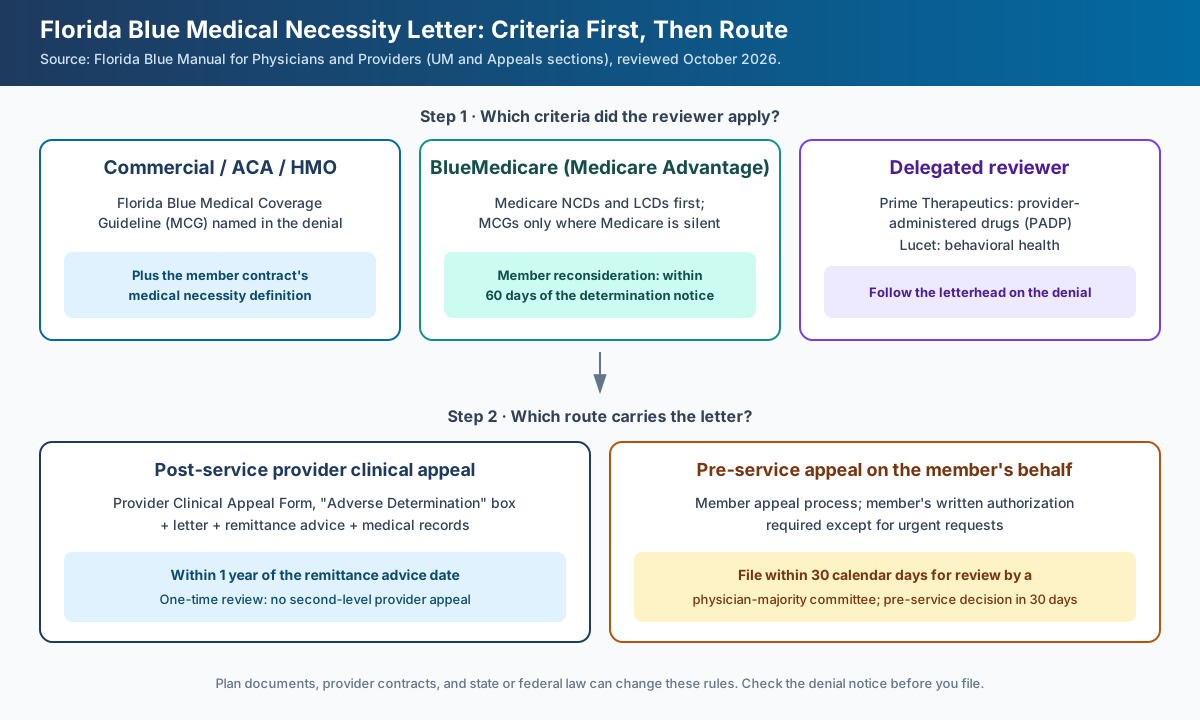
A Florida Blue medical necessity letter works when it answers the specific Medical Coverage Guideline (MCG) the reviewer applied and the medical necessity definition in the member's contract. Florida Blue's provider manual says its MCGs are used to decide coverage under the medical necessity terms of member contracts. BlueMedicare reviews use Medicare NCDs and LCDs first. Name the guideline from the denial, answer each criterion with a dated record entry, and pick the route. A post-service provider clinical appeal goes on the Provider Clinical Appeal Form within one year of the remittance advice date, and Florida Blue gives it only one review. A pre-service appeal runs through the member's appeal process. File it within 30 calendar days of the coverage decision to get review by a committee made up mostly of physicians. The copyable template is below.
Which Criteria Did Florida Blue Use to Deny the Request?
Before you draft anything, read the denial for the product line and the guideline it cites. Florida Blue applies different criteria depending on the plan and on who did the review. Your letter has to answer the criteria the reviewer actually used.
| Plan or service | Criteria the reviewer applies | Who reviews | Where to read the criteria |
|---|---|---|---|
| Commercial PPO (BlueOptions, BlueSelect), ACA (myBlue), and Florida Blue HMO | Florida Blue Medical Coverage Guidelines (MCGs) plus the medical necessity definition in the member's contract or evidence of coverage | Florida Blue utilization management | mcgs.bcbsfl.com, or the Coverage Guidelines link at the bottom of the Availity Eligibility & Benefits results |
| BlueMedicare (Medicare Advantage) | Medicare National and Local Coverage Determinations first. Florida Blue's medical policies or MCGs apply only where Medicare has no policy | Florida Blue utilization management | CMS Medicare Coverage Database, then mcgs.bcbsfl.com |
| Provider-administered drugs (Provider Administered Drug Program) | Medical necessity under the member's benefit plan | Prime Therapeutics Management (formerly Magellan Rx Management) | Florida Blue's PADP drug list and Prime's provider portal |
| Behavioral health | Lucet's review criteria | Lucet Behavioral Health (delegated) | Lucet provider resources, per the denial notice |
| Oncology and hematology for Medicare Advantage | New Century Health's review criteria | New Century Health | New Century Health provider portal |
The criteria and vendor roles come from the Utilization Management section of Florida Blue's Manual for Physicians and Providers and its Utilization Management program page, both reviewed in October 2026. Vendor scope can change. Trust the letterhead on the denial over this table.
Why the guideline matters. Florida Blue's manual says it builds its MCGs from external clinical evidence, specialty societies, physician consultants, the FDA, and the Blue Cross Blue Shield Association. A reviewer working an MCG checks its criteria in order. A letter that argues "medically necessary" in general gives the reviewer nothing new. A letter that quotes each criterion and points to the record does.
What Florida Blue's Provider Manual Says About Medical Necessity
Florida Blue doesn't publish one numbered definition for every plan. Its manual sends you to the member's contract, and three of its rules shape the letter.
- The member contract sets the definition. The manual says all services must meet the definition of medical necessity in the member's benefit contract or evidence of coverage. If you can get that definition, quote it in the letter.
- No authorization requirement doesn't mean no review. A service that didn't need authorization still has to meet that definition. The manual says it can be reviewed before the service, after it, or during it. A post-service denial on a service that never needed authorization is common, and this letter is the answer to it.
- Medicare and Florida Blue criteria aren't interchangeable. For BlueMedicare, the manual says CMS guidelines come first and Florida Blue's MCGs fill the gaps. Cite the NCD or LCD when one applies, and cite the MCG only when Medicare is silent.
Two tools can prevent the denial in the first place:
- Certificates of Medical Necessity (CMNs). Some MCGs have a CMN form, marked with a blue document symbol after the MCG's 9-digit policy number. A CMN lets the provider attest to what the records show instead of sending them. The guideline's Position Statement section explains each CMN.
- Voluntary Predetermination for Select Services (VPSS). For non-HMO products that don't require authorization, VPSS is an optional review done before the service. The manual says a VPSS review will typically eliminate the post-service medical necessity review of that service. VPSS isn't available when no MCG exists for the service.
Ask for the criteria in writing
Florida Blue's manual says HMO members may request copies of the scientific or clinical criteria used in a medical necessity denial. For ACA and other non-grandfathered plans, a full and fair review includes free access to the documents relevant to the claim (45 CFR 147.136). Get the exact MCG version before you write.
Florida Blue Letter of Medical Necessity Template (Copy and Use)
Use this letter with a prior authorization request, with a VPSS request, or with a clinical appeal. The treating physician signs it. It carries the clinical argument. The Provider Clinical Appeal Form or the member appeal form handles routing. The Florida Blue appeal letter templates cover the cover letter. Replace every bracket and delete the optional paragraphs that don't apply.
[PRACTICE LETTERHEAD]

[Date]

Florida Blue, [Utilization Management / Provider Disputes Department]
[Address, fax, or Availity route from the denial notice or the form instructions]
[If Prime Therapeutics, Lucet, or New Century Health issued the denial, address the letter to that reviewer instead]

RE: Letter of Medical Necessity
Member name: [Name]
Florida Blue member/contract number (alphas and numeric): [ID]
Date of birth: [MM/DD/YYYY]
Product: [ ] BlueOptions/BlueSelect (PPO)  [ ] myBlue  [ ] BlueCare (HMO)  [ ] BlueMedicare  [ ] Other: [ ]
Service requested: [Description]   CPT/HCPCS: [Codes]   Units/frequency: [ ]
Setting: [Office / ASC / hospital outpatient / inpatient / home]
Diagnosis: [Description]   ICD-10: [Codes]
Authorization / precertification / claim number: [Number]
Date(s) of service: [MM/DD/YYYY - MM/DD/YYYY] (post-service only)
Denial or remittance advice date: [MM/DD/YYYY]   Reviewing entity: [Florida Blue / Prime / Lucet / New Century Health]
Criteria cited: [Florida Blue Medical Coverage Guideline number and title, with effective date]
[BlueMedicare: NCD or LCD number and title, if one applies]

To the Medical Director:

I am the treating [specialty] physician for [Member name]. I am writing to document the medical necessity of [service] for [diagnosis] and to request [approval / reversal of the denial dated (date)].

1. CRITERIA ADDRESSED
The denial cites [MCG number and title / NCD or LCD]. This letter answers each criterion in that guideline, in order, with the record entry that supports it.
[If the member's contract defines medical necessity: The member's plan defines medically necessary services as "[quote]". The service meets that definition as documented below.]

2. CLINICAL SUMMARY
- Diagnosis confirmed on [date] by [exam / imaging / labs / pathology]: [key findings].
- Current severity: [objective measures, scores, imaging grades, lab values] as of [date].
- Functional impact: [specific activities the member cannot perform] documented on [date].
- Course: [onset, progression, relevant comorbidities].

3. CRITERION-BY-CRITERION RESPONSE
Criterion [1]: "[quote criterion from the MCG Position Statement]"
Met: [finding], documented in [record type] dated [date] (Attachment [A]).
Criterion [2]: "[quote criterion]"
Met: [finding], documented in [record type] dated [date] (Attachment [B]).
Criterion [3]: "[quote criterion]"
Met: [finding], documented in [record type] dated [date] (Attachment [C]).
[Add a line for every criterion. If one does not apply to this member, explain why with clinical reasoning and a citation.]

4. SUPPORTING CLINICAL EVIDENCE
[Guideline name, issuing organization, year, section] recommends [service] for patients with [criteria]. This member meets those criteria because [specific findings].

5. ALTERNATIVES TRIED OR RULED OUT
- [Treatment] from [date] to [date]: [dose/frequency]. Outcome: [failed / partial response / adverse effect], documented [date].
- [Treatment] from [date] to [date]: [outcome].
- [Alternative] is not appropriate because [contraindication / clinical reason].
[Drug requests under a step-therapy protocol: The member was approved to receive [drug] after completing the step-therapy protocol required by [prior plan], which paid for the drug within the 90 days immediately before this request. Documentation from that plan is attached.]

6. SETTING AND LEVEL OF CARE
[Include when the setting is in question.] The requested setting, [setting], is needed because [specific clinical reason: comorbidity, anesthesia risk, monitoring need, prior adverse event]. A lower level of care would not be safe or equally effective for this member because [reason], documented [date].

7. RISK OF DENIAL OR DELAY
Without [service], the member is at risk of [specific, documented clinical consequences].
[If urgent: Applying the standard timeframe could seriously jeopardize the member's life, health, or ability to regain maximum function. I request expedited review.]

8. REQUEST
I request that [Florida Blue / reviewer] [approve the request / reverse the denial] for [service, codes, units, dates, setting]. If the decision is upheld, please provide the specific criteria and guideline version applied, the name and specialty of the reviewing physician, and copies of the documents relevant to the decision.

Enclosures:
[ ] Office notes ([dates])                 [ ] Imaging / lab / pathology reports
[ ] Prior treatment records                [ ] MCG excerpt or citation
[ ] Denial notice or remittance advice     [ ] Provider Clinical Appeal Form (post-service appeals)
[ ] Member's written authorization (pre-service appeals, unless urgent)

Sincerely,

[Physician name, credentials]
[Specialty]   NPI: [Number]   Florida Blue provider number: [Number]
[Phone]   [Fax]   [Email]
[Signature]
Prepare this appeal packet with your team.
Draft the appeal, coordinate missing documents, and approve the reviewed packet. Keep your clearinghouse; your practice checks deadlines and submits through the payer’s accepted channel.
First 3 appeals free, then $20 per appeal. Start with your denial letter or EOB and available records. No meeting or clearinghouse connection required.
Section 3 does most of the work. Florida Blue's MCGs put their coverage criteria in a Position Statement. Quote those criteria in order and tie each one to a dated attachment. That lets the reviewer approve without hunting through the chart.
How to Fill In Each Section So It Survives Review
Every statement in the letter should point to a dated attachment. The reviewer is checking the record against the guideline, not weighing how strongly you argue.
Prepare this appeal packet with your team.
Draft the appeal, coordinate missing documents, and approve the reviewed packet. Keep your clearinghouse; your practice checks deadlines and submits through the payer’s accepted channel.
First 3 appeals free, then $20 per appeal. Start with your denial letter or EOB and available records. No meeting or clearinghouse connection required.
- Cite the MCG by number, title, and effective date. Florida Blue posts updates in the "What's New" section of its Medical Coverage Guidelines site. Cite the version in force on the date of service or request. If a newer version is more favorable, say so in a separate sentence.
- Use objective measures. Scores, imaging grades, lab values, and documented functional limits carry more weight than words like "severe."
- Date every failed alternative. "Tried PT" isn't evidence. "PT 2x/week from [date] to [date], no change in [measure], documented [date]" is.
- For drugs, check the step-therapy rule. Under Florida Statutes §627.42393, an insurer issuing a major medical individual or group policy can't require step therapy for a covered drug when the patient was previously approved to receive it through completion of a step-therapy protocol required by a separate health coverage plan, and provides documentation from that plan showing it paid for the drug during the 90 days immediately before the request. Insurers must also publish a way to request a step-therapy exception. Use the optional line in section 5 when it applies. The statute covers insurers issuing major medical policies, so check HMO and self-funded employer plans separately.
- Keep it to two pages. Put detail in attachments and reference them by date.
For a structure that works at any payer, see the medical necessity justification letter guide.
Where the Letter Goes: Pre-Service, Post-Service, or BlueMedicare
The same letter supports each route, but the forms and deadlines differ. Get the route wrong and a strong letter can be dismissed.
| Situation | How the letter is used | Deadline or rule (Florida Blue manual, Oct 2026) |
|---|---|---|
| Prior authorization request | Attach to the request in Availity, or send it when Florida Blue asks for clinical information | Clinical information that supports medical necessity is required when requested |
| VPSS (non-HMO, no authorization required) | Attach to the voluntary pre-service review | Available only when an MCG exists for the service; typically removes the post-service medical necessity review |
| Provider-administered drug (Prime) | Attach to the Prime pre-service request | Request before or on the date of service. Prime decides urgent requests within 72 hours and non-urgent requests within 7 days. Call (800) 424-4947 for urgent requests; don't use the website |
| Post-service denial: provider clinical appeal | Attach to the Provider Clinical Appeal Form with the "Adverse Determination" box checked, the remittance advice, and the medical records | Within 1 year of the remittance advice date. One-time review, with no second-level provider appeal |
| Pre-service denial: appeal on the member's behalf | Attach to the member appeal (Grievance/Appeal Form or a letter) | Member's written authorization required except for urgent appeals. File within 30 calendar days for physician-majority committee review. Decision in 30 days (pre-service) or 60 days (post-service); 72 hours for urgent HMO appeals |
| BlueMedicare denial | Attach to the member's reconsideration request | Within 60 calendar days of receiving the organization determination notice (42 CFR 422.582). Non-participating providers appealing payment denials have 60 days from the remittance advice |
| Behavioral health (Lucet) | Attach to Lucet's appeal | Lucet Behavioral Health, Attn: Appeals, PO Box 6729, Leawood, KS 66206; phone 866-730-5006 |
The BlueMedicare window comes from 42 CFR 422.582, which Florida Blue's Appeals section mirrors.
Post-service clinical appeals go to Florida Blue Provider Disputes Department, P.O. Box 44232, Jacksonville, FL 32231-4232, per the Provider Clinical Appeal Form instructions. Florida Blue's online training page also describes Availity's Electronic Appeals tool for clinical and administrative appeals, with status tracking in the Task List. The form says to send one claim per form. It also says an appeal sent without the related medical documentation won't be considered a valid appeal.
Only one appeal counts, so make it complete
Florida Blue's manual (Appeals section) says post-service provider appeals get one review, duplicate requests aren't processed, and all supporting documents must come with the request. If the member and the provider both appeal the same service, the member's appeal goes forward and the provider's is dismissed. Agree with the patient on who files before anyone sends anything.
For the forms themselves, see the Florida Blue appeal form guide. If the denial came from a prior authorization, the Florida Blue prior authorization denial guide covers that path. The physician can prepare for any clinical conversation with the reviewer using the peer-to-peer review call script.
Common Mistakes in Florida Blue Medical Necessity Letters
Most weak letters argue the wrong standard or reach the wrong queue. Watch for these:
- Citing an MCG on a BlueMedicare case where an NCD or LCD applies. Medicare criteria come first for BlueMedicare. Cite the MCG only if Medicare has no applicable policy.
- Sending the letter to Florida Blue when Prime or Lucet decided. Delegated reviews go to the delegated reviewer. Check the letterhead.
- Using the administrative form for a clinical denial. Medical necessity denials go on the Provider Clinical Appeal Form under "Adverse Determination." The Provider Reconsideration/Administrative Appeal Form is for claim allowance, coordination of benefits, contract, and timely filing issues.
- Sending the records later. The form instructions say an appeal without the medical documentation isn't valid, and the manual says duplicate requests aren't processed. There's no second attempt.
- Missing the 30-day member window on a pre-service denial. Florida Blue's manual ties physician-majority committee review to filing within 30 calendar days of the coverage decision. Don't treat the one-year provider deadline as if it applies here.
- Reusing another Blue plan's letter. The BCBS medical necessity letter covers the broader Blue system. Florida Blue's MCGs and routes are its own, so don't carry over another plan's policy citations.
Draft the Letter From the Denial With Muni Appeals
Muni Appeals drafts appeal letters from the Florida Blue denial notice or remittance advice and your clinical documentation. It organizes the record against the guideline the denial cites, flags the deadline, and lists the attachments the form requires. Your physician reviews and signs the letter, and your team files it through the route on the notice.
Muni doesn't decide medical necessity or replace the treating physician's judgment. It handles the drafting: matching chart entries to each MCG criterion so the one review Florida Blue gives you has everything it needs. If you're not sure a denial is worth contesting, start with the when-to-appeal decision framework.
Frequently Asked Questions
Does Florida Blue have a written definition of medical necessity?
Florida Blue's provider manual says every service must meet the definition of medical necessity in the member's benefit contract or evidence of coverage. It doesn't publish one definition for all plans. Ask the member, or check the plan documents, for the exact wording, and quote it in the letter.
What are Florida Blue Medical Coverage Guidelines?
They're Florida Blue's medical policies. Its manual says MCGs help determine coverage under the medical necessity provisions of member contracts. They're built from external clinical evidence, specialty societies, physician consultants, the FDA, and the Blue Cross Blue Shield Association. You can find them at mcgs.bcbsfl.com or through the Coverage Guidelines link in Availity's Eligibility & Benefits results.
How long do I have to appeal a Florida Blue medical necessity denial?
It depends on the route. A post-service provider clinical appeal must be submitted within one year of the remittance advice date. A pre-service appeal goes through the member appeal process. To get review by a physician-majority committee, file it within 30 calendar days of the coverage decision. BlueMedicare reconsiderations are due within 60 calendar days of receiving the determination notice. The member's plan or your provider contract can set different terms.
Where do I send a Florida Blue clinical appeal?
The Provider Clinical Appeal Form instructions say to mail clinical appeals to Florida Blue Provider Disputes Department, P.O. Box 44232, Jacksonville, FL 32231-4232. Florida Blue also describes an Availity Electronic Appeals tool for clinical appeals. Behavioral health appeals go to Lucet. Confirm the route on the denial notice before you send.
Can I appeal a Florida Blue post-service denial twice?
Not as a provider. The manual says Florida Blue does a one-time review of post-service provider appeals, with no second-level appeal rights, and doesn't process duplicate requests. Send the complete letter and every record the first time.
Who signs a Florida Blue letter of medical necessity?
The treating physician or other treating clinician signs it, with credentials, specialty, NPI, and Florida Blue provider number. Office staff can gather the records and draft the letter. The clinical statements should come from the clinician who knows the patient.
What is a Florida Blue Certificate of Medical Necessity?
A CMN is a Florida Blue form tied to a specific MCG. It lets the provider attest to what the medical records show instead of sending them. MCGs with a CMN show a blue document symbol after the 9-digit policy number, and the guideline's Position Statement explains the CMN. A CMN supports the initial request. If the request is denied, you still need a full letter and records for the appeal.
This guide reflects Florida Blue's Manual for Physicians and Providers (Utilization Management and Appeals sections) and the Provider Clinical Appeal Form instructions as reviewed in October 2026, plus Florida Statutes §627.42393, 45 CFR 147.136, and 42 CFR 422.582. Florida Blue's criteria, vendors, forms, addresses, and deadlines vary by product, plan, and provider contract, and they change over time. Check the member's denial notice and Florida Blue's current provider resources before you submit. This is administrative guidance, not legal or clinical advice.