

A Molina Healthcare medical necessity letter should argue against the definition that actually governs the member's plan, which usually isn't Molina's own. Molina's Clinical Policy 332 (last approved June 10, 2026) says it applies only when no definition exists in the member's benefit plan, the health plan contract, or state regulations. For Medicaid members, write to the state's Medicaid definition. Federal rules bar Molina's from being more restrictive (42 CFR 438.210(a)(5)). For members under 21, add the EPSDT "correct or ameliorate" standard. For Medicare Advantage, cite the NCD or LCD first. Only when no definition applies do you fall back on MCP-332's four elements: accepted standards of practice, appropriateness for the condition, not for convenience, and not costlier than an equally effective alternative. The copyable template below covers all three plan types.
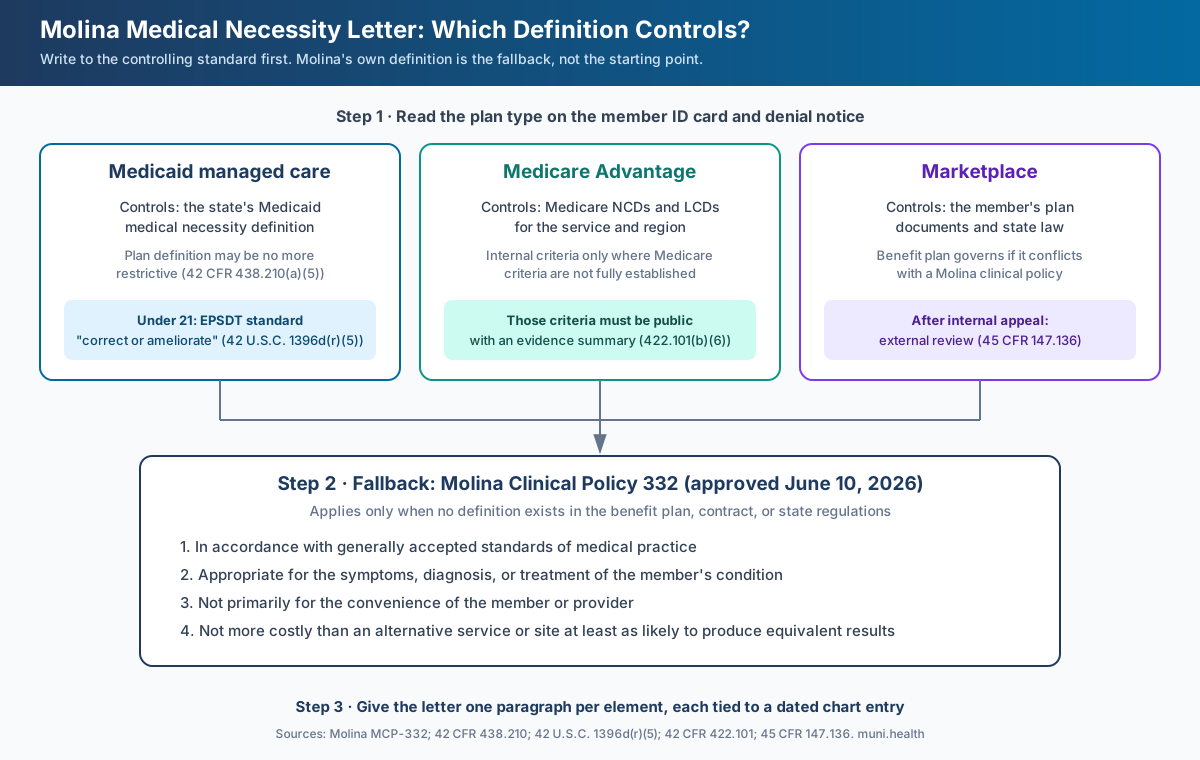
Which Medical Necessity Standard Applies to Your Molina Patient
The controlling standard depends on the product line, so read the plan type on the member ID card and the denial notice before you write a word. MCP-332 states its own limit: "Individual health plan definitions in government contracts for all LOBs (including Medicaid, Medicare, and Marketplace) have precedence and supersede" its definition.
That matters at Molina more than at most payers. Molina is a major Medicaid managed care plan, and in Medicaid the state writes the definition. A letter that only paraphrases Molina's commercial-style criteria can miss the stronger argument the state law gives you.
| Molina product | Definition to argue first | Where to find it | Molina policy role |
|---|---|---|---|
| Medicaid managed care, adult | The state's Medicaid medical necessity definition | State Medicaid statute or regulations, the state plan, and the Molina state provider manual | Molina's criteria can't be more restrictive than the state program (42 CFR 438.210(a)(5)) |
| Medicaid managed care, under 21 | EPSDT: services to "correct or ameliorate" a condition (42 U.S.C. 1396d(r)(5)) | Federal statute, plus the state's EPSDT guidance | Same no-more-restrictive rule. EPSDT can reach services the state plan doesn't otherwise list |
| Medicare Advantage | The applicable NCD or LCD for the service | CMS Medicare Coverage Database | MCP-332 says NCDs and LCDs supersede it for Medicare members |
| Marketplace | The member's plan documents and state insurance law | Evidence of coverage, plan contract, and state rules | The benefit plan governs if it conflicts with a Molina clinical policy |
| Any plan with no definition in those sources | Molina MCP-332's four elements | molinaclinicalpolicy.com | This is the policy's stated use |
One worked state example. California's Medi-Cal statute, Welfare and Institutions Code §14059.5, says a service is medically necessary for adults when it is "reasonable and necessary to protect life, to prevent significant illness or significant disability, or to alleviate severe pain." For members under 21, the same section adopts the federal EPSDT standard. Other states use different wording. Find your state's text before you draft.
For the federal side, 42 CFR 438.210(a)(5) also requires the state's definition to address the member's ability to achieve age-appropriate growth and development and to attain, maintain, or regain functional capacity. If the denial ignores function and the record documents it, say so.
Molina Clinical Policy 332: The Four Elements to Cover
When no other definition governs, Molina defines medically necessary services as care to evaluate, diagnose, or treat an illness, injury, disease, or its symptoms that meets all four elements below. Give each one its own paragraph backed by a chart entry. Even when a state definition controls, covering the four elements keeps a Molina reviewer from finding an easy gap.
| MCP-332 element | What the letter should show | Evidence to cite |
|---|---|---|
| 1. In accordance with generally accepted standards of medical practice | The requested service is what current guidelines recommend at this stage | Named specialty-society guideline with year and section; the service-specific Molina Clinical Policy if one exists |
| 2. Appropriate for the symptoms, diagnosis, or treatment of the member's condition | The diagnosis is confirmed, and the service matches its severity | ICD-10 codes, exam findings, imaging or lab results with dates, validated severity scores |
| 3. Not primarily for the convenience of the member or provider | The request is driven by clinical need, not scheduling, preference, or setting convenience | Functional limits, symptom progression, risk of harm from delay |
| 4. Not more costly than an alternative service or site at least as likely to produce equivalent results | Cheaper alternatives were tried and failed, are contraindicated, or wouldn't be equally effective | Prior treatments with dates, durations, and outcomes; contraindications; site-of-service rationale |
Element 4 is where many Molina denials sit. It's the cost-equivalence test, and step-therapy and site-of-service denials usually turn on it. Don't argue that the requested service is better in general. Show that each cheaper option has been tried, ruled out, or wouldn't produce the same result for this member, and give a date for each one.
Molina also publishes service-specific clinical policies at molinaclinicalpolicy.com, including separate Medicare versions for some services. If the denial names one, quote its criteria and match each criterion to your record. If it names licensed criteria instead, such as InterQual or MCG, ask for the specific criteria set used. Molina's use of each varies by state and product.
Molina Letter of Medical Necessity Template (Copy and Use)
This letter goes with a prior authorization request, a peer-to-peer, or an appeal. The treating physician signs it. It gives the clinical justification but doesn't serve as the appeal request itself. Attach it to the Molina appeal letter or the Molina PA request and denial templates, which handle routing, member consent, and deadlines. Replace every bracket, and delete the plan-type paragraphs that don't apply.
[PRACTICE LETTERHEAD]

[Date]

Molina Healthcare of [State]
[Utilization Management / Appeals address, fax, or portal from the denial notice or PA instructions]

RE: Letter of Medical Necessity
Member name: [Name]
Molina member ID: [ID]       Date of birth: [MM/DD/YYYY]
Product: [ ] Medicaid   [ ] Medicare Advantage   [ ] Marketplace   [ ] Integrated Medicare-Medicaid
Service requested: [Description]   CPT/HCPCS: [Codes]   Units/frequency: [ ]
Diagnosis: [Description]   ICD-10: [Codes]
Authorization / reference / claim number: [Number]
Denial date (if any): [MM/DD/YYYY]   Criteria cited in denial: [Policy name/number or criteria set]

To the Molina Medical Director:

I am the treating [specialty] physician for [Member name] and am writing to document the medical necessity of [service] for [diagnosis].

1. CONTROLLING MEDICAL NECESSITY STANDARD
[MEDICAID, ADULT] This member is enrolled in Molina's [State] Medicaid plan. Under [state statute or regulation citation], a service is medically necessary when [quote the state definition]. Under 42 CFR 438.210(a)(5), Molina's definition may be no more restrictive than the State Medicaid program's.
[MEDICAID, UNDER 21] This member is under 21 and entitled to EPSDT services under 42 U.S.C. 1396d(r)(5), which include services necessary to correct or ameliorate physical and mental illnesses and conditions. The requested service will [correct / ameliorate / prevent worsening of] [condition] as documented below.
[MEDICARE ADVANTAGE] Coverage for this service is addressed by [NCD/LCD number and title]. The member meets its criteria as shown below. If Molina applied internal criteria, please identify the publicly posted criteria and the basis for treating Medicare coverage criteria as not fully established under 42 CFR 422.101(b)(6).
[MARKETPLACE] The member's evidence of coverage defines medical necessity as [quote]. The service meets that definition as shown below.
[IF NO OTHER DEFINITION APPLIES] The service meets each element of Molina Clinical Policy 332, Medically Necessary Services.

2. CLINICAL SUMMARY
- Diagnosis confirmed on [date] by [exam / imaging / labs / pathology]: [key findings].
- Current severity: [objective measures, scores, vital signs, imaging grades] as of [date].
- Functional impact: [specific activities the member cannot perform, work/school impact, ADLs] documented on [date].
- Course: [onset, progression, relevant comorbidities].

3. CONSISTENT WITH GENERALLY ACCEPTED STANDARDS OF PRACTICE
[Guideline name, issuing organization, year, section] recommends [service] for patients with [criteria]. This member meets those criteria because [specific findings]. [If a service-specific Molina Clinical Policy applies: The member meets MCP [number] criteria [list each criterion and the matching record entry].]

4. APPROPRIATE FOR THE MEMBER'S CONDITION
[Explain why this service matches the confirmed diagnosis and its severity, and why a lower level of care would not address it.]

5. NOT PRIMARILY FOR CONVENIENCE
This request is based on [clinical need: symptom progression, functional decline, risk of harm]. It is not based on scheduling, location preference, or provider convenience.

6. NO LESS COSTLY, EQUALLY EFFECTIVE ALTERNATIVE
Alternatives tried or considered:
- [Treatment] from [date] to [date]: [dose/frequency]. Outcome: [failed / partial response / adverse effect], documented [date].
- [Treatment] from [date] to [date]: [outcome].
- [Alternative] not appropriate because [contraindication / clinical reason].
[Site of service, if relevant: Why the requested setting is required for this member.]

7. RISK OF DENIAL OR DELAY
Without [service], the member is at risk of [specific, documented clinical consequences].
[If urgent: Waiting for a standard decision could seriously jeopardize the member's life, health, or ability to attain, maintain, or regain maximum function. I request expedited review.]

8. REQUEST
I request that Molina [approve the authorization / reverse the denial] for [service, codes, units, dates]. If Molina maintains its decision, please provide the specific criteria applied and the name and specialty of the reviewing clinician, and I request a peer-to-peer discussion with a Medical Director.

Enclosures:
[ ] Relevant office notes ([dates])        [ ] Imaging / lab / pathology reports
[ ] Prior treatment records                [ ] Guideline excerpt or citation
[ ] Denial notice                          [ ] Member's written consent (Medicaid appeal on member's behalf)

Sincerely,

[Physician name, credentials]
[Specialty]   NPI: [Number]
[Phone]   [Fax]   [Email]
[Signature]
Prepare this appeal packet with your team.
Draft the appeal, coordinate missing documents, and approve the reviewed packet. Keep your clearinghouse; your practice checks deadlines and submits through the payer’s accepted channel.
First 3 appeals free, then $20 per appeal. Start with your denial letter or EOB and available records. No meeting or clearinghouse connection required.
Section 1 does the most work. A letter that names the controlling standard tells the reviewer which test to apply. Without it, the reviewer applies whatever criteria the first denial used. Keep only the plan-type paragraph that fits this member.
How to Fill In Each Section So It Survives Review
Every claim in the letter should point to a dated record entry the reviewer can find in the attachments. The reviewer is checking your letter against criteria, not reading it for persuasion.
- Quote, don't summarize, the controlling definition. Copy the state statute, NCD/LCD criterion, or evidence of coverage language exactly, and cite it. A paraphrase gives the reviewer room to apply a narrower reading.
- Use objective measures. Severity scores, imaging grades, lab values, and documented functional limits carry more weight than descriptions like "severe" or "debilitating" alone.
- Date every failed alternative. "Tried physical therapy" isn't evidence. "PT 2x/week from [date] to [date], no improvement in [measure], documented [date]" is.
- Match the denial's language. If the denial says "does not meet criteria for [X]," answer each criterion of [X] directly, in the same order.
- Keep it to two pages. Put detail in the attachments and reference them by date. Reviewers work from the letter outward.
For more on structure that applies at any payer, see the medical necessity justification letter guide.
Where the Letter Goes: Prior Authorization, Peer-to-Peer, or Appeal
The same letter can support three different steps. The rules around it change with each one. Use it at the earliest point you can, because a complete first submission avoids an appeal altogether.
Prepare this appeal packet with your team.
Draft the appeal, coordinate missing documents, and approve the reviewed packet. Keep your clearinghouse; your practice checks deadlines and submits through the payer’s accepted channel.
First 3 appeals free, then $20 per appeal. Start with your denial letter or EOB and available records. No meeting or clearinghouse connection required.
| Stage | How the letter is used | Rule to remember |
|---|---|---|
| Prior authorization request | Attach to the authorization request with the clinical summary | Standard Medicaid managed care decisions are due within 7 calendar days for rating periods starting on or after January 1, 2026 (42 CFR 438.210(d)) |
| Peer-to-peer | Use as the physician's talking points with the Molina Medical Director | Molina's peer-to-peer windows are short and set by state and product. Use the window on the denial notice. A peer-to-peer doesn't pause the appeal clock |
| Medicaid plan appeal | Attach to the appeal request filed on the member's behalf | 60 calendar days from the date on the notice, and a provider needs the member's written consent if state law permits provider filing (42 CFR 438.402(c)) |
| Medicare Advantage reconsideration | Attach to the reconsideration request | 60 calendar days after receipt of the notice, with receipt presumed 5 days after its date (42 CFR 422.582(b)) |
| Marketplace internal appeal | Attach to the internal appeal | Federal rules require at least 180 days to file, and external review follows a final internal denial (45 CFR 147.136) |
For Medicaid, the plan appeal is decided within 30 calendar days standard or 72 hours expedited. Either can be extended by up to 14 days (42 CFR 438.408). If Molina upholds the denial, the member can request a State Fair Hearing within the state's window. That window is no less than 90 and no more than 120 days from the appeal decision. The Medicaid fair hearing guide covers that step. Keep the same letter in the hearing packet.
Integrated Medicare-Medicaid plans follow their own route
Applicable integrated plans (some Molina dual-eligible products) use the unified procedures in 42 CFR 422.629–422.634 instead of the separate Medicaid and Medicare Advantage routes. Check the denial notice for the route and deadline before you file. The letter itself still works, but cite both the Medicare and the state Medicaid standard.
Before filing, check the Molina deadlines for your state in the Molina timely filing guide and the Molina appeal guide. To prepare the physician for the call, use the peer-to-peer review call script.
Common Mistakes in Molina Medical Necessity Letters
Most weak letters fail on the standard they argue, not on clinical facts. Watch for these:
- Arguing Molina's commercial-style criteria on a Medicaid case. If the state definition is broader, lead with it. For a child, lead with EPSDT.
- Skipping element 4. A letter that never addresses cheaper alternatives leaves the cost-equivalence test unanswered.
- Omitting member consent on a Medicaid appeal. Without consent, a provider-signed appeal of a pre-service denial may be treated as a provider dispute or sent back.
- Treating a peer-to-peer as the appeal. The 60-day Medicaid filing clock runs during and after the call.
- Ignoring the NCD or LCD on a Medicare Advantage case. If Medicare coverage criteria exist and the member meets them, that's the first argument. Any internal criteria Molina applies must be publicly posted with an evidence summary under 42 CFR 422.101(b)(6).
- Using a generic template from another payer. The BCBS-oriented medical necessity letter uses a different policy framework. Don't carry its citations over.
Draft the Letter From the Denial With Muni Appeals
Muni Appeals drafts appeal letters from the Molina denial notice and your clinical documentation. It organizes the evidence against the criteria the denial cites, flags the filing deadline on the notice, and lists the attachments to include. Your physician reviews and signs the letter, and your team files it through Molina's required channel for that state and product.
Muni doesn't decide medical necessity or replace the treating physician's clinical judgment. It removes the drafting work: matching chart entries to criteria and keeping the letter tied to the controlling standard.
Frequently Asked Questions
Does Molina Healthcare have its own definition of medical necessity?
Yes. Molina Clinical Policy 332 defines medically necessary services as care that follows generally accepted standards of practice, is appropriate for the member's condition, isn't mainly for convenience, and isn't more costly than an equally effective alternative. The policy says it applies only when no definition exists in the member's benefit plan, the health plan contract, or state regulations.
Which definition should I cite for a Molina Medicaid patient?
Cite your state's Medicaid medical necessity definition first. Under 42 CFR 438.210(a)(5), a Medicaid managed care plan's definition can be no more restrictive than the state Medicaid program's. Find it in the state Medicaid statute or regulations, or in the Molina state provider manual. For members under 21, also cite the EPSDT standard in 42 U.S.C. 1396d(r)(5).
Does EPSDT change a Molina medical necessity letter for children?
Yes. For Medicaid members under 21, EPSDT covers services necessary to "correct or ameliorate" physical and mental illnesses and conditions, and it can reach services the state plan doesn't otherwise list. State this standard in the letter and show how the service will correct, improve, or prevent worsening of the condition.
Who signs a Molina letter of medical necessity?
The treating physician or other treating clinician signs it, with their credentials, specialty, and NPI. For a Medicaid appeal filed on the member's behalf, the appeal request also needs the member's written consent if state law permits a provider to file. The consent is a separate document from the letter.
Can I use the same letter for prior authorization and an appeal?
Yes, with updates. For an appeal, add the denial date, the criteria the denial cited, and a direct answer to each one. Keep the plan-type paragraph and the evidence the same so the record stays consistent from the first request through any fair hearing or external review.
How do I find which Molina clinical policy was used to deny the request?
Start with the denial notice, which should state the reasons. Molina posts its service-specific clinical policies at molinaclinicalpolicy.com, with separate Medicare versions for some services. If the notice cites licensed criteria such as InterQual or MCG, ask Molina for the specific criteria used in the decision.
Is a Molina Medicare Advantage letter different from a Medicaid one?
Yes. For Medicare Advantage, cite the applicable NCD or LCD first, because MCP-332 says those supersede Molina's policy for Medicare members. The reconsideration must be filed within 60 days after receipt of the notice. Medicaid letters argue the state definition, and the plan appeal is due within 60 days of the notice date.
This guide reflects Molina Clinical Policy 332 (last approved June 10, 2026) and federal rules in 42 CFR Parts 422 and 438, 42 U.S.C. 1396d(r)(5), and 45 CFR 147.136, as of October 2026. Molina's medical necessity criteria, peer-to-peer windows, submission channels, and appeal procedures vary by state, product, and contract, and they change over time. Check the member's denial notice and the current Molina provider manual for your state before you submit. This is administrative guidance, not legal or clinical advice.