

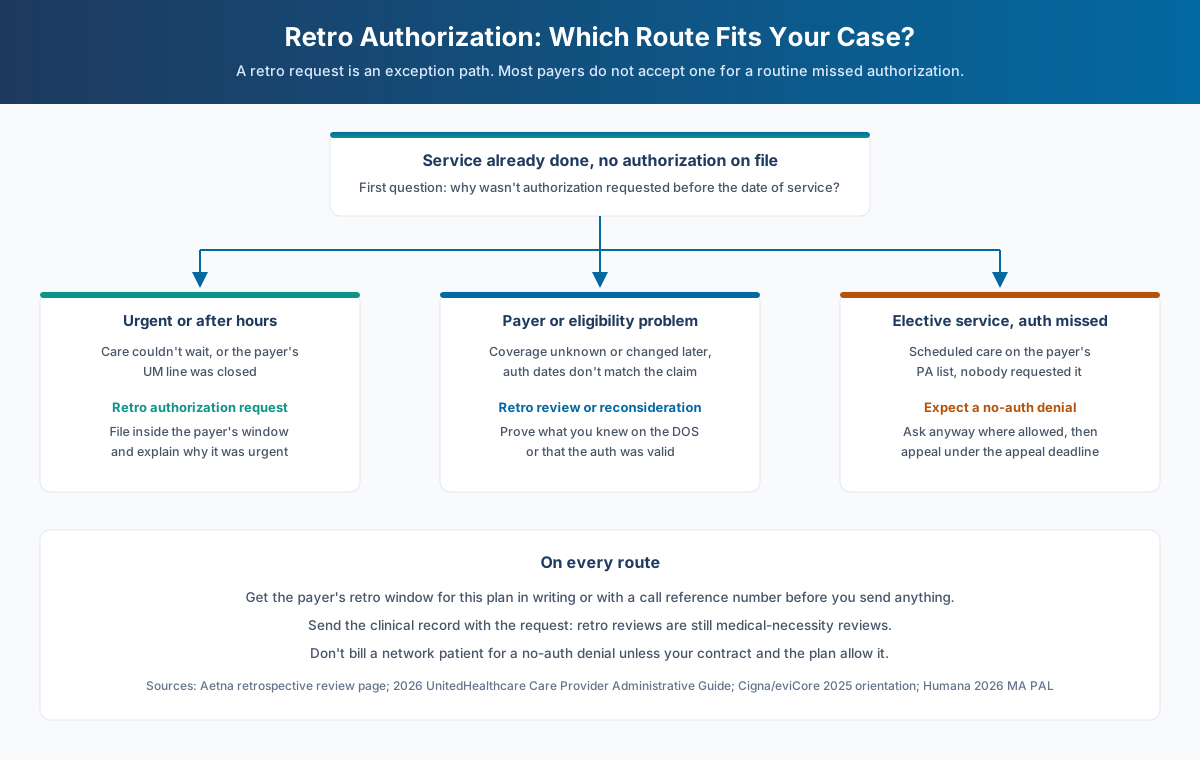
A retro (retrospective) authorization is a request for authorization after the service has already happened. Payers accept them only in narrow situations, not as a general fix for a missed prior authorization. The 2026 UnitedHealthcare guide allows a retro request within 2 business days after the date of service for urgent advanced imaging done outside business hours. Aetna's retrospective review page says retrospective review is not available for elective services on its precertification list that were done without precertification. Cigna takes retro requests by phone, with a window that "may vary by plan and/or state." Humana's 2026 Medicare Advantage list says services done without authorization "may be subject to retrospective medical necessity review." If the payer accepts a retro request in your situation, send it with the letter below. If it doesn't, expect a no-auth denial and appeal it, and don't bill a network patient for it.
What Is a Retro Authorization?
A retro authorization is any authorization request submitted after the date of service. Cigna's home health and DME program materials define it that way: "Any authorization request submitted after the date of service" (Cigna Healthcare and eviCore provider orientation, December 2025).
A retro request is still a medical-necessity review. The payer reviews the clinical record as it would for a prior authorization, then either issues an authorization number or denies it. UnitedHealthcare's 2026 guide says that if a retro-reviewed service was not medically necessary, "we will issue a denial and we will not issue an authorization number," and both the member and the provider get a denial notice with appeal rights (2026 UnitedHealthcare Care Provider Administrative Guide, Chapter 7).
Payers usually also want to know why authorization wasn't requested in advance. UnitedHealthcare requires documentation explaining "why the procedure had to be done on an urgent basis" and why authorization "could not have been requested during our normal business hours." A retro request that only says "we forgot" gives the reviewer nothing to approve.
Does Your Payer Allow Retro Authorization?
Sometimes, and almost always only for specific reasons. The table below comes from each payer's current provider materials, accessed November 9, 2026. It covers the plan types those documents cover. Medicaid, state-regulated, and self-funded plans can have different rules, so confirm the window for the patient's specific plan before you file.
| Payer | Does it accept retro requests? | Published window | Where the rule comes from |
|---|---|---|---|
| UnitedHealthcare (commercial) | Yes, for urgent advanced outpatient imaging and certain cardiac procedures done outside business hours. Missing a required prior authorization otherwise may lead to claim denial. | Advanced imaging and stress echocardiograms: 2 business days after the DOS. Diagnostic catheterizations and electrophysiology implants: 15 calendar days after the DOS. | 2026 UnitedHealthcare Care Provider Administrative Guide, Chapter 7 (effective April 1, 2026) |
| Aetna (commercial) | Only for listed exceptions: precertification was done but the dates don't match the claim, or Aetna becomes primary instead of secondary when an inpatient claim is adjudicated. Not available for elective services on its precertification lists that missed precertification. | No retro request window published. Emergency inpatient admissions require notification within 1 business day per the retrospective review page (2 business days per the 2026 precertification list). | Aetna retrospective review page; Aetna 2026 participating provider precertification list (updated November 1, 2026) |
| Cigna Healthcare (home health and DME program) | Yes. Retro requests go to Cigna by phone, not to eviCore. Cigna's other programs may route differently. | "May vary by plan and/or state regulations" | Cigna Healthcare and eviCore home health and DME provider orientation (December 2025) |
| Humana (Medicare Advantage and D-SNP) | Services without required authorization "may be subject to retrospective medical necessity review." Not getting authorization can mean financial penalties for the practice under its contract. | Not published in the list; ask provider services | Humana Medicare Advantage and D-SNP Prior Authorization and Notification List (effective July 1, 2026; revised November 2, 2026) |
| Blue Cross Blue Shield and Anthem plans | Varies. Each Blue plan sets its own utilization management rules. | Not published as a single national rule. Check the local plan's provider manual. | The member's local Blue plan or Anthem state provider manual |
UnitedHealthcare
The 2026 UnitedHealthcare Care Provider Administrative Guide sets out a retro process only for urgent care done outside normal business hours. For advanced outpatient imaging, the ordering provider "must make a retrospective prior authorization request within 2 business days after the date of service" by calling 1-866-889-8054. For cardiac procedures, the window is 2 business days for stress echocardiograms and 15 calendar days for diagnostic catheterizations and electrophysiology implants. Oxford members' advanced imaging goes to EviCore at 1-877-PRE-AUTH (1-877-773-2884), also within 2 business days.
Outside those cases, the guide is blunt: if you don't confirm a required prior authorization before the service, "we may deny claims. In that case, you cannot bill the member." For UHC prior authorization denials, the appeal path is the remedy, not a late authorization request.
Aetna
Aetna's retrospective review page allows retrospective review in two situations: precertification "requirements were met at the time the service was provided, but the dates of service do not match the submitted claim," and Aetna "converts from secondary payer to primary payer at the time of inpatient claims adjudication."
It lists where retrospective review is not available, including elective ambulatory or inpatient services on Aetna's precertification lists "for which precertification did not occur before providing the service," and emergency inpatient services that missed the notification requirement. The 2026 Aetna precertification list says emergency services don't require precertification, with exceptions. A precertified procedure that doesn't happen on the same day as the ER visit still needs it, and an ER visit that becomes an inpatient admission must be reported. The two Aetna documents state that reporting deadline differently (1 vs. 2 business days), so report the same day you can. For a missed elective precertification with Aetna, use the Aetna prior authorization denial appeal guide.
Cigna
Cigna's December 2025 orientation for its eviCore-managed home health and DME program says same-day precertification and retro requests "should be submitted directly to Cigna Healthcare by calling 1.800.88Cigna (800.882.4462) or the number on the back of the customer's card." It says the time to submit a retro request "may vary by plan and/or state regulations," and that Cigna communicates the retro determination. So the answer to "does Cigna allow retro authorization?" is yes, but you need the window for the patient's plan before you rely on it. The Cigna prior authorization phone numbers guide lists the other UM lines.
Humana
Humana's 2026 Medicare Advantage and D-SNP Prior Authorization and Notification List says services or medications provided without required authorization "may be subject to retrospective medical necessity review." It also warns that not obtaining authorization "could result in financial penalties for the practice and reduced benefits for the patient" based on the provider's contract and the patient's evidence of coverage. Humana Medicaid plans publish their own state manuals, so check that state's manual for a retro window. For denials, see the Humana prior authorization denial appeal guide.
Blue Cross Blue Shield and Anthem
Blue Cross Blue Shield is a federation of independent companies, so there isn't one BCBS retro authorization rule. Anthem, Florida Blue, Highmark, and the other Blue plans each publish their own utilization management rules by state and product. Find the "retrospective review" or "post-service review" section in the local plan's current provider manual, or ask provider services for the window and get a reference number.
When a Retro Request Is the Right Move
A retro request works when you have a real reason the authorization couldn't have been requested before the date of service. The common accepted reasons in current payer materials are:
- Urgent care outside business hours. UnitedHealthcare's process is built for exactly this, with a tight window.
- Authorization was obtained, but the dates changed. Aetna allows retrospective review when precertification was met but the dates of service don't match the claim. UHC says an authorization is valid only for the date or date range on it. If plans change before the service, call to update the dates in advance.
- Coverage changed after the fact. Aetna allows retrospective review when it becomes primary instead of secondary at inpatient claim adjudication. UnitedHealthcare says a claim reconsideration may be needed when eligibility changes retroactively, for example when its eligibility information turns out to be incorrect.
- The patient's coverage wasn't known at the time of service. This comes up with emergency patients who can't give insurance information and with coverage reported later. Payers handle this differently. Document when and how you learned of the coverage, and ask the payer which route applies.
A retro request is the wrong tool when an elective, scheduled service simply skipped a required authorization. Aetna says outright that retrospective review isn't available for that. UnitedHealthcare offers no retro path for it either. Expect a no-auth denial, then decide whether to appeal.
A Retro Request Is Not an Appeal
A retro authorization request asks for an authorization that doesn't exist yet, inside the payer's retro window. An appeal challenges a denial that already happened, inside the appeal deadline on the denial notice. They are separate processes with separate clocks. If a retro request is denied, the denial notice starts the appeal clock. If you're past the retro window, the remedy is usually an appeal of the no-auth claim denial. The complete prior authorization denial guide and what happens if prior authorization is denied walk through that path.
Retro Authorization Request Letter Template
Use this letter when the payer accepts retro requests for your situation and wants a written request or a written explanation with the clinical record. Replace every bracketed field. Delete the reasons that don't apply rather than leaving them blank.
[PRACTICE LETTERHEAD]

[Date]

[Payer name]
[Utilization Management / Prior Authorization Department]
[Address or fax number from the payer's current provider manual]

RE: Request for Retrospective (Retro) Authorization

Member name: [Patient full name]
Member ID: [ID number]          Group number: [If applicable]
Date of birth: [MM/DD/YYYY]
Date(s) of service: [MM/DD/YYYY - MM/DD/YYYY]
Service: [Description]  CPT/HCPCS: [Codes]  Units: [#]
Diagnosis: [ICD-10 codes and descriptions]
Place of service: [Office / outpatient / inpatient / ER - facility name]
Ordering provider: [Name, NPI, TIN]
Rendering provider: [Name, NPI, TIN, if different]
Claim number: [If a claim was already filed]
Call reference number: [From the call confirming retro requests are accepted]

To the Utilization Management Department:

[Practice name] requests a retrospective authorization for the service listed above, provided to [patient name] on [date of service]. We are submitting this request on [date], which is [#] [business/calendar] days after the date of service and within the retrospective request window that [payer name] stated for this plan [cite the manual section or call reference].

WHY AUTHORIZATION WAS NOT REQUESTED BEFORE THE SERVICE
[Keep the reason(s) that apply and delete the rest.]

[ ] Urgent care outside business hours. On [date] at [time], [patient] presented with [clinical findings]. The treating provider determined that [service] was needed urgently because [clinical reason a delay would risk harm]. [Payer]'s utilization management line was closed at that time, so authorization could not be requested in advance.

[ ] Coverage unknown at the time of service. At the time of service, [patient] [was unable to provide insurance information / reported no coverage / presented with different coverage]. We learned of [payer] coverage on [date] through [eligibility response / patient report / other payer's denial], and submitted this request within [#] days of learning of it. Supporting documentation is attached.

[ ] Retroactive eligibility or payer-order change. [Payer] coverage for [patient] was added or changed retroactively on [date], [or: [payer] became the primary payer after [other payer] [denied/terminated] coverage on [date]]. Authorization could not have been requested from [payer] before the service. Eligibility documentation is attached.

[ ] Authorization on file with different dates. Authorization number [#] was approved for [service] for [original date range]. The service was performed on [actual date] because [reason]. We request that the authorization be updated to the actual date of service.

MEDICAL NECESSITY
[Patient] is a [age]-year-old with [diagnosis], documented by [exam, imaging, labs]. [Summarize the history, prior treatment and its results, and why this service was the appropriate next step.] The service meets [payer]'s criteria in [medical policy name/number], specifically [criteria met and where each is documented in the attached records].

ENCLOSURES
1. Clinical notes for the date of service [and preceding visits]
2. [Imaging / lab / procedure reports]
3. [ER record and timestamps, for urgent cases]
4. [Eligibility documentation, for coverage-related cases]
5. [Original authorization approval, for date-change cases]

Please issue an authorization number for the date(s) of service above, or, if you deny this request, send a written determination that states the specific reason and the appeal rights and deadline.

Contact: [Name, title, direct phone, fax, email]

Sincerely,

[Provider name, credentials]
[NPI]
[Practice name]
Skip the blank template. Start with a review-ready draft.
Use the template as guidance, or let Muni prepare a payer-specific draft for your team to verify, sign, and submit.
See Muni Handle This DenialFirst 3 appeals free, then $20 per appeal. Start with your denial letter or EOB and available records. No meeting or clearinghouse connection required.
How to Submit a Retro Authorization Request
Confirm the route before you write anything, because a retro request in the wrong channel or outside the window gets denied for timing alone.
Prepare this appeal packet with your team.
Draft the appeal, coordinate missing documents, and approve the reviewed packet. Keep your clearinghouse; your practice checks deadlines and submits through the payer’s accepted channel.
Try Muni Appeals FreeFirst 3 appeals free, then $20 per appeal. Start with your denial letter or EOB and available records. No meeting or clearinghouse connection required.
- Find the reason it wasn't requested in advance. Match it to one of the accepted situations above. If none fits, skip ahead to an appeal plan.
- Get the window for this plan. Use the payer's manual for the product and state. If the manual says the window varies, as Cigna's does, call provider services, ask for the retro window and channel, and log the reference number.
- Check whether the payer wants a call first. UnitedHealthcare's retro process for imaging and cardiac care starts with a phone call, and Cigna routes retro requests by phone. Have the letter and records ready to fax or upload when the reviewer asks.
- Send the full clinical record. A retro request is still a medical-necessity review. Show the policy criteria and where each one is documented. The Cigna prior authorization template and the UHC prior authorization form guide list the clinical fields payers expect.
- Hold the claim, or put the authorization number on it. If you get an authorization number, include it on the claim. If the claim was already denied for no authorization, ask the payer whether to submit a corrected claim or request reprocessing.
- Calendar both deadlines. Track the claim filing limit (timely filing limits by payer) and, if the retro request is denied, the appeal deadline on that denial notice.
What to Do If the Payer Won't Accept a Retro Request
Treat it as a no-auth denial and appeal it. A no-auth denial is an administrative denial, so a medical-necessity argument on its own may not answer it. The strongest appeal leads with why authorization couldn't reasonably have been obtained in advance, then shows medical necessity.
- Urgent care: Use the timestamps and clinical findings from the record. If the patient is still in active treatment, the urgent and expedited appeal guide covers faster review.
- Payer error: Attach the eligibility response, call reference numbers, or the original authorization showing what the payer told you.
- Patient billing: UnitedHealthcare says you cannot bill the member for claims it denies because prior authorization requirements weren't followed, and many network contracts have similar hold-harmless terms. Check your contract before sending any patient statement.
How Muni Appeals Helps With Retro Authorization Denials
When a retro request is denied, or a claim is denied for no authorization, Muni Appeals turns the denial and your records into a review-ready appeal. Upload the denial notice and clinical records, and Muni drafts a letter that states the reason authorization wasn't obtained in advance, ties the clinical facts to the payer's criteria, and flags the deadline on the notice. Your staff verifies the payer's current route and submits.
Frequently Asked Questions
Does Cigna allow retro authorization?
Yes, in some cases. Cigna's December 2025 home health and DME orientation says retro requests go directly to Cigna at 1-800-882-4462 or the number on the member's card, and that the submission timeframe "may vary by plan and/or state regulations." Call provider services to confirm the window for the patient's plan.
Does Aetna allow retro authorization?
Only in narrow cases. Aetna's retrospective review page allows it when precertification was met but the dates of service don't match the claim, or when Aetna becomes the primary payer during inpatient claim adjudication. It is not available for elective services on Aetna's precertification lists that were done without precertification.
Does UnitedHealthcare allow retro authorizations?
For urgent care outside business hours, yes. The 2026 UnitedHealthcare guide gives 2 business days after the date of service for advanced outpatient imaging and stress echocardiograms, and 15 calendar days for diagnostic catheterizations and electrophysiology implants. Otherwise, UHC may deny claims for missed prior authorization, and you can't bill the member.
Does Humana allow retro authorization?
Humana's 2026 Medicare Advantage and D-SNP authorization list says services without required authorization "may be subject to retrospective medical necessity review." It doesn't publish a retro request window there. Humana Medicaid plans set their own windows in state provider manuals.
What is the time limit for retro authorization?
There is no universal limit. Each payer sets its own, and it varies by product, state, and service. Published examples include 2 business days (UnitedHealthcare urgent imaging) and 15 calendar days (UnitedHealthcare diagnostic catheterizations). Cigna says its window varies by plan and state. Get the window for the specific plan before you rely on it.
Can I bill the patient if a retro authorization is denied?
Usually not, if you're in network. UnitedHealthcare's guide says you cannot bill the member when claims are denied for not following prior authorization requirements. Other payers' contracts often have similar hold-harmless terms. Check your contract and the plan's rules first.
What's the difference between retro authorization and appealing a no-auth denial?
A retro authorization asks the payer to issue an authorization after the service, inside the payer's retro window. An appeal challenges a denial that has already been issued, inside the appeal deadline on that notice. If a retro request is denied, you can usually appeal that denial.
Get the Authorization, or Build the Appeal
Retro authorization is an exception path. It works when care was urgent, coverage wasn't knowable, or the payer's records were wrong, and only inside the payer's window. Confirm the window, send the reason and the record together, and switch to an appeal as soon as the retro route closes.
With Muni Appeals, your team gets:
- A review-ready appeal letter built from the denial notice and records your staff uploads
- The reason authorization wasn't obtained in advance, stated up front with supporting facts
- Staff control over the payer route, deadline, and final submission
This guide reflects UnitedHealthcare's 2026 Care Provider Administrative Guide (effective April 1, 2026), Aetna's retrospective review page and 2026 participating provider precertification list (updated November 1, 2026), the Cigna Healthcare and eviCore home health and DME provider orientation (December 2025), and Humana's Medicare Advantage and D-SNP Prior Authorization and Notification List (effective July 1, 2026; revised November 2, 2026), as accessed November 9, 2026. Retro authorization rules vary by payer, product, state, service, and provider contract. Verify the current rule with the payer before relying on any window in this guide. This guide is not legal or billing compliance advice.