

A behavioral health denial can be appealed on two grounds: standard medical necessity and federal parity law (MHPAEA). A parity appeal requires showing the insurer applies stricter criteria to behavioral health than to comparable medical care. Request the NQTL comparative analysis before drafting your appeal — this document is required under CAA 2021 and often reveals the disparity directly.
Why a Parity Appeal Is Different From Medical Necessity
A standard medical necessity appeal argues that the denied treatment is clinically appropriate for this patient. A parity appeal argues something structurally different: the insurer is applying a more restrictive standard to behavioral health than it applies to comparable medical or surgical care at the same level of intensity — making the standard itself the violation, not just the clinical judgment.
These are different legal arguments with different evidence requirements. A medical necessity appeal fails if your clinical documentation doesn't meet the insurer's threshold. A parity appeal argues that the threshold is illegal because it's stricter than what the plan applies to an analogous medical benefit.
Combining both arguments is almost always stronger than either alone. Most billing teams write only the clinical argument and miss the parity angle entirely — either because they don't know MHPAEA applies, or because they don't know how to build the comparative analysis that gives it legal grounding.
This guide focuses specifically on the parity appeal layer. For general behavioral health routing, level-of-care mechanics, and payer-specific submission addresses, see our mental health insurance denials guide.
MHPAEA in 2026: What Is and Isn't Enforceable
Understanding the current enforcement landscape matters before you cite specific rules in an appeal letter. Getting the citations wrong weakens the argument.
The core federal parity obligation is still fully in force. The 2013 Final Rule and the Consolidated Appropriations Act of 2021 (CAA 2021) requirements remain active and enforceable. These include:
- The prohibition on more restrictive NQTLs for behavioral health than for analogous medical/surgical benefits in the same classification
- The requirement that insurers perform and document a comparative analysis of each NQTL
- The obligation to disclose that comparative analysis to the plan sponsor, plan participants, or federal regulators on request
The 2024 Final Rule's new provisions are currently paused. On May 15, 2025, the Departments of Labor, HHS, and Treasury announced nonenforcement of provisions newly added by the 2024 final rule — specifically the meaningful benefits standard, data evaluation requirements, and related new comparative analysis obligations. This pause applies until a final decision in litigation brought by the ERISA Industry Committee (ERIC) in January 2025, plus an additional 18 months. The Departments have indicated they may modify or rescind the 2024 rule while the case is held in abeyance.
Enforcement Pause Does Not Eliminate Parity Rights
The pause applies only to provisions that were new in the 2024 rule. The core prohibition on discriminatory NQTLs (2013 Final Rule) and the comparative analysis disclosure obligation (CAA 2021 §203) are still enforceable. Providers can still request the NQTL comparative analysis and cite MHPAEA parity violations in appeals. The 2024 rule delay narrows what's new, not what already existed.
For ERISA self-insured plans: The DOL's Employee Benefits Security Administration (EBSA) continues enforcing core MHPAEA violations. ERISA self-insured plans are subject to federal enforcement only — state insurance department authority does not reach them.
For fully insured state-regulated plans: State insurance departments enforce MHPAEA, and many states have additional parity laws that go beyond federal requirements.
For Medicaid managed care: Federal parity rules under 42 CFR Part 438 apply separately, with enforcement through CMS and state Medicaid agencies. The commercial ERISA appeal path does not apply.
The Comparative Analysis Framework: Identifying Your Analogous Benefit
The foundation of a parity appeal is identifying the analogous medical/surgical benefit — the medical counterpart that the insurer covers at the same classification level without the restriction being applied to behavioral health.
MHPAEA organizes benefits into six classifications: inpatient in-network, inpatient out-of-network, outpatient in-network, outpatient out-of-network, emergency care, and prescription drugs. Parity analysis happens within the same classification. An insurer cannot apply stricter prior authorization requirements to inpatient behavioral health than to inpatient medical/surgical care in the same plan.
These analogous benefit pairs have been recognized by courts and regulators:
| Behavioral Health Benefit | Analogous Medical/Surgical Benefit | Classification | Common NQTL Issue |
|---|---|---|---|
| Inpatient psychiatric hospitalization | Inpatient medical/surgical hospitalization | Inpatient in-network | Stricter continued-stay criteria; more frequent concurrent reviews |
| Residential SUD treatment | Skilled nursing facility (SNF) care | Inpatient in-network | Day limits or step therapy required for SUD but not SNF |
| Partial Hospitalization Program (PHP) | Outpatient cardiac/pulmonary rehabilitation | Outpatient in-network | PA required for PHP; comparable rehab covered without PA |
| Intensive Outpatient Program (IOP) | Intensive physical rehabilitation | Outpatient in-network | Session limits applied to IOP not applied to comparable physical rehab |
| Outpatient psychotherapy | Outpatient physical or occupational therapy | Outpatient in-network | Annual visit caps for therapy; no comparable caps for PT/OT |
| Substance use disorder medication (MAT) | Chronic disease medications (e.g., insulin, immunosuppressants) | Prescription drugs | Step therapy or PA required for MAT; not required for comparable medications |
| Telehealth behavioral health sessions | Telehealth medical consultations | Outpatient in-network | Behavioral telehealth limited in ways medical telehealth is not |
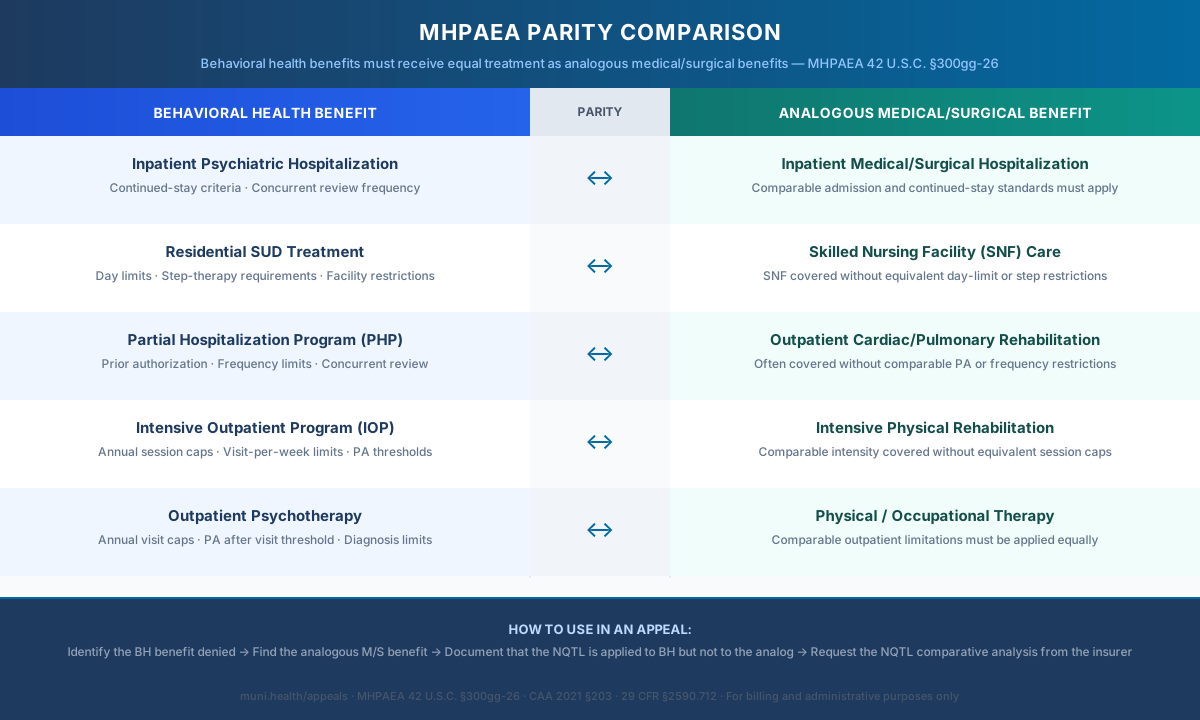
To build the comparative analysis argument for a specific denial:
- Identify the behavioral health benefit being denied and which classification it falls under
- Find the analogous medical/surgical benefit the plan covers in the same classification
- Identify the NQTL being applied differently — prior authorization, step therapy, visit limits, concurrent review frequency, or another restriction
- Document the disparity — show the restriction applies to behavioral health but not to the medical analog
This analog identification step is where most practices stop. The next step — documenting the specific disparity — requires requesting the insurer's own comparative analysis document.
The Six NQTL Categories That Drive Parity Violations
NQTLs (non-quantitative treatment limitations) are the conditions and processes insurers use to manage benefits that aren't simple numerical caps. They are the dominant source of behavioral health parity violations.
1. Prior authorization requirements. If a plan requires PA for outpatient psychotherapy sessions above a certain visit threshold but doesn't require PA for comparable medical outpatient services — physical therapy or outpatient cardiac rehab at the same visit count — that is an NQTL disparity. The requirement exists for behavioral health but not for the analogous medical service.
2. Medical necessity criteria. The clinical standards used to evaluate a behavioral health service must not be more restrictive than standards applied to analogous medical/surgical services. Whichever criteria set the payer cites (MCG, InterQual, UBH Coverage Determination Guidelines, or a proprietary set), ask for the version used and compare it with the criteria applied to the analogous medical service. UBH's guidelines were held more restrictive than generally accepted standards of care in Wit v. UBH (see below).
3. Step therapy and fail-first requirements. Requiring patients to try and fail at lower levels of care before authorizing the clinically indicated level — for behavioral health but not for comparable medical services — is an NQTL that must pass the parity comparison. If the plan covers analogous medical services at equivalent intensity without stepped-care requirements, document that disparity.
4. Concurrent review frequency. More frequent utilization review of ongoing behavioral health admissions than comparable medical admissions is an NQTL. If the plan reviews behavioral health admissions at a higher frequency than medical admissions in the same classification, document that disparity.
5. Network admission standards producing ghost networks. Applying more restrictive credentialing requirements to behavioral health practitioners — or reimbursing at rates that make network participation economically unviable — produces thin networks where in-network care is theoretically available but practically inaccessible. Ghost network parity claims require documenting the effective network adequacy compared to medical/surgical provider density in the same geographic area.
6. Geographic and facility type restrictions. Limitations on residential treatment facilities — licensing requirements, geographic restrictions, facility type standards — that don't apply to comparable medical facilities (SNFs, inpatient rehabilitation facilities) are potential NQTLs. If the plan requires state licensure as a specific residential treatment facility type for SUD coverage but covers SNF care without comparable licensing specificity, that is a parity argument.
Wit v. UBH Is Still Active — Use It for UHC Denials
The Wit v. United Behavioral Health injunction was extended on February 3, 2026, through February 3, 2031. It requires UBH/Optum to apply Coverage Determination Guidelines that reflect generally accepted standards of care (GASC), not internal guidelines more restrictive than GASC. This is a separate, independent appeal argument from MHPAEA. If a UBH denial cites criteria that contradict the treating clinician's standard of care, reference the Wit injunction explicitly: state the denial conflicts with the UBH obligation to apply GASC-compliant criteria under the February 2026 injunction extension.
How to Request the Comparative Analysis Document
The NQTL comparative analysis is the insurer's own documentation of how it designed a specific treatment limitation and how that limitation compares across behavioral health and medical/surgical benefits. This document can expose the parity violation in the insurer's own writing.
Who can request it: Plan sponsors (employers who sponsor the plan), plan participants, their authorized representatives, and state and federal regulators. Billing teams should submit requests as the provider's authorized representative.
Written request template:
To: [Plan Administrator / Insurer Appeals Address]

RE: Request for NQTL Comparative Analysis — CAA 2021 §203

Member Name: [Name]
Member ID: [ID]
Date of Service: [Date]
Benefit at Issue: [Describe the behavioral health service denied]
Denial Date: [Date]

Under the Consolidated Appropriations Act of 2021 (CAA 2021) §203
and the Mental Health Parity and Addiction Equity Act (29 CFR §2590.712),
I am requesting the NQTL comparative analysis for the
[prior authorization requirement / medical necessity criteria / other NQTL]
applied to [describe the behavioral health benefit].

Please provide:
1. The comparative analysis comparing application of this NQTL to
 behavioral health benefits and to analogous medical/surgical benefits
2. The specific clinical criteria, guidelines, or evidentiary standards
 used to impose this NQTL on the behavioral health benefit
3. The name and credentials of the clinical reviewer who issued the
 adverse determination

This request is made pursuant to CAA 2021 §203 and 29 CFR §2590.712.
Skip the blank template. Start with a review-ready draft.
Use the template as guidance, or let Muni prepare a payer-specific draft for your team to verify, sign, and submit.
First 3 appeals free, then $20 per appeal. Start with your denial letter or EOB and available records. No meeting or clearinghouse connection required.
If no response within 30 days: Document the request date and absence of response. Include the non-response in your appeal letter ("The plan has not responded to our request for the NQTL comparative analysis, submitted on [date], as required under CAA 2021 §203") and include it in any regulatory complaint. Failure to produce the document on request is itself a compliance issue that DOL or a state insurance department can act on separately.
What to look for in the document: Disparities between the behavioral health criteria and the medical/surgical criteria for the analogous benefit. If the comparative analysis shows more restrictive factors applied to behavioral health — or if it shows the analysis used different evidentiary standards for the two sides — that is the parity violation in the insurer's own writing. Quote it in the appeal letter.
Payer-Specific NQTL Patterns
UnitedHealthcare / United Behavioral Health (Optum). UBH's Coverage Determination Guidelines were found by courts to apply more restrictive standards than generally accepted standards of care for behavioral health LOC determinations (Wit v. UBH). If a UHC plan reviews inpatient psychiatric stays more often than comparable medical admissions, document that as a concurrent-review NQTL. Appeal through ProviderExpress.com — not the standard UHC commercial portal — and cite the Wit injunction where the denial rests on UBH's level-of-care criteria. Take the filing deadline from the adverse determination notice and your provider agreement. For ERISA group health plans, the member's own appeal window is at least 180 days from the adverse benefit determination (29 CFR 2560.503-1(h)(3)(i)).
See our guide to UHC prior authorization denial appeals for the standard PA submission workflow.
Aetna. Aetna self-manages its behavioral health utilization review without a separate subsidiary. Clinical Policy Bulletins (CPBs) govern behavioral health reviews. Request the specific CPB number cited in the denial, then compare the behavioral health CPB criteria against the CPB criteria for the analogous medical service — Aetna publishes CPBs for both. Disparities between CPB criteria for comparable benefits are direct parity evidence. Submit appeals through Availity.
For Aetna PA-specific routing and P2P windows, see our Aetna prior authorization denial appeal guide.
Cigna / Evernorth Behavioral Health. Evernorth uses MCG Behavioral Health Care criteria for most commercial accounts. If Evernorth denied on LOC grounds, request the MCG Behavioral Health criteria version used, then compare it against the MCG Medical criteria applied to the comparable medical level of care (cardiac rehab, acute physical rehabilitation). Evernorth's appeals unit is separate from Cigna's standard address — submit to the Evernorth Behavioral Health Central Appeals Unit (PO Box 188064, Chattanooga, TN 37422), not the standard Cigna appeals address.
For Cigna PA portal workflows, see our Cigna PromptPA guide.
BCBS — Carelon vs. Magellan vs. In-House. BCBS behavioral health management varies significantly by affiliate:
- Anthem / Elevance affiliates use Carelon Behavioral Health (formerly Beacon Health Options). Carelon uses InterQual Behavioral Health criteria for most LOC determinations and ASAM criteria for SUD. Submit appeals to Carelon directly, not Anthem's standard appeals address.
- HCSC affiliates (IL, TX, OK, NM, MT) — BCBS of Texas announced that, effective January 1, 2026, it administers behavioral health benefits for Blue Advantage HMO and MyBlue Health members itself instead of through Magellan Healthcare. Verify the current behavioral health administrator for every HCSC state plan by calling Provider Services before submitting any appeal. Other HCSC state affiliates may have different arrangements.
- Other BCBS affiliates vary by region. Some manage behavioral health internally; others delegate to Carelon or Magellan. Confirm the administering entity from the patient's ID card or Provider Services before filing.
BCBS Texas Magellan Transition — Verify Before Filing
For Blue Advantage HMO and MyBlue Health members, BCBS of Texas took over behavioral health administration from Magellan Healthcare on January 1, 2026, and claims go to BCBSTX. Sending one of these appeals to Magellan for a later date of service can misroute it. Confirm the current behavioral health administrator with BCBS TX Provider Services before submitting any appeal or PA request.
For BCBS medical necessity documentation templates, see our BCBS medical necessity letter guide.
State Parity Laws That Strengthen the Appeal
Many states have mental health parity laws that are more expansive than federal MHPAEA. For fully insured state-regulated plans, the stronger law applies — state parity law often provides broader rights, stricter insurer response timelines, and additional remedies.
Prepare this appeal packet with your team.
Draft the appeal, coordinate missing documents, and approve the reviewed packet. Keep your clearinghouse; your practice checks deadlines and submits through the payer’s accepted channel.
First 3 appeals free, then $20 per appeal. Start with your denial letter or EOB and available records. No meeting or clearinghouse connection required.
| State | Parity vs. Federal | Key Additional Protection | Applies To |
|---|---|---|---|
| California | Stronger | SB 855 (2021): mandates ASAM criteria for SUD coverage; prohibits step therapy for SUD residential when medically unnecessary | Fully insured individual and group plans |
| New York | Stronger | IMH Law: requires coverage of all medically necessary MH/SUD services equal to medical care; no lifetime or annual benefit limits | Fully insured plans (ERISA self-insured exempt) |
| New Jersey | Stronger | Broad parity for all MH/SUD services; state regulator actively investigates NQTL complaints | Fully insured state-regulated plans |
| Illinois | Stronger | Requires disclosure of UR criteria on request; mandates P2P review opportunity for any clinical denial | Fully insured; broader P2P enforcement than federal |
| Washington | Stronger | SB 5432: mandates ASAM criteria adoption; limits step therapy for SUD residential level of care | Fully insured plans |
| Colorado | Stronger | Requires parity in reimbursement rates (network adequacy parity); ghost network claims actionable | Fully insured state-regulated plans |
| Texas | Federal floor | State insurance department enforces federal MHPAEA; no material expansion beyond federal law | Fully insured state-regulated plans |
| ERISA self-insured (all states) | Federal only | ERISA preemption: state parity laws do not apply; DOL EBSA enforcement only | Self-insured employer plans nationwide |
Practical rule: For any behavioral health appeal involving a fully insured plan, identify the plan's state of regulation and check whether state parity law adds rights beyond federal MHPAEA. State insurance department complaint processes are also a parallel option — state regulators can require specific responses from insurers in ways that DOL enforcement cannot always replicate for individual claims.
Filing a Parity Complaint Alongside an Appeal
An appeal and a regulatory complaint are not mutually exclusive. Filing a complaint while the internal appeal is pending creates parallel pressure, generates a regulatory record, and puts the insurer on notice that the NQTL issue is being documented beyond the individual claim.
For ERISA self-insured plans — DOL EBSA: File at dol.gov/agencies/ebsa. EBSA can request the NQTL comparative analysis directly from the plan administrator, and plan administrators must respond to EBSA requests. Even when the individual appeal is resolved, a pattern of parity violations at the plan level can trigger broader enforcement action affecting other practices and patients.
For fully insured plans — state insurance department: Each state insurance department accepts formal complaints about coverage denials. In California, New York, Illinois, New Jersey, and Washington, state insurance regulators have enforcement tools that can result in plan-level changes — not just individual claim reversals. File citing the specific NQTL disparity, the analogous medical benefit, and the section of state parity law at issue.
For Medicaid managed care: File a state fair hearing request under 42 CFR §438.408. This is a separate track from commercial ERISA appeals. The deadline is typically 30–90 days from the denial notice depending on the state — check the notice. Federal Medicaid parity requirements under 42 CFR Part 438 still apply, but the procedural path is entirely distinct from commercial appeal processes.
What to include in the complaint:
- Member information and claim details
- Description of the NQTL applied to the behavioral health benefit
- The analogous medical/surgical benefit that is covered without the same restriction
- Any portion of the comparative analysis document received
- The denial letter and your appeal letter
A regulatory complaint does not guarantee reversal of the individual claim — for that, the internal appeal and external review track is the primary path. The complaint creates a record, applies institutional pressure, and may trigger plan-level review affecting future claims.
For external review rights and independent review organization process, see our Independent Review Organization appeal guide.
How Muni Appeals Supports Parity-Based Behavioral Health Claims
Behavioral health parity appeals take more preparation than standard medical necessity appeals. The right analog identification, the comparative analysis request, the payer-specific routing, and concurrent review deadline tracking all have to happen in the right sequence for the argument to land.
Muni Appeals helps billing teams:
- Surface the likely behavioral-health subsidiary for staff to verify — Evernorth, UBH/Optum, Carelon, or a BCBS affiliate-specific entity — before the practice selects a cover sheet and route
- Prepare an NQTL comparative-analysis request checklist and follow-up fields for staff to verify and manage
- Build documentation checklists for LOC appeals, medical necessity arguments, and parity-based arguments separately — these need different supporting materials
- Surface deadline risk from each uploaded denial; staff verifies, calendars, and monitors the applicable behavioral-health appeal window
Frequently Asked Questions
What is the difference between a medical necessity appeal and a parity appeal?
A medical necessity appeal argues that the denied treatment is clinically appropriate for this patient based on the patient's documented condition. A parity appeal argues that the insurer's standard for evaluating the claim is itself more restrictive for behavioral health than for comparable medical care — making the standard illegal under MHPAEA regardless of whether the clinical documentation meets it. The strongest behavioral health appeals address both: clinical documentation supporting necessity, plus a comparative analysis showing the insurer's criteria are stricter than those applied to the analogous medical benefit.
Is MHPAEA still enforceable in 2026 despite the enforcement delay?
Yes. The enforcement pause announced May 15, 2025 applies only to provisions newly added by the 2024 Final Rule — the meaningful benefits standard, data evaluation requirements, and related new obligations. The core prohibition on more restrictive NQTLs (2013 Final Rule) and the obligation to produce a comparative analysis on request (CAA 2021 §203) remain fully enforceable. A parity argument grounded in the 2013 rule and CAA 2021 is legally current.
How do I identify the analogous medical/surgical benefit for my appeal?
Look at the same classification where your behavioral health benefit falls. If the denied service is an IOP (outpatient benefit), identify which outpatient medical/surgical services the plan covers without the restriction applied to IOP — intensive physical rehabilitation and cardiac rehabilitation programs are standard analogs. If inpatient psychiatric care is denied, compare to inpatient medical/surgical admission and continued-stay criteria. If the plan covers the medical analog without the same prior authorization, visit cap, step therapy, or review frequency, you have the foundation of a parity argument.
Can I file a regulatory complaint while the internal appeal is still pending?
Yes. A DOL EBSA complaint (for ERISA self-insured plans) or state insurance department complaint (for fully insured plans) can be filed at any time — including while the internal appeal is pending. Filing a complaint does not waive your appeal rights and does not pause the appeal timeline. The complaint creates an independent regulatory record and can accelerate insurer attention to the individual claim.
What should I do if the insurer doesn't respond to the comparative analysis request?
Document the request date and the non-response. After 30 days, include the non-response explicitly in your appeal letter: "The plan has not responded to our CAA 2021 §203 request for the NQTL comparative analysis, submitted on [date]." Include the same notation in any regulatory complaint. Failure to disclose the comparative analysis on request is a separate compliance issue that DOL EBSA or a state insurance department can act on, and documenting it in both the appeal and complaint creates a parallel record.
Does MHPAEA apply to Medicare Advantage plans?
No. MHPAEA applies to group health plans, individual-market coverage, Medicaid managed care, and CHIP, not to Medicare or Medicare Advantage, so a parity argument is not available for an MA denial. Medicare Advantage behavioral health appeals follow the MA appeal ladder under 42 CFR Part 422, Subpart M, and rest on medical necessity and Medicare coverage rules. File MA complaints with CMS or through 1-800-MEDICARE; state insurance department authority does not cover MA plans.
What is a ghost network parity claim and how do I document it?
A ghost network exists when the plan nominally includes behavioral health providers in-network but network reimbursement rates are low enough that no providers actually accept the plan, making in-network care practically inaccessible. To document a ghost network parity claim: attempt to access in-network behavioral health providers and document each failed attempt (provider not accepting new patients, not accepting this plan, or the plan's geographic or credentialing restrictions making access infeasible). Compare this to the availability of in-network medical/surgical providers for comparable services in the same geographic area. Document the disparity in writing and include it in the appeal as an NQTL argument on network admission standards.
Ready to Build a Stronger Behavioral Health Appeal?
Many behavioral health appeals make only the clinical argument and never ask for the insurer's comparative analysis. The parity layer — showing that the insurer applies a stricter standard to behavioral health than to comparable medical care — is available for commercial and Medicaid managed care denials. It takes more preparation but gives the appeal a second, independent legal ground.
Get Started:
- Payer-specific behavioral health routing for Evernorth, UBH/Optum, Carelon, and BCBS affiliates
- NQTL comparative analysis request tracking and follow-up workflows
- Separate documentation checklists for clinical necessity, parity, and Wit injunction arguments
- Deadline monitoring across multiple outstanding behavioral health denials
This guide reflects 2026 MHPAEA requirements and behavioral health appeal procedures. The 2024 MHPAEA Final Rule enforcement delay applies only to new provisions — the 2013 Final Rule and CAA 2021 obligations remain in force. State requirements, plan types, Medicaid rules, and specific insurer procedures vary. Verify current submission addresses with payer Provider Services before filing. This content is for billing and administrative purposes and does not constitute legal or medical advice.