

Call after you have the CARC and RARC, not instead of reading them. Ask the rep for five things in order: the specific plan provision or payment policy behind the denial, the criteria or guideline the reviewer applied (and a copy of it), what records were reviewed and what was missing, whether the claim can be reprocessed or corrected without an appeal, and the exact appeal route — level, who can file, address or portal, and deadline. Close with a reference number, the rep's name, and a read-back. For group health plans covered by the ERISA claims rule, the internal criterion relied on must be identified or available free of charge on request, so asking for it is routine, not a favor.
Why the Code on the EOB Isn't Enough to Write an Appeal
A claim adjustment reason code tells you the category of the denial, not the argument you have to answer. CO-50 means the payer decided the service wasn't medically necessary; it does not tell you which medical policy, which criterion in that policy, or which missing note drove the decision. An appeal that guesses at those details answers the wrong question.
The rules already expect payers to state this detail. For employer group health plans, the Department of Labor claims procedure rule requires an adverse benefit determination notice to give the specific reason, a reference to the specific plan provisions it rests on, and a description of any additional material needed to perfect the claim (29 CFR 2560.503-1(g)(1)(i)–(iii)). For non-grandfathered group plans and health insurance issuers, the ACA rule adds the denial code and its meaning and a description of the plan's standard, if any, used in denying the claim (45 CFR 147.136(b)(2)(ii)(E), with a parallel rule for individual coverage at (b)(3)(ii)(E)).
In practice, the remittance arrives days or weeks before the written denial letter, and the letter is often addressed to the member. The denial reason call closes that gap: it gets the specific provision, criteria, and appeal route on the record while the appeal clock is already running.
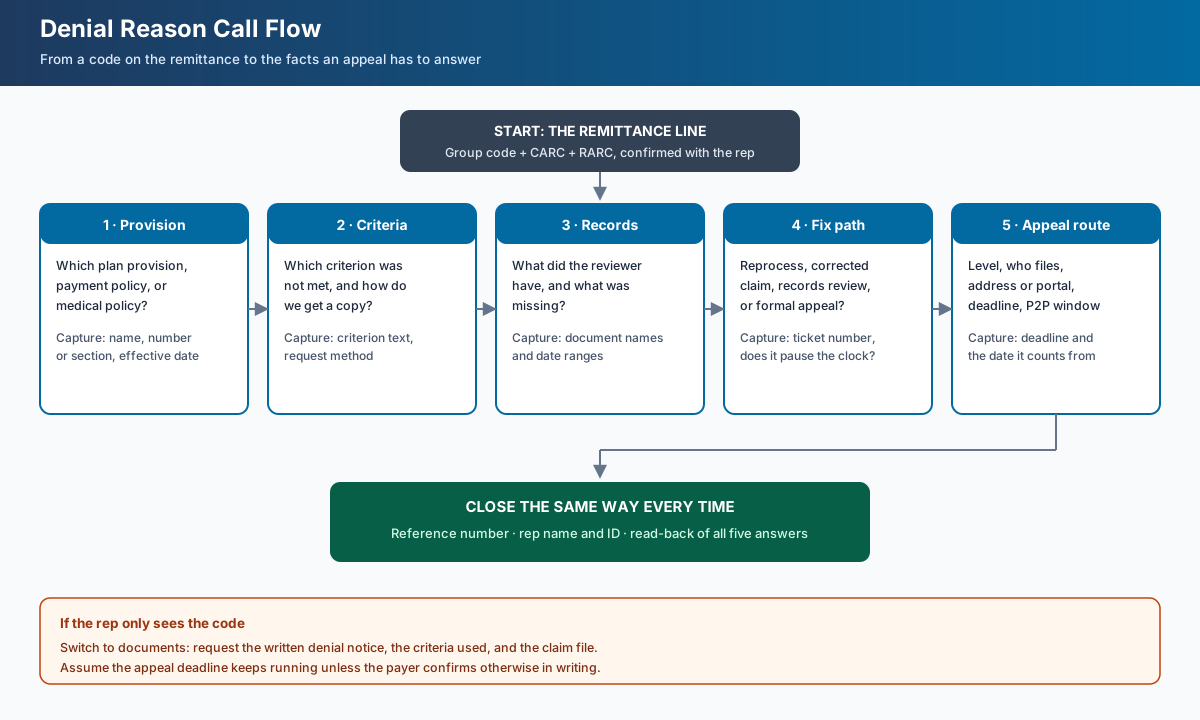
When to Make This Call (and When a Different Call Fits)
Make the denial reason call when you know the claim is denied and have the codes, but you can't yet tell what evidence would change the outcome. If you don't know whether the claim is denied, pending, or missing, you need a status call first.
| What you already know | The call to make | What it should produce |
|---|---|---|
| Nothing beyond "not paid yet" | Claim status call | Status category: pending, finalized, or not found |
| Denied, and you have the CARC/RARC | Denial reason call (this script) | Provision, criteria, missing records, fix path, appeal route |
| Denied for medical necessity on a prior auth or claim with a P2P option | Peer-to-peer scheduling call | A booked clinician-to-reviewer slot inside the payer's window |
| Appeal already filed | Appeal status call | Review stage, decision date, or proof the appeal is on file |
The status script is our claim status call script; the medical-necessity branch hands off to the peer-to-peer review call script; and once the appeal is out the door, follow it with the appeal status call script.
Before You Dial: What to Have Open
Have the remittance line, not just the claim, in front of you. Denials happen at the service-line level, and a rep who pulls up the wrong line will explain the wrong denial.
- Claim number, date of service, and the denied line — CPT/HCPCS, modifiers, units, and billed amount for that line
- The group code, CARC, and RARC exactly as they appear on the 835 or paper remittance — for decoding, see our EOB denial code guide
- What you submitted — the claim as billed, any attachments, and the date and channel records were sent
- Prior authorization number, if one applied, and what it covered
- Your standing on the claim — whether you are calling as the contracted provider, a non-contracted provider, or the member's authorized representative, and whether that designation is on file
- The appeal clock — the remittance date and the deadline you are currently assuming, so you can confirm or correct it on the call
Common Mistake
Calling before reading the remark code. RARCs often answer the question you were about to ask — "missing operative report," "not covered under this plan," "billed with an incompatible modifier." Use the call for what the codes can't tell you, not to have the rep read the remittance back to you.
The Denial Reason Call Script, Step by Step
Run the steps in order. The first two make sure you're talking about the same line; the middle three get the substance; the last two set up the next action.
Step 1: Confirm the department and your standing
Some payers route provider claim questions, member appeals, and provider disputes through different queues. Confirm before you spend hold time on the wrong one.
"Hi, this is [name] from [practice name], NPI [number], Tax ID [number].
I'm calling as the [contracted / non-contracted] provider about a denied
claim line. Am I in the right queue for the detailed reason behind a
claim denial, or do I need provider disputes or appeals?"
Take payer follow-up off your team's plate.
Let Muni handle eligibility, claim follow-up, and existing authorization status. Your team handles submissions and clinical discussions.
Start Calls free14 days or 30 minutes free, whichever comes first. $49/month per connected line plus $0.59/minute after an explicit upgrade. Card required to connect a number.
Step 2: Pin the exact line and code
"The claim is [claim number], date of service [date], member ID [ID].
The denied line is [CPT/HCPCS + modifiers], [units] unit(s), billed
[amount]. Our remittance shows [group code]-[CARC] with remark [RARC].
Are you seeing the same line and the same codes?"
If the rep sees different codes, stop and resolve that first. A reprocessed or adjusted claim may carry a new determination, and arguing the old code wastes the appeal.
Step 3: Ask for the specific provision or policy
This is the question the rest of the call depends on. You want a document name and number, not a paraphrase.
"Beyond the code, what is the specific reason this line was denied?
Can you give me the plan provision, payment policy, or medical policy
the decision was based on — the name and the policy number or section,
and its effective date?"
Step 4: Ask what criteria the reviewer applied, and request a copy
For clinical denials, the policy name is not enough. Ask which criterion in it the claim failed and how to get the document.
"Which criteria or guideline did the reviewer apply — an internal
medical policy, a licensed guideline, or a plan exclusion? Which
specific criterion was not met? How do I get a copy of that criterion
and of the clinical rationale for the decision?"
For group health plans, the notice must identify any internal rule, guideline, or protocol relied on, or say it was relied on and that a copy will be provided free of charge on request; for medical-necessity and experimental-treatment denials, the plan must explain the scientific or clinical judgment or say that explanation is available free on request (29 CFR 2560.503-1(g)(1)(v)). Those rights run to the claimant, so the rep may require a written request or an authorized-representative designation before sending it — ask which.
Step 5: Ask what was reviewed and what was missing
"What records did the reviewer have when this was decided? Did you
receive the [operative note / visit note / imaging report] we sent on
[date]? If something was missing, what exactly — document name and
date range — would have been needed?"
The DOL rule separately requires the notice to describe additional material needed to perfect the claim and why (29 CFR 2560.503-1(g)(1)(iii)). "Additional documentation" is not an answer you can act on; a document name is.
Step 6: Ask whether this needs an appeal at all
Some denials are fixed faster outside the appeal process: a payer-side processing error, a corrected claim, or a records submission the payer will reconsider. Ask before you build an appeal packet.
"Is this something you can send back for reprocessing, or that a
corrected claim would fix? Or does it need to go through a formal
appeal or provider dispute? If records alone would change it, can
they be submitted for reconsideration, and does that pause the appeal
deadline or not?"
Assume the appeal clock keeps running unless the payer confirms otherwise in writing. For the corrected-claim fork, see corrected claim vs. insurance appeal.
Step 7: Get the exact appeal route
"If we appeal, what is the first level called — reconsideration,
provider dispute, or member appeal — and can we file it as the
provider, or does the member need to sign an authorized-representative
form? What is the mailing address, fax, or portal path, and the exact
deadline counted from which date? Is a peer-to-peer review available,
and what is the window to request one?"
For many group health plans the federal floor is at least 180 days after the claimant receives the denial to appeal (29 CFR 2560.503-1(h)(3)(i)), but provider-contract dispute windows, Medicare, Medicaid, and state-regulated plans set their own. Write down the deadline the rep states and the date it counts from, and verify it against the written notice.
Step 8: Close and read back
"Before we finish, can I get a reference number for this call, your
name and rep ID? Let me read back what I have: the line was denied
under [provision/policy + number], criterion [X] was not met, the
reviewer had [records] and was missing [records], the path is
[reprocess / corrected claim / appeal at level Y], filed at [address
or portal], due [date]. Is that correct?"
The Reference-Capture Worksheet
Fill this in during the call, not after. It is the input to the appeal letter: every field maps to a sentence the letter needs, and the reference number lets the next person pick up without re-calling.
DENIAL REASON CALL — CAPTURE WORKSHEET
Date / time of call: ______________   Payer: ______________
Phone number dialed / queue: ______________
Rep name / ID: ______________   Call reference #: ______________

CLAIM LINE
Claim #: ______   DOS: ______   CPT/HCPCS + modifiers: ______
Group code / CARC / RARC (as rep confirmed): ______
Codes match our remittance?  [ ] Yes  [ ] No → details: ______

REASON
Plan provision / payment policy / medical policy: ______
Policy number or section + effective date: ______
Criterion not met (verbatim as stated): ______
Copy of criteria / rationale requested?  [ ] Yes  [ ] No
How it will be sent / what request is required: ______

RECORDS
Records the reviewer had: ______
Records missing (document name + date range): ______

FIX PATH
[ ] Payer reprocessing — ticket #: ______  expected by: ______
[ ] Corrected claim — what changes: ______
[ ] Records reconsideration — submit to: ______  pauses deadline? ______
[ ] Formal appeal / provider dispute (see below)

APPEAL ROUTE
Level name: ______   Who may file: [ ] Provider  [ ] Member/AOR form
Address / fax / portal path: ______
Deadline: ______  counted from: ______
Peer-to-peer available?  [ ] Yes  [ ] No   Request window: ______

NEXT ACTION
Owner: ______   Due: ______
Read-back confirmed by rep?  [ ] Yes
Keep the worksheet PHI-safe
Store the completed worksheet in the claim record inside your practice management or billing system, not in a shared spreadsheet or email thread. It contains member identifiers and clinical detail.
What the Rep's Answer Usually Means
Use the substance of the answer, not the tone of the call, to choose the next step.
Take payer follow-up off your team's plate.
Let Muni handle eligibility, claim follow-up, and existing authorization status. Your team handles submissions and clinical discussions.
Start Calls free14 days or 30 minutes free, whichever comes first. $49/month per connected line plus $0.59/minute after an explicit upgrade. Card required to connect a number.
| What the rep says | What it usually means | Next step |
|---|---|---|
| Names a medical policy and an unmet criterion | Clinical determination against documented criteria | Get the criteria, address that criterion in the appeal; consider peer-to-peer if offered |
| Names a plan exclusion or benefit limit | Coverage determination, not a documentation gap | Verify the member's plan document before appealing; the fix may be patient billing or an exception request |
| Records were missing or not received | Documentation gap | Ask whether records reconsideration is available; otherwise appeal with the named records |
| Coding, modifier, or data mismatch | Claim-form issue | Corrected claim, if the payer confirms that path |
| Processing error on the payer's side | Rep-correctable | Get a reprocessing ticket number and a date to call back |
| Can't say why beyond the code | Detail lives in the written notice or claim file | Request the denial letter, criteria, and claim file in writing; don't let the call substitute for them |
If the Rep Can't Tell You the Reason
Front-line reps often see only the code and a short system note. When that happens, stop pressing for an explanation and change the request to documents.
"I understand you may only see the code. Can you tell me how to get
the written denial notice and the criteria the reviewer used? Is there
a clinical or appeals team I can be transferred to, or a written
request process for the claim file? And can you note on this call that
we requested the specific reason today?"
For group health plans under the ERISA rule, a claimant is entitled on request, free of charge, to reasonable access to and copies of documents and records relevant to the claim (29 CFR 2560.503-1(h)(2)(iii)). Our ERISA self-funded plan appeal guide covers how to make that request and how it interacts with the appeal deadline.
Scope check
The federal notice rules cited here apply to employer group health plans and, for the ACA provisions, non-grandfathered group and individual health insurance. Original Medicare, Medicare Advantage, Medicaid, and provider-contract disputes follow their own notice and appeal rules. For Original Medicare, start with our Medicare redetermination guide.
Where Muni Calls Fits in Denial Follow-Up
For an approved claim-status or existing authorization inquiry, Muni Calls can call the insurer and ask for the payer-reported status, a reference number, and next steps. Your practice approves the workflow and reviews exceptions. Use the worksheet above for the details your team still needs to verify before deciding what to submit.
Patient and insurance calls share one plan and trial. Muni Calls pricing and trial details
Once the call tells you an appeal is the right path, our decision framework for when to appeal an insurance denial helps you decide which denials are worth the packet.
Frequently Asked Questions
What should I ask when I call an insurance company about a denied claim?
Confirm the denied line and its CARC/RARC, then ask for the specific plan provision or policy the denial rests on, the criterion the reviewer applied, which records were reviewed or missing, whether the claim can be reprocessed or corrected instead of appealed, and the exact appeal level, filing route, and deadline. End with a reference number and a read-back.
How is a denial reason call different from a claim status call?
A claim status call establishes whether a claim is pending, finalized, or missing, and gets the codes if it's denied. A denial reason call starts after that: it turns the codes into the specific provision, criteria, and missing evidence an appeal has to address, plus the route and deadline to file it.
Can I get a copy of the criteria the insurance company used to deny a claim?
Often, yes. For group health plans covered by the DOL claims procedure rule, the denial notice must identify any internal rule, guideline, or protocol relied on, or state that a copy is available free of charge on request (29 CFR 2560.503-1(g)(1)(v)). The right belongs to the claimant, so the payer may require a written request or an authorized-representative form from the member.
Does calling about a denial pause the appeal deadline?
No — assume it does not. A call, a records submission, or a reprocessing request does not pause an appeal clock unless the payer says so in writing. Record the deadline the rep states and the date it counts from, and file on time even while the reprocessing request is open.
What if the rep can only read me the denial code?
Ask for the written denial notice, the criteria used, and the claim file, and ask to be transferred to a clinical or appeals team if one handles detailed questions. Ask the rep to note on the call that you requested the specific reason. Then rely on the written documents, not the call, for the appeal.
Who can request the denial details: the provider or the patient?
It depends on the plan and your contract. Contracted providers can usually get claim-level detail and use the payer's provider dispute process. Rights under the ERISA claims rule belong to the claimant, so for member-level appeals and document requests the plan may require the member to designate the provider as authorized representative (29 CFR 2560.503-1(b)(4)).
What information should I write down on a denial reason call?
The rep's name and ID, a call reference number, the confirmed codes, the provision or policy name and number, the criterion not met, the records reviewed and missing, the fix path, the appeal level, filing address or portal, deadline and its start date, and whether peer-to-peer is available. The worksheet above captures all of it.
Turn the Denial Code Into an Appeal You Can Actually Write
A CARC tells you which kind of problem you have. The denial reason call tells you which document, criterion, and deadline you're up against. Run the same eight steps every time and keep the reference number. Then the appeal letter answers the payer's actual reason, not a guess.
This guide reflects federal claims-procedure rules in effect as of November 2026 (29 CFR 2560.503-1 and 45 CFR 147.136) and general payer phone practices. Notice contents, appeal levels, deadlines, and who may file vary by payer, plan type, provider contract, and state — confirm each with the payer and the written denial notice. This information is for administrative and billing purposes and is not legal or medical advice.