

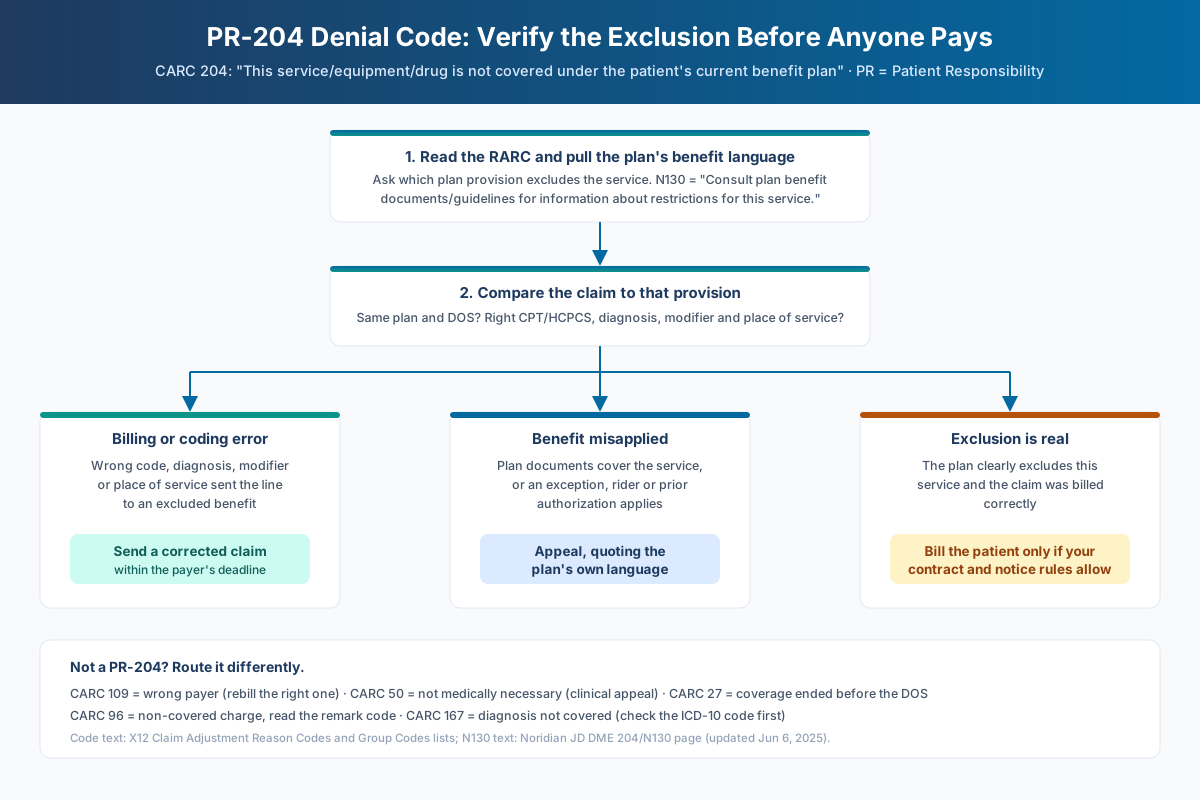
PR-204 means the payer says "This service/equipment/drug is not covered under the patient's current benefit plan" (X12 CARC 204), and the PR group code assigns the amount to the patient ("Patient Responsibility"). Read the remark code and denial notice to find out whether the payer relied on a benefit exclusion or clinical coverage criteria. Before you send the patient a bill, check the plan's actual benefit language against the claim. If a coding or billing error sent the line to an excluded benefit, send a corrected claim. If the plan documents cover the service, appeal and quote the plan's own language. If the denial cites medical necessity, address the cited criteria with clinical documentation. Bill the patient only when the exclusion is real and your payer contract and any advance-notice rules allow it.
What Does PR-204 Mean?
PR-204 says the payer decided the patient's current plan does not cover the service. The PR group code then puts the denied amount on the patient's side of the ledger.
The two parts mean different things:
- CARC 204 is the reason: "This service/equipment/drug is not covered under the patient's current benefit plan," per the X12 Claim Adjustment Reason Code list (code start date 02/28/2007).
- PR is the group code: "Patient Responsibility," per the X12 Claim Adjustment Group Code list. It tells you who the payer thinks owes the amount, not whether the payer got the benefit decision right.
Medicare contractors explain the group code the same way. Noridian describes PR as "the amount that may be billed to the beneficiary or to another payer on the beneficiary's behalf," and CO amounts as ones the beneficiary "may not be billed for" (Noridian JD DME group codes, updated Apr 25, 2024). That is why the same CARC 204 can arrive as CO-204 on one remittance and PR-204 on another. The payer chooses the group code when it adjudicates the claim.
The remark code (RARC) next to 204 often narrows it down. A common pairing is N130: "Consult plan benefit documents/guidelines for information about restrictions for this service" (Noridian JD DME, 204/N130, updated Jun 6, 2025). In plain terms, the payer is pointing you to the plan documents. That is where your verification starts.
Should You Bill the Patient for a PR-204?
Not until you have checked it. A PR-204 is the payer's statement about the patient's benefits, and it can be wrong. It can also be right about the plan and still not permit you to bill the patient under your own contract.
Three things have to be true before a PR-204 balance goes to the patient:
- The exclusion is real. The plan documents for this patient and date of service actually exclude or limit this service.
- The claim was billed correctly. The procedure code, diagnosis, modifier and place of service describe what was done. A billing error that lands a covered service in an excluded category is your fix, not the patient's bill.
- Your contract and notice rules allow it. Some in-network agreements and state or program rules restrict billing members for non-covered services, for example by requiring the patient's written agreement before the service. Check your participation agreement and the payer's provider manual. Medicaid and Medicare have their own rules on billing beneficiaries.
The Patient Statement Is the Last Step, Not the First
If you bill a patient for a PR-204 that turns out to be a coding error or a misapplied benefit, you have to correct it, refund it, or explain it later. Verify first. It also gives your front desk a clear answer when the patient calls about the bill.
PR-204 Decision Table
Use the remark code and denial notice to identify the coverage basis. Check the plan language for a benefit exclusion and the cited policy for a clinical denial.
| What verification shows | Likely cause | What to do |
|---|---|---|
| The plan document clearly excludes this service, and the claim was coded correctly | A true benefit exclusion | Check your contract and any advance-notice rules, then bill the patient or write off. Record the plan provision cited. |
| The CPT/HCPCS, diagnosis, modifier or place of service on the claim doesn't match the record | Billing or coding error mapped the line to an excluded benefit | Send a corrected claim with the right coding, inside the payer's corrected-claim deadline |
| The plan document covers the service, or a rider, exception or carve-in applies | Benefit misapplied at adjudication | Appeal and quote the plan's own benefit language; attach the page |
| You obtained prior authorization or a written benefit confirmation before the service | Adjudication ignored the authorization or confirmation | Request reprocessing or appeal, citing the authorization number or call reference |
| The patient's plan changed, or the claim went to an old plan | Coverage or routing problem, not a benefit exclusion | Verify coverage on the DOS; if another payer is responsible, rebill that payer |
| The remark code points to medical necessity or a coverage policy (for example an LCD) | A medical-necessity or policy-criteria denial carried on CARC 204 | Treat it as a clinical appeal: documentation against the cited criteria |
The last row matters for Medicare suppliers. Noridian's DME page lists "Item is not medically necessary" among the common reasons for 204/N130 and says a redetermination "may be submitted with all relevant supporting documentation" after reviewing the applicable LCD, policy article and documentation checklists (Noridian JD DME, updated Jun 6, 2025). If the remark code or denial letter points to coverage criteria, the medical necessity justification letter guide is the better playbook.
PR-204 vs. Codes That Look Similar
Several reason codes also say "not covered." Each one points to a different fix, so read the code before you decide who owes what.
| Code | X12 description | What it points to |
|---|---|---|
| CARC 204 | This service/equipment/drug is not covered under the patient's current benefit plan | Plan noncoverage: verify the benefit language and the reason in the denial |
| CARC 109 | Claim/service not covered by this payer/contractor. You must send the claim/service to the correct payer/contractor. | Wrong payer: rebill the responsible one |
| CARC 50 | These are non-covered services because this is not deemed a 'medical necessity' by the payer. | Clinical dispute: appeal with medical-necessity documentation |
| CARC 96 | Non-covered charge(s). At least one Remark Code must be provided... | Generic non-covered: the remark code tells you why |
| CARC 167 | This (these) diagnosis(es) is (are) not covered. | Diagnosis-driven: check the ICD-10 code before anything else |
| CARC 27 | Expenses incurred after coverage terminated. | Coverage ended before the DOS: find current coverage |
Definitions are from the X12 CARC list; CARC 96 is shortened here. The most expensive mix-up is treating a PR-204 like a CO-109. A 109 says you sent the claim to the wrong place. A 204 reports plan noncoverage. Check the stated coverage reason and confirm the correct payer if the patient's coverage changed.
How to Verify a PR-204 Before You Act
Verify a PR-204 by getting the exact plan provision the payer relied on, then checking the claim line against it. Do this before you post the balance to the patient.
- Read the full remittance line. Note the group code, CARC, every RARC, and any policy reference the payer included.
- Ask the payer which provision excludes the service. Call or use the portal and ask for the benefit exclusion or limitation by name and section, plus a call reference number. The eligibility verification call script covers how to document benefit answers.
- Get the plan document for the date of service. For commercial plans, that is the certificate of coverage, evidence of coverage, or summary plan description. For self-funded employer plans covered by ERISA, the denial notice must reference "the specific plan provisions on which the determination is based" (29 CFR 2560.503-1(g)(1)(ii)), and the claimant can request copies of documents relevant to the claim free of charge (29 CFR 2560.503-1(h)(2)(iii)). The ERISA self-funded plan appeal guide covers those rights.
- Compare the claim to the provision. Does the excluded service match the code you billed? Is there an exception, rider, age or diagnosis condition, or network condition that applies here?
- Check what you had before the service. A prior authorization, predetermination, or documented benefit quote changes the argument. The predetermination vs. prior authorization guide explains what each one does and doesn't guarantee.
- Pick the route and the deadline. Corrected claim, appeal, or patient billing. Corrected claims and appeals have separate deadlines; the corrected claim vs. insurance appeal guide explains which applies.
PR-204 Benefit-Verification Checklist
Fill this out for each PR-204 before the balance moves to the patient or to an appeal queue.
PR-204 BENEFIT-VERIFICATION CHECKLIST

Claim number: ______________________
Payer / plan name: ______________________
Member ID: ______________________
Date of service: ____________
Line(s) denied (CPT/HCPCS + modifier): ______________________
Group code + CARC: [ ] PR-204  [ ] CO-204  [ ] OA-204
RARC(s) on remittance: ____________
Remittance date: ____________

STEP 1 - WHAT DOES THE PAYER SAY EXCLUDES IT?
Plan provision cited (name / section / page): ______________________
Source: [ ] Denial letter  [ ] EOB/remittance  [ ] Payer call  [ ] Portal
Call reference number / date / rep: ____________
Plan document version in effect on DOS: ____________

STEP 2 - DOES THE CLAIM MATCH WHAT WAS DONE?
[ ] Procedure code matches the record
[ ] Diagnosis code(s) match the record and are in the right order
[ ] Modifier(s) correct
[ ] Place of service correct
[ ] Rendering provider / network status correct
Error found? [ ] No  [ ] Yes: ______________________

STEP 3 - DOES THE PLAN LANGUAGE ACTUALLY EXCLUDE IT?
[ ] Service is listed as excluded, with no exception that applies
[ ] Exception, rider, or condition applies: ______________________
[ ] Plan language is silent or ambiguous on this service
[ ] Prior authorization / predetermination on file: # ____________
[ ] Written or recorded benefit quote before service: ____________

STEP 4 - ROUTE
[ ] Coding error -> corrected claim
  Corrected-claim deadline: ____________  Date sent: ____________
[ ] Benefit misapplied / covered by plan language -> appeal
  Appeal deadline: ____________  Date sent: ____________
[ ] Coverage changed / wrong plan -> rebill responsible payer
[ ] Exclusion is real -> patient billing review
  Contract allows billing member for non-covered service? [ ] Yes [ ] No
  Patient's written agreement before service on file? [ ] Yes [ ] No [ ] N/A
  Decision: [ ] Bill patient  [ ] Write off  Approved by: ________

STEP 5 - CLOSE OUT
[ ] Account notes updated with provision cited and route taken
[ ] Front desk / scheduling notified if this service will recur
Skip the blank template. Start with a review-ready draft.
Use the template as guidance, or let Muni prepare a payer-specific draft for your team to verify, sign, and submit.
See Muni Handle This DenialFirst 3 appeals free, then $20 per appeal. Start with your denial letter or EOB and available records. No meeting or clearinghouse connection required.
PR-204 Appeal Letter Template
Use this when the plan's own documents cover the service, or an authorization or benefit confirmation contradicts the denial. If the payer requires its own appeal form or portal, attach this letter as the supporting explanation.
[Your Practice Letterhead]
[Date]

[Payer Name]
[Appeals Department]
[Address, fax, or portal reference from the denial letter or provider manual]

RE: Appeal of Non-Covered Benefit Denial (CARC 204)
  Patient: [Patient Name]    DOB: [Date of Birth]
  Member ID: [Member ID]    Group / Plan: [Group # / Plan Name]
  Claim Number: [Claim #]
  Date(s) of Service: [DOS]
  Service(s): [CPT/HCPCS code(s) and description]
  Rendering Provider / NPI: [Name, NPI]
  Billing TIN: [Tax ID]
  Remittance Date: [Date]
  [Prior Authorization / Reference #: [number], if applicable]

To Whom It May Concern:

We are appealing the denial of the service(s) above, adjusted with group code PR and CARC 204 ("This service/equipment/drug is not covered under the patient's current benefit plan") [and RARC [code]]. We believe the service is covered under the patient's plan for the date of service.

Basis for this appeal:
- The patient's [certificate of coverage / evidence of coverage / summary plan description], [section and page], states: "[quote the benefit language that covers the service]." A copy of that page is enclosed.
- [If applicable:] The exclusion the plan appears to have applied, [section], does not apply because [the service billed is different / the exception for ____ applies / the condition in the exclusion is not met].
- [If applicable:] [Payer Name] [issued prior authorization # ____ on [date] / confirmed coverage for this service on [date], call reference # ____].
- [If applicable:] The claim was billed with [code], which describes the service as documented. The enclosed record supports the code billed.

[If the plan is an ERISA plan:] Please identify the specific plan provision on which the determination is based and provide copies of all documents relevant to this claim, as provided under 29 CFR 2560.503-1.

We ask that [Payer Name] reprocess the claim under the patient's covered benefit. If [Payer Name] upholds the denial, please state the specific plan provision relied on and the next level of appeal available.

Enclosed:
- Remittance advice / EOB showing the CARC 204 denial
- Plan document page(s) cited above
- [Prior authorization or benefit confirmation, if applicable]
- [Relevant clinical documentation, if applicable]
- Copy of the original claim

Sincerely,

[Your Name]
[Title]
[Practice Name]
[Phone] | [Email]
How to Prevent PR-204 Denials
You prevent most PR-204 surprises before the visit, by checking benefits for the specific service and telling the patient what isn't covered while they can still decide.
Prepare this appeal packet with your team.
Draft the appeal, coordinate missing documents, and approve the reviewed packet. Keep your clearinghouse; your practice checks deadlines and submits through the payer’s accepted channel.
Try Muni Appeals FreeFirst 3 appeals free, then $20 per appeal. Start with your denial letter or EOB and available records. No meeting or clearinghouse connection required.
- Verify benefits for the service, not just eligibility. Active coverage doesn't mean a specific service is a covered benefit. Ask about the CPT code you expect to bill.
- Document benefit answers. Record the rep's name, date and call reference for every benefit quote.
- Get the patient's informed agreement in writing for likely exclusions. Where your contract allows billing members for non-covered services, it may require the patient's written agreement before the service. Medicare and Medicaid have their own rules on notifying and billing beneficiaries.
- Track PR-204 by payer, plan and code. Repeat denials on the same service usually mean a real plan exclusion your scheduling team should know about, or a coding pattern worth fixing.
How Muni Appeals Helps With PR-204 Denials
Muni Appeals doesn't decide whether a benefit is excluded. Your team verifies that against the plan documents. When the plan language, an authorization, or the record shows the service should have been covered, Muni Appeals drafts a review-ready appeal letter from the remittance, the plan provision, and the documentation your staff provides.
If you're deciding which denials are worth appealing at all, the when to appeal an insurance denial decision framework helps you sort the queue first.
Frequently Asked Questions
What does denial code PR-204 mean?
PR-204 means the payer says the service, equipment or drug "is not covered under the patient's current benefit plan" (X12 CARC 204), and the PR group code assigns the amount to the patient. The remark code or denial notice can show whether the decision is based on a benefit exclusion or clinical coverage criteria.
Can I bill the patient for a PR-204?
Sometimes, but verify first. Confirm the plan actually excludes the service and that the claim was coded correctly. Then check your payer contract and any program or state rules. Some in-network agreements restrict billing members for non-covered services unless the patient agreed in writing before the service.
Is PR-204 appealable?
Yes. A benefit appeal can show that the plan covers the service, an exception applies, or the payer approved or confirmed the service beforehand. Quote the plan's own benefit language in a benefit appeal and attach the page. For a clinical denial, attach documentation that addresses the cited criteria. If the denial came from a coding error, send a corrected claim instead.
What is the difference between PR-204 and CO-204?
The reason is the same: the service isn't covered under the patient's current benefit plan. The group code differs. PR says the payer considers the amount the patient's responsibility. CO says it is a contractual obligation, which Medicare contractors say may not be billed to the beneficiary.
What does PR-204 with N130 mean?
N130 says "Consult plan benefit documents/guidelines for information about restrictions for this service." The payer is pointing you to the plan documents. Get the specific provision, then check whether it applies to what you billed.
What is the difference between PR-204 and CO-109?
CO-109 means the claim went to the wrong payer and should be rebilled to the responsible one. CARC 204 reports plan noncoverage. Review the stated basis to decide whether a benefit check, coding correction or clinical appeal applies.
What is the difference between CARC 204 and CARC 50?
CARC 204 reports that the plan does not cover the service. CARC 50 specifically identifies a medical-necessity denial. For CARC 204, read the remark code and denial notice to choose the appeal basis. Cite the plan's benefit language when disputing an exclusion, and address the stated clinical criteria when the payer cites medical necessity.
Verify the Exclusion, Then Decide Who Pays
A PR-204 is the payer's claim that the patient's plan doesn't cover the service. Check it against the plan documents and the claim before the bill goes to the patient. Correct the coding errors, appeal the misapplied benefits, and bill the patient only when the exclusion is real and your contract allows it.
With Muni Appeals, your team gets:
- Review-ready appeal letters built from the remittance, the plan provision, and the documentation your staff provides
- Letters that quote the plan's own benefit language and ask the payer to name the provision it relied on
- Staff control over the route, the deadline, and every patient-billing decision
This guide reflects the X12 claim adjustment reason and group code lists, Noridian Medicare remittance guidance, and 29 CFR 2560.503-1 as available in November 2026. Benefit exclusions, remark codes, appeal deadlines, and rules on billing patients for non-covered services vary by payer, plan, contract, program, and state. Verify the plan documents, the payer's current provider manual, and your contract before billing a patient or filing an appeal. This guide is not legal or billing compliance advice.