

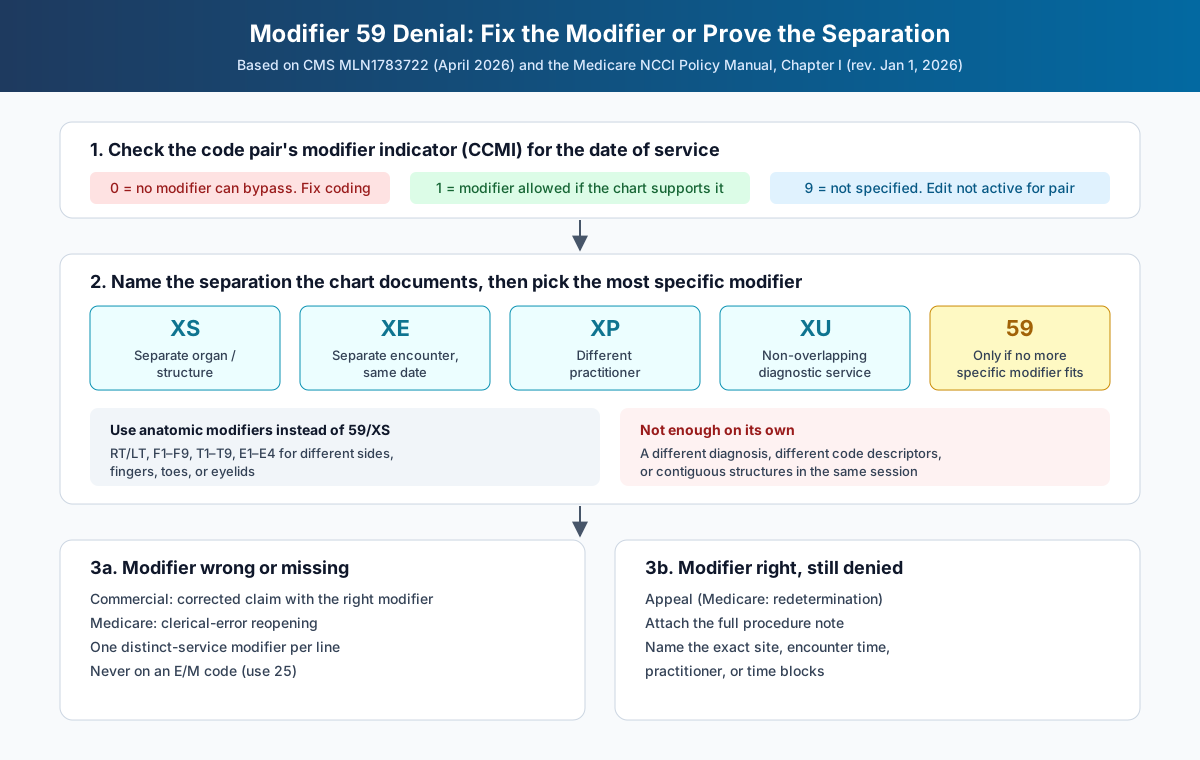
A modifier 59 denial means the payer didn't accept that two bundled procedures were "separate and distinct." CMS's April 2026 MLN booklet allows 59 or an X modifier only for a different anatomic site, a separate encounter, separate time blocks for timed codes, or certain diagnostic-before/after-therapeutic cases. It says to use XE, XS, XP, or XU "instead of modifier 59 whenever possible." First check that the edit allows a modifier at all (indicator 1). Then pick the most specific modifier and correct the claim, or appeal with the procedure note that shows the separation.
What a Modifier 59 Denial Actually Means
A modifier 59 denial means the payer applied a procedure-to-procedure bundling edit and didn't accept your modifier as a valid reason to pay both codes. The modifier was present, but the claim or the chart didn't show the kind of separation the edit requires.
Modifier 59 ("Distinct Procedural Service") doesn't make two procedures payable just because they are different procedures. The 2026 Medicare NCCI Policy Manual, Chapter I (revised January 1, 2026) says a modifier "shall not be appended... solely to bypass an NCCI PTP edit if the clinical circumstances do not justify its use." On Medicare remittances, the line usually shows CO-236: the procedure or procedure/modifier combination "is not compatible with another procedure... provided on the same day according to the National Correct Coding Initiative." Commercial payers may use CO-97, CO-236, or their own remark codes.
Key Statistic
In a November 2005 review, the HHS Office of Inspector General found that 40% of code pairs billed with modifier 59 in FY2003 didn't meet Medicare program requirements, which produced an estimated $59 million in improper payments. The data is old, but it is still the main federal reason modifier 59 claims get extra scrutiny.
Step 1: Check Whether the Edit Allows a Modifier at All
Before you appeal, look up the code pair's Correct Coding Modifier Indicator (CCMI) for the date of service. If it is 0, no modifier can bypass the edit and a modifier 59 appeal won't work.
The NCCI manual defines the three indicator values:
| CCMI | What It Means | What to Do With a 59 Denial |
|---|---|---|
| 0 | NCCI PTP-associated modifiers cannot be used to bypass the edit | Don't appeal on modifier grounds. Fix the coding, or dispute only if the payer applied the wrong edit or date |
| 1 | Modifiers may bypass the edit under appropriate circumstances | Appealable if the chart shows a separate site, encounter, practitioner, or non-overlapping service |
| 9 | Modifier use is not specified (used when a pair's deletion date equals its effective date) | The edit isn't active for that pair. Ask the payer to reprocess |
Medicare publishes the edit tables on the CMS NCCI PTP edits page. Commercial payers often follow NCCI but may add their own pairs. For example, Anthem's New York commercial policy C-09006 (last approved May 22, 2024) lists extra code pairs that don't allow a 59 override. For the full check of the bundling rule (payer, setting, and effective date), see the CO-97 denial code guide.
Step 2: Identify Which Kind of Separation You Have
CMS recognizes a short list of situations where two bundled codes are "separate and distinct." Your appeal has to fit one of them. A different diagnosis alone doesn't qualify.
The MLN booklet is direct about this: you don't need a different diagnosis for each procedure, but "different diagnoses aren't adequate criteria" for using 59 or an X modifier. The codes stay bundled unless one of these applies:
| Separation Type | Best Modifier | What the Chart Must Show |
|---|---|---|
| Different anatomic site, same encounter | XS (or 59 if XS doesn't fit) | Different organ, different anatomic region, or a non-contiguous lesion in a different region of the same organ |
| Different side of the body or digit | RT/LT, F1–F9, T1–T9, E1–E4, etc. — not 59 | Laterality or digit documented. CMS says to use the anatomic modifier instead of 59 or XS |
| Separate encounter, same date | XE (or 59) | Two distinct patient encounters with separate times or notes |
| Different practitioner | XP | A different practitioner performed the service |
| Timed codes in separate time blocks | 59 or XE | Each timed service completed before the next began, with time documented for each block |
| Diagnostic procedure that led to the therapeutic decision | 59 or XU | Diagnostic done first, not mixed with the therapeutic service, and the basis for deciding to proceed |
| Diagnostic procedure after a completed therapeutic procedure | 59 or XU | Not a common, expected, or necessary follow-up to the therapeutic procedure |
Contiguous Structures Don't Count
CMS says treating contiguous structures in the same organ or anatomic region "doesn't generally constitute treatment of different anatomic sites." Its examples include the retina and choroid in the same eye during one session, and the nail and the skin over the distal joint of the same toe. If both procedures were on contiguous tissue in one session, a 59 appeal usually won't hold up.
Step 3: Pick the Most Specific Modifier
CMS's order of preference is anatomic modifiers first, then XE, XS, XP, or XU, and modifier 59 only when nothing more specific fits. Some payers now refuse to pay 59 when an X modifier would have described the service.
The X modifiers took effect January 1, 2015, as more specific versions of 59:
- XE — Separate encounter: distinct because it occurred during a separate encounter on the same date.
- XS — Separate structure: distinct because it was performed on a separate organ or structure.
- XP — Separate practitioner: distinct because a different practitioner performed it.
- XU — Unusual non-overlapping service: distinct because it doesn't overlap the usual components of the main service.
Payer rules are getting stricter here. Independence Blue Cross says that for dates of service on or after October 1, 2026, "Modifier 59 will no longer be eligible for reimbursement when reported with non-time-based services," for both Commercial and Medicare Advantage products (IBX policy FAQ). Affected lines carry message code UMD0851. If IBX denied a non-timed service billed with 59, the fix is usually to resubmit with the correct X modifier, not to argue for 59.
Three placement rules prevent repeat denials:
- Put one distinct-service modifier on one line. Anthem's C-09006 says 59 "should not be appended to the same claim line item as X{EPSU}," and IBX doesn't consider the modifiers when more than one is on a single code.
- Choose the column carefully. Medicare allows 59 or an X modifier on either the Column 1 or Column 2 code (CR 11168). First Coast's CO-236 guidance puts NCCI modifiers on the minor (Column 2) code but allows 59 and the X modifiers on either code for Part B. Commercial payers may require a specific column, so check the policy.
- Never on an E/M code. CMS says modifier 59 "should not be appended to an E/M service." For a same-day E/M, see the modifier 25 denial guide.
Step 4: Decide Between a Corrected Claim and an Appeal
If the modifier was wrong or missing, fix the claim. If the modifier was right and the payer still denied it, appeal with the procedure documentation. Arguing in an appeal for a modifier you would change anyway wastes a review cycle.
| Situation | Route | Notes |
|---|---|---|
| Medicare: modifier missing, wrong, or on the wrong line | Reopening (clerical error) | Changing a modifier is a clerical-error reopening under 42 CFR 405.980. Check your MAC's portal and its list of modifiers that require a redetermination instead |
| Medicare: correct modifier, denial upheld | Redetermination | File within 120 calendar days of receiving the initial determination notice and attach the procedure note. Medicare presumes receipt five calendar days after the notice date unless evidence shows otherwise |
| Commercial: 59 used where an X modifier fits (e.g., IBX after Oct 1, 2026) | Corrected claim | Resubmit with the specific X modifier under the payer's corrected-claim rules |
| Commercial: correct modifier, denied as bundled | Payer appeal or coding dispute | Use the payer's claim-coding dispute channel if it has one. IBX requires a specific cover letter |
| Edit indicator is 0 | Neither (unless the edit was misapplied) | Correct the coding. Don't add a bypass modifier |
For Medicare details, see the Part B reopening guide and the redetermination guide. CMS explains how Medicare counts the redetermination filing window. For commercial claims, the corrected claim vs. appeal guide covers which route each payer expects. A Medicare NCCI denial is not patient responsibility: Noridian says providers "may not bill patient for NCCI edit denials" and shouldn't use an ABN for NCCI edits.
Checklist: Modifier 59 / X{EPSU} Denial Review
Run this before choosing a corrected claim or an appeal. Each "no" tells you which route to take.
MODIFIER 59 / X{EPSU} DENIAL REVIEW CHECKLIST

Claim #: __________  DOS: __________  Payer: __________
Column 1 code: ______  Column 2 code: ______
Modifier billed: [ ] 59  [ ] XE  [ ] XS  [ ] XP  [ ] XU  [ ] None
Denial code / remark: __________ (e.g., CO-236, CO-97, payer message code)

A. IS THE EDIT MODIFIABLE?
[ ] Looked up the code pair in the payer's edit table for this DOS
[ ] Modifier indicator = 1  (if 0: stop, correct coding; if 9: request reprocessing)
[ ] Checked the payer's own policy for extra no-override pairs
  or CPT "do not report with" parenthetical language

B. WHAT KIND OF SEPARATION IS DOCUMENTED?
[ ] Different side / digit / eyelid -> use RT/LT, F1-F9, T1-T9, E1-E4 (not 59)
[ ] Different organ or anatomic region, same session -> XS
[ ] Separate patient encounter, same date -> XE
[ ] Different practitioner -> XP
[ ] Diagnostic before therapeutic and the basis for the decision -> XU
[ ] Diagnostic after completed therapeutic, not routine follow-up -> XU
[ ] Timed codes in separate, non-overlapping time blocks -> 59 or XE
[ ] None of the above -> the services are bundled; do not appeal

C. IS THE CLAIM LINE BUILT CORRECTLY?
[ ] Only ONE distinct-service modifier on the line (not 59 + X)
[ ] Modifier is not on an E/M code (use 25 for same-day E/M)
[ ] Modifier placed on the Column 1 or Column 2 code per payer rule
[ ] Payer accepts 59 for this service type (IBX: non-timed 59
  not reimbursed for DOS on/after Oct 1, 2026)

D. DOES THE CHART PROVE IT?
[ ] Procedure note names each site / lesion / structure separately
[ ] Separate encounter times or separate notes (for XE)
[ ] Start/stop times for each timed service (for timed codes)
[ ] Diagnostic findings documented before the therapeutic decision (for XU)
[ ] Rendering practitioner identified for each service (for XP)

ROUTE:
[ ] Modifier wrong/missing -> corrected claim (commercial) or reopening (Medicare)
[ ] Modifier right, chart supports it -> appeal / redetermination with note
[ ] Chart doesn't support separation -> accept the bundled payment
Skip the blank template. Start with a review-ready draft.
Use the template as guidance, or let Muni prepare a payer-specific draft for your team to verify, sign, and submit.
See Muni Handle This DenialFirst 3 appeals free, then $20 per appeal. Start with your denial letter or EOB and available records. No meeting or clearinghouse connection required.
Template: Modifier 59 / X{EPSU} Appeal Letter
Use this letter when the modifier was correct, the edit indicator is 1, and the chart documents the separation. Replace every bracket with the specific site, encounter, time, or practitioner detail. A general statement that the services were "distinct" won't get past review.
[Practice Letterhead]
[Date]

[Payer Name]
[Appeals / Claim Coding Dispute Department]
[Address or submission channel]

RE: Appeal of Bundling Denial - Distinct Procedural Service
  Patient: [Name]   DOB: [DOB]   Member ID: [ID]
  Claim #: [Claim number]   Date of Service: [DOS]
  Column 1 code: [CPT]   Column 2 code: [CPT]-[59 / XE / XS / XP / XU]
  Denial code / message: [e.g., CO-236 / CO-97 / payer code]

To Whom It May Concern:

We request reconsideration of the denial of CPT [code]-[modifier] on [DOS],
which was denied as bundled with CPT [code].

The applicable edit for this code pair permits a modifier to bypass it
(modifier indicator 1) when the services are separate and distinct. That is
the case here, for the following reason:

[Choose ONE and complete it from the record:]

- Separate structure (XS): [Procedure A] was performed on [site / organ /
anatomic region], and [Procedure B] was performed on [different site],
which is not contiguous with the first site. The operative note documents
each site separately.

- Separate encounter (XE): [Procedure A] was performed at [time] during
[encounter 1]. The patient returned at [time] for [reason], and
[Procedure B] was performed during that separate encounter.

- Separate practitioner (XP): [Procedure B] was performed by [practitioner,
NPI], a different practitioner from the one who performed [Procedure A].

- Non-overlapping service (XU): [Diagnostic procedure] was performed before
[therapeutic procedure], was not mixed with it, and its findings
([finding]) were the basis for the decision to proceed.

- Separate time blocks (59/XE, timed codes): [Service A] was provided from
[start] to [stop] and [Service B] from [start] to [stop], in separate,
non-overlapping time periods.

This distinction is consistent with the CMS guidance in MLN1783722, "Proper
Use of Modifiers 59, XE, XP, XS & XU" (April 2026), and with Chapter I of
the Medicare NCCI Policy Manual (revised January 1, 2026)[, as adopted in
(Payer)'s reimbursement policy (policy number)].

Enclosed: the complete procedure / operative note for [DOS], [encounter
notes with times / timed-service log / diagnostic report], and the remittance
showing the denial.

Please reprocess CPT [code]-[modifier] for separate payment.

Sincerely,
[Provider Name, Credentials]   NPI: [NPI]
[Practice Name]   [Phone]   [Billing contact]
How Muni Appeals Handles Modifier 59 Denials
Muni Appeals reads the denial code and the procedure note together. Before anything is drafted, staff can see whether the chart supports a separate site, encounter, practitioner, or time block. If it does, Muni drafts the appeal around that specific separation. If the real problem is the wrong modifier, the claim goes back as a correction instead of an appeal that can't win. For other bundling denials, see the EOB denial code guide, which explains each remittance code.
Prepare this appeal packet with your team.
Draft the appeal, coordinate missing documents, and approve the reviewed packet. Keep your clearinghouse; your practice checks deadlines and submits through the payer’s accepted channel.
Try Muni Appeals FreeFirst 3 appeals free, then $20 per appeal. Start with your denial letter or EOB and available records. No meeting or clearinghouse connection required.
Frequently Asked Questions
Why was my claim denied when I used modifier 59?
The payer either had an edit that doesn't allow modifiers (indicator 0), didn't see a separate site, encounter, practitioner, or time block in the claim or the chart, or has its own rule against 59 when an X modifier fits. Check the indicator first, then the documentation, then the payer's modifier policy.
Should I use modifier 59 or XS, XE, XP, or XU?
Use the most specific modifier that fits. CMS says to use the X modifiers "instead of modifier 59 whenever possible" and to use 59 only when none of them fits. For different sides of the body or different digits, use the anatomic modifiers (RT/LT, F1–F9, T1–T9, E1–E4) instead of either.
Does a different diagnosis code justify modifier 59?
No. CMS says you don't need different diagnoses to use 59 or an X modifier, and different diagnoses alone aren't enough. The codes stay bundled unless the procedures were at different anatomic sites, at separate encounters, or in one of CMS's three timed or diagnostic situations.
Can I put modifier 59 and an X modifier on the same line?
No. Report one distinct-service modifier per line. Anthem's commercial policy says 59 shouldn't go on the same line as an X modifier, and Independence Blue Cross doesn't consider the modifiers when more than one is on the same code.
Can I add modifier 59 to a denied Medicare claim without an appeal?
Usually. Adding or changing a modifier is a clerical-error correction, which Medicare handles as a reopening. Most MACs process it through their portal. Check your MAC's list first, because some send certain modifier changes to redetermination. The 120-day redetermination deadline keeps running while a reopening is pending.
Can I bill the patient for a modifier 59 / NCCI denial?
Not for Medicare. Noridian says providers may not bill patients for NCCI edit denials and shouldn't complete an ABN for them. For commercial plans, check the contract. Bundling denials are usually provider write-offs (group code CO), not patient responsibility.
Is modifier 59 still accepted in 2026?
Medicare still accepts it when no more specific modifier applies. Some commercial and Medicare Advantage payers are narrowing it. Independence Blue Cross stopped paying 59 on non-timed services for dates of service on or after October 1, 2026. Check each payer's current modifier policy before relying on 59.
Fix the Modifier or Prove the Separation
Almost every modifier 59 denial comes down to one of two problems. Either the modifier didn't match what happened, or the chart doesn't show why the two services were separate. Work out which one you have before filing anything. A corrected claim fixes the first, and an appeal built on the procedure note fixes the second.
Get started:
- Denial code and procedure note reviewed together before drafting
- Modifier choice (59 vs. XE/XS/XP/XU vs. anatomic) checked against the documented separation
- Appeal letters built from the specific site, encounter, or time detail in the chart
This guide reflects CMS MLN1783722 (April 2026), the Medicare NCCI Policy Manual Chapter I (revised January 1, 2026), and payer policies reviewed November 7, 2026. CPT content is summarized for education. Payer reimbursement policies, edit tables, and appeal windows change, so verify the current rule for the date of service before filing. This guide is not legal, coding, or billing compliance advice.